
Adelyn Baxter

Digital Content Director, KTOO

"I help inform KTOO listeners, viewers and readers by finding creative ways to bring our content to our audience wherever they are."

To address concerns with policing and racism, Juneau starts by listening

More than 400 people attended a rally in support of black community members and black people nationwide on June 6, 2020, the 11th day of protests against police violence and systemic racism following the death of George Floyd. At several points protesters chanted “Juneau is not immune,” a reminder that residents of the capital city must also reckon with racism. (Photo by Rashah McChesney/KTOO)

The Juneau Assembly held a listening session Wednesday to hear from citizens with concerns related to policing and racism in the capital city. 

The three-hour meeting included some sobering testimony from more than 40 community members who called in, many of them people of color who shared stories of racial profiling and discrimination. 
During the listening session, elected officials sat silently along with Juneau Police Department leadership, the school district superintendent and the school board president. 

Vanessa Ferrara testified that she had lived in Juneau only a few months when she had an experience involving police that left her shaken. 

While riding the bus to work one morning, Ferrara said multiple police officers suddenly showed up and pointed guns at the passengers, saying they were responding to a call about a person with a knife. 

“We were all terrified and I didn’t feel like we were being protected by the police,” Ferrara testified. “I’ve never been that scared in my life.”

She said she and the other passengers were startled and confused as a man who had been sitting quietly stood up and was immediately arrested by the officers.

“This is not why I’m paying taxes, to be terrified. I believe that they failed to protect us,” Ferrara said. 

Multiple people said they were disappointed by Police Chief Ed Mercer’s initial hesitation to immediately release the department’s use of force policy without first consulting a lawyer. 

The department released the policy three days later. It details procedures officers can use to subdue a suspect, including the use of deadly force. 

Nathan Block is a recent graduate of the University of Alaska Southeast. He said that he was sentenced to seven years in prison for an armed robbery he committed in Juneau in 2011. 

Block credits the officers who arrested him and staff at Lemon Creek Correctional Center with helping to turn his life around, and said he values their work. Still, he believes police forces around the country need to be demilitarized. 

“However, defunding them also means a lack in training funding and I believe we should consider reallocating JPD funds for buying military-like equipment so that they could conduct more training exercises, considering a lot of the situations that we are deeming unacceptable around the country,” Block said. 

Some speakers recounted instances of racial profiling by officers. Many voiced support for the Black Lives Matter movement and the list of related demands issued by organizers of a recent rally in Juneau. 

Several people asked the Assembly to take action to directly address racism in the community through education and examining the racial makeup of city boards and commissions. 

In closing, Mayor Beth Weldon promised listeners that this was just the beginning. 

“This was a listening session and it was meant to be a starting point of a conversation,” Weldon said. “I’ve taken lots of notes and I’m sure my other assembly members have as well as the school district and the police department.”

Police department officials will speak to the Assembly again on Monday at a 6 p.m. committee of the whole meeting.

Listen to the full meeting testimony here

Juneau draws inspiration from Depression-era solutions with plan to put locals to work on trails

Groups of volunteers spread across the new Under Thunder trail on June 2 as part of the National Trails Day celebrations.The crews worked on clearing logs and debris and re-vegetating muddy areas along the trail. Erik Boraas, executive director of Trail Mix, cuts logs to be hauled off the trail.
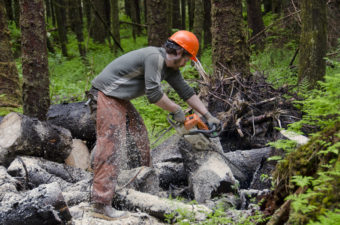
Erik Boraas of Trail Mix cuts logs to be hauled off the Under Thunder trail in June 2012. (Photo by Heather Bryant/KTOO)

A city proposal would use $1 million in CARES Act funding to create temporary jobs for locals out of work due to the pandemic. 

Supporters say the COVID-19 Conservation Corps would help stimulate the local economy, provide work training and improve many of Juneau’s well-loved trails. But it’s not the only legislation aimed at stimulating the outdoor economy. 
The New Deal-inspired work program aims to put people to work on city trails to help them recover from the financial impacts of COVID-19.

If approved by the Assembly on Wednesday, it would fund roughly 40 jobs. The money would be split between the Parks and Recreation Department, Eaglecrest Ski Area and Trail Mix, a local non-profit that builds and maintains trails. 

“We’re going to want to work people as long as we can, and it’ll be kind of a weather-dependent thing,” said Eaglecrest General Manager Dave Scanlan. “You know, if we have a slower start to the winter or a warmer, drier fall.”

Scanlan said they plan to about 12 hire people to help with summer maintenance on ski, hiking and biking trails on the mountain. 

The city already posted job listings for temporary positions at Eaglecrest and in the Parks and Recreation Department, even though the funding hasn’t officially been approved. 

Parks Director George Schaaf said that’s because they want to be able to move as quickly as possible once it is. The Assembly has been supportive of the proposal from the Economic Stabilization Task Force in committee discussions so far.

Schaaf said they hope to get people working by early July. And with more than 250 miles of trails in Juneau, there’s plenty to do.  

“As we’ve added more miles of trail here in Juneau over the last few years, we haven’t necessarily been able to add additional funding or resources to take care of those trails,” Schaaf said. “So we are looking forward this year to getting out and clearing pretty much every trail in our inventory.”

Both Schaaf and Trail Mix Executive Director Ryan O’Shaughnessy pointed to a number of trail bridges that could use replacement, such as one on the Dupont Trail in Thane. Schaaf added that there’s a backlog of drainage work and washout repairs along sections of Perseverance Trail that they’d like to get to.

Pay for the temporary positions is around $20 an hour. 

Sierra Gadaire is a manager at Gastineau Guiding, one of many local tour companies that had to lay people off this summer as it became clear the cruise ships wouldn’t be coming. 

She said the majority of unemployed tourism workers in Juneau are year-round residents, since the pandemic started before temporary workers arrived for the season. 

“They will not be making as much money as they may have made in a tip economy job like tourism is, but they’re already committed to being here … now they are able to work on a project that directly benefits their community,” Gadaire said. 

Gadaire has also been advocating for a statewide job plan using stimulus money to benefit Alaska’s outdoor recreation economy. 

Part of that also involves encouraging the congressional delegation to support the Great American Outdoors Act. That bill would divert billions of dollars to deferred maintenance and outdoor infrastructure across the country. 

“I expected it to be happening on a state and federal level. But the fact that it’s also happening on a city level is fantastic,” she said. 

That federal legislation could also directly benefit Juneau’s conservation corps by providing additional funding in the future.

“I’m very optimistic that the federal bill that’s working its way through the Senate may be a conduit for future funding to keep these people that we’re going to train through Eaglecrest, Parks and Recreation and Trail Mix and to provide a funding source to continue doing this work that Conservation Corps is going to do this summer,” Scanlan said.

The Senate is expected to vote on the bill tomorrow. 

With in-person markets canceled, Celebration encourages virtual options to sell traditional crafts

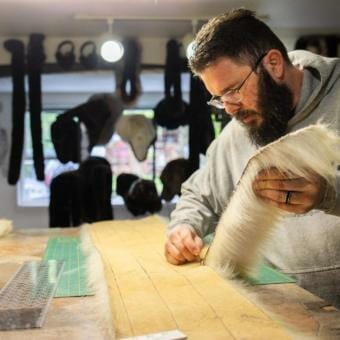
Artist Robert Miller of Sitka works with polar bear hide in his workshop. (Photo courtesy Caitlin Fondell)

The biennial Celebration, one of the largest gatherings of Alaska Natives in the country, brings an estimated $2 million to Juneau in just four days.

While the city will miss out on bed and sales tax revenue this year thanks to the pandemic, Native artists who come from all over to sell their work will feel the financial hit even more.

Walking through the artist market at Celebration in years past, visitors would have seen rows of tables covered in copper jewelry, intricate weavings and beautiful formline carvings.

This year, with the in-person event postponed, Sealaska Heritage Institute still wanted to support artists. So, they created a virtual marketplace.

Chief Operating Officer Lee Kadinger said they reached out to artists across the state. Fewer than 20 participated.

“Typically in a Celebration year, we have approximately 60 artists booths,” Kadinger said. “So there’s, you know, definitely about a third of what we usually have.”

Artists submitted short videos showcasing their work, which ran between segments during the virtual program. Their contact information is also listed on the Celebration website.

“We recognize that that’s not going to be nearly as impactful as having a booth with a table here with thousands of people streaming past on a daily basis,” he said. “But it was a way to hopefully, you know, provide some assistance and relief to artists in these difficult times.”

According to a study by the McDowell Group, during the last Celebration attendees spent an estimated $40,000 in the artists market.

Celebration isn’t the only gathering canceled this year, and that will make things hard for some of the Native artists who exclusively sell their products at artist markets.

Kuxháach Jeremiah James is Tlingit of the Kaagwaantaan clan. He’s from Yakutat and works mainly with seal and otter skins.

He’s been selling blankets and pelts at Celebration since 2012, but he didn’t have time to submit anything to the virtual market.

“It’s pretty hard to sell sea otter blankets and hats and scarves until you touch the sea otter,” James said. “You don’t make those connections over the phone or internet connections when you’re moving a blanket at $8,000 or $10,000.”

James said he also sells his work at the annual Alaska Federation of Natives convention. But it’s not clear whether that event will take place this year.

Artist Kuxháach Jeremiah James of Yakutat works on a seal skin hat. (Photo courtesy of Sealaska Heritage Institute)

Not all artists rely on markets. But some — particularly those who specialize in mediums like sea otter fur or walrus ivory — avoid online retail sites.

That’s because digital markets like Etsy have a history of removing listings made with those materials, even though Alaska Native people are legally allowed to hunt and use them to make traditional handicrafts.

Robert Miller is Tlingit of the Kiks.ádi clan. He lives in Sitka and has been working with furs for about eight years.

Miller said he’s always relied on online sales for his business, and he’s built up a small but loyal client base through his website.

“When this pandemic started, I was like, you always gotta throw something new into the mix,” Miller said. “So I found some polar bear that I could work with and you know, you just change it up. You’re always changing it up and putting new things on the market.”

He even managed to find new clients out of state.

Miller said participating in business development programs through Path to Prosperity and the Alaska Small Business Development Center has helped him get a handle on the online market.

Both James and Miller have also taught skin sewing classes through Sealaska Heritage Institute in the past as a way to continue educating others in traditional arts.

Even though it will be harder to sell this year without the in-person market, James said his business will get by. Anyway, the artist market isn’t the part of Celebration he loves the most.

Earlier in the week, he and a friend sat on a remote beach north of Yakutat and watched videos of dance groups on the stage in Juneau’s Centennial Hall from the last Celebration. He’s a dancer too, performing with the Mount St. Elias dancers from Yakutat.

“That’s what I miss about Celebration, is the dance groups and being in that atmosphere in that room,” he said.

First-ever virtual Celebration happens this week

Celebration 2018 grand processional June 6, 2018, Juneau. (Photo by Adelyn Baxter)

Without parades of dancers and a packed convention hall, this year’s Celebration will look very different.

Sealaska Heritage Institute’s board of trustees decided to postpone the four-day gathering until June 2021 due to the COVID-19 pandemic.

This year’s virtual Celebration theme is “Have Courage,” in reference to the pandemic that caused the in-person gathering to be postponed. Tlingit artists Donald Héendei Gregory designed this image with a warrior helmet and face shield to represent the strength Alaska Native peoples have always used to overcome challenges, with a devils club leaf in the background to symbolize traditional medicine and healing.(Image courtesy of Sealaska Heritage Institute)

The biennial event typically brings thousands of Alaska Natives from across Southeast and beyond to Juneau for all-day dance performances, fashion shows, arts bazaars and other events celebrating Tlingit, Haida and Tsimshian cultures.

This year, SHI put together the first-ever virtual Celebration instead. A four-day live broadcast will feature recorded dance performances from 2018 and new videos submitted by past participants.

The theme for this year’s Celebration is “Have Courage.” In addition to dance performances, the virtual events include the toddler regalia review, storytelling segments, a fashion show and a juried art show.

The show kicks off Wednesday night at 7 p.m. with a welcome and tribute to former Lt. Gov. Byron Mallott, who died last month. It concludes Saturday afternoon.

Viewers can watch the events on SHI’s Youtube channel and on 360 North. A full schedule of events can be found here.

Editor’s note: KTOO is under contract with Sealaska Heritage Institute to produce television and online video coverage of this year’s virtual Celebration.

Juneau Assembly decides not to create local travel quarantine

Updated post

The Juneau Assembly decided not to create a local 14-day quarantine for travelers at a special meeting Wednesday

The proposed ordinance would have applied to any residents, workers or visitors arriving at the Juneau International Airport from out of state. 

But a new state health mandate that goes into effect Saturday essentially does the same thing, unless visitors test for COVID-19 before their trip. 

Gov. Mike Dunleavy announced last week that the state’s previous 14-day quarantine for new arrivals would end this week. The Assembly decided adding a local quarantine on top of that wasn’t necessary.

Original post

The Juneau Assembly will hold a virtual special meeting tonight at 6 p.m. to discuss an emergency ordinance establishing a local 14-day quarantine for anyone arriving in town from out-of-state.

The Assembly discussed the ordinance at meetings last week and on Monday, but was waiting on additional guidance on Gov. Mike Dunleavy’s statewide 14-day quarantine mandate, which is set to expire Friday.

Gov. Dunleavy plans to hold a press conference Wednesday at 5 p.m. to discuss updates. It’s not clear if that will give the Assembly enough information to make a final decision on the ordinance.

The meeting will be streamed via Facebook Live and Zoom Webinar. You can also watch below.

Details about how to participate in the meeting can be found online.

Correction: A previous version of this story incorrectly stated the new statewide travel mandate goes into affect Friday. 

Former state chief economist Ed King files to run against Rep. Andi Story in Juneau

Ed King, King Economics Group, presents a 101 about the Alaska Permanent Fund during a Lunch and Learn in the Capitol in Juneau on Feb. 26, 2020.
Ed King presents a 101 about the Alaska Permanent Fund during a Lunch and Learn in the Capitol in Juneau on Feb. 26, 2020. (Photo by Skip Gray/KTOO)

Only one of Juneau’s two democratic state representatives will have a challenger in the November election. 

Former state chief economist Ed King intends to run as an independent against Democratic Rep. Andi Story in District 34. The district includes the Mendenhall Valley, Auke Bay and out the road. 

King said Monday he’s running to address Alaska’s financial situation. 

“Year after year we’ve been kind of just kicking the can, spending money out of savings, not really changing the structure, not really addressing the structural problems,” King said. “I think something has to change.”

King is a veteran and has lived in Juneau for four years. Since leaving his job with the state last year, he started his own firm focused on Alaska’s economy. 

He said he hopes to help bridge the partisan divide in the Legislature, especially when it comes to the unpopular subject of a statewide tax. 

“I personally prefer an income tax to a sales tax. But a property tax … should be up for discussion,” he said. “We have to raise revenue somehow.”

Running without the backing of a political party and in the midst of a pandemic will be a challenge, King said, but he’s up for it. 

Before his name can appear on the Nov. 3 ballot, he has to collect 89 signatures and file a nominating petition with the Division of Elections. He has until the Aug. 18 primary election to submit everything. 

Story and Rep. Sara Hannan — who represents District 33 including downtown, Douglas and the upper Lynn Canal — were both elected in 2018 and filed to run for reelection last year. 

Site notifications
Update notification options
Subscribe to notifications