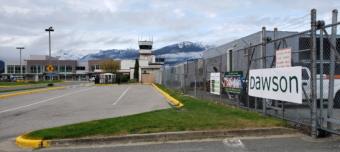
Masked travelers head into the terminal of Juneau International Airport on May 15, 2020. Alaska Airlines requires passengers wear masks in response to the COVID-19 pandemic and CDC recommendations. (Photo by Jeremy Hsieh/KTOO)
The Juneau Assembly plans to decide on Wednesday whether to require a quarantine for travelers entering the borough from out-of-state.
During a special meeting Monday night, the assembly heard testimony from members of the public about an emergency ordinance requiring visitors, workers and Juneau residents to quarantine for 14 days upon arrival to monitor for COVID-19.
Many local residents who called in expressed support for the ordinance.
But, Mike Lobeki, who runs a fishing lodge in Elfin Cove, is worried that a local quarantine would prevent guests to his lodge from being able to fly through Juneau. Many of the reservations for his lodge have already been canceled due to the pandemic and related travel restrictions.
“We’re going broke,” Lobeki said. “We’re just wondering if there’s anybody taking into consideration what you guys can do to help us.”
The draft ordinance currently requires businesses that host tourists at lodges to submit mitigation plans to the city.
The Assembly is hoping for more details from the state about Gov. Mike Dunleavy’s plan to lift the statewide travel quarantine on Friday and instead require travelers take a COVID-19 test within 72-hours of flying to Alaska.
Chief Medical Officer Dr. Anne Zink and Health Commissioner Adam Crum are scheduled to speak at Wednesday’s meeting.
The second hearing is for an emergency ordinance creating a 14-day quarantine for travelers arriving in Juneau from out-of-state. The statewide travel quarantine for out-of-state travelers is set to expire Tuesday and be replaced by increased testing for visitors. City Manager Rorie Watt is recommending that the Assembly take public testimony on the ordinance Monday and schedule another special meeting at 6 p.m. on Wednesday to allow time to receive more clarification from the state.
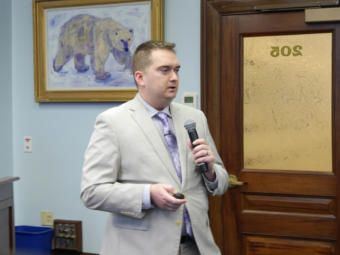
Head official Nicole Johnston hosts the 2020 Native Youth Olympics awards ceremony virtually this year. (Screenshot from Facebook Live)
The Native Youth Olympics brings together student athletes from across the state each year to celebrate Alaska Native culture through competitive events.
Organizers canceled this year’s games due to the COVID-19 pandemic, but they found a way to continue the annual tournament that’s rooted in sportsmanship and survival.
Instead of meeting at the Alaska Airlines Center in Anchorage this year, teams sent in videos of athletes competing in their events. Coaches submitted score cards and judges reviewed the submissions. The winners were announced Friday during a virtual awards ceremony.
“We had over 50 athletes from over 20 communities compete from as far north as Nunamiut, as far west as Nome and as far south as Unalaska and Juneau,” said head official Nicole Johnston on Facebook Live. “Nearly every region in the state was represented.”
Johnston said athletes competed outside on beaches and driveways, inside community centers and from their living rooms.
Juneau athlete Ezra Elisoff, a junior at Thunder Mountain High School, placed first among boys in the Alaskan High Kick with a height of 84 inches.
The event requires balance and strength as athletes try to kick a small seal skin ball dangling from a string above them.
“The thing is, you don’t really need fancy equipment,” Elisoff said. “All you need is just a kicking ball and a nice place to yourself.”
Juneau’s 2018 Native Youth Olympics team at the statewide competition in Anchorage. (Photo courtesy of Kyle Worl)
Several other Juneau athletes placed in other events. Elisoff and his teammates trained after school throughout the school year.
Though he said it was disappointing to have the in-person event canceled, he’s just glad he got to compete — even if he won’t get to celebrate his victory with his team.
Competitors in Native Youth Olympics build each other up throughout the event. Elisoff said in other sports — like high school wrestling — you don’t see that.
“It’s different because you’re encouraged to help others and you’re encouraged to encourage each other and cheer each other on because that’s kind of what kept our ancestors alive, you know, all those years ago,” he said. “So I’m kind of proud to say that this is part of my culture.”
Native games extend outside of Alaska. Youth and adults regularly compete in similar events against athletes from as far away as Greenland.
The annual World Eskimo-Indian Olympics, which take place in Fairbanks in July, have also been canceled. Organizers say they hope to be able to hold an online celebration.
The results of this year’s virtual Native Youth Olympics will be posted on citc.org.
The two most recent cases of COVID-19 identified in Juneau appear to be related to travel outside of the borough. That comes as city officials weigh the need for a local travel quarantine mandate.
According to Juneau Public Health Nursing, the initial investigations into the cases announced on Thursday and Friday show that both are travel-related.
Juneau has had 33 confirmed cases of the disease so far. The majority have been traced to secondary transmission from another infected person. The only other travel-related case identified in the capital city was the very first case identified back in March.
The state saw a surge in cases this week with 13 new cases announced on Thursday, marking the highest daily increase in more than a month.
At a special meeting Thursday night, the Juneau Assembly discussed whether it would like to implement its own 14-day quarantine for travelers arriving from out-of-state, similar to the local mandate approved in March before Gov. Mike Dunleavy’s statewide travel quarantine superseded it.
A Princess cruise ship in Juneau. (Photo by Heather Bryant/KTOO)
Canada has extended its ban on cruise ships until at least the end of October due to the global pandemic.
“Cruise ships with overnight accommodation and a capacity of more than 100 persons — that includes passengers and crew — will be prohibited from operating in Canadian waters until at least Oct. 31,” said Canadian Federal Transport Minister Marc Garneau, speaking to reporters in Ottawa on Friday.
The announcement extinguishes any chance of salvaging Alaska’s delayed cruise ship season, thanks to a federal law requiring foreign-flagged ships to stop in a foreign port when traveling between U.S. ports.
The Port of Seattle announced an indefinite port closure for cruise ships in March, after the Centers for Disease Control and Prevention issued a no-sail order for cruise ships following several outbreaks on international sailings.
Many major cruise lines have already delayed their seasons in response to the earlier announcements. Alaska expected to see a record-breaking 1.4 million passengers during this year’s April to October season.
According to recent industry numbers, more than 550 Alaska sailings have been canceled at this point. That accounts for almost 90% of sailings.
The Juneau Assembly will hold a virtual special meeting tonight at 6 p.m.
In addition to hearing updates on COVID-19 mitigation and the out-of-state travel quarantine, the Assembly will discuss legislation accepting $53 million in federal CARES Act funding, a resolution appropriating more than $1 million to child care relief for providers impacted by the COVID-19 pandemic and an ordinance requiring cloth face masks on Capital Transit buses.
The meeting will be streamed on Facebook Live and via Zoom Webinar. You can also watch right here when the meeting begins.
Details about how to participate in the meeting can be found online.
Close
Update notification options
Subscribe to notifications
Subscribe
Get notifications about news related to the topics you care about. You can unsubscribe anytime.