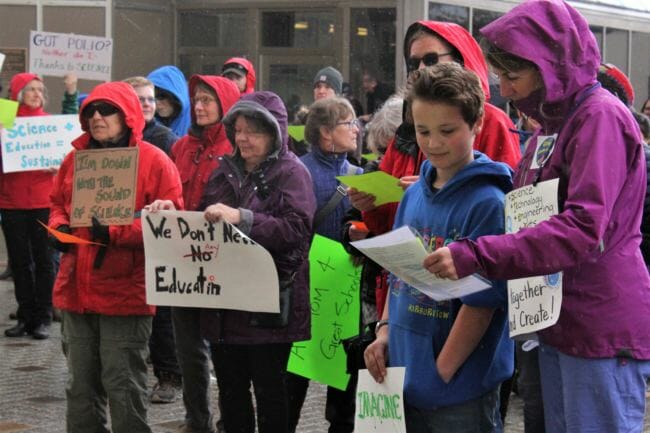
Participants brave the rain outside the state capitol at the second annual March for Science in Juneau on Saturday. (Photo by Adelyn Baxter/KTOO)
Supporters of science and public education rallied outside the state Capitol on Saturday as legislators debated education funding.
First grade teacher at Harborview Elementary School Jennifer Thompson led the crowd in a chant so the legislators inside could hear them.
“STEAM starts early. Learning makes it great. We all work together; innovate and create!” they yelled in unison.
This was the second annual March for Science. Participants in the international event call upon lawmakers to base their policies in evidence-based research and facts. This year, organizers partnered with Great Alaska Schools, a statewide organization that advocates for quality public education.
“Right now, as we know, the Legislature is deciding about school funding,” said Emily Ferry, a volunteer with Great Alaska Schools who helped organize the rally. “And we know that having hands-on science experiences, as well as art and music experiences, can really enhance education and we want to have those experiences for our kids so that we can have a strong future for Alaska.”
Ferry and many of the speakers talked about the importance of emphasizing STEAM — an acronym for science, technology, engineering, art and math education — at an early age.
The Senate passed House Bill 287 on Saturday; it’s likely to go to conference committee to resolve differences over funding. It funds education independently from the overall state budget, with the intent that it would pass earlier.
And HB 339 would increase the state’s per-student funding to school districts. The House passed the bill Saturday afternoon. It now goes to the Senate.
“If the Legislature does not increase education funding, then the school board’s going to have to go back and cut even more programs, more teachers,” Ferry said. “That’s going to make bigger class sizes, it will be less individualized, harder for students to learn, less programs to make it engaging and hands-on. I think the kids lose.”
Among its budget cuts, the Juneau School Board voted to end a college readiness program called AVID at the middle school level.
Thunder Mountain High School junior Laurine Araneta spoke about the program and the advantage it gave her when entering high school and starting to think about college.
“For me personally, my mom didn’t graduate college and AVID has helped me just get into it … like, find out how to apply for grants and scholarships and financial aids,” Araneta said. “You know, for students who really want to go to college, if they’re not informed, then I feel like they’re discouraged to even try because they don’t have that guidance or support.”
School administrators, teachers and parents from across the state testified before the House Finance Committee on Tuesday in support of increased school funding.
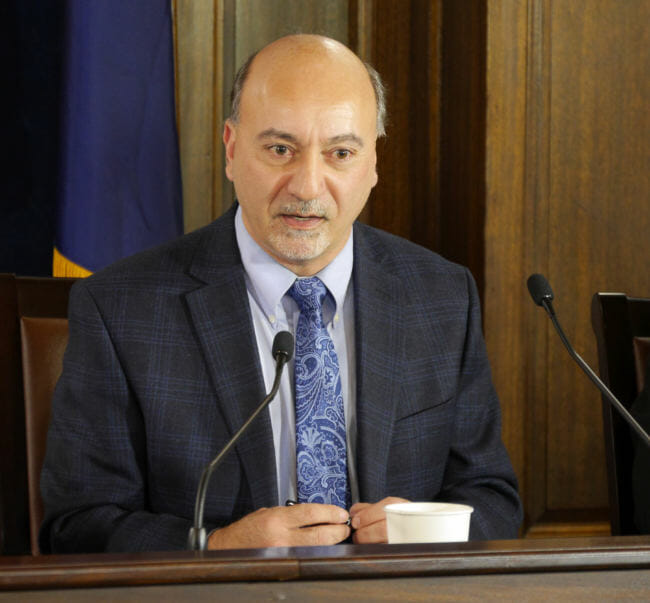
Rep. Les Gara, D-Anchorage, address the Capitol Press Corps during a House Majority Press Availability on March 28, 2017. (Photo by Skip Gray/360 North)
Anchorage Rep. Les Gara’s House Bill 339 would increase the base student allocation by $100 to $6,030. The BSA determines how much money school districts receive on a per-student basis.
Gara, a Democrat, said he has heard repeatedly from teachers who feel the daily burden of budget cuts.
“Class sizes up, the number of students they teach are up, and they really don’t feel the support coming from the Legislature at all,” Gara said. “So we’re also possibly losing our best teachers, and that’s not the way to move forward.”
No one spoke against the bill. A number of school district superintendents testified in favor. Many were in town for this week’s Alaska Association of School Administrators Legislative Fly-In. Their districts ranged in size from Craig to Anchorage, but the common message was clear: school districts have been hit hard by budget cuts, and they can’t take any more.
Without the bill, the proposed budget would flat-fund K-12 education again next school year. Multiple testifiers pointed out that this amounts to a decrease, since costs continue to rise for schools. Rising health insurance premiums are one of the biggest reasons.
Many spoke about unsustainable increases to classroom size and teachers who are spread too thin by their workloads.
Out of necessity, Hoonah School District Superintendent Ralph Watkins is also the principal, technology director and a middle school teacher. He said education is too important for legislators not to act.
“In Hoonah, we are combining classes. We have kindergarten/first grade, second grade/third grade, fourth grade/fifth grade,” Watkins said. “This is unsustainable.”
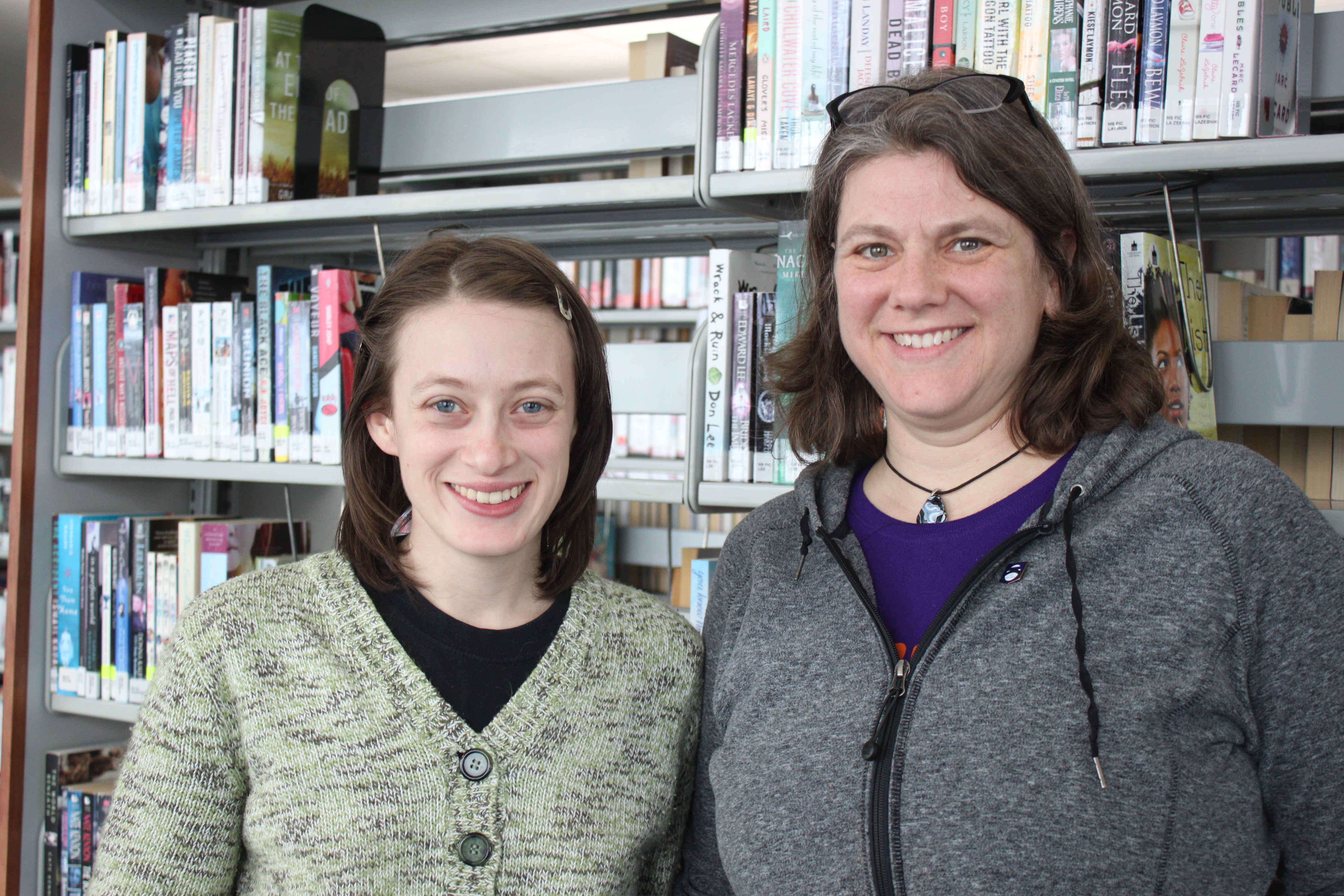
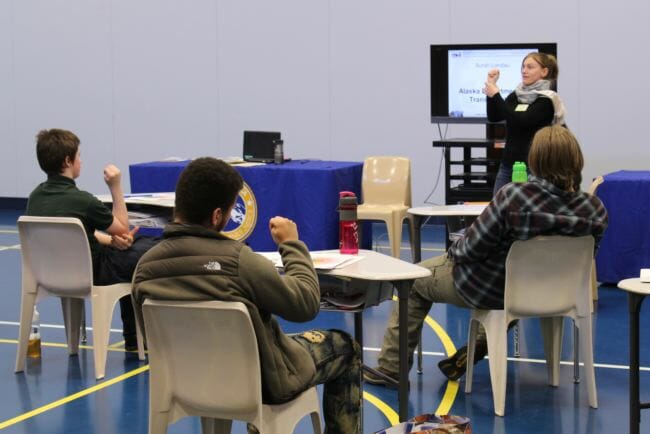
Volunteer Aurah Landau leads Johnson Youth Center residents in a mindfulness exercise during the 2018 Transition Camp. (Photo by Adelyn Baxter/KTOO)
During a weeklong program, several teenage residents of a Juneau youth facility worked on life skills, such as creating resumés and establishing good credit.
The annual Transition Camp presented a series of speakers and workshops last week aimed at easing the return home for the young men at Johnson Youth Center.
The facility’s Superintendent Jess Lujan says the youth center functions more like a school than a prison.
In addition to educational classes, residents attend group sessions for things like anger management classes or substance abuse.
“We actually work with these youth to make sure that they are ready to be back and become productive members of society,” Lujan said. “Our kids literally group from the moment they wake up, all the way to the moment they go to bed, they’re doing something.”
Most of them eventually graduate with their high school diploma.
Each youth center resident committed a crime at some point, and were sent to the facility by court order. They mainly come from Juneau and Southeast, but some come from farther away.
Students typically spend up to two years at the facility.
Alaska’s Educational Resource Center, SERRC, runs the training camp. Although SERRC stands for Southeast Regional Resource Center, it runs programs throughout the state.
SERRC special education specialist John Cowper travels around the state to bring similar training to other communities.
“Nome, we were in Kotzebue this year. We have been working with North Slope, it’s just all a matter of scheduling but they’re definitely interested,” Cowper said. “But yes we try to make these available to every school district. Everybody has students who need some transitional supports.”
Each day, the Transition Camp focuses on a different topic and skill set. On the first day, residents learned about their role within the community. Gov. Bill Walker and Lt. Gov. Byron Mallot stopped by to speak to the young men.
Day two involved education options for residents to explore once they leave.
Cowper said the goal is to give them the tools to become independent.
“Day three is all about employment; finding, keeping a job. We have lots of entrepreneurs come in and they talk about how they did it and what they look for in good employees,” Cowper said.
Independent living and healthy lifestyle choices rounded out the week.
Ten residents, ranging from age 14 to 17, participated in the Transition Camp. The program is now in its third year at Johnson Youth Center.
Close
Update notification options
Subscribe to notifications
Subscribe
Get notifications about news related to the topics you care about. You can unsubscribe anytime.