Adelyn Baxter

Digital Content Director, KTOO

"I help inform KTOO listeners, viewers and readers by finding creative ways to bring our content to our audience wherever they are."

JPD says alcohol likely a factor in accidental home shooting Saturday

Juneau police responded to a 911 call early Saturday morning for an apparent accidental shooting at a downtown residence.

According to a police statement, the call came at 4:30 a.m. Police found a 27-year-old woman at a residence in 400 block of Harris Street with an apparent self-inflicted gunshot wound to her right thigh.

Police say the shooting appeared to be unintentional and alcohol was likely a factor.

Police seized guns from the residence but have not yet identified which weapon was used in the incident.

Capital City Fire/Rescue transported the woman to the hospital. She sustained serious injuries to her leg but is in stable condition, according to police.

‘Hope isn’t a strategy’ in school budgeting, or is it?

The Juneau School Board passed its budget for the 2019-2020 school year Tuesday night, approving $85.8 million. The final vote was 6 to 1.

But where much of that money is coming from isn’t set.

The district faced more than $3 million in cuts. Board members spent March working through a priorities list, making tough decisions about what programs and items should go next school year.

So far, the district will have 17 fewer teaching positions next year. But the process is far from over, and more cuts are likely.

School funding in Alaska comes from two primary sources – the state and local governments. For the last two years, state contributions to school districts have stagnated. Since school costs continue to rise, schools officials say it amounts to a decrease in funding.

The district built its budget based on the admittedly hopeful assumption that the Legislature will raise the base student allocation. That’s the amount of money the state sends school districts per typical student.

Rep. Les Gara’s HB 339 would raise the BSA by $100 per student to $6,030. That would mean an additional $1 million for Juneau schools. That bill is still in committee, and has not showed much sign of movement in recent weeks.

From the beginning of the board’s budget deliberations, Superintendent Mark Miller acknowledged the district was being optimistic. But, he said, the district would have to revisit the budget no matter what, after the Legislature passes a spending bill. Last year, that didn’t happen until June 30.

Miller put it this way to the school board:

“So the question is, do you want to over-cut and then put back? Or do you want to be a little more optimistic and then potentially have to cut a little more?”

On Tuesday, the board discussed ways to get the word out about the importance of HB 339’s passage for Juneau’s schools. For some members, optimism about the bill had waned. When the board’s student representative Sahil Bathija asked when the district was likely to know the outcome of the bill, Miller responded playfully.

“I have an eight ball that I use for this … but I didn’t bring it with me, so it’s hard for us to say,” Miller replied.

Board member Emil Mackey was more blunt: “I’ll say it, I don’t think it’s going to happen.”

It’s a gamble, one that many districts across the state have wrestled with. Anchorage School District Superintendent Deena Bishop said they decided not to factor a BSA increase in when building their budget, though they remain hopeful.

“So we planned on what we knew we had, and we’re advocating for what we need,” Bishop said.

ASD faces a budget gap of more than $13 million for next year. Bishop said they scaled down administrative costs and looked for other efficiencies, but dozens of teacher positions will be cut if more money doesn’t appear.

hope chalkboard
(Creative Commons photo by Kyle Steed)

“We’ve testified. There’s optimism, there’s hope. I know hope isn’t a strategy, but we believe that we have many legislators that see the needs in schools and want to support the needs in schools,” said Bishop. “But we’re also preparing for what reality looks like.”

Juneau’s school budget also assumes the City and Borough of Juneau will fund the school district to the state-imposed cap. Which it has, historically.

Separately, the district is asking for $1.3 million extra local money for non-classroom expenses, like buses and high school activities. There’s no state limit on that type of local spending.

At the end of Tuesday’s meeting, it was clear that board members have grown frustrated with years of flat funding.

Board member Andi Story, the only no vote Tuesday night, said she was disappointed the budget cut programs that promote equity in learning, like a college readiness program in middle schools called AVID. Story argued that program is vital for disadvantaged students who don’t have the same support system at home as others.

“We’re about trying to lessen income inequality. That’s why I’m on the board,” Story said. “I’m on the board to make a difference for the kids who aren’t succeeding in our system.”

The high school AVID program wasn’t affected.

Mackey said he believes Juneau students receive a good education, but that forced cuts mean they can’t ensure that it continues to improve. He said if anything, it’s getting worse. And he blames the Legislature.

“I believe we are a convenient scapegoat, because we have to do their dirty work and make cuts when we’re not adequately funding,” Mackey said.

School systems all over the state are the in the same situation.

Correction: A previous version of this story misstated that the Juneau School District had cut no teaching positions. The school district will have 17 fewer teaching positions next year.

School board approves budget as questions over state funding loom

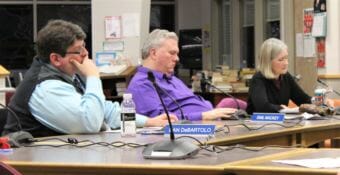
Juneau School Board members Dan DeBartolo, Emil Mackey and Andi Story prepare to vote on the FY19 district budget at a special meeting March 27, 2018. (Photo by Adelyn Baxter/KTOO)
Juneau School Board members Dan DeBartolo, Emil Mackey and Andi Story prepare to vote on the district’s Fiscal Year 2019 budget at a special meeting on Tuesday. (Photo by Adelyn Baxter/KTOO)

The Juneau School Board passed its annual budget Tuesday night, approving an estimated $85 million to $86 million for next school year.

The board proposed some cuts but ultimately added to the budget during the four-hour special meeting. Director of Administrative Services David Means said he did not immediately have the final budget amount available, but would know Wednesday once he had a chance to run the numbers.

The district’s budget remains full of uncertainty. The state Legislature has yet to approve a spending bill. District staff built the budget based on the assumption that the Legislature would raise next year’s base student allocation, the amount of money the state sends school districts per typical student.

A bill currently in committee, HB 339, would raise the BSA by $100 per student to $6,030. That would mean an additional $1 million for Juneau schools.

The budget also assumes that the Juneau Assembly will spend the maximum amount it’s allowed to on local schools under state law. That has been the case in recent years. But the district will also ask for another $1 million for student transportation, food services and high school activities not subject to the cap.

The school district intends to submit its budget to the city by the end of the week. The Assembly then has until the end of May to determine its contribution.

UAS names new education college dean tasked with ambitious in-state teacher hiring goals

By 2025, the University of Alaska says it wants nine out of 10 teachers hired in the state to be one of its graduates.

According to the university, two-thirds of Alaska’s teachers currently come from out of state.

Incoming Executive Dean of the Alaska College of Education (Photo courtesy of UAS)
Steve Atwater is the incoming executive dean of the Alaska College of Education. (Photo courtesy UAS)

It’s an ambitious goal, one that will require more coordination among the teacher training programs at the university’s three main campuses. To oversee that, the University of Alaska Southeast Tuesday named Steve Atwater as the executive dean of the new Alaska College of Education.

The new role will be responsible for education programs at UAS while also coordinating with existing programs at UAA and UAF.

Atwater starts July 1. The job is based in Juneau, but he’ll travel frequently to work with faculty and staff at other campuses as chair of the newly created UA Teacher Education Council. Atwater said a big part of that will involve looking at common issues for the three campuses and finding uniform solutions.

“An easy way to look at that would be the placement of interns in rural Alaska,” Atwater said. “How do we do that? How do we put student teachers into rural Alaska? Right now we have three different ways to do it, and so this will be coming up with some processes that will be standard across the system.”

The UAS School of Education will be restructured. At UAA and UAF, the education programs will be absorbed into other colleges. UAS Chancellor Rick Caulfield said class offerings and faculty will remain the same.

“So students will continue to be able to become teachers at each of the three universities in the university system, but he’ll be providing a coordination role and a leadership role across the entire state,” Caulfield said.

Caulfield made the final decision to choose Atwater based on recommendations from a search committee.

He said the university’s Board of Regents is looking to UAS to lead the system’s push for more Alaskan teachers. He said he’s excited for Atwater to take on the challenge.

“The major focus in the short run will be the restructuring, but my hope in the long run is we’re going to see far more Alaskans choosing to become teachers and we’ll see more students in our classrooms and in our online program as well,” Caulfield said.

Atwater said meeting the university’s 90 percent goal will mean working with partners across the state.

“So I look forward to working with the Legislature, other entities to try to really encourage that conversation to be broader than just the university recruiting students but to really grow the esteem of the teaching profession as a way to help direct or steer students into that,” Atwater said.

In recent years, school districts across the state have struggled with staffing shortages.

Atwater comes from the University of Alaska Fairbanks, where he’s the interim dean of the School of Education. He was a former superintendent for both the Kenai Peninsula Borough and the Lake and Peninsula school districts and got his start teaching in rural schools in Western and Southwest Alaska.

The Alaska Association of School Administrators named him 2013’s Alaska Superintendent of the Year.

Juneau residents, legislators call for gun reform at March for Our Lives protest

Juneau residents and legislators protested Saturday in solidarity with the March for Our Lives in Washington, D.C.

Like the Parkland survivors who led the national protest, Alaskans called on lawmakers to do more to protect not only students, but everyone, from gun violence.

About 200 people gathered outside the Juneau offices of Sens. Lisa Murkowski and Dan Sullivan. They called for more gun control legislation and stricter background checks for those buying guns.

Juneau-Douglas High School senior Noah Williams spoke and led the crowd in chants. He said he wants to see lawmakers like Murkwoski and Sullivan stop accepting money from the NRA.

“They stand to gain a profit off of our deaths and I think that’s disgusting and I don’t think we have to stand for it anymore,” Williams said.

State Rep. Geran Tarr also spoke. The Anchorage Democrat introduced House Bill 75 last year. It establishes red flag laws that allow judges to remove guns from the homes of people at higher risk of committing acts of violence.

“The idea is that you’re trying to intervene in a crisis situation and prevent someone from harming themselves or others and using the court to help you intervene by removing the guns,” Tarr said.

The bill has had several hearings in the House Judiciary Committee and Tarr said she’s hopeful it will be moved out next week.

After some initial confusion, the marchers headed for the state Capitol, where a smaller group rallied.

Several Juneau residents who survived the Route 91 Harvest festival shooting in Las Vegas last October also attended. Ivana Barrick went to the festival as she had several times before, never imagining that it would become the site of the deadliest mass shooting in U.S. history.

“As a gun owner myself, we just want to make a distinguished line and people who are responsible with guns and then we need to make stricter laws for people who do have problems, that we do need to address it,” Barrick said. “So something has to change and we fully support Parkland and what they’ve started.”

Juneau’s march was one of hundreds playing out across the country Saturday. The main march in Washington, D.C. drew hundreds of thousands. The latest wave of demands for stricter gun laws have been spurred largely by the student activists who survived the school shooting in Parkland, Florida.

Rep. Harriet Drummond said watching young people take a stand against gun violence, including last week’s student walkouts in Juneau and elsewhere, has been inspiring.

“I don’t think we’re gonna be able to stop these young people and why would we want to? This is how change happens,” Drummond said.

A mother embraces her daughter at a protest against gun violence on Saturday, March 24, 2018. (Photo by Adelyn Baxter/KTOO)
A mother embraces her daughter at a protest against gun violence on Saturday. (Photo by Adelyn Baxter/KTOO)

After clients discover backlog, Juneau pet cremation business owner says he’ll make good

Tammy Hunt's family dog, Bob, died in January. She waited two months for her bill from Bridge Pet Services. (Photo courtesy of Tammy Hunt)
Tammy Hunt’s family dog, Bob, died in January. (Photo courtesy Tammy Hunt)

After Tammy Hunt’s boxer died in January, she hired a local pet cremation service to pick up the remains.

In mid-February, when her stepson’s cat died, he called the same company.

But neither of them heard back from the business, Bridge Pet Services, for weeks about their bills.

On a recent weekend, they stopped by the shop and noticed a blue Toyota full of black and white plastic bags.

They took a closer look, and realized the bags were labeled with people’s names, pet names and dates going back weeks. They showed me video of what they saw.

Hunt said they were both horrified to think their own pets might be decomposing in the back the truck.

“You know, if we didn’t care, we’d just take our pets out to the landfill,” she said.

She said seeing those bags brought back the stress of losing her dog all over again.

She decided to post about it on a Juneau Community Collective Facebook thread.

The reaction from other clients of Bridge Pet Services was immediate.

Some said they’d tried calling, emailing, texting and even knocking on the door to talk to someone. Other customers noted bills and pet’s ashes that were overdue by a month or more.

“If the service is offered, then the service should be rendered,” Hunt said. “If the service cannot be rendered, then it should not be offered. I think that ordinances might need to be either enforced or altered to accommodate pet owners a little bit better.”

“It’s just embarrassing and I’m just trying to get this sorted out and get back on track,” said Mike Dziuba, who founded Bridge Pet Services with his now ex-wife in 2007. “My own dog was getting older at the time, and I just didn’t want to ship him to Anchorage and I wasn’t in a place where I was putting roots down where I was going to be at a house where I felt comfortable burying him there.”

When a pet passes away, Juneau residents are required by city ordinance to dispose of the remains immediately.

Before Bridge opened, they could bury the pet on their own property or use the landfill’s disposal service.

“I felt like I was providing an option for town instead of the landfill, of course, although I know there are still people that choose that option,” Dziuba said. “But it wasn’t for me and it’s not for most of my owners.”

Dziuba’s clients can choose an individual cremation to receive their pet’s ashes in an urn afterward, or communal cremation, where multiple pets are cremated together and Bridge disposes of the ashes.

Prices vary based on weight. Home pick-up costs $35.

Dziuba said business tends to pick up in the winter months. He thinks it’s because the ground is too hard to bury pets.

Animals awaiting cremation are usually stored inside in freezers.

It typically takes him up to two weeks to cremate and get ashes back to clients, but acknowledged he’d fallen behind because of some personal issues.

He said he didn’t want to make excuses.

“I don’t necessarily blame anybody for griping. But I’ll talk to anybody individually and try to square it up that way. I think that’s kind of the best route.”

He runs the business alone now and works full-time at Bartlett Regional Hospital during the day, so animals in body bags sometimes sit in his truck until he can return to his shop.

Dziuba said he has time off from work coming up and plans to devote it to getting caught up and making things right with his clients.

In addition to individual owners, he works with the Gastineau Humane Society and local veterinarians, picking up animals that have been put down or found dead on the side of the road and cremating them.

The humane society had a crematorium years ago, but no one working there now remembers when it went away.

City Manager Rorie Watt said the city had received calls from concerned Bridge clients. He said they asked the Gastineau Humane Society to reach out to Dziuba and is hopeful the business will get back on track.

“I do think it’s a service that the public appreciates and the prior method of burying dead pets in the landfill really was not very popular with a lot of people.”

Hunt and her stepson both eventually heard back from Dziuba. She’s still upset about what happened, but said Dziuba waived her bill.

Site notifications
Update notification options
Subscribe to notifications