Adelyn Baxter

Digital Content Director, KTOO

"I help inform KTOO listeners, viewers and readers by finding creative ways to bring our content to our audience wherever they are."
U.S. Coast Guard, Juneau police test response capabilities with nuclear scenario

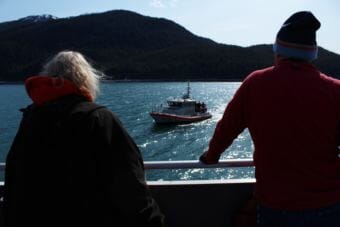
Volunteers watch as a U.S. Coast Guard vessel approaches the St. Nicholas during a training exercise. (Photo by Adelyn Baxter/KTOO)
Volunteers watch a U.S. Coast Guard vessel approach the St. Nicholas during a training exercise in Juneau waters on Wednesday. (Photo by Adelyn Baxter/KTOO)

Juneau emergency responders took part in a training exercise this week to test their ability to work together in the event of a large scale threat. Part of the simulation involved responding to a nuclear bomb aboard a ferry.

About 30 community volunteers got the chance to ride along for a close-up view of operation “Shielded Eagle.”

On Wednesday, the St. Nicholas took off from a dock by the ferry terminal with passengers and a handful of crew.

It may have looked like a typical tour excursion, but the St. Nicholas was standing in for the Alaska Marine Highway ferry Columbia. It was also carrying an imaginary nuclear threat.

Later on, members of the U.S. Coast Guard Sector Juneau and the Juneau Police Department would board the vessel. But for now, Allen Marine Tours put out coffee and doughnuts for passengers, who range from retirement age to college students. Despite the serious nature of the exercise, volunteers are enjoying themselves.

“Like everybody said, I really want to thank you for being here. I mean, although, it’s a pretty nice day for a boat ride,” says Rich Baenen, a member of the Coast Guard Exercise Support Team.

Baenen explains that the training scenario involves a radiological device planted somewhere on the boat by terrorists. Earlier, a device that emits low levels of radiation — for real — was hidden on board.

“What your role is, is simply passengers, right? Somewhere in this scenario, there could be some bad guys, some bad gals, but you’re not one of them,” Baenen says.

Jack and Judy Marshall, both in their 70s, went along for the free boat trip.

“You know, with all this sun and everything, it’s going to be really beautiful out here,” Jack Marshall says. “A lot of mountains are white. Should be great. Maybe see a whale or two.”

And they did, almost immediately. A humpback whale surfaces near the boat.

Carolyn Garcia is on the email list for Juneau’s emergency planning committee and signed up as soon as they put out the call for volunteers last week.

“I’m interested in the drill just because I’m also a Red Cross volunteer and I’m interested in helping respond to emergencies and participate and just know what’s going on as far as what the rest of the community is doing,” Garcia says.

After a few hours spent floating offshore, a Coast Guard boat approaches. They pull up alongside the boat and board quickly, plastic guns in their holsters.

The team asks passengers to sit with their hands above their heads until they can verify identities.

Volunteers take part in a training exercise for Juneau emergency responders aboard the St. Nicholas. (Photo by Adelyn Baxter/KTOO)
Volunteers take part in a training exercise for Juneau emergency responders aboard the St. Nicholas in Juneau waters on Wednesday. (Photo by Adelyn Baxter/KTOO)

Passengers secured, the team searches the boat and locates the hidden device.

A member of the U.S. Coast Guard Sector Juneau use a radiation detector to locate a device aboard the St. Nicholas during a training exercise. (Photo by Adelyn Baxter/KTOO)
A member of the U.S. Coast Guard Sector Juneau uses a radiation detector aboard the St. Nicholas on Wednesday. (Photo by Adelyn Baxter/KTOO)

Coast Guard Lt. Tim Storbeck was part of the team of coordinators in charge of the exercise. He said they were happy with the team’s performance. While a terrorist scenario may seem like a remote threat for Juneau, he said the point was to test response capabilities and make Juneau safer.

“If something major happened where we absolutely needed the police department to go out, if we hadn’t practiced beforehand,” Storbeck said. “For example, they don’t have life jackets, ’cause they don’t have a maritime unit, so the Coast Guard had to provide life jackets for the police department. We wouldn’t want to find that out when we’re going out to respond to some sort of scenario.”

Police Lt. Krag Campbell agreed. They regularly practice on their own, but don’t get the chance to collaborate much.

“We don’t get that many opportunities to work with them like that, so this was a good opportunity to us to work together to see how are things were working, how’s our communication,” Campbell said.

The exercise continued Thursday, with the teams picking up right where they had left off. Evaluators will debrief at the end of the week.

Young athletes prepare to represent Juneau at statewide traditional games competition

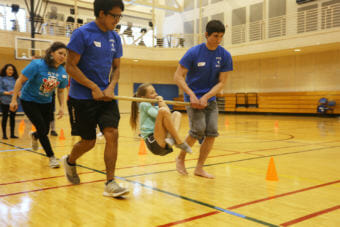
Rayna Tuckwood, 11, competes in the Wrist Carry event at the 2018 Traditional Games. Her distance of 186 feet 4-and-a-half inches won the female Middle School Division. The contest was sponsored by Sealaska Heritage, Central Council of Tlingit and Haida Indian Tribes of Alaska and Wooch.Een in collaboration with Goldbelt Heritage. (Photo by Annie Bartholomew/KTOO)
Rayna Tuckwood, 11, competes in the Wrist Carry event at the 2018 Traditional Games. Her distance of 186 feet 4 1/2 inches won the female Middle School Division. (Photo by Annie Bartholomew/KTOO)

Juneau is getting ready to send its first team to the statewide Native Youth Olympics competition in almost 30 years.

At least 10 middle and high school athletes will travel to Anchorage in late April to compete, but as their coach says, their biggest opponent will be themselves.

The athletes competed against one another and community members at the 2018 Traditional Games at the University of Alaska Southeast Recreation Center last weekend.

Native Youth Olympics has brought together young people from across the state for more than 45 years. The event celebrates Native culture with games adapted from traditional hunting and subsistence practices.

It’s open to all middle and high school students.

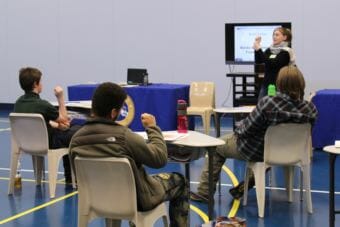
Athletes who will represent Juneau at the state competition gathered at UAS to see who would compete in which events.

Native Youth Olympics features 10 official games, each testing competitor’s strength, agility and flexibility. Some even test their pain endurance.

Like the wrist carry, where athletes suspend themselves by just their wrist from a pole. Two people run in circles around the gym, carrying them until they fall off. Sometimes it only takes a few steps, but the state record is 730 feet.

“We’re going to look at the results from the past two days and that will decide which athlete will do which game at the competition,” coach Kyle Worl said.

Kyle Worl demonstrates the Kneel Jump event for participants at the 2018 Traditional Games held at the University of Alaska Southeast Recreation Center. The contest was sponsored by Sealaska Heritage, Central Council of Tlingit and Haida Indian Tribes of Alaska and Wooch.Een in collaboration with Goldbelt Heritage. (Photo by Annie Bartholomew/KTOO)
Kyle Worl demonstrates the Kneel Jump event for participants at the 2018 Traditional Games held at the University of Alaska Southeast Recreation Center. (Photo by Annie Bartholomew/KTOO)

He spent the past couple of months building Juneau’s team from the ground up, which meant recruiting athletes, holding weekly practices to work on technique and finding sponsors to help get them to the games.

Now he has enough athletes to field not one, but two teams in Anchorage.

“The most important thing I try to instill in them is this is a competition between yourself and you are competing to reach your personal best, or improve your personal best,” Worl said.

As the athletes competed, they took time to cheer on their competitors, pushing one another to kick higher, jump farther and even offering tips between events.

That’s part of what makes the sport unique.

Dzantik’i Heeni Middle School seventh-grader Trinity Jackson is headed to Anchorage with the team.

She plays volleyball and basketball and runs cross-country, but says the Native Youth Olympics is different.

“Even if you lose, your friends are like ‘oh, it’s OK, you’re going to hit it higher next time.’ Or they’ll give you some pointers,” Jackson said.

Her friend, teammate and fellow Dzantik’i Heeni seventh-grader Skylar Tuckwood has been to the statewide competition before.

She competed for Dillingham, where the games are a big deal, before moving to Juneau.

“I like how other coaches from other teams will give you tips,” Tuckwood said. “They’re like ‘oh, if you swing your hips more, you’ll be able to hit higher’ or like, ‘if you bend your knee you’ll be able to hit higher.’ They’re all really helpful.”

Female Kneel Jump Middle School Division winners Trinity Jackson, Kalila Arreola, and Skylar Tuckwood at the 2018 Traditional Games. The contest was sponsored by Sealaska Heritage, Central Council of Tlingit and Haida Indian Tribes of Alaska and Wooch.Een in collaboration with Goldbelt Heritage. (Photo by Annie Bartholomew/KTOO)
Female Kneel Jump Middle School Division winners Trinity Jackson, Kalila Arreola, and Skylar Tuckwood at the 2018 Traditional Games. (Photo by Annie Bartholomew/KTOO)

Both Jackson and Tuckwood hope to compete in the one-foot high kick, where athletes kick a small, furry ball hanging from a string as it’s gradually raised higher and higher.

Tuckwood came in first among middle school girls, beating her personal best with a height of 76 inches.

Jackson got second place. Her best is 72 inches.

She said she’s nervous to compete in front of so many people in Anchorage for the first time. But she’s also excited.

“Here, we’re kind of all a team, really,” she said. “We’re all in the same sport and we’re all trying to beat our own goals.”

Worl wants his athletes to keep practicing and improving up to the event, but he’s not worried about bringing home medals.

“I’m just concerned about them having a good time, giving it their best effort,” he said. “Native Youth Olympics is a really fun event where you don’t have to be really competitive to be able to have fun. It’s just fun to meet these students from all around Alaska and it’s fun to celebrate our culture in this way.”

The weekend competition included an Indian taco and T-shirt fundraiser, which raised almost $2,000 for travel, Worl said.

The team is sponsored by Central Council of the Tlingit and Haida Indian Tribes of Alaska and Sealaska Heritage Institute. Goldbelt Heritage Foundation, UAS student group Wooch.Een and local design brand Trickster Company have also lent support.

The statewide competition takes place April 26-28 at the Alaska Airlines Center.

City reaches agreement over AEL&P sale

merger
(Creative Commons image by Mike Lawrence/creditdebitpro.com)

The city has reached an agreement with Hydro One and the parent company of Juneau’s electric utility.

According to a release from the City and Borough of Juneau, city-hired attorneys worked on a list of commitments with Hydro One and Avista Corporation, which owns Alaska Electric Light & Power. The city says it will resolve Juneau residents’ concerns.

Hydro One is trying to buy Avista. The Juneau Assembly is an intervenor in the part of the process overseen by the Regulatory Commission of Alaska.

Clarification: A reference to “city attorneys” has been clarified as “city-hired attorneys.”

UA President Johnsen shares outlook for university budget

University of Alaska President Jim Johnsen talks about the spread of the university's campuses @360 in Juneau on on April 3, 2018.
University of Alaska President Jim Johnsen talks about the spread of the university’s campuses @360 in Juneau on Tuesday. (Photo by Rashah McChesney/Alaska’s Energy Desk)

University of Alaska President Jim Johnsen has spent the last few months advocating for more funding for the university, arguing that it cannot withstand continued budget cuts.

The Alaska House of Representatives passed its version of the state operating budget Monday by a narrow margin. It includes $19 million more for the university’s operating budget than Gov. Bill Walker proposed.

Johnsen, appearing on Forum@360,  said he was grateful the House decided to increase UA’s budget and is hopeful the Senate will follow suit.

“I can’t control that process, certainly,” Johnsen said. “But what I can do is continue every single day advocating for the interests of the university but always setting those in the context of the interest of the state.”

The university’s annual budget has declined by more than $60 million since 2014, forcing cutbacks that have affected class offerings, staffing and campus enrollment.

In 2016, Johnsen put forward Strategic Pathways, his plan to cut costs and consolidate administration while making the university function better. UA faculty and staff last year criticized Strategic Pathways, and Johnsen. The plan is in its final phase and being implemented across UA campuses.

“I think that the tough decisions the regents have made, the university has made, has gone a long way in persuading legislators that now is the time to stop the cuts and to actually start investing back into higher education for the state,” Johnsen said.

Part of that reinvestment effort includes the new, consolidated Alaska College of Education based in Juneau. Last week, the University of Alaska Southeast announced that Steve Atwater will lead the school as the new executive dean. The university has set a goal to produce 90 percent of the K-12 teachers hired in the state by 2025.

“There’s no more important job in Alaska, in my view, than teachers,” Johnsen said. “And we’re importing 70 percent each year, 70 percent of the new teachers hired in the state. And they churn at a very high rate.”

Johnsen said the university plans more scholarships and outreach to recruit prospective teachers for Alaska classrooms.

The Teach for Alaska Presidential Scholarship provides up to $12,000 to Alaskans pursuing a teaching degree at any UA campus.

Police arrest suspect in downtown window smashing spree

Someone used rocks to break windows of at least seven downtown Juneau businesses during the weekend.

According to a news release, Juneau police received a report shortly before 2 a.m. Sunday that a number of windows along South Franklin Street and elsewhere had been vandalized.

The Taqueria co-owner Luke Metcalfe said his restaurant’s front door window was broken.

“You see a lot of broken windows after crazy nights downtown,” Metcalfe said. “At first, I assumed it was a robbery just because the Goldtown has been robbed frequently. I’m glad nothing got stolen, that was kind of a nice surprise.”

Metcalfe said the window was the only damage, but didn’t have an estimate of replacing the glass. Metcalfe said his business was closed for lunch Monday.

Police identified Juneau resident Monte Nix as the suspect and arrested him later Sunday on four counts of criminal mischief.

Other criminal charges are pending. Police believe alcohol was a factor.

Records show Nix being held without bail at Lemon Creek Correctional Center.

Juneau Police Department estimates that total damages range between $8,000 and $12,000.

Disclaimer: Luke Metcalfe is a KTOO board member.

Site notifications
Update notification options
Subscribe to notifications