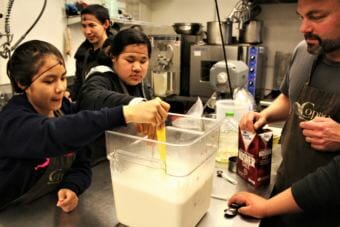
Students on a cultural exchange trip from Noorvik Aqqaluk School make ice cream with Marc Wheeler in the kitchen at Coppa in Juneau. (Photo by Adelyn Baxter/KTOO)
Four middle school students from Noorvik Aqqaluk School visited Juneau this week as part of the statewide Sister School Exchange program.
The program promotes understanding between Alaska’s rural and urban communities by setting up cultural exchanges for middle and high school students. The Northwest community of Noorvik was paired with Dzantik’i Heeni Middle School.
On Thursday, the Noorvik students paid a visit to Coppa where owner Marc Wheeler taught them how to make ice cream. They got to choose the flavor — mint chocolate ice cream.
“What else do you think we need in there?” Wheeler asked the group as one student stirred in the mint.
“The chocolate!” said eighth grader Lindsay Schuerch.
Student from Noorvik Aqqaluk School mix together mint ice cream and chocolate at Coppa during a cultural exchange visit. (Photo by Adelyn Baxter/KTOO)
Wheeler’s own daughter Celia, a middle school student at Dzantik’i Heeni, got to travel to Noorvik recently to experience life in rural Alaska.
“She came back and was just talking so much about riding on snow machines and eating muktuk and all the basketball they played there. She had a great time,” Wheeler said.
The group arrived Sunday and is staying with host families.
Besides class, they’ve made the rounds of all the Juneau sites — a tour of the Douglas Island Pink and Chum, Inc. hatchery, a visit to the Alaska State Museum, the state capitol and cultural lessons at Sealaska Heritage Institute. They even met Gov. Bill Walker and Lt. Gov. Byron Mallott and had a pizza party at the Governor’s Mansion.
Jeffrey Robinson is the teacher traveling with the group. He and other exchange leaders from across the state attended a training in November.
“I think it’s just exposure and building relationships. So my students up in the villages are, obviously, a little bit more isolated and have a certain paradigm that they have,” Robinson said. “Bringing them down into the cities, it’s kind of an eye-opening experience for them. But it’s still in the same state.”
Later on, the Noorvik students would return to the shop for an ice cream social with the students from the Juneau exchange.
The four students will leave Friday after a whale watching cruise.
The University of Alaska Southeast’s Technical Education Center. (Photo by Adelyn Baxter/KTOO)
A long-running partnership between the University of Alaska Southeast and Juneau-Douglas High School may come to an end.
The university allowed the high school to use its automotive facility across Egan Drive for more than 30 years.
Budget constraints mean the school district can no longer afford rent.
The high school’s automotive program runs largely out of the university’s Technical Education Center across the street from the high school.
High school students learn a variety of skills through the program from how to change oil to transmission swaps.
“For us right now, it’s an economic situation where we’re paying $40,000 to hold basically three classes over there, with an up-to-$3 million cut,” said David Means, district director of administrative services. “It’s something we just felt like we couldn’t afford.”
During the budgeting process this spring, the school board made a lot of tough decisions.
One budget item they decided to cut was the $40,000 the district pays annually to rent space in the auto shop from the university.
The district hoped it could negotiate rent with the university. But that hasn’t been the case.
Juneau-Douglas High School automotive instructor Steve Squires points out some of the awards students have won over the years for technical knowledge. (Photo by Adelyn Baxter/KTOO)
“I’ve known the school district has been under budgetary crisis, everybody knows that, for the last few years. But it didn’t really dawn on me that the automotive program wasn’t going to make the cut until just a few weeks ago,” said Steve Squires, who has taught the small engine and automotive programs for 19 years.
Squires said he would still be able to teach small engine and introduction to automotive classes in the building.
But losing the auto shop would put an end to the hands-on instruction students receive in the more advanced courses.
“What’s really unfortunate is I think a lot of the (career and technical education) programs are finally starting to turn around and people are starting to understand that college isn’t the only way to make a good living and a good career,” he said.
Squires teaches about 80 students a year and said while he has kids who just want to learn the basics, a number of them go on to automotive or engineering careers.
They’ve won national awards and scholarships using what they learned in the shop.
Some former students now work in repair shops and auto part stores in town.
National trade schools recruit a handful of students each year.
One graduate now works for Tesla.
“They have a facility they have to pay for heating and the maintenance of the equipment and things like that, but they’re really not very negotiable to any kind of reduction in fee when the school district’s going through such a hard budgetary process,” Squires said.
UAS Chancellor Rick Caulfield said the university had a professional broker look at the facility in 2016 to evaluate the rent. The broker determined $40,000 was a fair price.
“We’re all facing budget challenges and at the university we’ve made a number of cuts and I know the school district is facing some of the same challenges,” Caulfield said. “We’re interested in continuing our partnership with the school district, but in the end they have to decide whether that’s a program they want to continue or not in light of their other budget priorities.”
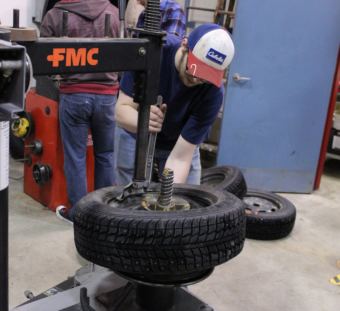
Dylan Rice, a senior, adjusts a tire during an automotive class in the UAS Technical Education Center. (Photo by Adelyn Baxter/KTOO)
The university is open to looking for ways to lower rent, Caulfield said. They offered to cut it in half by reducing the amount of space the high school class takes up in the auto shop. The district did not think that would work.
JD senior Dylan Rice has been in the class for two years and is waiting to hear back from automotive schools.
“When you take away the hands-on part of the learning, it’s just book work,” Rice said. “I think that you can’t apply what you know from the book if you’re not using your hands.”
The topic is likely to come up at Wednesday’s special Assembly meeting on the city’s operating budget. The district may ask the city to help cover the cost of rent.
Correction: An earlier version of this story misstated the location of the university’s Technical Education Center. It’s across Egan Drive from the high school, not Glacier Highway.
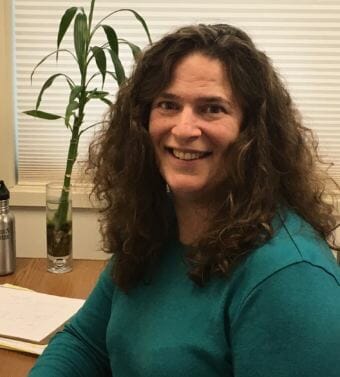
Sarah Jahn is the Juneau School District’s next director of administrative services. (Photo courtesy Juneau School District)
The Juneau School District has named Finance Officer Sarah Jahn as its next director of Administrative Services, effective July 1.
In her new role, Jahn will take on managing the district’s nearly $90 million budget. She will also oversee programs like student transportation, information technology, facilities upkeep and maintenance.
She takes over for David Means, who’s retiring after 13 years with the district and 36 as a school administrator in Southeast. His last day of work is June 29.
Jahn has a bachelor’s degree in accounting from the University of Alaska Southeast. She also has associate’s degrees in accounting and business management from UA Fairbanks.
She started as a payroll and benefits manager for the school district in 2008 before being promoted to payroll supervisor and then to her current role under Means.
An interview committee made up of staff from the City and Borough of Juneau, the school district and school board members held public interviews yesterday before selecting Jahn.
“Barefoot Guy” Ezra Strong looks out on Dredge Lake during a hike. (Photo by Adelyn Baxter/KTOO)
Xtratufs, Bogs, Muck Boots — comfortable, waterproof footwear is pretty much a necessity here in Juneau. But not for the local some know as “the barefoot guy.”
Curious Juneau stars you and your questions. Every episode we help you find an answer. Catch up on past episodes, or ask your own question on the Curious Juneau page.
“Oh yeah, barefoot guy! What’s the story?” said Juneau resident Michael Boyer. “Is he a hobbit? Is he into New Age spiritual stuff? Don’t his feet get cold?”
Boyer lives in the neighborhood above Juneau-Douglas High School.
As he’s out walking his dog or with his kids day to day, he’s noticed a certain walker who also frequents the area.
“Rain, shine, 10 degrees, 70 degrees, uh, never any shoes,” Boyer said after submitting his question to Curious Juneau. He wanted to know more about the mysterious man whose bare footprints crisscross the neighborhood.
One 30-degree day, I had my own sighting downtown near the State Office Building. The ground was slick with ice, and across the street, a bearded man in cargo shorts was walking — without shoes.
I introduced myself and he laughed in a “not again” kind of way.
I met Ezra Strong on a sunny day in late March for a hike along Dredge Lake Trail. Several inches of snow were on the ground. He wore shorts, a light pullover and, of course, no shoes.
Strong grew up in Tenakee Springs, the youngest of six kids. He’s 29 and works in IT for the Juneau School District, where he has to wear sandals.
He’s brought a book with him for the hike, just something he pulled off the shelf at home. He often reads while he walks.
As we set off, I noticed pretty quickly that Strong seemed to fare better than me in a lot of the slushy spots.
“Stuff like this, I’m probably better off than most people in shoes,” he said. “Actual real ice? Not so much.”
He said he would love it if they made micro spikes for bare feet, but he makes do.
Gravel sticking to his feet is probably the most annoying thing he deals with.
Ezra Strong poses after a hike on Dredge Lake Trail. (Photo by Adelyn Baxter/KTOO)
Of course, the main question is why go barefoot at all?
“My right foot is defective. I was born with a birth defect, apparently,” he said. “I think it has something to do with the shape of the arch.”
One of his older brothers had the same issue.
Doctors told their parents the solution was to break the foot and reset it.
Doctors did that for the brother, but by the time Strong came along, his mom hesitated.
“I guess she didn’t want to have to put another kid through having his foot broken, so they just never did it to me,” he said. “So, getting stuff that fit me was a pain.”
Strong’s right foot is abnormally wide. And people with weirdly shaped feet just don’t have a lot of options.
As a kid growing up in a rural community, running around without shoes was no big deal.
He moved to Fairbanks for college. Winters were colder and he didn’t have a car.
For the first time, his feet started drawing attention.
A reporter for the student newspaper at the University of Alaska Fairbanks did a story on him.
Then the questions really started up.
“Facebook and that sort of thing were just becoming a thing,” he said. “I started getting these weird emails from people on the East Coast who had read this.”
He doesn’t understand the fascination with his feet.
For him, it’s always been about comfort.
He experimented with different sizes, styles and brands, but nothing works. He owns a pair of 15-year-old running shoes — They’re about two sizes too big, and the sides are almost worn away.
“The shoes hurt pretty bad too, but it’s better to have the shoe pain for 15 minutes to go jogging than it is to deal with having a shattered callus for the next three days,” Strong said.
He’s experienced mild frostbite, cuts, infections and cracked heels.
Ezra Strong hikes barefoot along the Dredge Lake Trail in Juneau. (Photo by Adelyn Baxter/KTOO)
He uses over-the-counter products like Flexitol, a cream with shea butter and aloe, to help heal.
But it’s not as easy as it used to be.
“As I get older, my theory, again, is my body takes a little longer to recover and to repair,” Strong said. “It’s been getting worse.”
Not long ago, he reached out to a California startup company that 3-D prints shoes.
Their custom-sizing model seemed promising. But they told him they’re in the middle of a transition period and not accepting orders.
Strong said he’s hopeful technology will eventually catch up to his feet.
In the meantime, it’s not all bad.
“I have to say, I love being a bad influence for children,” he said, laughing. “The idea to these children that you don’t have to wear shoes for your entire life seems to startle them and I have seen more than one child, when they see me pass, sit down on the sidewalk or the beach and start trying to pull off their own shoes.”