Alaska Beacon is part of States Newsroom, a network of news bureaus supported by grants and a coalition of donors as a 501c(3) public charity. Alaska Beacon maintains editorial independence. Contact Editor Claire Stremple for questions: info@alaskabeacon.com. Follow Alaska Beacon on Facebook, Bluesky and Twitter.
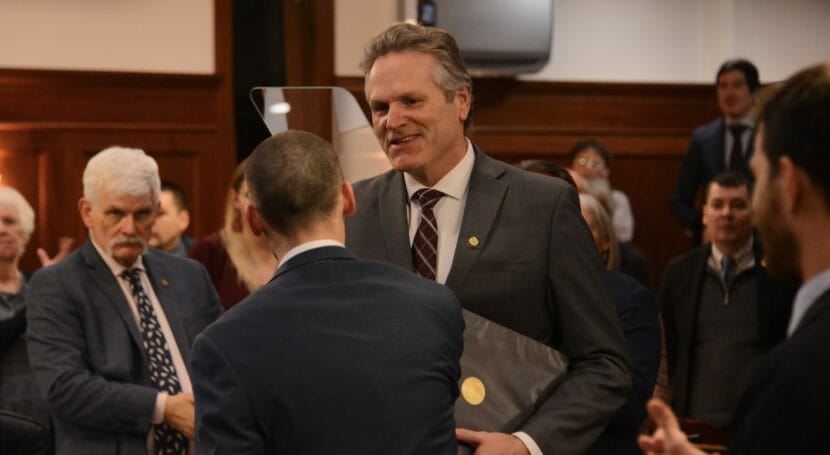
Alaska Gov. Mike Dunleavy shakes the hands of state legislators as he prepares to deliver the 2023 State of the State address to the Alaska Legislature on Monday, Jan. 23, 2023, in Juneau, Alaska. (Photo by James Brooks/Alaska Beacon)
In his annual address to the Alaska Legislature, Gov. Mike Dunleavy identified successes from his first four-year term in office and called for action on a list of administration priorities, including more funding for a “statehood defense” program that has launched a series of lawsuits against the federal government.
Speaking Monday night at the state Capitol in Juneau, the governor also said he would work with state legislators to make Alaska “the most pro-life state in the entire country.”
Doing so, he said, would require affordable housing, improvements to education, economic opportunity and quality of life. Dunleavy also said it would be important to consider life “from the moment of conception on.”
He did not include a firm proposal for meeting those goals.
In June, following the U.S. Supreme Court’s decision to overturn Roe v. Wade, the governor said he would introduce an abortion-related constitutional amendment this year. He has not yet done so, and officials in the governor’s office did not say whether he will introduce one.
“Alaska does have constitutional protection for abortion, so I would suspect — though I don’t know this — that he would propose a constitutional amendment,” said Sen. Cathy Giessel, R-Anchorage.
Rep. Calvin Schrage, I-Anchorage and the House minority leader, said in a written statement that he was encouraged by the governor’s speech and hopes that it means that in areas like the state’s base student allocation, he will support “investment in maternal and children’s health, raising BSA educational funding, and restoring defined benefits for our hard-working public employees.”
Legislators generally praised the speech, saying they are optimistic that the governor’s second term will mark a change from the administration’s often-combative relations with the Legislature in his first four years.
“Overall a positive, forward-looking speech, but I guess the devil’s in the details, and I look forward to hearing the details,” said Sen. Bill Wielechowski, D-Anchorage.
Though the governor’s “pro-life” message lacked details, other elements of his speech have already been introduced in his budget.
One of the administration’s biggest pushes is an expansion of its statehood defense initiative, which funds lawsuits, frequently using hired attorneys, against the federal government.
“When federal agencies are clearly wrong, when they’re misinterpreting the Statehood Act, ANILCA, or other laws governing our relationship with the federal government, we have an obligation to stop them,” Dunleavy said, referring to the 1980 Alaska National Interest Lands Conservation Act that conserved much of the land in Alaska.
Speaker of the House Cathy Tilton, R-Wasilla, said that’s in line with the priorities of the House’s coalition majority.
The administration has already requested and received millions of dollars that it has used for lawsuits on a variety of topics, and the governor’s newest budget requests $10 million more for the effort.
Legislators say they’re interested.
“I think we need to continue to move forward and protect our natural resources to make sure we stay in business,” said Sen. Bert Stedman, R-Sitka and co-chair of the Senate Finance Committee.
The governor also requested $5 million to market Alaska as an area of opportunity for new businesses. The North to Opportunity program, as the governor termed it Monday, is an existing effort the Dunleavy administration has already used to advertise Alaska to fishing companies, tourism businesses, aerospace ventures and even the U.S. Navy SEALs.
Dunleavy said he would “declare war on fentanyl,” a drug that has contributed to a rising number of deaths in Alaska and elsewhere.
Police in Skagway suspect two weekend drug overdose deaths in that community were linked to fentanyl, and the governor has already said he will introduce legislation to increase criminal punishments for drug dealers whose product results in a fatality.
Shortly before the governor’s speech, a hundred-strong rally outside the state Capitol urged Dunleavy and lawmakers to increase the state’s per-student funding formula, known as the base student allocation.
That topic is expected to appear frequently in this year’s legislative session, but the governor’s speech did not mention it, and lawmakers noted its absence.
“I wish he would have spoken more about education,” said Senate President Gary Stevens, R-Kodiak. “I don’t think we heard much specificity about how we would solve that problem.”
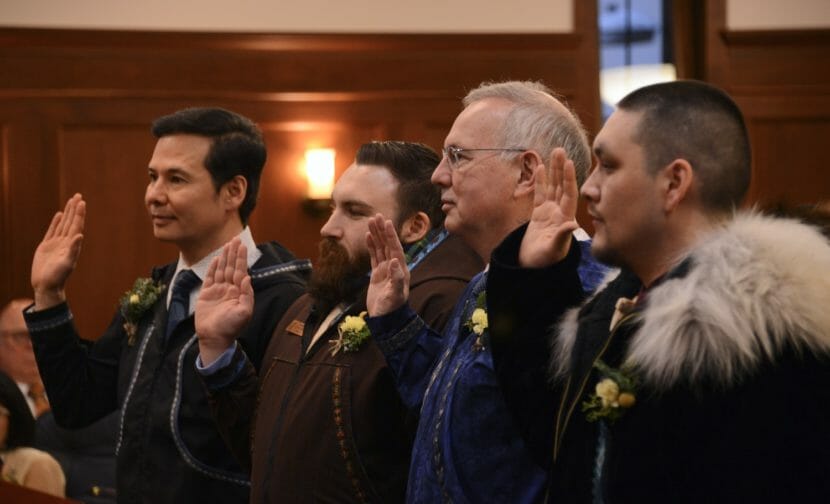
The four members of the Alaska Bush Caucus, (from left to right) Reps. Neal Foster, D-Nome; C.J. McCormick, D-Bethel; Bryce Edgmon, I-Dillingham; and Josiah Patkotak, I-Utqiagvik, take their oaths of office on Tuesday, Jan. 17, 2023 at the Alaska State Capitol in Juneau. On Thursday, three of the four voted in favor of Rep. Cathy Tilton, R-Wasilla, for Speaker of the House. (Photo by James Brooks/Alaska Beacon)
Last week, rural members of the Alaska House of Representatives ended the six-year reign of a predominantly Democratic coalition, flipping control of the House to a predominantly Republican coalition.
By joining 19 of the House’s 21 Republicans, the four members of the House’s rural “Bush Caucus” averted the kind of leadership deadlock that plagued the House in 2019 and 2021. They’ve also put themselves and their new coworkers in position to dictate the flow of legislation and items in the upcoming state budget.
In interviews and public statements, the four lawmakers — Rep. Bryce Edgmon, I-Dillingham; Rep. Neal Foster, D-Nome; Rep. C.J. McCormick, D-Bethel; and Rep. Josiah Patkotak, I-Utqiagvik — said their decision came after dozens of alternative proposals failed and came about on the night before Rep. Cathay Tilton, R-Wasilla, was elected speaker of the House.
“After many hundreds of hours of discussions with other legislators, the team made the decision to take the offer to join an organization to be in a position of influence,” Edgmon said.
How it happened
“It’s always a tough decision,” Foster said.
Negotiations started the day after Election Day, Foster said, with calls between prospective members of the Alaska House.
November’s election results showed 21 Republicans elected to the 40-person House, but Republicans declined to work with Rep. David Eastman, R-Wasilla, or Rep. Louise Stutes, R-Kodiak.
That left them with 19 votes, two shy of the number needed for majority control of the Alaska House. The House’s multipartisan coalition, in charge for the past six years, also lacked the votes needed for control.
In private phone calls, text messages, Zoom chats and in-person meetings, lawmakers tried to sway one another to dozens of prospective and competing House majorities.
An attempt among first-time lawmakers to organize a bipartisan majority failed, though it received attention in the Alaska Landmine, a political website. Quieter ideas proposed by Republicans, Democrats and independents alike also failed.
From the start, the independent Patkotak was seen as a potential ally of a Republican organization. His Christian faith, interest in oil and gas development, and passion for hunting seemed to fit in better with the Republican group, he said.
Some Republicans believed he was close to joining them in 2021 and hoped to convince him in 2023. It wasn’t a sure thing, Patkotak said.
He didn’t want to split the Bush Caucus, which could have diluted the political power of rural Alaska in the House, and he wanted to see if Republicans were prepared to surrender enough control to bring the entire rural group along. The Bush Caucus members represent the four House districts covering Northern and Western Alaska.
He needed, he said, to see a formal report showing the committee assignments each member of the Bush Caucus would receive.
“I think we’ve always had the understanding that it’s better for the Bush Caucus to stay together,” Patkotak said.
A proposal was ready by the first day of the legislative session. It put Edgmon and Foster atop the powerful House Finance Committee. McCormick and Patkotak would be on the Community and Regional Affairs Committee — a common destination for legislation affecting cities, boroughs and rural Alaska — and Patkotak would be among the leadership of the new majority.
“He said, ‘This is a path forward that I see. What do you guys think about it?’” Foster said.
After talking among themselves, they agreed and spoke about their intentions shortly before the House convened on Tuesday.
With Patkotak favoring the Republican caucus and Rep. David Eastman, R-Wasilla, likely to vote alongside other Republicans, “it was my belief they had the 21 votes to organize, regardless of the full Bush Caucus,” Edgmon said.
“This is the one avenue that seemed to be the most viable in terms of trying to keep it in one caucus,” Foster said.
Democrats and independents unsuccessfully tried to sway Edgmon, Foster and Patkotak. McCormick voted against Tilton as speaker, but stuck with the Bush Caucus and is now a member of the majority.
Before 2017, when the predominantly Democratic coalition took control, it was common for the Bush Caucus to join Republicans in the majority, the better to advocate for rural priorities.
“I work hard to put my district in the best possible position,” Edgmon said.
The key difference between then and now is that Republicans used to hold a majority without the Bush Caucus. Now, they hold a majority because of the Bush Caucus.
It’s creating some odd allies, at least by historical standards.
Six years ago, when Edgmon served as speaker of the House, the governing coalition voted to limit debate and tried to force a budget bill forward in an attempt to avert a government shutdown.
In an agitated speech, Rep. Dan Saddler, R-Eagle River joined a series of Republicans in denouncing Edgmon. His decision to limit debate, Saddler said, was “worse than Pearl Harbor.”
Saddler is now majority leader of the same organization that features Edgmon. He says he regrets those words but considers them the politics of the moment, an assessment Edgmon agrees with.
“That’s politics,” Edgmon said. “In the ebb and flow of politics, whatever happened years back is water way under the bridge.”
Local issues, not national political lines
“I’m certain there are going to be people who feel like they would rather have me here on one side or the other,” Foster said, but he feels like in his district, they’re in the minority.
Political parties, he said, don’t run deep.
“You don’t see a lot of, like, fundraising events, you don’t see a lot of (political) meetings like that,” he said.
Instead, Foster said, what matters is delivering the support — either direct financial payments like the Permanent Fund dividend, or indirectly, through government services — that his district needs.
That district, covering Nome and the Bering Strait coast, has the second-highest poverty rate of any House district in Alaska.
“We need to make sure that we’ve got housing that sort of shapes up,” Foster said. “What can we do about weatherization programs? Because, you know, when you come to folks who are just struggling to get by, what are you going to tell them?”
In the 32nd Legislature that ended last week, Patkotak was one of the most conservative members of the predominantly Democratic coalition that controlled the House.
Because that coalition had only 21 members, he was on the House’s bleeding edge, forced into uncomfortable votes on contentious issues. Now in the 33rd Legislature, he’s part of a 23-person majority and is on neither extreme politically.
The absence of a single member of the majority because of illness or a family emergency won’t bring business to a halt, as has occasionally happened over the past two years.
The Legislature isn’t a 9 to 5, Monday through Friday job, Patkotak noted. The need to research, meet constituents’ needs and work on legislative issues means that lawmakers are working long after they come off the House floor.
Patkotak’s third child was born about the time the 32nd Legislature began, and he wasn’t able to participate in the first two years of that child’s life because of the need to stay on call, Patkotak said.
“That plays a big role in my decision-making process,” he said. “I about missed them altogether.”
Important to the rest of the state, he noted, is the fact that the Bush Caucus’s decision short-circuits the tortuous leadership struggle the House endured in 2019 and 2021. It took three weeks in each case to elect a speaker because of the tight margins between Republicans and the multipartisan coalition.
Had the Bush Caucus stayed with the existing coalition, that deadlock could have returned.
McCormick, of Bethel, is the newest member of the Bush Caucus. Elected unopposed except for write-in candidates, he’s also the youngest member of the Legislature and a firm Democrat.
When it came time to vote for Tilton, he voted no but still agreed to join the majority.
The vote, he said, was a gesture of solidarity for his Democratic friends, and he hopes they will continue to work together. He doesn’t expect retaliation for his decision.
“That’s kind of been in the back of my mind, but I haven’t seen or heard anything like that,” McCormick said.
Part of the reason may be the fact that even though they are now in the minority, Democrats and independents still have a large amount of influence in the House.
Among the 11 members of the House Finance Committee, six are independents or Democrats. Coordinated action could enable them to block legislation or amend the state budget, though that’s hypothetical at this point.
Or, said Rep. Sara Hannan, D-Juneau and a member of the minority, a lack of retribution could be a recognition that in Alaska’s flexible politics, this is normal.
“In this business,” she said, “you can’t afford to have hard feelings.”
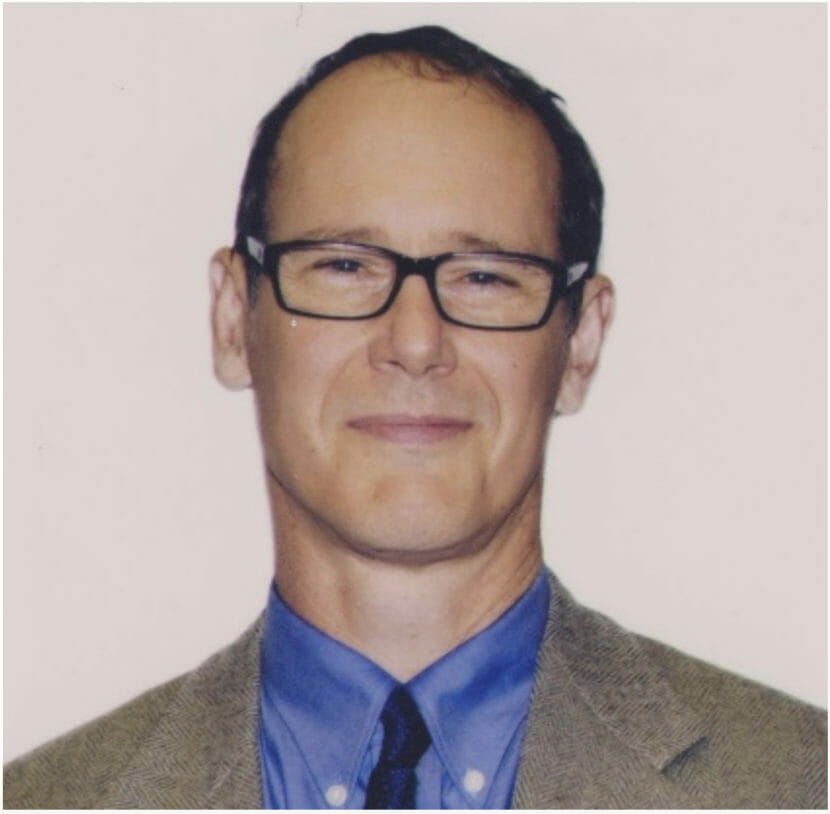
Jude Pate, appointed to the Alaska Supreme Court by Gov. Mike Dunleavy on Jan. 20, 2023, is seen in an undated photo provided by Pate to the Alaska Judicial Council. (Handout photo)
Gov. Mike Dunleavy on Friday appointed Jude Pate of Sitka to the Alaska Supreme Court, making him the first justice to come directly from someplace other than Juneau, Anchorage or Fairbanks since 1960.
Before Pate, the last justice who met those standards was Walter Hodge, who came from Nome and served on the court in 1959 and 1960.
Former Chief Justice Joel Bolger came from Kodiak but served on the state Court of Appeals in Anchorage before joining the Supreme Court in 2013.
Dunleavy announced the appointment by email Friday.
“The governor interviewed each of the nominees and selected Judge Pate because he determined he was the best candidate for the court,” said Jeff Turner, the governor’s deputy communications director.
The governor’s office did not answer questions asking whether Pate’s residency was a factor. In 2021, the governor sought new nominees for a Supreme Court vacancy, citing the lack of a rural option.
Pate was appointed to fill a vacancy created this month by the retirement of Justice Daniel Winfree, who is reaching the constitutionally mandated retirement age of 70.
In December, the Alaska Judicial Council nominated four experienced attorneys as options for the vacancy. Under the state constitution, the council examines the qualifications of applicants for a vacancy and selects a list of nominees based on merit, not political affiliation.
The other three nominees were Anchorage Superior Court Judge Dani Crosby, Department of Law attorney Kate Demarest and Fairbanks attorney Aimee Oravec.
If Dunleavy had picked any of those three, it would have put three women on the five-person high court, creating the first majority-female Alaska Supreme Court in state history.
In addition to being the first rural member from outside of the three largest cities in decades, Pate is also the first member of the court to come from Southeast Alaska since the retirement of Justice Bud Carpeneti in 2013.
Born in Germany to a military family, Pate has extensive legal experience as a judge, tribal attorney and public defender, according to his resume, and he has a colorful early job history that includes jobs as “a baker, house painter, film projectionist, bartender, construction worker, hotel maid, a pizza delivery driver, and briefly as a strawberry field worker and as an attendant in a tanning salon.”
A graduate of the University of Kansas and Lewis & Clark Northwestern School of Law, he has lived in Alaska for 30 years and was appointed a Sitka Superior Court judge by then-Gov. Bill Walker in 2017.
Correction: Former Alaska Supreme Court Justice Bud Carpeneti’s title has been corrected.
A sign outside of a store in midtown Anchorage announcing that they accept EBT Cards, the distribution method for SNAP benefits (Photo by Anne Hillman/Alaska Public Media)
Ten Alaskans are suing the state, saying it failed to provide food stamps within the time frames required by federal law. The complaint was filed Friday in Superior Court in Anchorage against Alaska Health Commissioner Heidi Hedberg. The lawsuit said that in her role as commissioner of a department that failed to provide needed services, Hedberg “has subjected thousands of Alaskans to ongoing hunger and continues to do so.”
Some families have waited four months to receive Supplemental Nutrition Assistance Program (SNAP) benefits, also known as food stamps, the complaint alleged. In the absence of these benefits, people have sought other means to get food or make food last longer.
“We’ve got people who are relying on family members. We’ve got people who are relying on food pantries. We’ve got people who are eating less so they can feed their kids, trying to juggle their bills and decide whether they’re going to pay for their heat or their groceries,” said Saima Akhtar, senior attorney at the National Center for Law and Economic Justice, one of the firms representing the plaintiffs in this lawsuit.
“People are taking as many different avenues as they can to take care of their families and eat right now, and it shouldn’t be that hard,” Akhtar said.
The complaint asserted the delay is due to the “immense delays and chaos of the Alaska Department of Health,” and pointed to the unresolved “massive backlog of unprocessed SNAP cases that has left thousands of Alaskans without critical food assistance in the coldest months of the year.”
While 10 Alaskans are named in the class action suit — residents from Anchorage, Marshall, Petersburg, Wasilla, Bethel, Palmer, Nome and Delta Junction — they represent thousands of other Alaskans who are facing the same issue.
Under federal law, the Department of Health must provide ongoing SNAP benefits to eligible applicants no later than 30 days after the date of application. Households that qualify for expedited processing are required to get their benefits within seven days of the application being filed. Some families have been waiting months, the complaint said.
The lawsuit asked the court to find that the Alaska Department of Health has violated the federal SNAP Act and violated due process clauses of the federal and state constitutions. The suit wants the court to order the Department of Health to process people’s SNAP applications and recertifications within the timeframe required by federal law, to allow people to apply and seek benefits on the first day they contact the agency, and to ensure that there are adequate language interpretation services and translations of documents for those who need it.
Essentially, Akhtar said, the injunctive relief is asking the state to “do the things that they are legally obligated to in operating the program within the federal guidelines.”
The plaintiffs are not seeking monetary damages.
“They want to get fed,” Akhtar said. “And they also have the opportunity to try and influence the system so that this is not happening again, so that their siblings and their children and communities aren’t going hungry, too.”
In an email on Friday, a spokesperson for the Department of Health said, “The Commissioner and DOH cannot comment on the complaint or the lawsuit because we have not seen the complaint or been served in the lawsuit.” The spokesperson didn’t immediately answer other questions regarding the backlog or its cause, or availability of language translation services for SNAP applications and forms.
Chair of the Senate Health and Social Services Committee Sen. David Wilson, R-Wasilla, said his committee will hear from the Department of Health about the food stamp application backlog during its meeting on Tuesday, Jan. 24.
It’s a huge issue, he said: “We’re talking about, you know, people’s sustenance… It’s a health safety issue.”
“We want to know, basically, what can we do in the Legislature to help you fix this problem and how fast can it be fixed and resolved? And those are the issues that I want to focus on,” Wilson said.
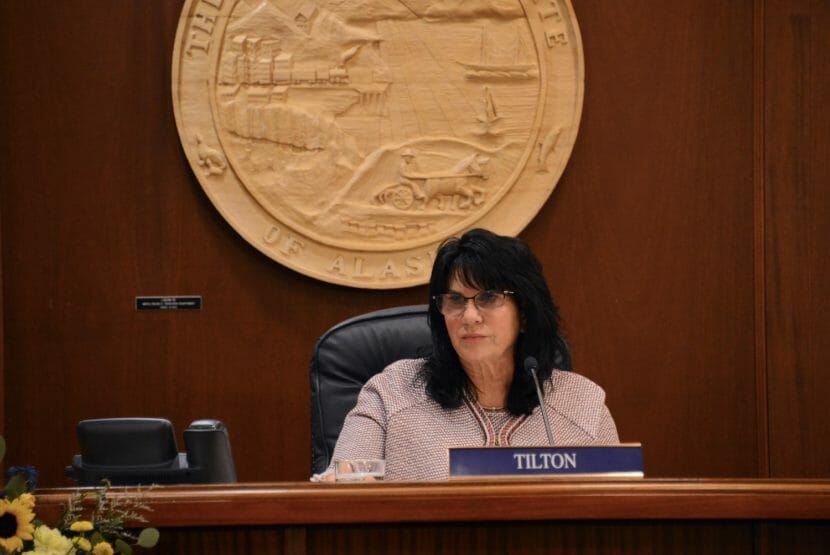
Speaker of the House Cathy Tilton, R-Wasilla, presides over the Alaska House of Representatives on Thursday, Jan. 19, 2023, at the Alaska State Capitol in Juneau. (Photo by James Brooks/Alaska Beacon)
A day after taking control of the Alaska House of Representatives, members of the new Republican-led coalition majority say they intend to prioritize fiscal issues and were cautious about proposals to increase the state’s per-student public school funding formula.
“I think it’s probably safe to say that what brings us together is some fiscal stability for the state of Alaska,” said Speaker of the House Cathy Tilton, R-Wasilla. “That is something that is important and has been important to — I believe — all of us sitting here in this room.”
The precise definition of “fiscal stability” appears to vary among legislators, but Tilton and other members of the majority suggested that a bipartisan, bicameral plan released in 2021 could be a guide.
One of the components of that plan is a tighter state spending cap, and legislation enacting a new statutory spending cap has already been scheduled for a hearing next week in the House Judiciary Committee.
The proposal would limit governmental spending to a percentage of the state’s gross domestic product and was originally proposed by Sen. James Kaufman, R-Anchorage.
Kaufman’s bill has yet to be scheduled for a hearing in the Senate, but matching legislation was introduced in the House by Rep. Will Stapp, R-Fairbanks, and is slated to be heard first.
Because a legislature cannot restrain future legislatures’ budgetary authority with law alone, statutory spending cap changes would be ceremonial at best, but Stapp said the bill is intended to act as a guide that could turn into a binding, constitutional amendment in the future.
House Minority Leader Calvin Schrage, I-Anchorage, said the new majority’s desire for “fiscal stability” doesn’t mean much without details.
“What does fiscal stability mean? Is that just a bunch of cuts to balance the budget? We’ve seen that over the past few years, I think it’s pretty clear that Alaskans don’t want that approach,” he said.
He said the minority caucus has clear objectives.
“I think we’ve heard from Alaskans loud and clear: What’s important to them is investing in education this year, investing in workforce development and in our universities,” Schrage said. “How do we recruit and retain workers in this competitive environment when we’re competing all across the U.S.?”
Advocates for public schools are encouraging the Legislature to increase the state’s base-student allocation, the formula used to fund public schools in Alaska, and Gov. Mike Dunleavy has also signaled support for an increase, though one does not appear in his proposed state budget.
The new House majority didn’t list a BSA increase among its priorities.
“We’re not saying that there shouldn’t be an increase to the BSA,” Tilton said. “It’s something that we do need to have a conversation (about). But along with that comes a thought that there could be other options and alternatives.”
The new House majority includes 23 of the House’s 40 members: 19 Republicans, two independents and two Democrats.
The non-Republicans are all members of the House’s rural “Bush Caucus,” and when committee assignments were made official on Thursday, two members of that group — independent Rep. Bryce Edgmon of Dillingham and Democratic Rep. Neal Foster of Nome — were named co-chairs of the powerful House Finance Committee.
A Republican, Rep. DeLena Johnson of Palmer, was named a third co-chair.
The chairmen and chairwomen of the House’s 11 committees hold a powerful role in dictating the flow of bills through the Legislature, and the other assignments included Rep. Sarah Vance, R-Homer, as chair of the House Judiciary Committee and Rep. Mike Prax, R-North Pole, as chair of the Health and Social Services Committee.
Prax said his committee will spend next week on informational hearings and hasn’t scheduled any bill hearings. Vance has scheduled Stapp’s bill and one from Rep. Andy Josephson, D-Anchorage, that would intensify criminal punishments for people who commit crimes in front of children.
Vance, who has sponsored legislation that would repeal Alaska’s new ranked choice voting system, said she is also interested in legislation that would increase the security and reliability of the state’s election system.
She suggested that a bipartisan elections bill that failed to pass the Senate on the final day of last year’s legislative session could be a starting point, but it could fare better if broken into smaller pieces of legislation.
The 23-member majority does not include Rep. Dan Ortiz, I-Ketchikan, or Rep. Louise Stutes, R-Kodiak, who said on Wednesday that they were interested in joining the majority.
Ortiz is now in the House’s 15-member, predominantly Democratic, minority caucus, and Stutes is in a group by herself, a status shared with Rep. David Eastman, R-Wasilla.
Stutes, who has been placed on the House’s transportation and fisheries committees, said she’s still interested in joining the majority if it will have her.
Eastman, who labeled himself “a man without a country” while referring to his status outside either caucus, has been assigned to the judiciary committee.
Sen. Shelley Hughes, R-Palmer, is seen in the chambers of the Alaska Senate on Wednesday, Jan. 18, 2023. Hughes is one of three Republican senators outside the Senate’s 17-person supermajority. At right is Sen. Loki Tobin, D-Anchorage. (Photo by James Brooks/Alaska Beacon)
Sen. Shelley Hughes thought she’d be on the Senate Education Committee. She said Senate President Gary Stevens had asked her to be on it and she agreed.
“He has a real heart for the kids and education as I do also, so he was really happy when I agreed, and he called me probably a couple more times, ‘Hey, I’ve got you down. Just want to make sure you’re OK.’ Yes. And then another call, ‘OK, we’re good to go,’” Hughes said Wednesday.
But Hughes, a Palmer Republican, is not on the Education Committee. She said she didn’t know that until the Committee on Committees report came out Tuesday — the first day of the session — and her name was not on the standing committee list. Not on education, not on any standing committee.
Hughes said it felt like a kick in the gut: “It was a shock.”
Hughes is starting her 11th year as an Alaska legislator. Last year, she was majority leader and sat on five standing committees, including education; three joint committees, including the influential Legislative Council; three finance subcommittees; and two other committees. This year, she’s on one special committee — the Special Committee on World Trade.
Hughes, Sen. Mike Shower and Sen. Robert Myers are part of a three-member unofficial minority. Without five members, they are not an official minority, as defined by the Legislature’s rules. That means there’s no minority leader, no minority press officer.
“Somebody always has to take the turn on the minority. And, you know, it rolls around,” Hughes said. “It’s my turn this time.”
Stevens, a Kodiak Republican, is Senate president and heads the 17-person bipartisan supermajority, which controls the 20-member Senate. He said he intended for Hughes to be on the education committee.
“She’s an excellent member of the Education Committee. She has really made a tremendous contribution to that committee over the years so I would love to see her back on education,” Stevens said Wednesday.
Likewise for Shower on the State Affairs Committee, which he chaired last session, and Myers on Transportation, which he chaired. Myers did receive a chair on the Transportation Committee and is the only non-majority member to get assigned to a standing committee.
“The caucus made the decision not to give positions to the other two — to Shower or to Hughes,” Stevens said.
“I’d like to have them on a committee, but the caucus was quite upset about the way that they have been going on talk radio and saying a lot of negative things and even mean-spirited things about other senators. You know, you really should not be doing that. If you disagree with someone, that’s fine, but they should not go beyond showing a disagreement. You should not question someone’s character or — really, it’s just a matter of getting along with people,” Stevens said.
Hughes denied doing that on various commercial talk radio shows in the state: “I focus on policy and process and don’t name names.” She said she’s disagreed with other senators and has differentiated herself. During election season, she threw support for some candidates and not others, but she “didn’t go trash” anyone.
“I don’t agree that I crossed the line that’s inappropriate. I think it is fine to say you disagree,” Hughes said.
Shower has been absent in the Capitol the first two days of the Legislature and did not respond to text messages from the Beacon.
When four Democrats were an unofficial minority in 2015 and 2016 because they didn’t have the necessary five seats to be an official minority, the majority assigned committee seats to all of them.
Stevens said committee makeups could change. There’s no timeline, he said, but it could be revisited in three to four weeks. Ultimately Stevens would like Hughes and Shower in committees in which they can contribute.
“I have to see how things turn out. I want to make sure that they’re willing to work with us and to not be destructive of individuals or personalities,” he said.
Stevens said he wouldn’t classify not being assigned to a standing committee a form of punishment, “but I don’t know how else you would classify it.”
“The Senate is a very collegial body and it has to work together. And if people aren’t able to respect others, then this is what happens,” Stevens said.
A binding caucus
Stevens said the caucus of eight Republicans and nine Democrats is a “binding caucus,” “which says that if you’re going to stay in the caucus, you have to vote for the budget.” It also means, he added, “you agree to support the president and his rulings from the chair.” If a member doesn’t do those things, they should withdraw from the caucus, he said.
He said the Senate hasn’t been able to depend on Hughes, Myers and Shower to support the budget. In 2021, the three senators voted against the budget; in 2022, they voted for it.
Myers, a North Pole Republican, said he was offered a position in the majority and turned it down. Wasilla Republican Sen. David Wilson said he invited Myers to join the coalition.
Wilson, himself, said it took him a few days to decide whether or not to join the coalition. He sought guidance from several state and community leaders and decided that it would benefit his constituents to be part of the majority.
“We came to that conclusion, that being in the coalition was the best outcome to give a voice to my district,” Wilson said.
For Myers, though, being part of a binding caucus is a no-go.
“I campaigned against the binding caucus in 2020. And that’s still a relatively big issue for a good chunk of my voters. And in my view, my vote belongs to my conscience and to my constituents,” he said. “I can sleep with myself better at night, look myself in the mirror if I’m open and upfront and honest and say, I’m going to vote on something based on the merits not because of an agreement I made beforehand.”
An unrecognized minority
Post-election, Myers said he was not surprised to see a coalition form, but “I did not expect it to reach supermajority status like that.” And, he said, it’s pretty clear “they’re shutting us out of pretty much everything.” In the past, he said, minority members have been given standing committee assignments.
Myers is on the Transportation Committee and hopes he can do meaningful work there, though he said it’ll be dependent on the chair — Anchorage Republican Sen. James Kaufman — and what bills get introduced.
Myers plans to prioritize communicating with constituents about what’s happening during the session and “just see what kind of opportunities pop up.” He isn’t sure how being part of an unrecognized minority will go, but “we’ll muddle through for now at least.”
Sen. Bill Wielechowski said the three senators can still be actively involved and have a say.
“You’re always welcome to come in and have a conversation with people whether you’re on a committee or not on committee. Because, ultimately, if you don’t agree with something that’s going through the process, then you can run an amendment on the floor. I mean, there’s plenty of opportunities. And, quite frankly, a lot of the opportunities happen in legislators’ offices, speaking with people,” Wielechowski said.
Hughes said the three members who are outside of the majority have advantages over those who are in it.
“We have a stronger and better relationship with the governor than the majority has. We have a stronger and better relationship with the House Republicans, so half the House. So, we have things definitely working in our favor,” she said.
“We actually are not going to be twiddling our thumbs all the time,” Hughes said.