Alaska Beacon is part of States Newsroom, a network of news bureaus supported by grants and a coalition of donors as a 501c(3) public charity. Alaska Beacon maintains editorial independence. Contact Editor Claire Stremple for questions: info@alaskabeacon.com. Follow Alaska Beacon on Facebook, Bluesky and Twitter.
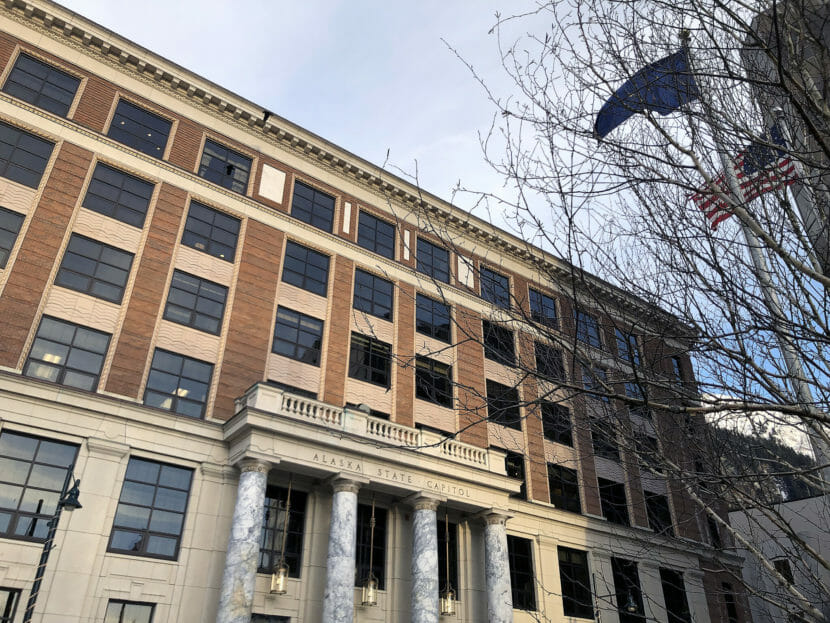
The Alaska State Capitol is seen on Wednesday, Dec. 21, 2022, in Juneau, Alaska. (Photo by James Brooks/Alaska Beacon)
Two weeks before the Alaska Legislature convenes in Juneau, members of the state House and Senate say they don’t expect much work this year on legislation involving controversial social issues like abortion and transgender rights.
“I think it’s safe to say that the social issues along those lines probably will not get a lot of movement,” said Rep. Cathy Tilton, R-Wasilla.
Bills involving those topics will be introduced as soon as Monday, the first day that legislation prefiled ahead of the legislative session will be revealed to the public.
But with a bipartisan supermajority in control of the Senate and tight margins expected in the House, lawmakers say they don’t expect controversial bills to advance because Democrats will be positioned to block conservative legislation and Republicans will be able to block progressive items.
Rep. DeLena Johnson, R-Palmer, supports restrictions on abortion. She said she and other lawmakers have the right to introduce bills dealing with social issues, but she’s also pragmatic.
“The Dobbs decision is on everybody’s minds — has been nationwide,” she said of the U.S. Supreme Court decision allowing states to ban abortion.
“Here in Alaska, I don’t think there’s any exception. There’s going to be interest in what people are going to do, but given our setup, I don’t think that’s going to happen. Nothing’s going to happen with that,” she said.
Anything that becomes law will require compromise and bipartisan support, as well as the consent of Republican Gov. Mike Dunleavy. That can be tough to find: In the 32nd Legislature, 686 bills were introduced but only 111 became law.
Abortion-related legislation faces a particularly high hurdle here because the Alaska Supreme Court has ruled that abortion access is protected by the privacy clause of the Alaska Constitution. Restricting abortion would require a new ruling from the court or a constitutional amendment. Dunleavy has said he will propose such an amendment, but passage requires a supermajority in the House and Senate.
“I can’t see anything too radical — either left or right — getting by the Senate, and if there’s a level of bipartisanship in the House organization, that’s just another roadblock for legislation that’s controversial,” said Rep. Dan Ortiz, I-Ketchikan.
Senate President Gary Stevens said members of the 17-person Senate supermajority will meet starting Thursday in Girdwood to begin considering their legislative priorities.
That work will continue through the start of the session on Jan. 17, he said.
“It’s going to be pretty much moderate issues that we deal with. No extreme issues, I wouldn’t think,” he said.
Stevens said his top priorities are avoiding overspending from the Alaska Permanent Fund and preventing the implementation of an income tax or a sales tax.
Beyond that, he said, he expects education funding, food security and state employee retirement to be big issues.
Those priorities are in line with those voiced by members of the Alaska House. Rep.-elect Dan Saddler, R-Eagle River, is returning to the House after serving four terms in the 2010s.
“The budget’s going to be big, the dividend’s going to be big again,” he said of items that will consume legislative time.
“You’ve seen a real push among the chattering classes about the need for education funding increases. Inflation is a much larger factor in Alaska state finances than it has been for the previous 20 years,” he said.
Alaska ended its pension program for new state employees in 2006, but the state has struggled to retain and recruit employees in recent years, and there is a push to revive a pension plan to encourage hiring.
A pension program for public safety workers passed the House last year but died in the Senate, and many lawmakers anticipate a revived push this year.
Rep.-elect Rebecca Himschoot, an elementary teacher from Sitka, is a nonpartisan first-term lawmaker who will be sworn into the House on the 17th.
“Defined benefits fits into any conversation I’m going to have about a state that provides the workforce and the services that community members need to thrive,” she said.
Rep. Bryce Edgmon, I-Dillingham, said that defined benefits — the formal name for a pension plan — “needs to be and will be pushed forward in the House this time around.”
He said the “holy grail” issue for state lawmakers is agreement on a long-term fiscal plan, a theme echoed by other members of the House.
In 2021, a bicameral, bipartisan working group drafted the framework for a fiscal plan, which included a revised state spending cap, new formula for Permanent Fund dividend payments, budget cuts and new revenue.
Last year, lawmakers were unable to agree on the precise structure of any piece of a plan, and none passed into law.
The Dunleavy administration is expected to unveil a carbon-monetization program later this month, which could satisfy the call for new revenue, but multiple legislators said any idea along those lines is likely to take more than one year.
“It takes a while for people to learn about new ideas,” Johnson said.
She suggested the House Ways and Means Committee could be tasked with working on a fiscal plan, while Himschoot speculated that a special session focused on long-term fiscal issues might be warranted.
In either case, lawmakers believe it won’t be easy or quick to resolve this year’s session, even if social issues are off the table.
In 2017, the first year of the 30th Legislature, lawmakers needed four special sessions. Two years later, in the first year of the 31st Legislature, they needed two special sessions. In 2021, the first year of the 32nd Legislature, they needed four.
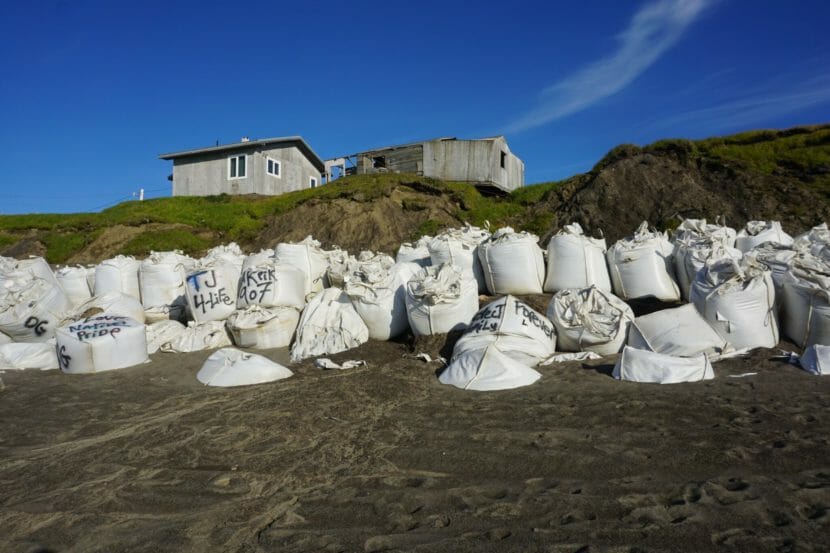
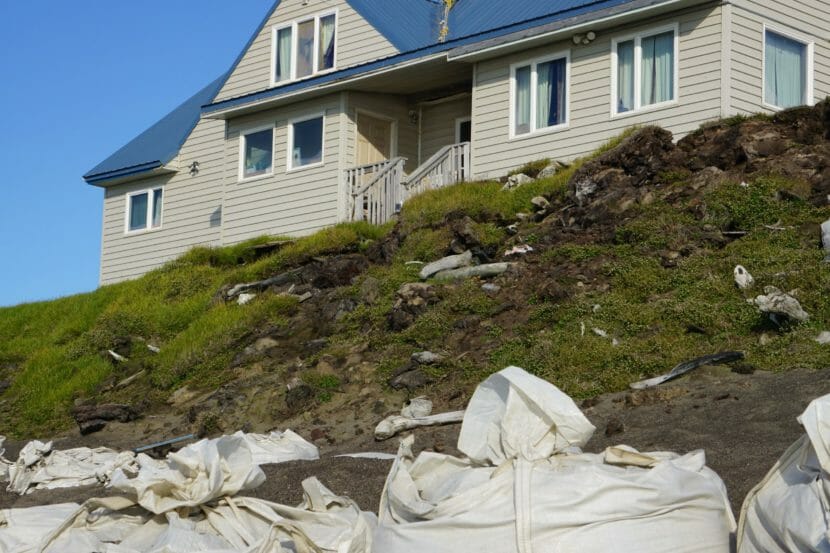
Houses, seen on Aug. 2, teeter on the edge of an Utqiagvik bluff that is being rapidly eroded by permafrost thaw. The house on the right has been abandoned. At the base of the bluff are SuperSacks filled with sand, placed there as part of the effort to hold back ocean waves and slow down erosion. (Photo by Yereth Rosen/Alaska Beacon)
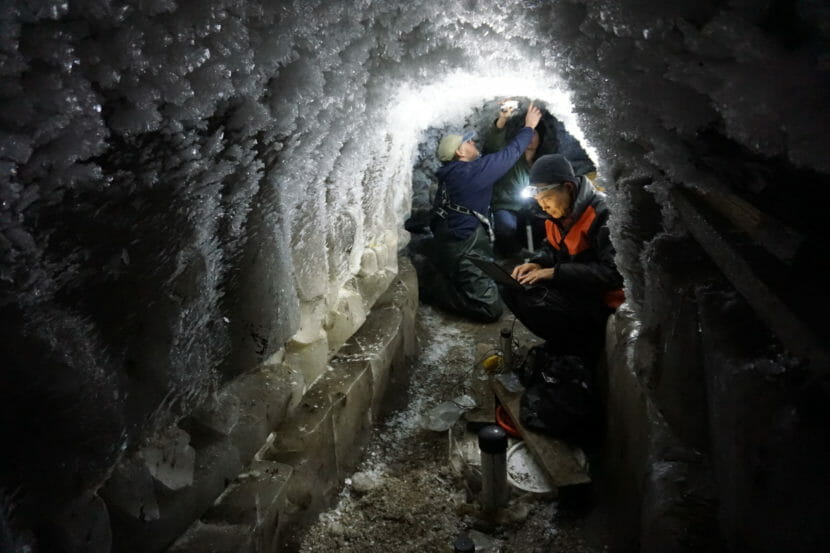
Nearly 20 feet below the ground of a field of open tundra in the nation’s northernmost community, an icy world gives a picture of the ancient past and the future of this part of the Arctic.
Embedded in the walls of a tunnel is frozen peat, its features perfectly preserved from 10,000 years ago.
“It’s quite fresh, and it keeps the shape of the moss,” said Go Iwahana, a University of Alaska Fairbanks scientist who descended down a metal ladder to reach a low, 10-meter (32-foot) long tunnel built into the permafrost in the 1960s.
Sloshing below the floor are mobile pools of super-salty and bacteria-packed brine, the remnants of an ancient lagoon that dates back at least 40,000 years and is completely cut off from the Arctic Ocean.
Go Iwahana, a scientist with the Unviersity of Alaska Fairbanks’ International Arctic Research Center, checks on conditions at a borehole in the permafrost research tunnel in Utqiagvik on Aug. 5. Behind him is Todd Sformo, a wildlife biologist with the North Slope Borough. Permafrost temperatures measured in the tunnel have increased by 3 degrees Celsius (5.4 degrees Fahrenheit) in the past decade. (Photo by Yereth Rosen/Alaska Beacon)
Within the soil, though, the modern world is making its mark. Iwahana, crawling around along the low tunnel, sent probes 1.5 to 2 meters down boreholes to see how the modern world has made its mark. “Three,” he called out after reading a thermometer.
The soil here has warmed over the past decade from minus-6 degrees Celsius to minus-3 , or from 21.6 degrees to 26.6 degrees Fahrenheit, said Iwahana, who works at UAF’s International Arctic Research Center.
“That’s a lot,” he said.
Findings at the tunnel are consistent with those elsewhere on the North Slope. As air temperatures rise, the soils as deep as 20 meters below the surface are warming at a rate of up to 4 degrees Celsius per decade, according to long-term measurements by UAF scientists.
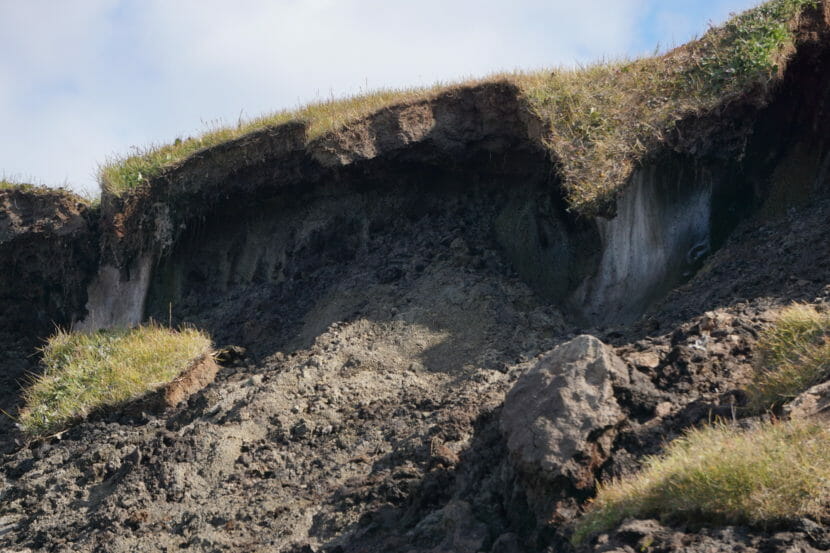
Wedges of ice, features of the ice-rich permafrost that underlies Utqiagvik, are exposed on Aug. 2 on an eroding beach bluff. A record rainfall the week before in the northernmost U.S. community helped speed up thaw, sending chunks of sod-topped soil downhill. (Photo by Yereth Rosen/Alaska Beacon)
For Utqiagvik, the North Slope’s biggest community and home to nearly half of the North Slope Borough’s residents, the unrelenting warming means trouble.
The most obvious is seen at the places where ice-rich permafrost is closest to the surface: the coastline at Utqiagvik’s downtown core, where a bluff has cleaved dangerously close to the edge of houses. Beneath one abandoned house is a gaping hole where the bluff has completely eroded away. Another house, owned by Doreen Fogg-Leavitt’s in-laws, is teetering on the edge.
“I remember 20 years ago, when her backyard to the edge was a good 30 feet, 40 feet. Now it’s about three,” said Fogg-Leavitt, natural resources manager for the Inupiat Community of the Arctic Slope, the local tribal government.
The North Slope has some of the fastest erosion measured in the nation, according to the U.S. Geological Survey, and rates have accelerated. The coastline is losing as much as 9.5 meters a month, according to findings by Williams College researchers presented in mid-December at the annual conference of the American Geophysical Union.
Erosion has brought the edge of a permafrost bluff to the back of Oliver and Annie Leavitt’s home in Utqiagivk. The house and the bluff it sits on are seen on Aug. 2. Protruding from the bluff are artifacts from Utqiagvik’s past, including whale bones used for sod homes. (Photo by Yereth Rosen/Alaska Beacon)
The long-term warming of frozen soil that Iwahana and his UAF colleagues are measuring in the tunnel is just one of the factors that work in combination to erode the coastline.
Another is sea ice loss. More open water – persisting this year into late November – means more opportunities throughout the year for waves to hit the beach and make contact with permafrost bluffs. That causes “niche-erosion block collapse,” said Tom Ravens, a University of Alaska Anchorage civil engineering professor.
There are more subtle factors, too, which Ravens listed at a permafrost workshop held in Anchorage in November. A change in precipitation patterns from snow to rain sends heat from the surface into the soil. The ocean water, aside from bringing soils in contact with heat, also contains salt, another thaw factor. Long-term thawing is causing vast stretches of land to sink, pulling down the coastline along with the rest of the landscape. Measured sinking across the North Slope from 2017 to 2022 averaged 3 centimeters to 5.8 centimeters, depending on location, according to UAF research to be presented at this month’s AGU annual meeting.
Sophisticated revetment to replace sand-filled bags and sand piles
At Utqiagvik, erosion is especially worrisome because of the large size of the community – about 4,500 people – and the large concentration of important infrastructure, including buildings, roads, utilities and, right next to the beach, a landfill.
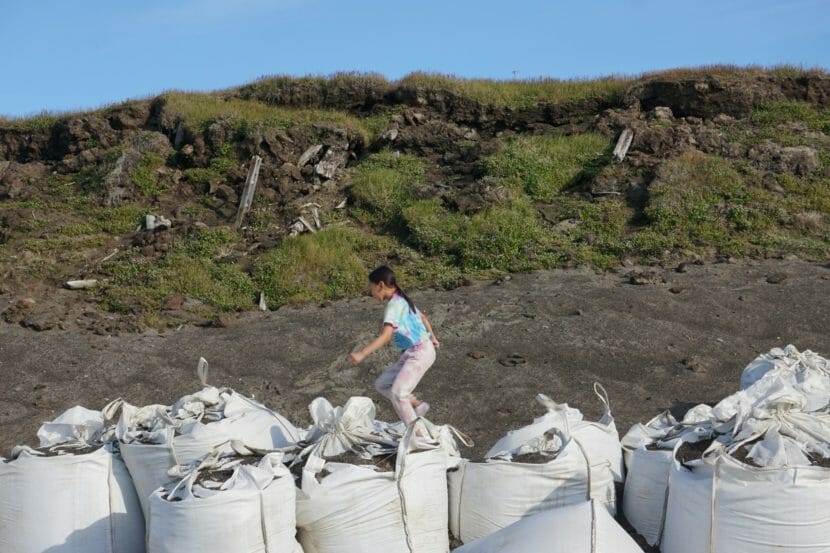
The North Slope Borough in recent years has piled up masses of sand-filled Supersacks, delivered by barge each summer, to keep the sea’s water away from the most vulnerable resources. Beyond the walls of Supersacks, the borough uses heavy equipment to pile up beach sand into a makeshift barrier.
A more durable fix is on the way.
The U.S. Army Corps of Engineers is putting the final touches on the design for five miles of what’s known as a revetment, to protect the shoreline. It is a massive project that has been several years in the planning and is expected to take at least six years to complete, said Bruce Sexauer, chief of civil works project management for the Corps of Engineers’ Alaska district.
A girl plays on Aug. 2 on the sand-filled SuperSacks lined up at Utqiagvik’s beach. The sacks are used to try to protect the permafrost bluff from ocean waves that speed erosion. The thaw has exposed beams and artifacts from dwellings used in Utqiagvik’s past. (Photo by Yereth Rosen/Alaska Beacon)
In the past, Utiqagvik has been able to do a little mix of “managed retreat,” moving some buildings and property away from the disappearing shoreline. But the region is fairly flat, and those options are largely exhausted.
“Now they are at a place where the important infrastructure is right up next to the edge. Their water supply and sewage lagoon are right up against the edge,” Sexauer said. The revetment project is seen as the most practical long-term solution, and Utqiagvik’s position as a service and business hub gives all North Slope communities a stake in it.
“If Utqiagvik suddenly had a catastrophic issue, that would have an effect on the other communities in the area,” Sexauer said.
The full cost of the revetment project is yet to be determined. The 2022 Disaster Relief Supplemental Appropriations Act included a provision that puts $364.3 million into the project.
The Corps expects to formally seek bids this coming summer for the first phase of the project, the 0.75-mile section right at the central bluff, Sexauer said. A request for bids for the rest of the project is expected about a year later. The full project also incorporated a rebuild of Stevenson Street to raise the elevation of the oft-flooded roadway leading north of town toward Point Barrow.
Site-preparation work for the erosion-control project is expected to start in 2024, Sexauer said.
The revetment design plan is for multiple layers of different material with varying porosity, from industrial fabric to large boulders, to preserve the ground’s cold temperatures, Sexauer said. That type of multilayer technology has proved to be successful, so far, for a much-smaller revetment at the erosion-threatened village of Shishmaref farther south in the Bering Strait region, according to Corps of Engineers’ reports.
It is important that the revetment be more than a simple rock wall, said one expert.
“Even if you build a rock revetment very strong, the permafrost below can degrade,” said Ming Xiao, a Pennsylvania State University civil engineering professor. “You can’t just build on the existing permafrost.”
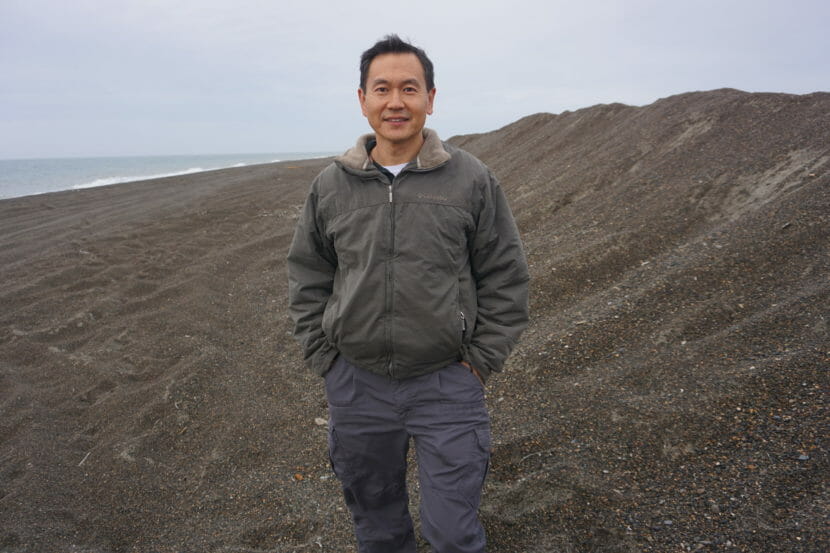
Ming Xiao, an engineering professor at Penn State University, stands on Aug. 3 by a piled-up sand berm used as a makeshift barrier to protect parts of Utqiagvik from storm-driven flooding. Xiao is leading a project that uses a fiber-optic cable to track the minute movements of warming and thawing permafrost. (Photo by Yereth Rosen/Alaska Beacon)
Xiao is leading a project, with collaborators from UAF and Virginia Tech University, that uses a buried fiber-optic cable to measure the minute movements within the soil of Utqiagvik’s warming permafrost. The hope is that the underground vibrations, when correlated with temperature measurements, can forecast conditions in decades to come. “Then we can predict in the future, say 50 years, what the ground temperature is going to be,” he said. And that, in turn, will give information about whether the ground is too weak to support any structures atop it, he said.
The Supersacks are certainly not up to the erosion-control task, Xiao said. For one thing, he said, they are made of material that degrades when exposed to the sun’s ultraviolet light, something that is unrelenting in summer. For another, the sacks can be punctured in rough weather, “and the wave is going to pick up the Supersasck and put it into the ocean,” he said.
Below-ground threats to pipelines and cellars
Beyond the eroding shoreline, a less-visible thaw problem lies beneath the surface: threats to underground pipes for water and utilities.
About a third of Utqiagvik’s water, wastewater and electrical lines run through a protected, temperature-controlled tunnel called the “Utilidor.” Built in the oil-money heyday of the 1980s, the Utilidor was too expensive to extend beyond its initial 3 miles. That leaves most of the rest of the system with underground piping, and thaw risks lurk even 12 feet below the ground’s surface.
That danger materialized in a different North Slope community in the spring of 2021. In Point Lay, 180 miles southwest of Utqiagvik, a sudden thaw collapse in the permafrost severed a main water line, temporarily cutting off flow of water to the village clinic and to several houses. It was a particularly ill-timed event, as it came during the COVID-19 pandemic, when clean water became a critical need.
Protected as it is, the Utilidor is not impenetrable. Storms in 2015 and 2017 came close to sending water flooding into it, according to the Corps of Engineers. With waves breaking up the seasonally maintained beach berms, seawater also came close to contaminating the freshwater lagoon, the Corps reported. In October, Utqiagvik was slammed by a storm that, though not as serious as the 2015 and 2017 events, pushed saltwater from the sea again over barriers to flood Stevenson Street and enter the lower lagoon; one more breach and seawater would have hit the city’s upper-lagoon drinking water supply.
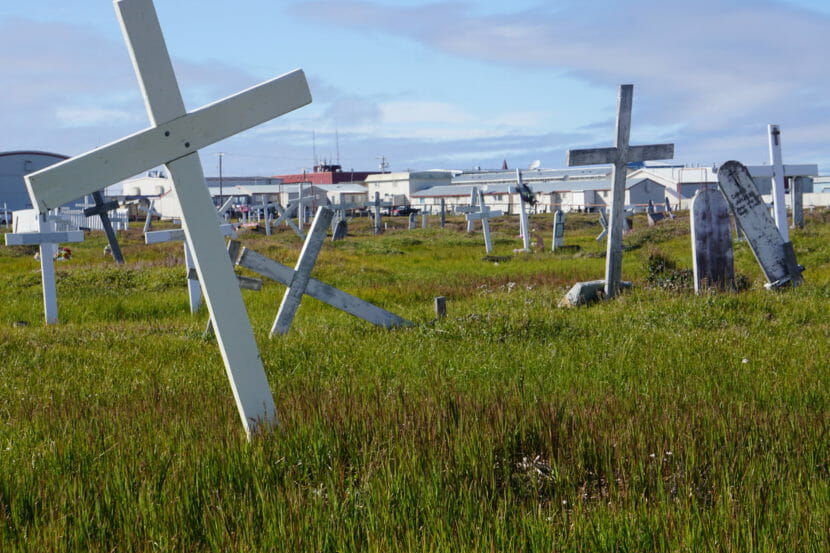
Grave markers in Utqiagvik’s cemetery, seen on Aug. 6, are tilted, a sign of thaw in the ground below. Permafrost thaw impacts extend to the dead. (Photo by Yereth Rosen/Alaska Beacon)
Permafrost thaw, in combination with storm flooding, is encroaching on some cultural practices, too.
Many of the community’s traditional Inupiat permafrost cellars, known as sigluaqs, have been damaged by flooding or other incursions.
That happened in 2015 to the sigluaq maintained by Fogg-Leavitt’s family. While there was no pooled water in it, the temperatures rose high enough to thaw the meat. It remained edible, she said, but the taste was compromised; the blood ran out during the thaw, meaning it was impossible to create the traditional fermented product.
The thaw threats have prompted some changes in practices, she said. “Some younger crews are using walk-in freezers exclusively,” she said. But others are passionate about keeping their sigluaqs intact and functional. To that end, ICAS is experimenting this winter with technology: installation of thermosyphons, devices that pull heat out of the ground passively. Only a few cellars are to be included in the first phase of the project, but it could be expanded in the future, she said.
“This is what we’re going to do to sustain our culture,” Fogg-Leavitt said. “We’ll see if it works.”
Gravesites and archaeological resources at risk
Thaw effects extend even to the dead.
That is seen at the modern cemetery, where grave markers have tilted as the ground below warmed. It is also seen at the central bluff in town, where remnants of historic homes made of sod and driftwood are crumbling away, and at more remote sites, to more remote coastal area, where sometimes-ancient artifacts and even gravesites are being lost.
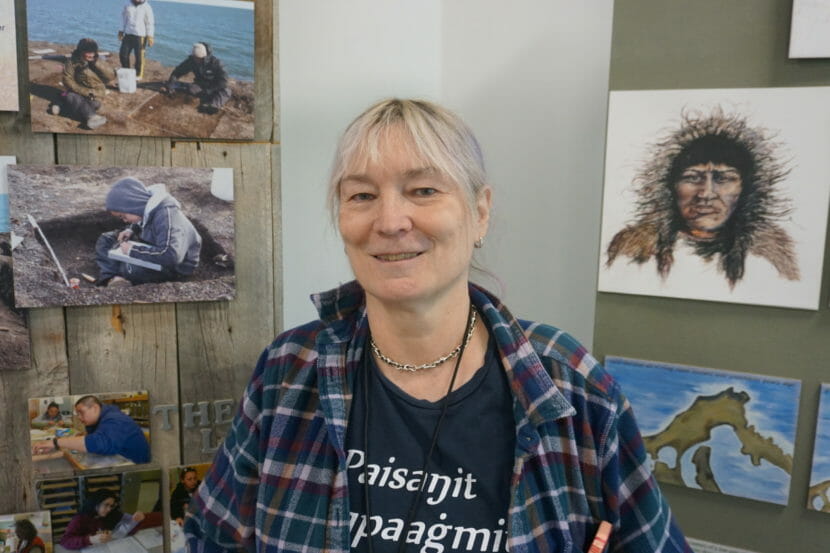
Archaeologist Anne Jensen stands next to a display at the Barrow Arctic Research Center that explains her work rescuing eroding cultural sites in and around Utqiagvik. (Photo by Yereth Rosen/Alaska Beacon)
Rescuing those sites has been the mission of archaeologist Anne Jensen. Now with Bryn Mawr College, Jensen lived for decades in Utqiagvik and previously worked for the Ukpeaġvik Iñupiat Corp.’s science department.
When the 800-year-old remains of a young girl were uncovered by erosion in 1994, Jensen was on the case; the girl was determined to have been a victim of starvation and numerous chronic diseases. She was named Anaiyaaq, meaning “young girl,” and her body was reburied.
When accelerating erosion was exposing gravesites at Nuvuk, an ancient settlement at Point Barrow, Jensen was also at work to rescue remains; the sites were from a cemetery area with use stretching back about 1,000 years. She has done other work at a well-known archaeological site about 18 miles down the Chukchi Sea coast called Walakpa, which was thought to be stable until about a decade ago, when a fall storm began carving off the once-frozen bluff.
The vulnerable archaeological sites are not just about culture, Jensen said. “Sites are not just culture. They are a frozen tissue archive. Everything in it is preserved.” That includes ancient DNA in both tissues and sediments, stable isotopes and other pieces of information that can be used to reconstruct past conditions, she said.
The places where Jensen has worked represent only a small fraction of the archaeological and cultural sites packed along the coastlines at Utqiagvik and elsewhere on the North Slope. Several have already been lost, such as the 100-year-old Esook Trading Post that was swallowed by the Beaufort Sea in the early 2000s. Many more are likely to wash away before anyone knows what they held, Jensen said.
“There’s not enough money on the planet. It’s either excavate them or write them off,” she said.
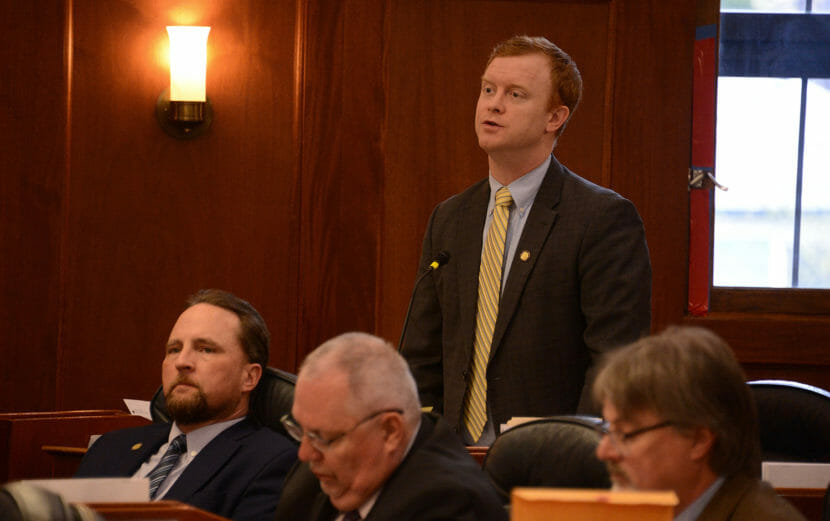
Rep. David Eastman, R-Wasilla, speaks on the floor of the Alaska House of Representatives on Monday, May 2, 2022 at the Alaska State Capitol in Juneau. (James Brooks/Alaska Beacon)
The Alaska Supreme Court will not have a chance to rule on the case of a legislator accused of violating the state constitution’s disloyalty clause, clearing the way for him to take office.
On Tuesday, Matanuska-Susitna Borough resident Randall Kowalke said he will not appeal a lower-court defeat to the state’s high court, citing the risks of a failed argument.
The decision means Rep. David Eastman, R-Wasilla, is set to be sworn in for a new term Jan. 17, but it leaves legal ambiguity around how the disloyalty clause should be enforced in the future.
Kowalke said he is “absolutely” disappointed by the outcome after he sued Eastman and the Alaska Division of Elections in July, challenging the division’s decision to certify Eastman as a candidate despite more than a dozen objections.
Kowalke alleged that Eastman’s membership in the Oath Keepers, a group linked to the Jan. 6, 2021, insurrection at the U.S. Capitol and labeled an antigovernment militia by the federal government, violates a clause of the Alaska Constitution.
That clause, written during the 1950s Red Scare, states that anyone who “advocates, aids or belongs to” a group that advocates the forcible overthrow of the U.S. government cannot hold public office in Alaska.
After a weeklong trial, Superior Court Judge Jack McKenna concluded that Eastman is a member of the Oath Keepers and the group does advocate the overthrow of the U.S. government, but that the First Amendment of the U.S. Constitution protects Eastman unless he had “a specific intent to further the Oath Keepers’ words or actions aimed at overthrowing the United States government.”
Though Eastman was present at protests outside the Capitol’s restricted zone during the Jan. 6 insurrection, McKenna concluded that his presence was unrelated to any calls to action by the Oath Keepers and did not violate the First Amendment.
Kowalke said he was dissatisfied with that ruling.
“I was attempting to determine tolerance in Alaska for this kind of stuff,” he said, “and it sort of seems like you could join Hezbollah, but if you made an announcement the day you joined that you had no intention of furthering their goals, you’re good.”
Earlier in the case, an appeal had seemed likely, but Kowalke and attorney Goriune Dudukgian said on Tuesday that the interpretation used by McKenna added a third hurdle for them to surpass.
“We didn’t want to proceed with an appeal where we would create bad law that would be binding precedent and would make it more difficult in the future in Alaska — or even in other states — to bring similar eligibility challenges,” Dudukgian said.
Because the case was not decided by the Alaska Supreme Court, a future judge considering a similar disloyalty clause case isn’t required to follow McKenna’s thinking. He or she could come up with a different interpretation of the First Amendment.
Asked about Tuesday’s decision by Kowalke, Eastman said by text message, “The right of voters in Wasilla to elect their own representatives has been preserved, but the price they were asked to pay to defend that right demonstrates the extent to which Alaska courts have been weaponized against conservative candidates and voters. It is unconscionable that the Constitution was retooled to allow this type of lawfare to take place in Alaska.”
Eastman has repeatedly asked for donations to pay for the cost of his legal defense, and a website created to collect those donations states, “The expense of this trial is expected to cost $300,000.”
Kowalke was represented in his lawsuit by a civil rights firm, the Northern Justice Project, which represented him pro bono. He said the potential cost of an appeal was not a factor.
An official with the Alaska Department of Law said that agency and the Division of Elections are still evaluating McKenna’s decision and what the agency’s next steps will be.
In a pretrial order, McKenna determined that the Division of Elections is responsible for enforcing the disloyalty clause, but his final order on Eastman’s eligibility had little to say about future actions by the division.
The Division of Elections has been without an executive director since the retirement of Gail Fenumiai in December.
The first day of the Alaska Legislature’s 2023 session is Jan. 17 in Juneau.
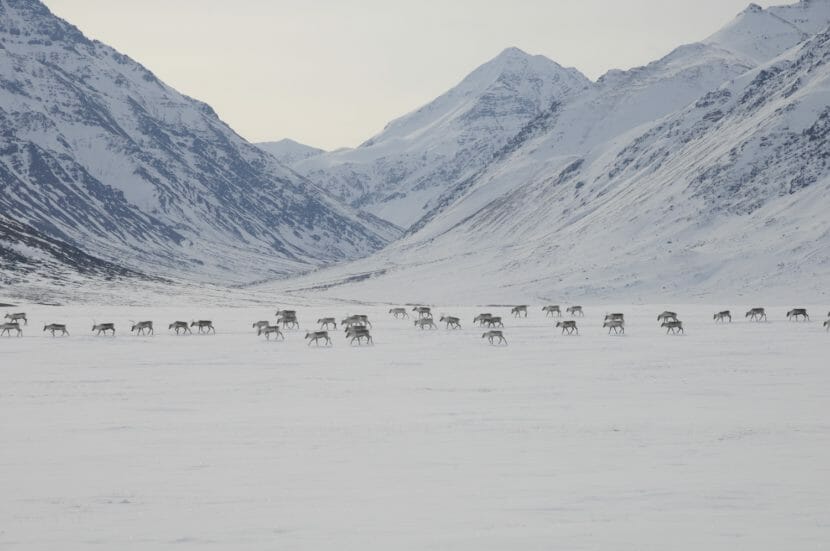
Caribou cross through Gates of the Arctic National Park and Preserve in their 2012 spring migration. The Western Arctic Caribou Herd, long one of the largest in North America, has declined precipitiously and is now at the lowest size since the early 1980s. The herd’s range includes Gates of the Arctic. (Photo by Zak Richter/National Park Service)
One of the biggest caribou herds in North America has taken a nosedive, and climate change is a likely culprit in the population decline.
Alaska’s Western Arctic Caribou Herd population is lower than at any time in over four decades, with numbers put at 164,000, down from a high of nearly 500,000 in 2003, according to the Alaska Department of Fish and Game.
In a meeting room in a downtown Anchorage hotel earlier this month, representatives of Indigenous villages and other organizations dependent on the caribou spent three days discussing the bad news and how to respond to it.
“Right now, our caribou is very, very critical,” said Vernon Cleveland, chairman of the Western Arctic Caribou Herd Working Group, an advisory panel representing people of the region. The herd went from 188,000 in 2021 to 164,000 in the past year, “and it’s going down. We have to do something about it,” he said.
For a short-term response, the working group, which advises policy makers on wildlife management, agreed on recommendations for new cuts in hunting limits, which had already been reduced. There should be more avoidance of cows, as adult female survival was shown to be on an especially bad trend, the group also concluded. Additionally, members of the working group urged better reporting from villages of their hunting experiences and successes. For now, it is estimated that only about a tenth of the region’s hunts are reported to Fish and Game, said Alex Hansen, the department’s Kotzebue-based regional biologist.
But neither hunting nor predation by bears or wolves is implicated in the long-term decline. Instead, several signs point to climate change as having a big effect on the herd.
There is a continued pattern of later fall migration, as recorded by biologists. At the Kobuk River, a key landmark in Gates of the Arctic National Park that the caribou pass in their annual southward trek, the first crossings are about a month later in the year than they were just a decade ago, according to biologists’ information.
“Back in the day, we had animals crossing over in late August,” Kyle Joly, a National Park Service biologist who studies the herd, told the working group. In contrast, in 2020 the first crossing was in early November, the earliest in the record going back to 2010,
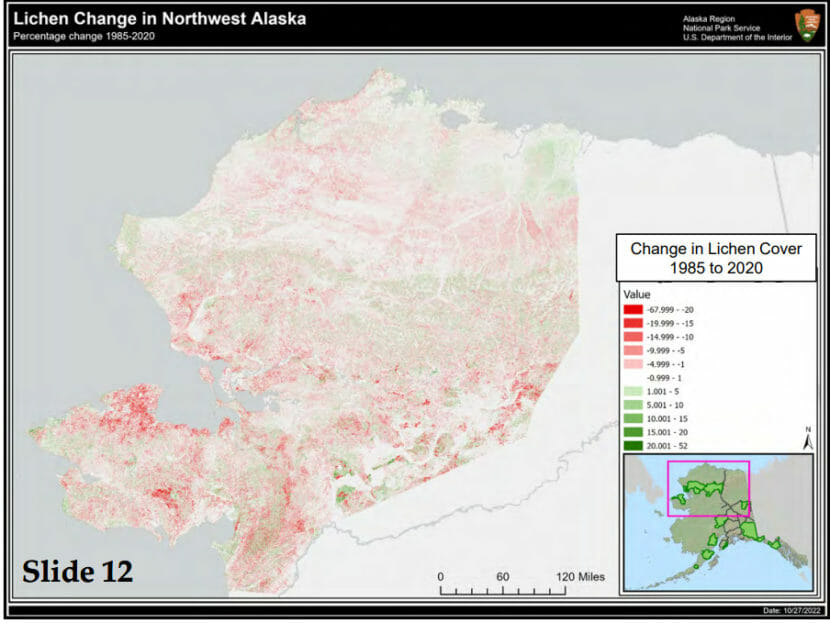
Another possible factor is the change to vegetation on which caribou depend. As the climate warms, woody plants are growing farther north, displacing many of the tundra plants that caribou eat. New research that is underway has shown a transformation in part of the western Arctic herd’s range since 1985. The changes are particularly drastic on the Seward Peninsula, in the more southern area of the herd’s range, according to preliminary results of the research, being led by Fairbanks scientist Matthew Macander, who has done similar research in other parts of Alaska.
A map shows the changes in lichen cover in northwest Alaska from 1985 to 2020. The darkest red areas have lost the most lichen coverage, and the Seward Peninsula is notable for such losses. Green areas show increased lichen cover. The map, from research led by Fairbanks scientist Matthew Macander, were presented at the 2022 annual meeting of the Western Arctic Caribou Herd Working Group. (Graph provided by National Park Service)
“Basically, you’re going from great to not-very-good caribou habitat,” Joly told the working group.
Macander’s preliminary findings are consistent with Seward Peninsula residents’ reports of scarce caribou sightings in their region. And they are consistent with data produced by radio tracking of caribou. Of the 33 caribou fitted with radio collars during the fall 2021 migration, none spent the following winter in the Seward Peninsula’s Bering Land Bridge National Monument, according to information presented by Joly to the working group.
Caribou and reindeer herds shrinking across the cirumpolar north
Caribou populations are famously volatile, so the Western Arctic herd’s losses could be reversed in the future. Still, around the north, most caribou and wild reindeer populations are on the decline, and many key populations have crashed.
Only two of the 23 herds monitored in an international network – the Porcupine herd that straddles northeastern Alaska and northwestern Canada and the Lena-Olynek herd in Siberia — were at historic highs, according to the 2018 Arctic Report Card issued by the National Oceanic and Atmospheric Administration. Globally, populations declined by about 40% over three generations, according to scientists with the CircumArctic Rangifer Monitoring and Assessment Network. Some of the most stunning declines have been in Arctic Canada, where the George River herd fell from over 800,000 in the 1990s to about 8,000 now and the Bathurst herd fell from 470,000 in the mid-1980s to 6,240 in 2021.
A litany of climate-change impacts are affecting migration of caribou and wild reindeer, according to a recent study led by Joly. They include changes in snow and ice, along with the vegetation transformations being seen in places like the Seward Peninsula. Other impacts of warming are increased rain-on-snow events, which cause hardships for all tundra grazers, and increase in disease-carrying parasites. Permafrost thaw that leads to abrupt changes in lakes, with some draining and others forming, has mixed impacts on caribou migration, according to the study.
Caribou and reindeer around the north are also affected by human development, which fragments habitat, Joly’s research said.
Even for the Western Arctic herd, which has a largely intact habitat, development has made a mark.
The major site of development in the caribou range is northwest Alaska’s Red Dog Mine, one of the world’s biggest producers of zinc. Years of research have found that migrating caribou are affected by the 53-mile road that connects the inland mine with its Chukchi Sea port used to export ore.
For reasons that have yet to be fully understood, a large percentage of migrating caribou refuse to cross the road, altering their migration patterns to avoid it.
The latest piece of evidence of that behavior comes from the past year’s radio tracking. Of the 33 animals collared in the fall of 2021, 10 wound up roaming the area near the Red Dog road. Two of those crossed the road and survived for the full year afterward. Of the eight that did not cross, only five survived for the full year after. It is a tiny sample size, Joly told the working group, but hints at something important. “Sixty-two-and-a-half percent versus 100 percent survival, it’s potentially a big deal.”
Dust deposited by ore-hauling trucks could be affecting caribou and other wildlife, scientists have said.
A newly published study found that tundra plants on either side of the road were thinned out by years of dust deposits. Particles of zinc, lead, cadmium and metal sulfides reduced plant quantity and diversity up to a kilometer away from the road, according to the National Park Service-led study, published in June in the journal PLOS One.
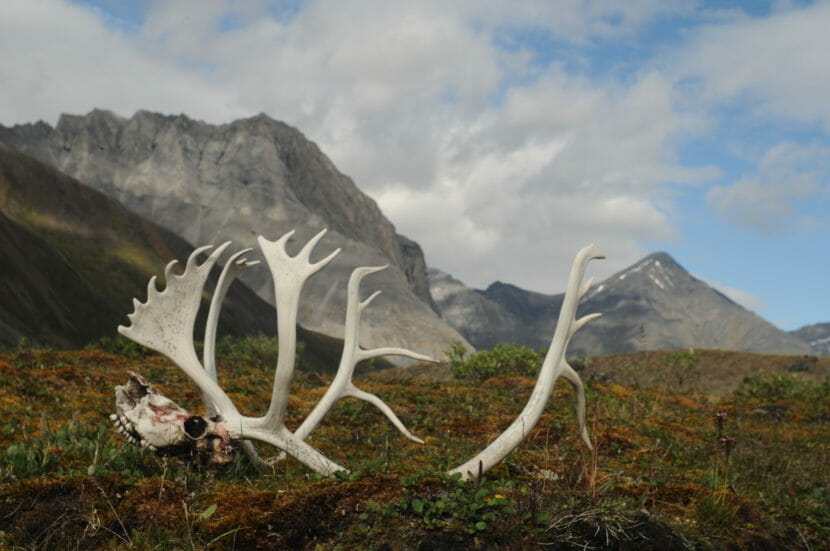
Antlers and a skull from a dead caribou are seen on Aug. 1, 2014 on the ground in the Oolah Valley of Gates of the Arctic National Park and Preserve. (Photo by Cadence Cook/National Park Service)
In recent years, the mine’s operator, Teck Resources Ltd., has taken steps to reduce dust from truck traffic along the road. But even with those improvements in dust management, the tundra plants grow so slowly the damage will take a long time to repair, the Park Service-led study said. “Due to the slow growth rates of these nonvascular plants … it is likely that long-term recovery would take many decades after contaminants decrease additionally following mine closure or more intensive fugitive dust control,” the study concluded.
Existing road impacts cited in arguments against Ambler road project
The experience with the Red Dog road contributes to wariness in the region about another mining-related development: the proposed 211-mile road that would cut through the Brooks Range foothills to the isolated Ambler Mining District in northwestern Alaska. The project, which is proposed by the Alaska Industrial Development and Export Authority, is seen as crucial in enabling development of large copper mines.
So does experience with the Dalton Highway, the now-public highway that was originally built as an industrial-use-only supply route along the Trans Alaska Pipeline corridor to the Prudhoe Bay oil field. It was opened to full public access in 1994.
The Ambler project is controversial because of its potential impacts on caribou and other resources. It has been the subject of lawsuits that prompted the Biden administration to reconsider an approval granted in 2020 by the Trump administration. Numerous tribal governments along the proposed route of the Ambler road have passed resolutions in opposition to it.
At the annual working group meeting, members also expressed their misgivings.
“If the road opens up, we’re going to have a lot of people up in that area. No fish, no caribou, no animals, just like the Dalton Highway,” said Cleveland, who is from the Inupiat village of Noorvik. The development represents a threat to traditional Indigenous lifestyles, he said. “We live off the land. We live off tuttu,” he said, using the Inupiaq word for caribou. “We live off caribou, moose, geese, beaver.”
Tom Gray, a working group member from Nome, asked U.S. Bureau of Land Management officials attending the meeting to consider rejecting the current road proposal.
“If this road goes in place, our way of life is going to change,” Gray said. “If it’s hard for our culture and our caribou, you could turn the switch off and say, too bad, figure another way.”
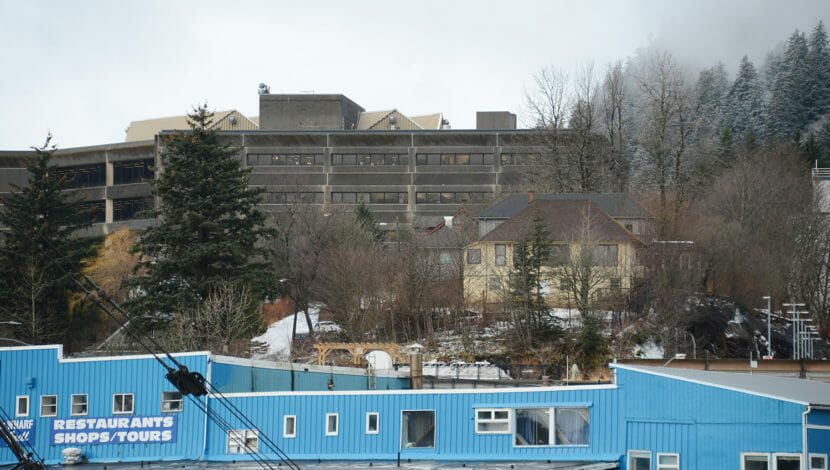
Juneau’s Telephone Hill neighborhood is seen at center right, beneath the State Office Building, on Wednesday, Dec. 28, 2022. The neighborhood, owned by the state of Alaska, is being transferred to the City and Borough of Juneau. (Photo by James Brooks/Alaska Beacon)
The state of Alaska is returning to the City and Borough of Juneau a multimillion-dollar plot of land once envisioned for a new Capitol building.
On Tuesday, acting Department of Natural Resources Commissioner Vasilios Gialopsos signed an order transferring Telephone Hill, a historic residential area overlooking downtown Juneau, to the capital city.
The transfer was required under legislation written by Sen. Jesse Kiehl, D-Juneau, and passed by lawmakers earlier this year, ending an almost 50-year-old project intended to construct a new Capitol for the Alaska Legislature.
“It really needs to be in the hands of the city,” Kiehl said in August. “It’s going to lead to some better use of that parcel, with full public participation on what that looks like.”
The transfer won’t be final until city officials sign an affidavit releasing the state from liability, which would allow the deed to be signed over, said DNR natural resource specialist John King.
Juneau officials have already been considering their options, including using the property for a new city hall.
In October, local voters rejected a proposal to borrow $35 million to build that new city hall, but because the bonding proposition failed by less than 3 percentage points, city manager Rorie Watt said city officials believe voters may have liked the idea of a new city hall, just not the particular plan on the ballot.
Kiehl said he doesn’t care for the city hall idea.
“This is really prime real estate,” he said. “It could be anything from hotel and condo — various housing options, hopefully with an inclusive low-income element — to large-scale light commercial. I’m not inclined for that to be the city hall, though I do think Juneau needs to own its own much larger city hall.”
The residents of Telephone Hill are also concerned by the idea. Since Kiehl’s legislation passed, they’ve been in limbo and subject to unenforced eviction notices.
In September, resident Tony Tengs testified to the city assembly, saying it doesn’t make sense to demolish homes during a housing crisis.
Telephone Hill is Juneau’s oldest historic neighborhood, home to the oldest still-occupied house in Alaska, the Edward Webster House, built in 1882. Seventeen people live in the neighborhood’s seven properties, a city survey found in August. None of the homes in the area are eligible for historic recognition because they have been modified, but all date from before 1920 and are some of the oldest homes still standing in Alaska.
The neighborhood has been owned since 1984 by the state, which was considering construction of a new Capitol and acquired the site in anticipation. The city contributed $2 million to the state’s purchase of the properties on the hill, under the condition that it be developed for a new Capitol building.
That never happened, owing in part to the cost of the project and the unpopular result of a city-sponsored 2005 Capitol design competition. Meanwhile, the city charged the state interest on its $2 million investment. By 2008, the figure had reached $6.4 million, and the state and Juneau signed an agreement that said the debt would be forgiven if the land was given to the city.
When Gov. Mike Dunleavy entered office in 2018, he ordered a review of surplus state-owned land across Alaska, and Telephone Hill — then owned by the Department of Transportation and Public Facilities — was identified as a prime candidate for disposal.
After Kiehl’s legislation passed, DOT transferred Telephone Hill to DNR in preparation for the ultimate transfer to the city. That ended a decades-long leasing arrangement with the neighborhood’s remaining residents, who received eviction notices in August.
Those notices have never been enforced, and Watt said the city has no intention to do so. For the meantime, residents are on month-to-month leases with the city, which is also in charge of managing the property.
How long the status quo remains in place will be up to city officials once the local government takes full control.
“There are any number of good possibilities,” Kiehl said in August, “and frankly, the opportunities for redevelopment of any lot downtown are tremendous.”
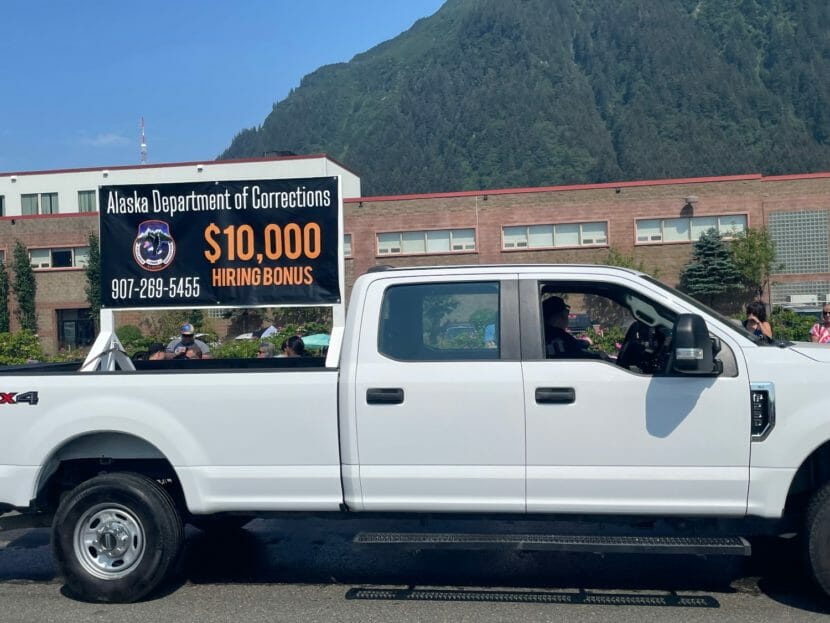
The Alaska Department of Corrections advertises its $10,000 hiring bonus during a July Fourth parade in Juneau in 2022. (Photo by Lisa Phu/Alaska Beacon)
Alaska’s top-grossing public employee during the last fiscal year was a forensic psychiatrist for the state prison system, according to a report released after a public records request by the Alaska Beacon.
Dwight Stallman received $415,500 in gross pay during fiscal year 2022, which ran from July 1, 2021 through June 30, 2022. That was the highest figure among 15,484 employees listed. An executive for the Alaska Gasline Development Corporation likely was paid more, but his compensation will not be disclosed until early 2023.
State workers’ regular salaries are disclosed regularly by the state, but many employees also receive relocation expenses, bonuses for working in remote areas, overtime pay, or receive deposits into their retirement account in exchange for unused leave. These additions are not regularly disclosed but may be part of their gross pay.
Among the top 10 earners in the report are four investment officials — three from the Alaska Permanent Fund and one from the Teachers Retirement System — three state troopers, a corrections officer in Bethel, and the chief psychiatrist of the Alaska Psychiatric Institute.
Public safety positions — either with the state troopers or the Department of Corrections — account for 11 of the top 25 positions and 28 of the top 50.
Police departments and prison systems across the country, including in Alaska, have repeatedly raised salaries and have offered bonuses in order to compete amid a shortage of licensed officers.
Investment employees are also in demand: Though top investment officials at the Alaska Permanent Fund are among the highest-paid in the state, the state-owned corporation is struggling with vacancies as workers leave for higher-paid jobs elsewhere.
The newly released report doesn’t include all state jobs, said Frank Hurt of the state Division of Personnel and Labor Relations.
Members of the Alaska State Defense Force — the state’s organized militia — the National Guard, AmeriCorps volunteers, board members, stipend recipients and student workers are excluded.
Independent public corporations, such as the Alaska Railroad, Alaska Gasline Development Corporation and the Alaska Housing Finance Corporation, are also excluded because they use separate accounting systems.
Those corporations disclosed their top earners in a listing of executive salaries earlier this year. That listing runs by calendar year rather than fiscal year.
In calendar year 2021, AGDC president Frank Richards received $447,167 in total compensation, making him the state’s highest-paid employee during that period.
The same listing showed AHFC Corp. CEO Bryan Butcher with compensation of $305,150. That would have been 12th in the gross pay report. Railroad president and CEO Bill O’Leary’s $297,825 compensation would have been 15th.
Gov. Mike Dunleavy’s salary of $145,002 was No. 862 on the list, just behind the manager of the Bethel airport.
The 2022 listing of executive salaries will be published early next year but isn’t as comprehensive as the gross pay summary.
When asked why Dr. Stallman was the state’s top gross earner, Betsy Holley, a spokesperson for the Alaska Department of Corrections, said Stallman and the Bethel officer who finished in the top 10 “are paid in accordance with the assigned salary schedules for their job classes, duty stations, applicable collective bargaining agreements and personnel rules.”
Stallman’s regular salary is $289,500 and no overtime was listed in the report, indicating he may have received bonuses for special duty or cashed in vacation time.
That was the case for at least some of the Alaska State Troopers who finished among the state’s highest earners. All three were shown to be working for Detachment C, which covers western and southwestern Alaska, an area larger than the combined states of West Virginia, Ohio and Alabama.
An official with the Alaska Department of Public Safety said some of the figures for its top-grossing employees “include moving costs for relocation to remote areas of Alaska and may also include cash outs of personal leave to an employee’s deferred compensation retirement account.”
Austin McDaniel, a spokesperson for the department, said Lt. Lonnie Gonzales, Sgt. Scott Sands, and trooper Abraham Garcia — all within the top 10 — “are all dedicated and longtime DPS employees who provide high quality public safety services to the residents of rural Alaska. All Alaska State Troopers are paid in line with Alaska law, their respective collective bargaining agreements, and Alaska administrative code and rules.”
Nationally, police officers’ salaries averaged $70,750 in 2021, the latest year for which the federal Bureau of Labor Statistics has published information. Alaska’s average salary for officers, $87,510, was the fourth-highest in the nation.
For psychiatrists, the national average is $249,760, and the figure for forensic psychiatrists, who receive extra training, was not available.
For all Alaskans, not just those working for the state, the average household income is $91,547, according to the latest American Community Survey conducted by the U.S. Census.
Three of the Alaska Permanent Fund Corporation’s investment officers, including chief investment officer Marcus Frampton, are among the state’s top 10 employees.
In calendar year 2021, APFC executive director Angela Rodell earned $444,933 in total compensation; she was fired by the corporation’s board at the end of the year, halfway through FY22, and isn’t listed in the gross pay report.
The corporation’s new director, Deven Mitchell, is slated to receive a salary of $350,000, which would place him among the top 10 in the coming year.
Preliminary information presented to the corporation’s board of directors earlier this month indicates investment staff managing the $76 billion Permanent Fund continue to be underpaid when compared to staff at similar organizations elsewhere in the country.
The board is investigating a new salary and bonus system and voted to give Mitchell the power to award incentive bonuses for FY22 performance even though the bonuses require the fund to have positive returns.
The bonuses will instead act as incentives to stay with the corporation and will boost some APFC employees’ gross pay for FY22 above what’s listed in the current report.