Alaska Beacon

Alaska Beacon is part of States Newsroom, a network of news bureaus supported by grants and a coalition of donors as a 501c(3) public charity. Alaska Beacon maintains editorial independence. Contact Editor Claire Stremple for questions: info@alaskabeacon.com. Follow Alaska Beacon on Facebook, Bluesky and Twitter.

Fishery disaster aid and nearly $500 million worth of Alaska projects included in omnibus budget bill

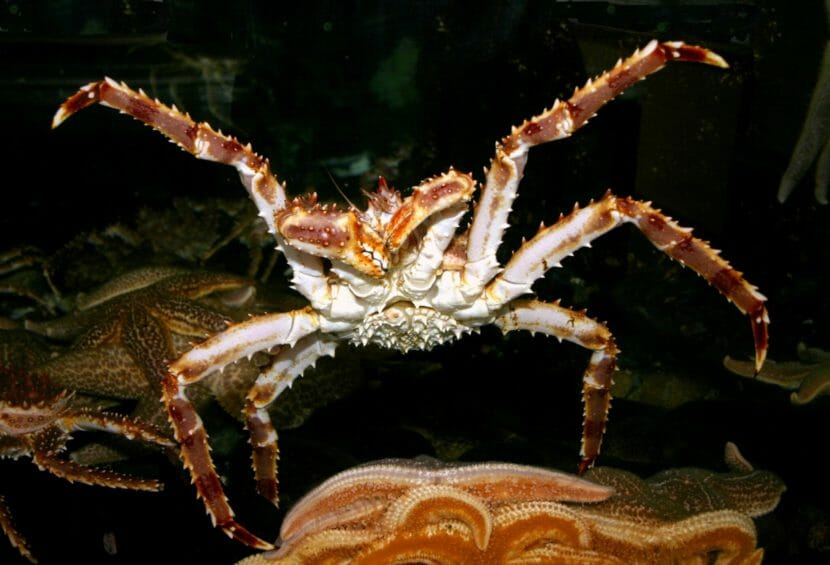
A red king crab, underwater
A red king crab is seen in the water at Kodiak in 2005. The collapse of the red king crab fishery in Bristol Bay was one of the Alaska events that prompted a series of official fishery diaster declarations last week — and Congressional approval of $300 million in aid. (Photo by David Csepp/National Oceanic and Atmospheric Administration)

Aid to Alaska fishermen, companies and communities was included in the year-end omnibus appropriations package that won final passage on Friday.

The $300 million in aid funding follows official disaster declarations issued last week by U.S. Commerce Secretary Gina Raimondo for Alaska salmon and crab fishery failures dating back to 2020, as well as some salmon failures in Washington state dating back to 2019.

“This will be relief for commercial, recreational, subsistence harvesters, all those who were directly impacted by the fishery stock crashes,” Sen. Lisa Murkowski, who helped write some sections of the legislation, said in an online news conference Friday.

The disaster aid also supports research and communities that lost fish-tax revenues and it includes a provision, the Fishery Resource Disaster Improvement Act, that aims to improve administration of disaster funding and gets money to the affected parties, the Alaska Republican said.

“We recognize that it’s one thing to get the disaster declaration. It’s another thing, then, to get the funding. And it is yet another step to get the funding out to those who have been impacted,” Murkowski said.

The money is a relief to those affected, one fishery organization said.

The $300 million in total disaster aid “is a great start for much-needed money to help fishermen and communities pay their bills,” Jamie Goen, executive director of Alaska Bering Sea Crabbers, said in a statement. “We commend the Secretary of Commerce, NOAA Fisheries, and members of Congress, particularly the Alaska and Washington delegations, for their swift action and attention to this issue affecting so many hard-working Americans and family fishing businesses.”

Alaska Bering Sea Crabbers is one of the groups affected by the first-ever closure of the Bering Sea snow crab fishery and the second consecutive year of closure for the Bristol Bay red king crab fishery. In both cases, stocks are too low to support any harvesting.

Aside from the disaster relief, there is money in the bill for fishery initiatives, including research and monitoring in the Yukon and Kuskokwim river drainages and in the Bering Sea, sites where fish returns have been disastrously low.

Those provisions were among more than 130 Murkowski-endorsed Alaska projects totaling nearly $500 million that were included in the package as “congressionally directed spending,” what was in past years referred to as earmarks. Because Murkowski was the only member of Alaska’s three-person delegation to push for those projects, her office handled all of the requests from around the state. ‘

To winnow down the approximately 1,600 requests received, Murkowski said she focused on the items that appeared to address the most critical needs, largely water, sanitation, health and even trash management.

Her message to the requesting communities, she said, was simple: “We want to focus on the things that make your community healthier and safer.”

Among the projects that cleared the bar were those related to water in rural Alaska, including water, wastewater and garbage-handling improvements in the Pribilof Islands, drinking-water and wastewater improvements in Nome and upgrades to wastewater treatment on the North Slope.

There are numerous Arctic-specific provisions in the omnibus bill, some of them included as Congressional Directed Spending Projects, such as the $5 million for Ilisaġvik College’s work to complete design of a new campus in Utqiagvik, and some of them meeting needs specified in the National Defense Authorization Act, such as additional funding for the Ted Stevens Center for Arctic Security Studies.

Included in the omnibus package are updates to the 19th century-era Electoral Count Act. Murkowski was part of a working group that wrote the Electoral Count Reform and Presidential Transition Improvement Act, which she said will “make sure that we never have another Jan. 6, we never have the uncertainty that comes to what is the role of the vice president in verifying an election, what is the threshold for challenging state’s electoral submissions.”

This story originally appeared in the Alaska Beacon and is republished here with permission.
Oath Keepers seek to overthrow government, judge says, but First Amendment protects Eastman

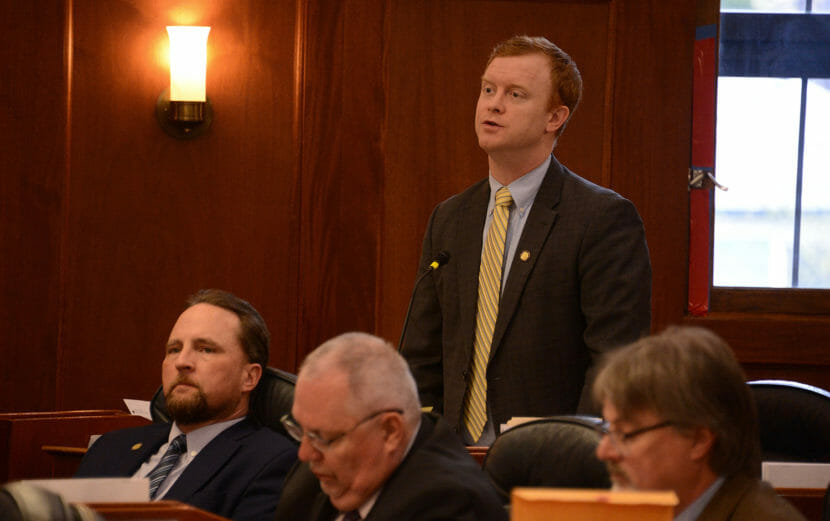
Rep. David Eastman speaking on the Alaska House floor
Rep. David Eastman, R-Wasilla, speaks on the floor of the Alaska House of Representatives on Monday, May 2, 2022 at the Alaska State Capitol in Juneau. (James Brooks/Alaska Beacon)

An Anchorage Superior Court Judge has ruled that Wasilla Republican Rep. David Eastman’s membership in the Oath Keepers does not violate the Alaska Constitution’s disloyalty clause because of First Amendment protections for free speech.

The decision, which may be appealed, means Eastman may continue serving in the Alaska Legislature. Eastman was re-elected in November.

In a 49-page order issued Friday morning, Judge Jack McKenna said the Oath Keepers — labeled an antigovernment militia by the federal government — “are an organization that has, through words and conduct, taken concrete action to attempt to overthrow by violence the United States Government.”

That meets the standards for disloyalty under Article XII, Section 4 of the Alaska Constitution, which says that someone who aids or belongs to an organization that advocates the forcible overthrow of the U.S. government is barred from holding office here.

But the ruling doesn’t end there. The First Amendment must be considered, McKenna said: “The court further finds that Rep. Eastman is a member of that organization, but that he does not and did not possess a specific intent to further the Oath Keepers’ words or actions aimed at overthrowing the United States government. The court therefore finds that he is not disqualified from holding public office by Article XII, Section 4.”

The decision comes in response to a lawsuit filed by a Matanuska-Susitna Borough resident, Randall Kowalke, who challenged Eastman’s eligibility for office under the disloyalty clause.

A ruling in Kowalke’s favor could have prevented Eastman from taking office.

“We’re obviously disappointed by the outcome and need to figure out our next steps,” said Goriune Dudukgian, who represented Kowalke at a seven-day bench trial.

An appeal to the Alaska Supreme Court has been expected, but Dudukgian said a decision on whether or not to appeal will not take place until after Christmas.

“We obviously have to make a quick decision,” he said.

Eastman did not respond to a text message seeking comment but has been actively fundraising for his legal defense. In emails sent to supporters, he solicited donations and suggested that he could spend as much as $300,000 on his case. A fundraising dinner had been scheduled for Friday night in Wasilla.

McKenna’s order has been placed on hold pending an appeal to the Alaska Supreme Court, meaning Eastman is not yet fully clear to take office. The Alaska Legislature convenes Jan. 17.

The Alaska Division of Elections was also a party to the lawsuit, and McKenna’s final order did not address the division except to say that its role is resolved by the broader decision.

“The Division of Elections takes no position on the merits of these claims. As ordered by the Court, the certification of the House District 27 election will be delayed until there is another order,” said Patty Sullivan, communications director for the Alaska Department of Law.

McKenna’s findings are a new interpretation of the Alaska Constitution’s disloyalty clause, which has never before been tested in court, and go beyond the clause’s plain language. The clause was written during the anticommunist Red Scare of the 1950s.

Intended to target the Communist Party of the United States, the clause declares that membership alone is enough to rule someone ineligible for public office in Alaska.

Subsequent rulings by the U.S. Supreme Court found that the First Amendment protects speech and association to a greater degree than envisioned by the authors of the Alaska Constitution, and McKenna took those rulings into account.

“The court holds that Alaska’s disqualification for disloyalty clause must be interpreted in harmony with the First Amendment to the United States Constitution,” he said.

In order for a person to be barred from public office under the disloyalty clause, he said, “there must be ‘knowing affiliation with an organization possessing unlawful aims and goals, and a specific intent to further those illegal aims.’”

The latter part of that statement was taken from a 1982 U.S. Supreme Court decision affirming that nonviolent action is protected by the First Amendment.

McKenna had hinted at the direction of his ruling with a mid-trial request for additional briefing on the intersection of the disloyalty clause with U.S. constitutional amendments.

Dudukgian argued that the 1982 Supreme Court decision and similar cases aren’t relevant because the case is about Eastman’s qualifications, not his ability to join a group. McKenna disagreed.

“Even under rational basis review, interpreting Article XII, section 4 to bar a person from office for mere membership in an organization violates the First Amendment,” he said.

He concluded that the Oath Keepers did intend violent action and the overthrow of the U.S. government during the Jan. 6, 2021 insurrection at the U.S. Capitol, but he also found that Eastman did not interact with or support the Oath Keepers during the insurrection.

Eastman didn’t interact with the group’s leaders or other Oath Keepers before or during the insurrection, and he didn’t enter the restricted grounds around the Capitol during the insurrection, the trial showed.

“Based upon the evidence presented at trial, the court does not find that Rep. Eastman had a specific intent to aid the Oath Keepers in planning for January 6. Nor does the court find that Rep. Eastman had a specific intent to aid the Oath Keepers’ actions on January 6,” McKenna said.

This story originally appeared in the Alaska Beacon and is republished here with permission.
Alaska Legislature votes $6.6 million for legislative housing near Juneau Capitol building

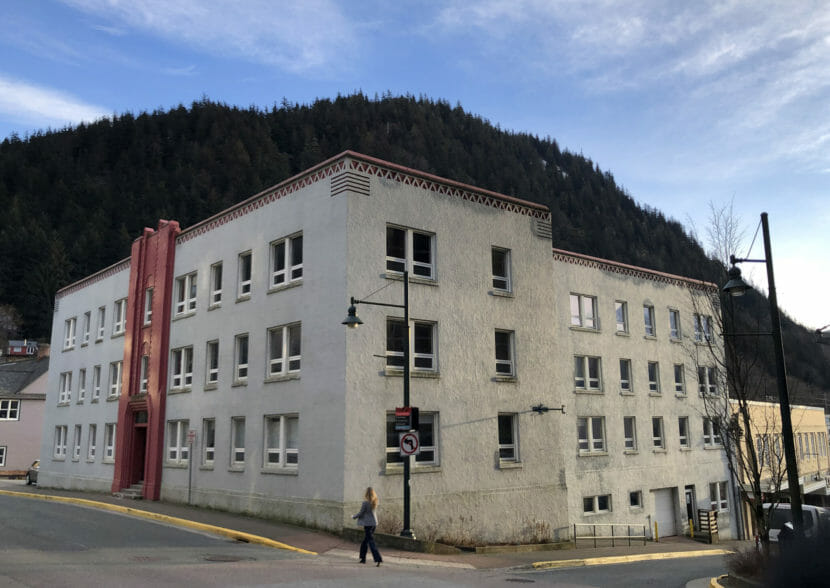
A woman walking past a blocky, grey-and-red office building.
The Assembly Building is seen on Wednesday, Dec. 21, 2022, in downtown Juneau, Alaska. (Photo by James Brooks/Alaska Beacon)

A House-Senate committee of the Alaska Legislature has approved spending $6.6 million to renovate a downtown Juneau office building into 33 apartments for legislators and staff.

During a Monday vote on the proposal, lawmakers said the state-owned building will help alleviate a chronic shortage of housing in the capital city during the legislative session.

“One of the biggest challenges we have is housing,” said Sen. Bert Stedman, R-Sitka.

“I think this is the right move,” he said.

The cost of construction is also being subsidized by a Juneau-based foundation whose goal, at least partially, is to keep Juneau as the state capital.

The Assembly Building, built in 1932, will be the Legislature’s new apartment building. Located kitty-corner to the Capitol, it was originally constructed as an apartment complex but was converted into offices in the 1980s.

Renovations are expected to take a minimum of one year, with a tentative completion date in January 2024. It isn’t yet clear how the building will be managed, who will be allowed to rent space, or whether legislators will forgo their per diem expense payments if they have a state-owned apartment.

In 2022, legislators were eligible for $307 per legislative day to cover food, housing and other expenses during the legislative session. Those payments came atop their annual salary of $50,400.

The 9-2 vote by the Legislative Council to move ahead with the apartment plan passed with Republicans, Democrats and independents voting in support.

Republican Rep. Cathy Tilton, R-Wasilla, and Sen. Mike Shower, R-Wasilla, voted against it.

“I really am not a fan of the Legislature being in the business of being a landlord and competing with the private sector,” Tilton said.

Shower said he is worried about the project’s rising costs. In February, the Legislative Council voted 9-5 in favor of a $5.5 million plan based on preliminary estimates. The final contract, with Dawson Construction, is worth almost $8.6 million.

The Juneau Community Foundation, which bought the building in 2021 and donated it to the Legislature at no cost, is also donating $2 million to pay for part of the building’s renovation, lowering the Legislature’s share to the $6.6 million approved this week.

“Juneau benefits by being the capital city. It fills our restaurants, it brings in people,” said Amy Skilbred, executive director of the $70 million foundation.

In 2014, the wealthy owner of Juneau’s electric company, Alaska Electric Light and Power, sold the business and donated most of the proceeds to the foundation. One of the conditions of that donation was the creation of the Juneau Capitol Fund, which is intended to support the Capitol as long as it remains in Juneau.

Skilbred said purchasing the Assembly Building is in line with the fund’s goals.

Legislators and staff have found it difficult to find housing, she said, because tourist season begins in May, compressing the market for short-term rentals at the end of the legislative session.

The problems are exacerbated if the Legislature calls special sessions in the summer.

“When they are called back, it’s hard to find housing both during and after session,” Skilbred said.

Garrett Schoenberger, a Juneau real estate agent and developer, said the price of the renovation is “high, but it’s not surprising.”

“I’d say that’s probably in line with just the craziness of today’s construction pricing,” he said.

Plans published in February call for 15 one-bedroom apartments and 18 studio apartments with a common laundry on each floor.

Juneau, like most of Alaska’s towns and cities, is experiencing a severe housing shortage, and the city’s downtown has a large number of commercial buildings with disused upper-floor apartments.

Shoenberger said renovating the Assembly Building is “a net gain for our community” and said he hopes it will inspire others to take similar action.

“It’s a welcomed addition,” he said.

This story originally appeared in the Alaska Beacon and is republished here with permission.
COVID-19 pushed Alaska’s death rate higher and life expectancy lower in 2021

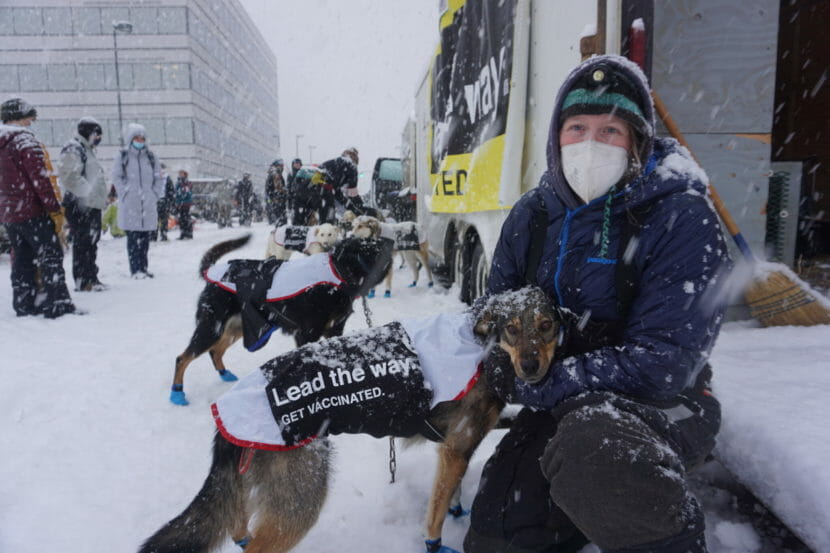
A masked musher on a snowy Anchorage street holding a dog that's wearing a sweater that says "lead the way, get vaccinated" on it
Musher Paige Drobny, wearing the required face mask at the ceremonial Anchorage start of the 2022 Iditarod Treail Sled Dog Race on March 5, carried a pro-vaccine message on her way to Nome. A race rule mandated masking at large gathering sites during the race to prevent the spread of COVID-19. (Photo by Yereth Rosen/Alaska Beacon)

Alaskans’ life expectancy dropped and death rate rose in 2021, with COVID-19 ranking as the third-highest cause of death during the year, according to the Vital Statistics Annual Report released last week by the Alaska Division of Public Health.

The difference between 2021 and 2020 was driven mostly by COVID-19. In 2021, there were 6,216 total deaths in the state, compared to 5,183 in 2020.

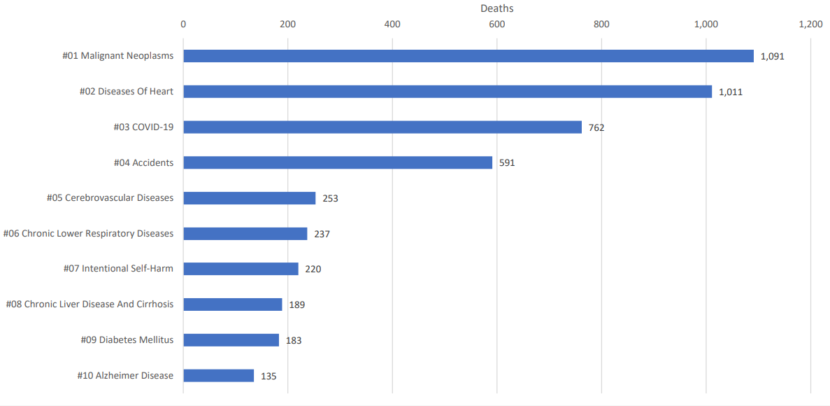
In 2021, 762 Alaskans died of COVID-19, and another 79 Alaskans died with COVID-19 as a contributing factor, the report said. That compares to 2020, the first year of the pandemic, when 182 Alaskans died from the disease and another 15 died with COVID-19 as a contributing factor.

The age-adjusted death rate in 2021 was 908.3 per 100,000 people, and Alaskans’ life expectancy was calculated at 77.5 years. That compares to an age-adjusted death rate of 785.3 per 100,000 people and a calculated life expectancy of 80 years in 2020.

A bar graph showing the ten leading causes of death in Alaska in 2021. COVID is third behind cancer and heart disease -- and well ahead of accidents.
The 10 leading causes of death in Alaska in 2021, as reported by the state Division of Public Health, show malignant neoplasms (cancer) at the top and COVID-19 in third place. (Graph from Alaska Vital Statistics 2021 Annual Report)

It was similar to a national decline in life expectancy, as reported by the Centers for Disease Control and Prevention. U.S. life expectancy fell to 76.1 years from 77 years in 2020, with the decline driven by COVID-19, according to the CDC. It was the second consecutive year of declining life expectancy, from 79 years in 2019, according to the CDC.

In Alaska, aside from COVID-19, the death and disease statistics in 2021 were mostly similar to those of the previous year.

Alaska’s top two leading causes of death in 2021 were cancer and heart disease, the same as in 2020. Suicide continues to rank in the top 10 of causes of death, in seventh place in 2021, as it was in 2020.

One difference between the years, in addition to the pandemic-caused deaths, were noticeable increases in alcohol-related and drug-related fatalities in 2021, according to the report.

People walking through a giant inflatable colon that has inflatable tumors on it.
An attendee at the Alaska Federation of Natives 2022 convention in Anchorage walks through an inflatable display about colon cancer. Cancers of all types remained the top cause of death in Alaska in 2021, as has been the case in other years, according to the latest annual report on state vital statistics. But in 2021, COVID-19 was third on the list of causes of death. (Photo by Yereth Rosen/Alaska Beacon)

Aside from becoming the third-leading cause of death in Alaska, COVID-19 imposed far greater treatment costs in 2021 than in the prior year, according to a separate report released by the division.

It ranked third as a cause for hospitalization, after childbirth and septicemia, according to the Alaska Health Facilities Data Reporting annual report. There were 4,184 inpatient hospitalizations for COVID-19 in 2021, compared to 1,629 in 2020, and the intensive care unit total of 2,167 was more than twice the total for 2020. Costs for treating COVID-19 in Alaska hospitals totaled about $595 million in 2021, up from $195 million in 2020, with an average per-patient charge of $142,095 compared to $119,579 in 2020. The average COVID-19 hospital stay was 9.2 days in 2021, compared to the 2020 average of 8.2 days.

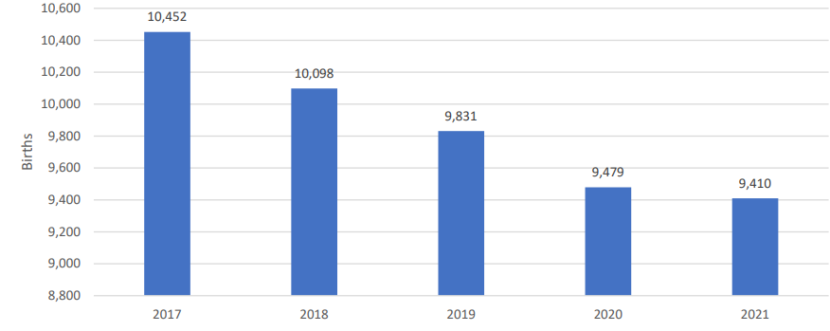
Despite the increased number of deaths, they were well outnumbered by births in 2021, the same as in previous years, with 9,410 babies born in the year. That compares to the 9,479 born in 2020.

Total births have decreased each year since 2017, when there were 10,452 babies born in Alaska, the report said.

A bar graph showing Alaska birth rates declining from 2017 on.
Total births in Alaska, as reported by the state Division of Public Health, have declined every year since 2017. (Graph from Alaska Vital Statistics 2021 Annual Report)

Fertility rates slipped in 2021 to 64.3 births per 1,000 women of child-bearing age, defined as 15 to 44. That was down from 65 in 2020 and continuing a years-long slide. In 2017, according to the division, Alaska had 71.3 births per 1,000 women.

Both the vital statistics and health facility annual reports provide detailed breakdowns about varying demographic groups, geographic regions and medical conditions.

The vital statistics report even noted the most popular names for Alaska babies born in 2021: Amelia for girls and a tie between Noah and Oliver for boys.

This story originally appeared in the Alaska Beacon and is republished here with permission.

Dead brown bear cub shows how avian influenza is lingering in Alaska’s environment

""
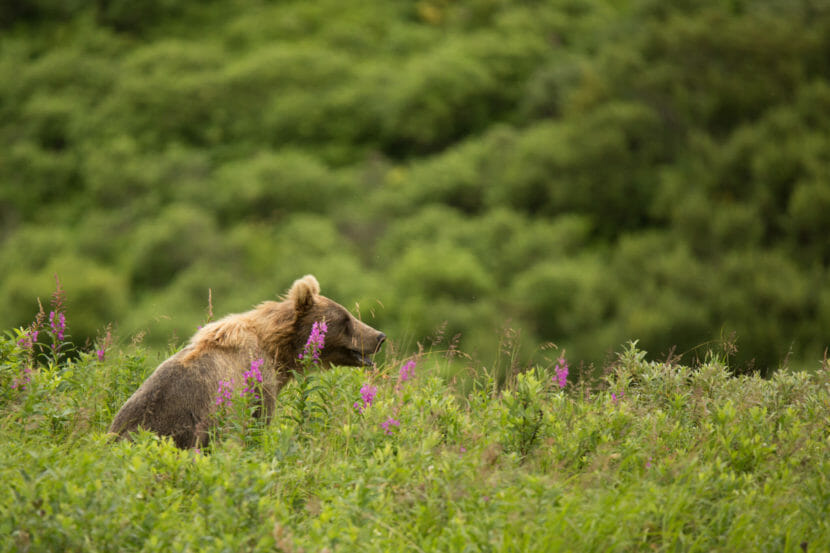
A yearling brown bear cub sits in the brush in the Kodiak National Wildlife Refuge on Jully 23, 2015. On Nov. 26, a local deer hunter found a different cub that was confirmed to be the first brown bear to have died from the highly pathogenic avian influenza that is circulating in wild and domesticated bird flocks. (Photo by Lisa Hupp/U.S. Fish and Wildlife Service)

dead brown bear cub found on Kodiak Island is one of the latest signs that the current strain of highly pathogenic avian influenza behind the deaths of tens of millions of birds is continuing to circulate in wild populations, infecting a variety of species.

The cub carcass, discovered on Nov. 26 by a local deer hunter, was the world’s first documented death of a brown bear from the current strain of avian influenza, said Nate Svoboda, the Kodiak area wildlife biologist for the Alaska Department of Fish and Game.

The cub’s virus infection, confirmed by a laboratory in the Lower 48, was announced on Wednesday by the department.

It was the second such bear death in the United States; the first U.S. bear known to have died from the infection was a black bear cub in Glacier Bay National Park, a case that followed an earlier black bear case in Canada, said Dr. Bob Gerlach, Alaska’s state veterinarian.

Expect to keep finding birds and possibly other mammals infected with this strain of influenza, warned Gerlach, who gave a presentation on Wednesday to the Alaska Native Tribal Health Consortium’s Local Environmental Observer Network.

Unlike past waves, which passed quickly through bird populations before petering out in a matter of months, this strain appears to be extremely persistent, Gerlach said.

“The concern is it’s maintaining itself in the wild bird populations,” he said in the webinar. That means state and federal agencies and their partners will have to keep monitoring outbreaks and bracing for more waves of infected wild and domestic birds after migratory species arrive next spring, he said.

A brown bear cub that has been dead for a while lies on its side on the ground.
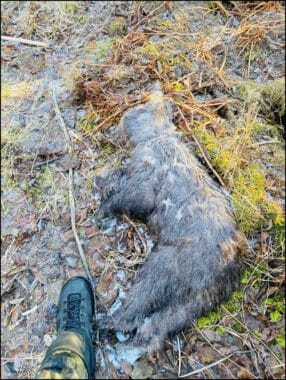
A dead brown bear cub is seen on the ground in a riparian area on Kodiak Island on Nov. 26. The cub, discovered by local hunter Jeff Woods, was the world’s first brown bear victim of the highly pathogenic avian influenza that is currently criculating among wild and domesticated birds, as well as among some mammals. State officials believe the bear, which was emaciated, had fed on some infected birds. (Photo by Jeff Woods/Provided by Alaska Department of Fish and Game)

“What we’re anticipating is this may be here for a while,” he said.

Around the world, the virus has damaged several populations of birds, including some rare species. Among the bird populations hard hit by this avian influenza are cranes in Israel, where thousands were found dead about a year ago, and more recently, pelicans and other seabirds in Peru.

Several mammals of different species have also succumbed to the virus. In the United States, the list includes red foxes — with some cases found in Alaska — and in the Lower 48, land animals like skunks and raccoons. Some marine mammals have also died from the disease, notably harbor seals in Maine.

The brown bear cub discovered on Kodiak Island was likely dead for only two or three days, and there were no signs of damage to the body, Svoboda said. However, he said, it was emaciated, which is unusual for a bear in the fall, the time of year when bears are normally their maximum weight, having packed on fat in preparation for denning.

The infected black bears found in Glacier Bay National Park and in Forillon National Park in Canada’s Quebec province were both euthanized. They were found to be extremely ill, having trouble walking, and racked by seizures, state officials said. The Alaska black bear cub was blind and had been abandoned by its mother, they said. Necropsies revealed that both bear cubs had encephalitis, an inflammation of the brain, Alaska and Canadian officials said in statements.

The black and brown bear cubs likely picked up the virus after eating infected birds, Gerlach said. There is no evidence that bears can infect other bears with the virus, he said.

And there is no evidence that humans are at much risk from this virus, Gerlach said. “This particular strain does not have a high propensity to get into and infect people,” he said in the LEO webinar.

That is good news for Alaska bird hunters, he said, though the usual advice about sanitation practices of handwashing, glove-wearing and avoidance of sick birds and animals continues to apply.

Since the disease emerged in Alaska birds last spring, about 800 samples from dead animals suspected to have infections have been processed, and there were nearly 100 cases confirmed by Lower 48 labs to have been positive, Gerlach said. The vast majority were from birds, though there were some mammal cases.

A man in a plaid shirt stands outside a glass-and metal building facade.
Dr. Bob Gerlach, Alaska’s state veterinarian, stands outside the Department of Environmental Conservation lab in Anchorage on May 13. (Photo by Yereth Rosen/Alaska Beacon)

That is only a small fraction of the cases in the wild populations, Gerlach said. Officials in Alaska are limiting their shipments of samples because the Lower 48 labs doing the testing are backlogged and are placing higher priority on commercial poultry.

That has left a lot of birds untested, in Alaska and elsewhere. In the Bering Strait and Yukon-Kuskokwim regions, for example, residents have reported numerous suspected but unconfirmed cases of avian influenza among wild birds. Those included swans and various types of geese that were exhibiting strange and distressed behavior consistent with influenza infection.

Meanwhile, there are numerous wild birds that are healthy but infected with the virus – and able to spread it around, Gerlach said. He cited some recent tests by the U.S. Department of Agriculture, which found a significant number of Southcentral Alaska birds were carrying the virus but unaffected by it.

“They’re still flying around and depositing their droppings everywhere,” he said.

Whatever virus is spread by those birds could linger a long time in the environment, Gerlach said, pointing to research led by U.S. Geological Survey wildlife geneticist Andy Ramey that found that avian influenza viruses can remain infectious for more than a year in Alaska’s wetlands environments.

“Unfortunately, we do know that the extreme cold up here preserves the virus very well,” he said. “So we do know it’s going to be a problem for us.”

This story originally appeared in the Alaska Beacon and is republished here with permission.
Acting Alaska health commissioner Hedberg is pick for permanent boss

A closeup of a woman standing at a lectern and speaking into a microphone
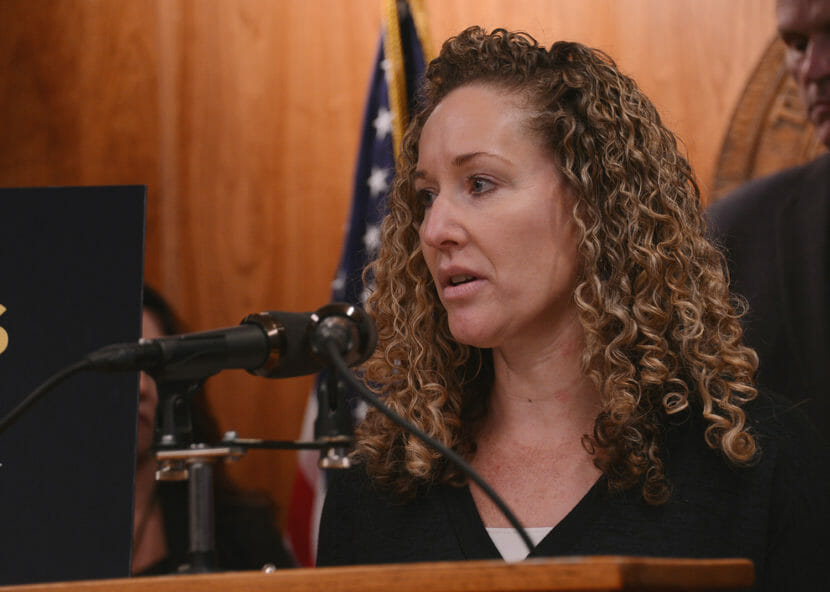
Heidi Hedberg, interim commissioner of the Alaska Department of Health, speaks at a news conference on Thursday, Dec. 15, 2022, at the Alaska State Capitol in Juneau. (Photo by James Brooks / Alaska Beacon)

Gov. Mike Dunleavy has named the Alaska Department of Health’s interim leader as the agency’s new permanent commissioner.

In a prepared statement Monday, he announced the appointment of Heidi Hedberg, who has served in a variety of roles within the state’s division of public health. Hedberg’s appointment is subject to confirmation by the Alaska Legislature.

“After working with Commissioner Hedberg the past four years, she has impressed me with her management skills, and ability to enact public health policies that make Alaskans healthier and safer,” Dunleavy said in a prepared statement. “Alaskans can be confident that the department responsible for their health and welfare is in good hands.”

The Department of Health formed July 1 after Dunleavy split the Department of Health and Social Services into two separate agencies. Adam Crum, the commissioner of the merged agency, continued as commissioner of the Department of Health until Dunleavy named him commissioner of the Department of Revenue in November.

Hedberg became acting health commissioner at that time.

She said in a prepared statement Monday that she was honored to be selected for the job.

Asked why there was a gap between her selection as acting commissioner and her decision to accept the job on a permanent basis, she said by email, “I wanted time to evaluate if this was the right position for me, being able to balance work and personal life. I am a wife and mom and love my family just as much as I love my work.”

As commissioner, Hedberg will earn a salary of $141,160.50, a figure set by Alaska’s state compensation commission. Her salary as division director, according to an Oct. 31 report, was $129,129.

The Department of Health has 1,442 full-time employees and a $950 million budget, the second-largest among state agencies. If federal funding is included, the department’s budget is proposed to be $3.1 billion in Fiscal Year 2024, the largest among state agencies and just under a third of all state operating budget spending.

This story originally appeared in the Alaska Beacon and is republished here with permission.

Site notifications
Update notification options
Subscribe to notifications