Alaska Beacon is part of States Newsroom, a network of news bureaus supported by grants and a coalition of donors as a 501c(3) public charity. Alaska Beacon maintains editorial independence. Contact Editor Claire Stremple for questions: info@alaskabeacon.com. Follow Alaska Beacon on Facebook, Bluesky and Twitter.
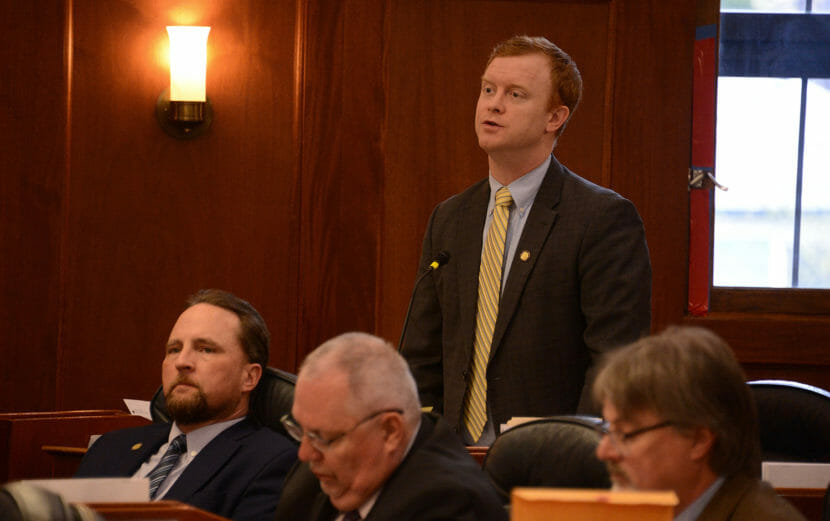
Rep. David Eastman, R-Wasilla, speaks on the floor of the Alaska House of Representatives on Monday, May 2, 2022 at the Alaska State Capitol in Juneau. (James Brooks/Alaska Beacon)
A trial on whether Wasilla Republican Rep. David Eastman is eligible for state office is set to begin on Monday, after a judge ruled on Friday against attempts by him and the state Division of Elections to dismiss the case.
The trial will focus on whether the Oath Keepers advocate the forceful overthrow of the U.S. government by “concrete” action, Anchorage Superior Court Judge Jack McKenna ruled.
Randall Kowalke sued to have Eastman ruled ineligible for violating the disloyalty clause of the Alaska Constitution. Eastman is reportedly a lifetime member of the Oath Keepers.
Eastman had argued that only the Legislature could determine whether he is eligible for office and that Kowalke didn’t have standing to challenge Eastman’s eligibility. McKenna ruled against Eastman on both issues, finding that the Legislature has given both the administration and the courts a role in elections and that state law allows anyone to challenge a candidate’s eligibility.
McKenna wrote that he will interpret the disloyalty clause of the state constitution in light of the protections included in the First Amendment of the U.S. Constitution. That means Kowalke will have to prove not only whether the Oath Keepers advocate the overthrow of the U.S. government, but also that they advocate or have taken concrete actions to overthrow it.
Kowalke argued that the Division of Elections should have ruled Eastman ineligible. The division said it shouldn’t be subject to a trial because it followed its regulations in not disqualifying Eastman.
McKenna ruled that state law requires the division to determine whether candidates for public office are eligible under the federal and state constitutions, as well as state law. So the division will also face trial.
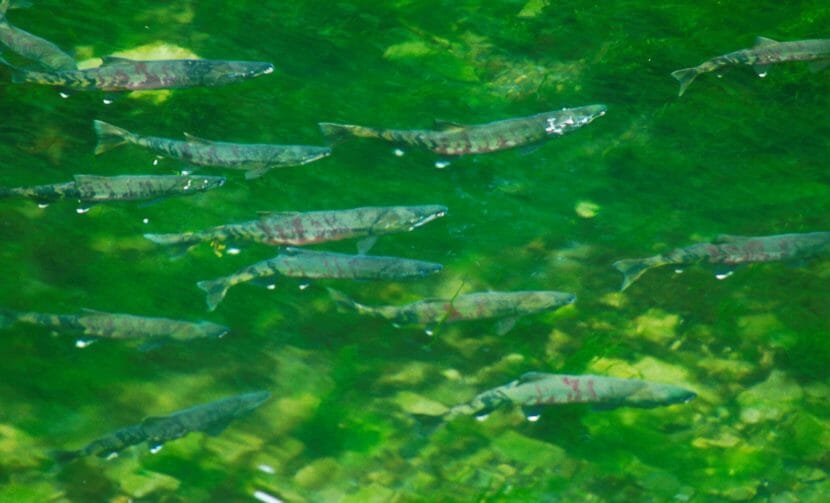
Spawning chum salmon spawning swim in 1990 in Kitoi Bay near Kodiak. With Western Alaska chum and Chinook salmon runs collapsing, there are widespread complaints that too many salmon are being intercepted at sea by large trawl vessels. A task force created by Gov. Mike Dunleavy has recommended multiple steps to address bycatch of salmon, halibut and crab. (Photo by David Csepp/NOAA Alaska Fisheries Science Center)
New controls on how fish are commercially harvested and more research to understand the effects of climate change in the ocean and in freshwater spawning grounds are some of the key recommendations of an Alaska task force examining ways to address bycatch, the term for capture of untargeted species in commercial seafood harvests.
Gov. Mike Dunleavy, who created the task force a year ago, released the group’s final report late Thursday.
“I look forward to working with task force members and stakeholders to do everything we can to get more fish to return to Alaska’s waters,” Dunleavy said in a statement.
The collapse of salmon runs vital to western Alaska — and public complaints that too many salmon were being intercepted at sea before returning to spawning grounds — triggered the creation of the Alaska Bycatch Task Force. However, its work extended to bycatch of various crab species and halibut.
To some degree, bycatch is unavoidable, the task force said.
“All fisheries have bycatch. Through our work we saw a need, and made recommendations for, continued work on incentives and methods to avoid and reduce bycatch. In regards to the long term, there is a need to find ways to better utilize unavoidable bycatch,” John Jensen, the task force chairman, said in an introductory statement in the final report.
One recommendation in the report is for the state to establish a “scientific-based” firm cap on chum salmon bycatch in the Bering Sea pollock fishery.
Such a cap has long been in place for Chinook salmon, a species that is the subject of a U.S.-Canada treaty. However, the North Pacific Fishery Management Council, the panel that regulates commercial fishing in federal waters, has so far declined to set any cap on bycatch of any other salmon species.
Another recommendation is to expand the number of people observing the trawl fleet operating in the Gulf of Alaska. To better track bycatch of prohibited species, all vessels conducting bottom trawling in the Gulf should have certified fishery observers posted onboard, the report said. Trawling is a term for fishing with a large, wide net that a ship drags, often to harvest groundfish near the sea bottom.
Those observers are already required on all pollock trawlers operating in the Bering Sea, but only partial observer coverage is currently required for vessels operating in the smaller Gulf of Alaska harvests.
The North Pacific Fishery Management Council is scheduled to review the task force findings at its ongoing meeting in Anchorage. The council is meeting through early next week to set 2023 groundfish harvest levels and take other actions.
The council on Friday rejected a proposed emergency rule that would bar fishing for six months in an area measuring about 3,900 square nautical miles that is considered to be essential habitat for red king crab.
The rule was requested by Bering Sea crab harvesters, who say the ban would prevent crabs from being injured or killed by trawl gear that scrapes the seafloor.
Emergency action is justified, Jamie Goen, executive director of the Alaska Bering Sea Crabbers organization, said in a letter to the council. “Time is of the essence for protecting this stock,” she said.
Representatives of the trawling harvesters oppose the emergency rule, questioning its efficacy. In their written comments to the council, leaders of the At-Sea Processors Association and United Catcher Boats say there is exceedingly low red king bycatch by the trawl fleet, and that pushing trawl vessels out of the designated red king crab protected area would increase the risk of bycatch of salmon and other species.
Ultimately, council members decided that the rule sought by the crab harvesters was not supportable.
“I agree most cerntaintly that this is an emergency. It just doesn’t merit the criteria of the emergency action,” member Andy Mezirow said before voting to with the rest of the council to reject the proposed rule.
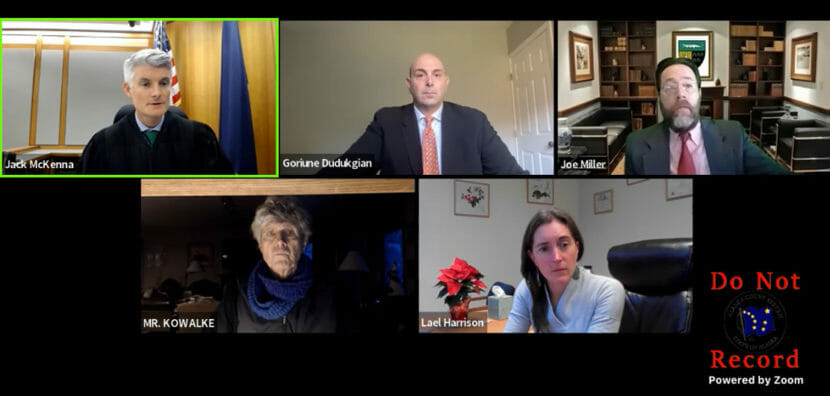
This screenshot from the Alaska Court System shows Anchorage Superior Court Judge Jack McKenna and the attorneys involved in the Thursday, Dec. 8, court hearing about the lawsuit challenging Rep. David Eastman’s eligibility for office. (Screenshot)
Attorneys representing the Alaska Division of Elections and Rep. David Eastman, R-Wasilla, urged an Anchorage Superior Court judge on Thursday to dismiss a lawsuit challenging Eastman’s eligibility for office and avoid a trial intended to determine whether Eastman has violated a Red Scare-era loyalty clause in the Alaska Constitution.
After more than an hour of oral argument, Judge Jack McKenna said he intends to issue a ruling by Friday. In the meantime, all sides should be prepared for a trial to begin Monday.
That trial is intended to answer two key questions:
Is Eastman a member of the Oath Keepers, a group whose leaders were convicted of federal crimes associated with the Jan. 6, 2021 insurrection at the U.S. Capitol?
Do the Oath Keepers advocate the overthrow of the U.S. government by force or violence?
If McKenna concludes that the answer to both questions is “yes,” he could rule Eastman ineligible to serve in the Alaska Legislature despite Eastman’s victory in the November general election. Eastman could be replaced in the Legislature by the second-place finisher.
That’s the hope of Randall Kowalke, a Matanuska-Susitna Borough resident who filed suit in July, hoping to force Eastman’s disqualification.
But before the trial may begin, McKenna must first rule on several preemptive defenses brought by the Alaska Division of Elections and Joe Miller, the attorney defending Eastman.
No mistake in approving Eastman, Division of Elections argues
In written arguments and in court on Thursday, attorneys representing the division said the agency did not make a mistake when it approved Eastman’s candidacy without investigating whether Eastman had violated Article XII, Section 4, of the state constitution.
That clause bans someone from holding office in Alaska if they “aid or belong to” a party or organization that “advocates the overthrow by force or violence” of the state or federal government.
Elections officials received almost two dozen complaints challenging Eastman’s eligibility under that clause, but attorney Lael Harrison said the division lacks the legal authority to conduct an investigation beyond simply examining public records.
State records, she said, don’t include a listing of what organizations a candidate belongs to or whether those organizations violate the disloyalty clause. Furthermore, she said, state law hasn’t given the division the ability to conduct independent investigations or issue subpoenas.
McKenna asked Harrison whether that conflicts with a state regulation requiring the division’s director to review candidate qualifications according to guidelines set by the federal and state constitutions, not just state law.
Kowalke’s attorneys have argued that the division must enforce the constitution’s disloyalty clause because no other state agency will, and McKenna has issued a preliminary order holding that the division does bear responsibility.
Harrison acknowledged the regulation but said there is a “total lack of standards” and a “total lack of criteria” as to how to enforce it.
“The plaintiff apparently believes the division … should have just started calling people, just get people on the phone: ‘Hey, does your organization advocate the overthrow by force or violence of the United States government?’” Harrison said.
Harrison and the division contend that the division took the steps that state law requires and should be dismissed as a party to the case. The state has taken no position on the question of whether the disloyalty clause applies to Rep. Eastman.
Eastman argues plaintiff lacks standing, authority to bring suit
Defending Eastman on Thursday was Joe Miller, the conservative Alaska attorney who twice ran for U.S. Senate against Lisa Murkowski.
In pretrial briefings and in court, Miller offered a variety of defenses against the lawsuit, saying Kowalke lacks standing to bring the case, that only the Legislature can judge a legislator’s qualifications, and that as a matter of law, Kowalke hasn’t presented facts before trial to show that Eastman or the Oath Keepers violate the disloyalty clause.
Miller said that because Kowalke doesn’t live in Eastman’s district, he is ineligible to bring a lawsuit against Eastman.
Goriune Dudukgian, representing Kowalke, said it is “pretty obvious that all Alaskans have an interest in what happens in Juneau,” and he pointed to a 1983 Alaska Supreme Court decision in which the court upheld the ability of a voter outside a district to challenge a state redistricting plan affecting another district.
Miller cited Article II, Section 12, of the state constitution, which says in part that “Each (house of the Legislature) is the judge of the election and qualifications of its members.” He argued that clause proves the Legislature, not the court, should determine Eastman’s eligibility. Because the Legislature voted against intervening in the lawsuit, Miller said, the case should be dismissed.
McKenna asked Miller about precedent — the Alaska Supreme Court has twice before ruled on cases in which a legislator’s eligibility was challenged under a clause of the constitution that prevents a legislator from holding another job with the state.
“So what’s really the difference between the disqualification in Article II, Section 5, and Article XII, Section 4?” McKenna said.
The difference, Miller said, is that in the prior cases, the court ruled on the “secondary issue, which is the dual offices provision,” not on the legislators’ qualifications.
As the arguments proceeded, McKenna asked Dudukgian how the disloyalty clause compares to the U.S. Supreme Court’s 1957 decision in Yates v United States, which ruled that the First Amendment protects radical speech unless it creates a “clear and present danger.”
“What’s the area that’s constitutionally protected, and what’s not?” McKenna said.
The line in the sand is incitement to action or actual action, Dudukigan said, “and that’s the case with the Oath Keepers.”
“There’s not a scintilla of evidence,” Miller said, that the Oath Keepers advocated the overthrow of the U.S. government or that Eastman did so.
The Jan. 6 insurrection at the U.S. Capitol, followed by guilty verdicts against Oath Keepers, prove otherwise, Dudukgian said. That was a unique situation, he said, rebutting an argument from Miller, who said that a ruling against Eastman could open a “Pandora’s box” of similar cases against politicians of all kinds.
“As far as opening up a Pandora’s box, I don’t think the court needs to be worried about that. Because what happened on Jan. 6, and what happened with the Oath Keepers, Proud Boys and some other organizations, was a unique event in American history where groups actually staged an armed rebellion and attempted coup in Washington, D.C.,” Dudukgian said.
“Nobody else has done what the Oath Keepers did, which is not just use rhetoric and words, but actually follow them up with actions, coordinated, planned and staged an armed rebellion in our nation’s capital,” he said.
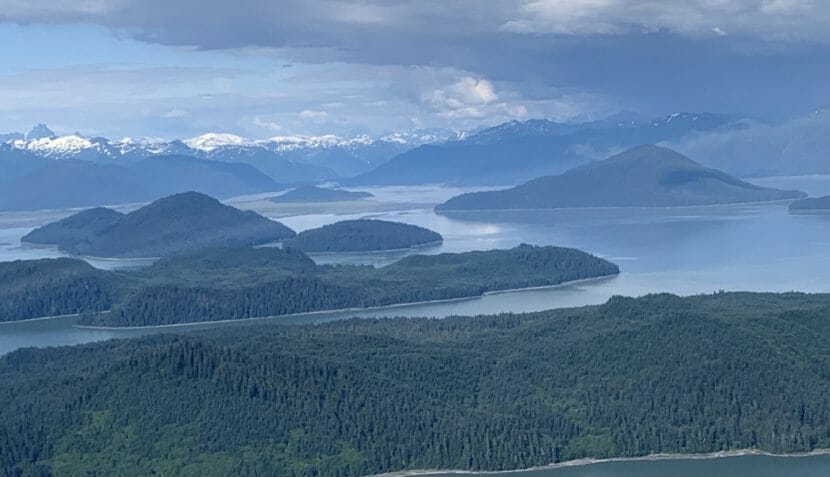
The Stikine River Flats area in the Tongass National Forest is viewed from a helicopter on July 19, 2021. The Stikine River flows from British Columbia to Southeast Alaska. It is one of the major transboundary rivers impacted by mines in British Columbia. Alaska tribes and communities are seeking some new protection to avoid downstream impacts. (Photo by Alicia Stearns/U.S. Forest Service)
Alaska Native tribes seeking better protection from the environmental impacts of Canadian mines have enlisted some allies in their flight: Lower 48 tribal governments with concerns of their own about transboundary mining impacts.
A delegation of tribal representatives from Alaska, Washington state, Montana and Idaho traveled to Washington, D.C., this week for meetings on Wednesday that pushed for action to regulate downstream effects of mines in British Columbia.
The meetings Tuesday and Wednesday were with Biden administration officials and officials at the Canadian embassy, said a statement from the National Wildlife Federation.
Chalyee Éesh Richard Peterson, president of the Central Council of the Tlingit and Haida Indian Tribes of Alaska, has a representative attending the meetings.
“Canada’s mining in our shared rivers is one of the biggest threats to our wild salmon and our Indigenous way of life,” Peterson said in a written statement. “In the face of a rapidly changing climate, British Columbia continues to permit massive open-pit gold mines in the headwaters of our largest salmon producing rivers – without the consent of downstream Tribes.
“Our way of life depends upon the health of our transboundary waters and we will not stop until we can ensure the environmental security and stability of our shared rivers. We have been calling on the United States and Canada to honor their legal and ethical obligations and to act immediately to protect our traditional territories from legacy, on-going, and proposed mining in British Columbia. We must get ahead of this before it’s too late.”
The tribes are seeking protective action under the Boundary Waters Treaty of 1909, the framework for resolving disputes over shared waters. The organization that investigates cross-border problems and recommends solutions is the International Joint Commission.
The Stikine-LeConte Wilderness Area, seen on June 18, 2014, is located near Wrangell and at the saltwater terminus of the river. The Stikine River flows from British Columbia, and downstream areas in Alaska are at risk from mining pollution generated in that Canadian province, tribal officials say. (Photo by Brian Logan/U.S. Forest Service)
Alaska tribes, communities, fishermen and various other organizations have for years expressed concerns about cross-border impacts from mines in British Columbia.
Teaming up with the Lower 48 tribes is a somewhat new approach, said Mary Catharine Martin of the Juneau-based group Salmon Beyond Borders. The tribes from different regions have different specific issues of concern, but they are similar in that they are about the “poorly regulated British Columbia mining that does not take into account the concerns of the people who live downstream,” Martin said.
The unified tribal campaign comes amid a British Columbia mining boom, with industry expenditures hitting a near-record level in 2021.
For Southeast Alaska, the main rivers affected by British Columbia mining are the Taku, Stikine and Unuk, Martin said. There are dozens of operating or formerly operating mines along those rivers, most of them gold producers with large quantities of waste material, she said.
Communities and organizations in Southeast Alaska have two specific goals they are trying to accomplish, Martin said. They are seeking a ban on mine waste dams on transboundary rivers shared by British Columbia and Alaska, and they want a pause on new mining in the key transboundary fivers “until all of us connected to the rivers are consulted and have a seat at the table,” she said
There is a British Columbia/Alaska Bilateral Working Group that addresses transboundary water issues, but that is largely an information-gathering and information-sharing organization. It does not have any enforcement powers.
The Biden administration has already taken some action on mining impacts to tribal areas in Montana and Idaho. The State Department in June called for an investigation by the International Joint Commission into selenium pollution flowing downstream into those states from coal mines operated by Teck Resources.
Icee Delgado, 9, gets a flu shot after getting her COVID-19 vaccine on Thursday, Nov. 11, 2021, at Riverbend Elementary School in Juneau, Alaska. (Photo by Rashah McChesney/KTOO)
Alaska’s flu season is worsening with no signs of leveling off, the latest surveillance report from the Alaska Department of Health showed on Wednesday.
This week, the Anchorage Daily News reported that unusually high rates of flu and respiratory syncytial virus are filling pediatric units at hospitals across the state, and the weekly flu report indicates no change in the situation.
“Based on this week’s flu snapshot, you can see that the rate is still going up precipitously, and there’s no sign of it leveling off,” said Dr. Joe McLaughlin, Alaska’s state epidemiologist.
This season is unusually early and hard-hitting by historical standards; Alaska’s flu season typically runs from October through May, peaking in February, but the number of laboratory-confirmed flu cases began rising in late October and has already passed the February 2019 peak of the last pre-pandemic flu season.
This week’s national flu-tracking report has yet to be published by the Centers for Disease Control and Prevention, but as late as last week, the CDC rated Alaska’s influenza level as “low” compared to other states, another sign that conditions here may worsen before they improve.
“We know that the influenza infection rates were the highest early on in the Southeastern part of the United States,” McLaughlin said, “and then they gradually made their way westward and northward. We are the furthest west and the furthest northern state in the United States, and so it could be that the worst of the flu season is still ahead of us.”
If there is positive news, McLaughlin said, it’s that this year’s flu vaccine appears to be a good match for the most commonly circulating strains of flu.
“That means if you’ve been vaccinated, your chances of getting influenza infection — if you’re exposed — go down. And then if you do wind up getting a breakthrough infection, you’re typically going to get a milder infection that’s going to last a shorter period of time, and it will be associated with lower risk of hospitalization and death,” McLaughlin said.
Alaska’s flu vaccination dashboard, published by the Department of Health, shows only 20% of Alaska residents at least 18 years old have been vaccinated for the flu this year.
“We’re currently seeing very low rates of vaccination against influenza, as well as the COVID booster. And we are still seeing a lot of hospitalizations, and unfortunately, many preventable deaths due to COVID across the nation,” McLaughlin said.
He said that antiviral medicines are available with a prescription if someone is infected, but prevention is still important, particularly during the holidays.
He advises skipping holiday parties if you’re feeling ill and using the methods that worked during the COVID pandemic — wearing masks, social distancing, avoiding people who are sick.
“Fortunately, our COVID rates are much lower now than they were last holiday season. So that’s a really good thing. But we do still have lots of other respiratory pathogens circulating, and we have very high hospitalization rates, especially among children. So it is going to continue to be important during this holiday season for people to remain vigilant and protective and try to do what they can to protect themselves and their loved ones from getting a respiratory infection,” he said.
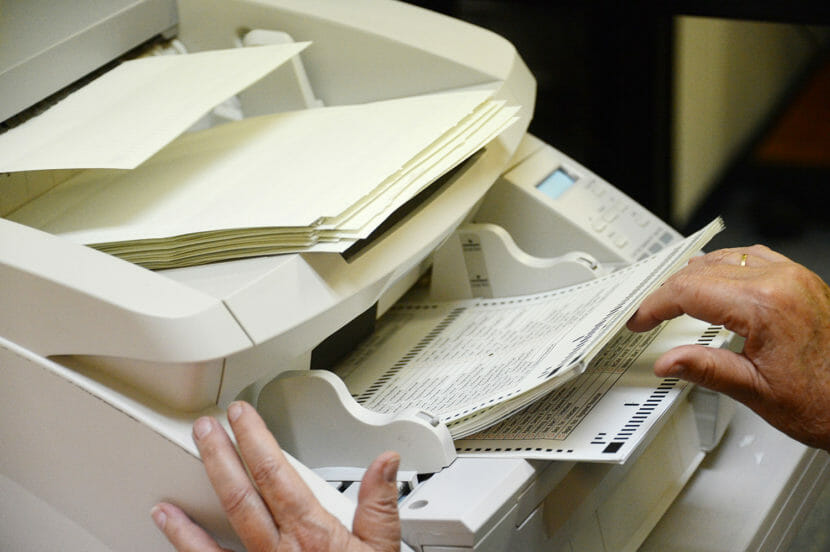
Laraine Derr feeds ballots through a scanner on Wednesday, June 15, 2022 at the Division 1 office of the Alaska Division of Elections in Juneau, Alaska. Derr was among elections workers counting ballots in Alaska’s special U.S. House primary election. (Photo by James Brooks/Alaska Beacon)
Ballots from six rural Alaska villages were not fully counted in Alaska’s November elections, the Division of Elections said Friday. A division official said the U.S. Postal Service failed to deliver them to the state election headquarters before the election was certified on Nov. 30.
“You’ll need to contact the USPS to find out why there were some that never arrived — as we were told from poll workers, everything had been mailed,” said Tiffany Montemayor, the division’s public relations manager, by email.
As a result, 259 voters in St. George, Levelock, Ambler, Kiana, Kobuk and Noorvik had their ballots only partially counted, the division said.
“The Postal Service is aware of six canvas bags that arrived after the November 30th final deadline. We regret the issues caused by this incident and are reviewing the process with the Alaska Division of Elections to avoid any recurrence in future elections,” said James Boxrud, communications manager for the Postal Service’s WestPac Area.
Though the failed delivery did not change any election results, it adds to a record of rural-voting problems this year.
After the August special election for U.S. House, seven villages’ ballots failed to reach elections officials in time to be counted.
Also in August, two polling places failed to open as planned. In November, two other rural polling places opened late on Election Day.
In addition, a disproportionately large number of ballots from rural Alaska were rejected in the June by-mail special primary to fill the U.S. House seat left vacant by the death of Congressman Don Young.
“It’s not an awesome trend,” said Michelle Sparck of Get Out The Native Vote, a group that encourages voter participation in Alaska’s rural, predominantly Native, communities.
The problems caused by November’s missing ballots were exacerbated by the state’s implementation of the new ranked choice voting system.
At 131 of Alaska’s 401 voting precincts, ballots are counted by hand, with results telephoned to elections officials, who add them to the results and publish a preliminary report.
Alaska’s new ranked choice voting system uses a computerized sorting process to determine final winners in close races, which means each ballot must be scanned to get a final result.
In Maine, ranked choice ballots are trucked to the state capital for processing. Here, that isn’t possible, so elections officials arranged for them to be mailed to Juneau.
Alaskans for Better Elections is the nonpartisan nonprofit backing ranked choice voting in Alaska. Amanda Moser, chief strategy officer for the group, said the failure of all ballots to arrive on time is “unfortunate” because “these voters didn’t have the opportunity to have their maximum voice included.”
“Moving forward, really working with the Division of Elections and other statewide partners that are in this space, we need to find the best path in order to make sure that all Alaskans have the opportunity to have their full voice expressed in the election,” she said.
After the partial failure in August, elections officials paid to have the completed ballot packages sent by USPS Express Mail.
As of Monday morning, the packages from the six villages still had not arrived in Juneau.
Asked whether elections officials have a new plan, Montemayor said that as of Friday, they did not but will look at other options in the upcoming year.
Last year, the administration of Gov. Mike Dunleavy proposed a bill that would allow the Division of Elections to mandate by-mail voting in small communities where hiring poll workers is difficult. That bill did not pass the Legislature.
Sparck said any solution that involves the U.S. Mail in rural Alaska needs to be reconsidered.
“We don’t do well by mail,” she said of rural Alaska voting, “whether it’s weather or postal service staffing issues or English as a second language disadvantages.”
“I can’t say that’s a better alternative,” she said.