Alaska Beacon is part of States Newsroom, a network of news bureaus supported by grants and a coalition of donors as a 501c(3) public charity. Alaska Beacon maintains editorial independence. Contact Editor Claire Stremple for questions: info@alaskabeacon.com. Follow Alaska Beacon on Facebook, Bluesky and Twitter.
The entrance of the University of Alaska Southeast in Juneau as seen on May 25, 2022. (Photo by Lisa Phu/Alaska Beacon)
The University of Alaska faculty union membership has ratified a tentative contract agreement with the University of Alaska administration. United Academics certified the ratification vote results Monday.
The union membership ratification is another step in the process toward implementing the contract. The Board of Regents approved the tentative contract during its November meeting. The final step is approval from the Alaska Department of Administration.
The tentative agreement includes faculty salary increases of 3%, 2.75% and 2.5% over three years, which are slightly higher than the administration’s original “best and final offer” of 3%, 2.5% and 2%. The contract is retroactive to July 1, 2022. To provide back pay for the salary increase, the university will request it as a supplemental budget item in the coming legislative session. The overall compensation increases will be included in the university’s budget request submitted to the Legislature for funding approval.
“Salary increases do rely on legislative appropriation and the Governor’s signature on the budget,” said Robbie Graham, University of Alaska associate vice president of public affairs, speaking on behalf of the administration in an email.
Faculty union President Abel Bult-Ito has “no doubt” that the legislature will fund it. He said ratifying the contract “provides some stability for the next couple of years” and shows “the unity of the union.”
About 50% of the union’s 677 eligible voters — or 344 members — voted. Of those, 324, or 94%, voted to approve the tentative agreement. Normally, only 30 to 40% of the membership votes, said Bult-Ito. But he thinks having part of the negotiation process open to the union members through Zoom increased interest. “Of course, we would like to see everyone vote but, you know, over 50% is a good deal,” he said.
Bult-Ito said the relationship between the union and administration is “still very strained but hopefully agreeing to the contract takes the pressure off a bit and improves it.”
During the lengthy negotiation process, both the union and the administration filed unfair labor practice complaints with the Alaska Labor Relations Agency — the union in August and the administration in September. The state agency is still collecting briefings for both complaints.
The two parties are due to be back at the negotiation table in August 2024.
A copy of the Alaska Constitution is seen on Thursday, July 28, 2022. (Photo by James Brooks/Alaska Beacon)
In November 1955, the 55 delegates of Alaska’s constitutional convention gathered in Fairbanks, intent on drafting the fundamental document for a new state. But before they began, each member stood and swore an oath, declaring they were not a member of the Communist Party and did not support any organization that advocated the overthrow of the U.S. government.
In the 75 days that followed, the delegates debated the form of Alaska’s state government, sometimes asking themselves how the state might be governed during a nuclear war or if Alaska was invaded by the Soviet Union.
Encouraged by Congress, they included a clause that forbids someone from holding public office if they aid or belong to a group that advocates the overthrow of the U.S. government.
This month, 67 years after the delegates gathered in Fairbanks, that clause will be judged in court for the first time.
Though it was written during the waning days of the anticommunist scare of the 1950s, the clause will be tested against a member of the political right, Rep. David Eastman, R-Wasilla. Eastman has been accused of violating the clause by holding a lifetime membership in the Oath Keepers, a right-wing militia group whose founder was convicted of sedition in connection with the Jan. 6, 2021, insurrection at the U.S. Capitol.
The lawsuit challenging Eastman’s eligibility was filed by a Matanuska-Susitna Borough resident, Randall Kowalke, who said his goal is to determine the clause’s limits.
“I think the takeaway is, what’s our level of tolerance? What are we going to allow from our candidates or representatives? Are we going to allow full-blown communists? Jihad folks? Fascists? Particularly those that are supporting the overthrow of our government? I guess it’s time to find out,” he said this summer.
Attorneys representing Kowalke are asking Anchorage Superior Court Judge Jack McKenna to declare that Eastman is a member of the Oath Keepers, that the Oath Keepers advocate the overthrow of the U.S. government, and that the constitution’s disloyalty clause prohibits Eastman from holding office.
On the first point, Kowalke’s attorneys have already provided documentation showing Eastman is a “founding lifetime member” of the group. For the second, they have been aided by last week’s sedition conviction, though it’s not clear whether the judge will rule that the entire group holds its leader’s views.
The third point may be the most difficult: In order to succeed, Kowalke’s attorneys will have to demonstrate that the disloyalty clause doesn’t violate state and federal guarantees of free speech.
For decades, sedition laws in other states and those passed by the federal government have been invalidated by judges or rewritten by legislators.
Only if they succeed on all fronts, will Eastman be replaced in the state House by the No. 2 finisher in this fall’s election, Republican Stuart Graham.
If they fail, the disloyalty clause could become irrelevant, similar to the way the Alaska Constitution’s ban on gay marriage was invalidated by court order.
On Dec. 8, attorneys will argue in court about whether the case should proceed to trial. If a judge rules in the plaintiffs’ favor, the trial is slated to begin the following week, with a decision possible by the middle of the month.
Alaskans’ disloyalty, defined by Hawaiians
Kowalke filed his lawsuit in July against Eastman and the Alaska Division of Elections, which is accused of improperly approving Eastman’s candidacy. In a court filing last month, state attorneys defending the division traced the origins of the Alaska Constitution’s disloyalty clause to a visit by a U.S. senator to Hawaii in 1948 during a push for statehood there.
Hugh Butler, a Republican from Nebraska, said in a memo published the following year that his visit “leaves me with the deep conviction that international revolutionary communism at present has a firm grip on the economic, political, and social life of the Territory of Hawaii.”
Butler’s belief was based on strikes by the International Longshore and Warehouse Union in 1948 and 1949.
Though his claims about communist infiltration were unsubstantiated, Butler was chair of the Senate committee in charge of American territories, and his belief contributed to the defeat of statehood for Hawaii at that time.
In response to Butler’s comments and those of anticommunist senators, his committee in 1950 amended a Hawaii statehood bill to require that its constitution contain a clause stating that “no person who advocates, or aids or belongs to any party … which advocates the overthrow by force or violence of the government … shall be qualified to hold any public office under the state constitution.”
When Hawaii’s constitutional delegates met later that year, they inserted a clause into their constitution that copied the congressional language almost word for word.
Alex Goodall, a lecturer at University College London, is a historian who has studied the period and authored a history of America’s efforts to fight subversion.
By 1947, he said by email, fear of the Soviet Union was nearing its peak. The Truman and (later) Eisenhower administrations identified and investigated thousands of government employees for possible disloyalty.
“Potential subversive organizations were assumed to include revolutionary leftist groups like the Communist Party USA as well as right-wing organizations such as the Nazi Party and the Ku Klux Klan,” he said by email.
Thousands of gay men and women were also fired from their jobs during these investigations because they were considered possible security threats.
“Although Second Red Scare fears were on the wane by the later 1950s, it would again seem logical to see the Alaska Constitution as a continuation of these practices at the state level,” Goodall said.
Hawaiian statehood — as well as Alaska’s — was delayed throughout the 1950s by opposition from members of the U.S. House. During that time, statehood bills were repeatedly introduced and defeated. One in 1955 stated that any constitution for Alaska or Hawaii must contain a disloyalty clause as a condition of statehood.
Though that bill never became law — and the later Alaska Statehood Act didn’t include the requirement — delegates at the constitutional convention in Fairbanks operated under the belief that the disloyalty clause was required.
The minutes of the convention contain few references to the clause, and delegate Victor Rivers noted during debate that it “is an antisubversive section, which is required, as we understand it, one of the required clauses of this constitution.”
The language used by the delegates — still in effect today — was identical to the wording used by Hawaii’s drafters in 1950.
But Hawaii has changed its wording since then. Anne Feder Lee, who wrote a book analyzing the Hawaiian constitution, noted that when Hawaii held a constitutional convention in 1968, “delegates recognized that rulings by the U.S. Supreme Court had made this language unconstitutional, as violative of the rights to association and belief guaranteed by the First Amendment to the U.S. Constitution.”
At the time, Hawaiian delegates considered deleting the section entirely but instead modified it that year and again at a convention in 1978.
The modern language now requires someone to be convicted of attempting to overthrow the government or conspiracy to overthrow the government before being disqualified.
Former Trump adviser John Eastman offers testimony
Eastman hasn’t been convicted or even accused of attempting to overthrow the government. He flew to Washington, D.C., ahead of the Jan. 6 insurrection and attended former President Trump’s rally preceding the insurrection, but in pretrial depositions and filings, he said he approached — but never entered — the restricted area around the U.S. Capitol.
Goriune Dudukgian is one of Kowalke’s attorneys and said the case isn’t about trying to put Eastman in jail.
“This isn’t a case about criminal liability. We’re not trying to send Rep. Eastman to jail. And we’re also not asking him to quit the Oath Keepers. It’s just a matter of whether he’s eligible to serve under the Alaska Constitution,” he said.
The Division of Elections, though a defendant in the lawsuit, isn’t taking a stance on that issue. Dudukgian and Kowalke’s other attorneys argue that the division failed to enforce the constitution when it certified Eastman’s eligibility for office without attempting to verify any of almost two dozen challenges.
The division, through attorneys assigned by the Alaska Department of Law, has said that it doesn’t have the power to investigate loyalty claims.
“No statute provides any guidance or other process for the division to determine a candidate’s loyalty to the government,” state attorneys wrote.
Kowalke’s attorneys disagree, saying the state constitution requires an investigation. A preliminary decision has gone in their favor but could be changed after further argument.
The bulk of the case is a challenge by Kowalke against Eastman, who is represented by attorney Joe Miller, a former two-time candidate for U.S. Senate.
Miller has offered a variety of preemptive defenses, including that the court lacks jurisdiction, that Kowalke lacks standing to bring a lawsuit, and that he failed to state a proper claim.
Kowalke’s attorneys have attempted to shoot down each of those defenses ahead of a Dec. 8 summary judgment hearing. If Kowalke wins that hearing, the case will proceed to a trial that is expected to last at least a week.
To help his defense, Eastman has the support of John C. Eastman, a constitutional attorney and former Trump adviser. The two men are not related.
In written expert testimony, John Eastman noted that the language of Alaska’s disqualification clause (and Hawaii’s before that) resembles a 1940 law known as the Smith Act that was intended to punish sedition before America’s entry into World War II.
In 1951, Communist Party officials convicted under the act appealed to the U.S. Supreme Court, and the justices ruled in favor of the act’s legality.
But six years later — 14 months after Alaskans ratified their draft constitution — the Supreme Court partially reversed itself, saying that free speech is protected unless it poses a “clear and present danger.”
Donna Haverty-Stacke, a professor of history at Hunter College in New York, has studied historical free speech prosecutions and noted that the 1957 decision “defanged the Smith Act. You needed to show that the speech led to imminent action.”
Alaska’s constitutional disloyalty clause, approved with the rest of the constitution in 1956, arrived just as public views of free speech were changing.
“Right at the moment where things are starting to thaw, Alaska put this in its constitution,” she said.
In 1966, the Georgia Legislature refused to seat Julian Bond, an activist who opposed the Vietnam War. Among the arguments made against him was the idea that his statements violated his oath to defend the Constitution of the United States.
The U.S. Supreme Court, citing the First Amendment, ruled in Bond’s favor, Eastman said, suggesting that a similar argument should prevail here.
“Under these precedents,” John Eastman wrote, “Representative Eastman’s current membership in the Oath Keepers is protected by the First Amendment, both against criminal indictment and exclusion from office.”
Kowalke’s attorneys are taking a different approach. In writing, they said the disloyalty clause is akin to the Alaska Constitution’s residency and age requirements for a legislator.
“Here, Alaska’s disqualification for disloyalty clause is nothing more or less than an additional constitutional qualification for officeholding and should be interpreted accordingly,” they wrote.
Kowalke’s attorneys suggested the court shouldn’t interpret Alaska’s disloyalty clause as banning someone from speaking abstractly about the destruction or overthrow of organized government. Instead, they said, relying on language from the 1957 Supreme Court decision, that it should be interpreted as requiring advocacy of “concrete action for the forcible overthrow of the government.”
“When judged against this standard, the words and actions of the Oath Keepers go well beyond the line of First Amendment protected speech,” they wrote.
Whatever decision Judge McKenna reaches this month, an appeal to the Alaska Supreme Court is expected. If the case is decided on First Amendment grounds, it could also head to federal court and possibly the U.S. Supreme Court.
One act could short-circuit that whole process. If Eastman quits the Oath Keepers and disavows his membership, there’s no longer a potential violation of the disloyalty oath.
“If he unequivocally and completely disavows his membership and he says, ‘Given the conviction of Rhodes and the other Oath Keepers, I’m hereby terminating any association that I have in the organization,’ then it would probably go away,” Dudukgian said.
“I don’t see that happening. But if it did, we’d have to look at it and make a final decision.”
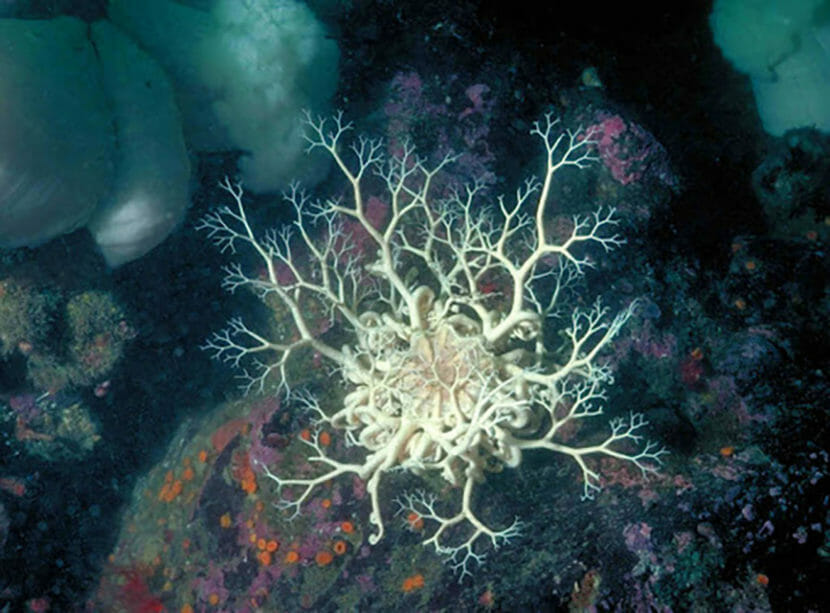
A basket star is seen on the Alaska seafloor. If ocean warming continues on its current trajectory, marine life at the bottom of the Bering Sea and Chukchi Sea will look a lot different in the coming decades, according to a new study. The seafloor environment will be too warm for the snails, worms, clams and mussels that make up the diets of walruses and some seabirds and fish species. But basket stars like this one and related brittle stars — species that do not currently play much of a role in the food web — are expected to thrive in the warmer temperatures. (Photo provided by NOAA Alaska Fisheries Science Center)
There is danger lurking on the floor of the Bering and Chukchi seas for mussels, snails, clams, worms and other cold-water invertebrates, according to a new study led by National Oceanic and Atmospheric Administration scientists.
If climate change continues its current trajectory, the Bering and Chukchi seafloor areas will be too warm for those creatures by the end of the century.
In turn, that means trouble for walruses and other marine species. Snails and mussels are particularly important to commercially harvested fish like halibut and yellowfin sole, along with being prey for the Pacific walruses that gather in the summer in the northern Bering and southern Chukchi seas. The Bering Sea is part of the North Pacific Ocean south of the Bering Strait that separates Alaska from Russia, while the Chukchi Sea is part of the Arctic Ocean just north of the strait.
The results warn that those seafloor-dwelling populations of invertebrates that support populations of Bering Sea and Chukchi Sea marine mammals “may be seriously impacted by future ocean warming,” the study said. That also affects coastal residents who depend on traditional harvests of walruses and seabirds for food and cultural connections, the study said.
Under the current climate trajectory, key cold-water bottom-dwelling prey species are on track to lose half of their suitable habitat by mid-century, the study said. By the end of the century, almost the entire Bering and Chukchi sea region would be too warm for them to live on the seafloor there, the study found.
The resulting seafloor habitat would be taken over by a few species that can tolerate a wide range of temperatures – creatures like brittle stars and basket stars, relatives of sea stars. But those marine species are very minor players in the food web.
The study is a cooperative effort of scientists from NOAA’s Alaska Fisheries Science Center, NOAA’s Pacific Marine Environmental Laboratory, the University of Washington and the Institute of Marine Research in Norway.
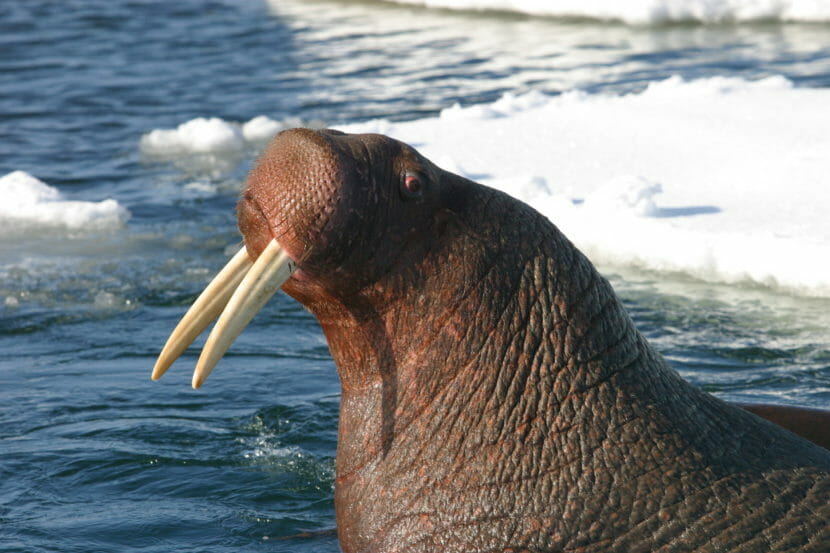
A young bull walrus rests on a piece of sea ice in Alaska waters on April 13, 2004. Walruses eat clams, mussels, snails and worms that live on the seafloor. Projected ocean warming threatens those food supplies and may force walrus populations farther north. (Photo by Joel Garlich-Miller/U.S. Fish and Wildlife Service)
It uses a decade’s worth of data to calculate the preferred temperatures for a variety of species that dwell on the bottom of the sea in areas of the Bering and Chukchi that normally have seasonal ice coverage.
In the past, that data has been used to understand fish and crab populations that are important to the commercial seafood industry. The new study, however, used the data to examine the prospects for sometimes overshadowed bottom-dwelling species. That makes it the first examination of climate-change impacts on the entire suite of invertebrates living on the seafloor environment there, said lead author Libby Logerwell of NOAA’s Alaska Fisheries Science Center.
The prospects appear grim for most of them – and for the species that need them for food.
“The climate models under this ‘business-as-usual’ climate change scenario project that the thermal habitat for all but the few most heat-tolerant arctic invertebrates will shrink dramatically northward by the end of the century,” Logerwell said by email.
The species that would benefit account for only about 8% of the animal groups currently in the environment, the study said.
Because the study projects into the future, its findings do not explain the recent crash in Bering Sea crab stocks, Logerwell said. The “thermal habitat” for crab still exists through much of the Bering, she said. However, long-term prospects appear to be poor if climate change continues on its current trajectory. Habitat with suitable temperatures for crab species is likely to move farther north, she said.
The study was published in the journal Deep Sea Research Part II: Topical Studies in Oceanography.
A notice posted on a bulletin board at the University of Alaska Anchorage’s School of Allied Health, seen on Wednesday, warns about rising rates of syphilis. The notice provides information about prevention and treatment. Alaska has some of the nation’s highest rates of sexually transmitted diseases, including syphilis, and the escalating trend is continuing, according to newly released state statistics. (Photo by Yereth Rosen/Alaska Beacon)
Syphilis cases in Alaska increased dramatically last year, continuing a pattern in a state that in recent years has had some of the nation’s highest rates of sexually transmitted diseases, health officials said.
Alaska recorded 447 cases of syphilis last year, a 24% increase over the 2020 total, according to a bulletin released Wednesday by the state Division of Public Health’s epidemiology section. Cases were almost evenly split between men and women, and 89% of the cases were among urban residents, the bulletin said. Five of the cases were recorded as congenital, meaning that they were among babies born to infected mothers.
Syphilis is especially dangerous for infants, for whom it can be fatal.
The rise in syphilis is a national trend, the bulletin noted. Perennial factors like substance abuse, poverty and lack of stable housing were compounded by the COVID-19 pandemic, which interrupted access to preventive services and care for those infected, the bulletin said.
Even among other state’s rising rates, Alaska’s problems with sexually transmitted diseases stand out.
Of all U.S. states, Alaska in 2020 had the nation’s third-highest rates of syphilis and chlamydia and the eighth-highest rate of gonorrhea, according to the Centers for Disease Control and Prevention.
Alaska case numbers started their dramatic increase in 2019, more than doubling from the previous year before jumping to 323 in 2020, which was followed by the total of 447 in 2021.
That pattern appears to be continuing in 2022. So far this year, the state has had at least eight cases of congenital syphilis, Clinton Bennett, Department of Health spokesperson, said by email.
There are many factors that combine to produce such high rates in Alaska, Bennett said.
One likely contributor, he said, is Alaska’s relatively youthful population, with one of the youngest median ages; rates of sexually transmitted infections “tend to be higher among teens and young adults,” he said. Other likely contributors include reduced access to health care — even in Anchorage, the biggest city, where people experiencing homelessness, who are disproportionately affected, “have challenges with transportation to get to a clinic for testing and/or treatment,” he said.
There are limited free or testing and treatment options, and Alaska’s public health infrastructure is also more limited than those in other states, affecting outreach and partner work, he said.
The epidemiology bulletin includes 15 recommendations for better diagnosing syphilis and preventing its spread. Those recommendations include screenings of all pregnant patients during their first prenatal visits, along with possible follow-up screenings; administration of pregnancy tests for reproductive-aged syphilis patients; and periodic comprehensive screening of patients in certain high-risk categories for multiple sexually transmitted infections.
Alaska already requires the initial syphilis screening for pregnant patients that is recommended in the epidemiology bulletin, Bennett noted.
The problems of rising rates of syphilis and other sexually transmitted diseases extend well beyond Alaska.
In Washington state’s King County, the local district that includes Seattle, public health officials have recorded a five-fold increase in syphilis among women since 2015, for example. That includes an increase in congenital cases among babies, a danger that has prompted health officials to recommend routine syphilis screenings for all sexually active women 45 and younger.
The trend exists outside of the United States as well. The COVID-19 pandemic is being blamed for disrupting HIV testing and prevention programs throughout Europe and delivering a setback to goals of eradicating that disease.
Elections workers double-check the results of Alaska’s Aug. 16, 2022 primary election during a meeting of the state review board on Tuesday, Aug. 30, 2022 at the Alaska Division of Elections in Juneau. (Photo by James Brooks/Alaska Beacon)
The Alaska Division of Elections uneventfully certified the results of the state’s Nov. 8 general election on Wednesday, becoming the 26th state to finalize its election.
None of Alaska’s 62 legislative and statewide races changed leaders as members of the multipartisan state review board examined unofficial results for accuracy, then signed an oath on Tuesday.
All three statewide incumbents — Republican Gov. Mike Dunleavy, Republican U.S. Sen Lisa Murkowski, and Democratic U.S. Rep. Mary Peltola — were re-elected.
In the state’s closest race, Anchorage Republican Rep. Tom McKay leads Democratic challenger Denny Wells by seven votes, a slight increase from the four-vote lead he held when final unofficial results were announced a week ago.
The margin is well within the range for a state-paid recount, which Wells must request within five days. Speaking on Wednesday afternoon, he said he had not made a final decision but was leaning toward that request.
Also Wednesday, attorney Stacey Stone said four west Anchorage residents who attempted to challenge the eligibility of Rep.-elect Jennifer “Jennie” Armstrong will refile their case.
Armstrong, a Democrat, defeated Republican Liz Vazquez by 805 votes in the final result, but the four residents — all Vazquez supporters — have alleged that Armstrong did not live in Alaska long enough before registering as a candidate for office.
An Anchorage judge dismissed a prior version of the lawsuit, saying it was untimely and needed to be refiled after the election.
A third state House seat is also subject to legal challenge. Incumbent Rep. David Eastman, R-Wasilla, won re-election with 51.3% of the vote in his state House district, but a Matanuska-Susitna Borough resident has accused him of violating the Alaska Constitution’s disloyalty clause.
Eastman is listed in the roster of the Oath Keepers, a right-wing militia, as a lifetime member, and a lawsuit from resident Randall Kowalke claims that membership violates a constitutional clause that prevents someone from holding public office or working for the state if they belong to (or support) a group that advocates the overthrow of the U.S. government by force.
A trial has been tentatively set for the second full week of December to decide the issue, but preliminary arguments on Dec. 8 could negate the need for a trial.
All three races are significant for control of the Alaska House. Final results show Republican-registered candidates controlling 21 seats in the 40-person House, enough to control the body and dictate the flow of legislation.
It remains unclear whether those Republicans will stay unified or whether divisions among Republicans will cause some to defect to the multipartisan coalition that has controlled the House since 2016 but now doesn’t hold a majority of seats.
In the state Senate, the final results did not result in any changes to the makeup of a 17-member coalition majority that now controls the 20-person Senate.
Last week, a group of Republicans and Democrats announced that they will jointly control the Senate, excluding three more-conservative Republicans from leadership.
The cast-vote record, indicating how Alaskans voted in the state’s ranked-choice elections, is expected later this week, an elections official said.
The Port of Alaska is seen from the air on Aug. 11, 2022. (Photo by Yereth Rosen/Alaska Beacon)
If a nationwide rail strike takes place this month, the Alaska Railroad will keep moving, but tie-ups in the Lower 48 could disrupt cargo that comes to Alaska from Seattle and Tacoma, officials said this week.
Several unions are planning a strike that could begin as soon as Dec. 9 after the failure of contract negotiations between those unions and the nation’s largest railroads.
The biggest sticking point is the issue of health and personal leave. Unions say workers have been forced to work grueling schedules due to short-staffing and policies that prevent workers from taking leave to address health issues and personal problems.
President Joe Biden negotiated a compromise deal to avoid a strike in September, but workers at four of the 12 unions involved in the negotiations voted down the proposal. Those four unions represent a majority of workers in the 12 groups.
Now, the strike is looming again, and Biden is urging Congress to pass legislation that would force workers and rail companies to accept a strike-averting deal.
Rep. Mary Peltola, D-Alaska, said on Tuesday that she will not vote for the legislation in its present form.
“I just don’t think it’s right or fair to expect workers to go to work sick as a dog without being able to have a few days to recover,” she said in an interview with NBC News.
Railroads carry 28% of America’s freight, according to pre-pandemic figures published by the Federal Railroad Administration. While most Christmas gifts are already on shelves, any disruptions to that freight traffic could lead to shortages of some products.
Asked whether a strike could cause catastrophic damage to the national economy, Peltola said, “I think it could also cause a catastrophic damage to the nation’s economy if we’re expecting a whole sector of employees to go to work sick,” she said.
Alaska’s two U.S. senators have yet to take a public position on the strike-averting legislation.
Here in Alaska, 68% of employees at the state-owned Alaska Railroad are unionized, but those unions aren’t part of the current labor struggle, said Christy Terry, the railroad’s director of external affairs.
“The strike will not affect our service within Alaska,” she said in an email.
“The only impact we will encounter, due to the strike, will be with railcars that originate in the Lower 48 and are interchanged to us in Seattle,” she said.
Though the Alaska Railroad isn’t directly connected to the Lower 48, it does operate a rail-marine barge service that takes railcars from Seattle to Whittier and back.
In 2021, that barge accounted for 8.7% of all railcars moved on the railroad, but the service solely carries heavy industrial goods, not things bound for store shelves, Terry said.
“Yes, there would be an impact if there was a service disruption, but solely (on) commercial goods. Those would be along the lines of mining, oilfield, construction, etc.” she said.
She and others said that if Alaska sees any disruption during a rail strike, it would most likely be at the southern end of Alaska’s supply chain, where goods are loaded onto ships and barges bound for the Port of Alaska in Anchorage or smaller facilities in Southeast Alaska, Kodiak, Unalaska and along the coast.
Dylan Faber is the government and community relations manager for Matson, which ships regularly to Alaska. He said there are no plans to change the shipping schedule here.
“And I haven’t seen any hiccups in the schedule that indicate that we would have any impact,” said Jim Jager, director of external affairs for the Port of Alaska. “The problem is: Do the goods get to Tacoma?”
The Northwest Seaport Alliance is the combined port authority for Seattle and Tacoma, and rail service carries more than half of the cargo imported inland through those ports, said Melanie Stambaugh, the authority’s communications director.
“A rail service stoppage would likely lead to cargo containers remaining on marine terminals for longer periods of time,” she said in an email. “Marine Terminal capacity is limited and large quantities of containers remaining on terminal can reduce how quickly vessels can be unloaded/loaded.”
That could disrupt outbound shipments to Alaska, but it’s impossible to tell how large the disruption would be.
During the COVID-19 pandemic, the port authority created “near-dock container yards to handle surge cargo capacity,” Stambaugh said. “These yards can offer some relief in the event of a rail strike.”
Furthermore, she added, “Many products that move north to Alaska are sourced in the Puget Sound, and these products should not be impacted by rail.”