Alaska Beacon is part of States Newsroom, a network of news bureaus supported by grants and a coalition of donors as a 501c(3) public charity. Alaska Beacon maintains editorial independence. Contact Editor Claire Stremple for questions: info@alaskabeacon.com. Follow Alaska Beacon on Facebook, Bluesky and Twitter.
The offices of the Alaska Permanent Fund Corp. are seen Monday, June 6, 2022 in Juneau, Alaska. (Photo by James Brooks/Alaska Beacon)
On Monday, the cryptocurrency bank BlockFi filed for bankruptcy, the announcement coming less than three weeks after the financial implosion of FTX, one of the world’s largest cryptocurrency exchanges.
The collapse of free-wheeling and unregulated cryptocurrencies is having an impact on investors who were at the bleeding edge of finance, but the impact on the $76.7 billion Alaska Permanent Fund has been muted, according to public records and statements from officials at the corporation that governs the fund.
“For a while, we were getting a lot of letters saying that it was crazy we don’t own any cryptocurrency,” said Marcus Frampton, chief investment officer for the Alaska Permanent Fund Corp., speaking in an August interview.
“Those letters have slowed down a little bit,” he said at the time.
While the corporation’s publicly listed assets don’t include cryptocurrency, the fund has invested in companies that facilitate the trading of cryptocurrencies.
With private equity, the corporation invests Permanent Fund money into companies that haven’t yet begun selling stocks on the open market. The intent is to buy part of a company that will grow and be much more valuable by the time the corporation “goes public.”
The fund typically invests in third-party firms that pick companies to invest in, and one of those firms put APFC money into FTX, said Paulyn Swanson, the APFC’s communications director.
“The Alaska Permanent Fund has an indirect exposure of approximately $4 million to FTX through our private equity program,” she said in an email.
All of the fund’s cryptocurrency investments combined are a tiny sliver of the private equity portfolio.
“Altogether, APFC’s Private Equity program, including Venture Capital, has invested approximately $20 million into crypto-related investments, has investments with a current value of ~$70 million, and has received distributions of ~$70 million,” Swanson said. “While the current valuations of these investments may come under pressure in the future, overall, this sector has been a profitable (albeit small) area of investment for APFC.”
Asked for details about the fund’s successful investment, Swanson said the corporation was an early investor in Coinbase, a cryptocurrency exchange.
Two venture capital investments made on behalf of APFC resulted in significant gains when Coinbase began selling stock publicly, Swanson said.
“These investments have distributed $67.6 million back in gains. This Coinbase win in venture capital is the vast, vast majority of ~$70 million we’ve received back in distributions,” she said.
Public records show the corporation still holds some Coinbase stock, but the value of that stock was small, about $250,000 as of Sept. 30.
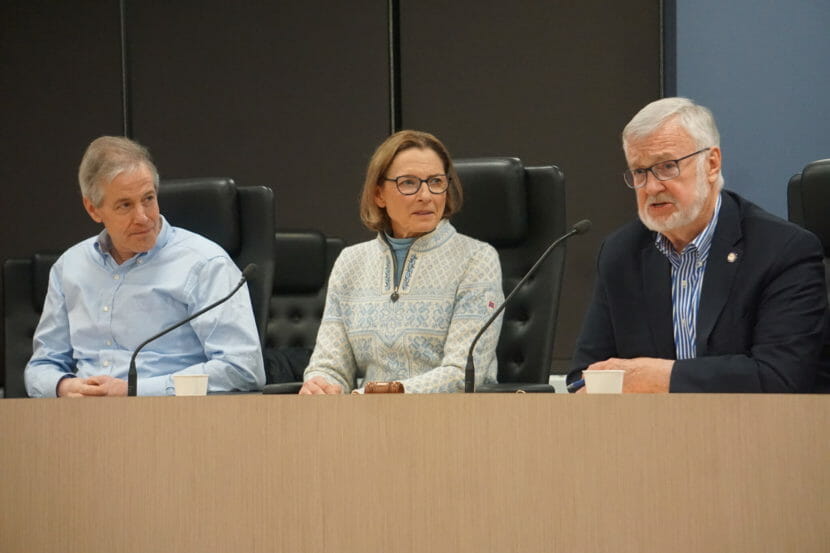
Sen. Gary Stevens of Kodiak, right, speaks at an Anchorage news conference on Friday announcing the formation of a 17-member bipartisan majority caucus. Stevens, a Republican, will be president of the body and Republican Cathy Giessel, sitting next to him, will be majority leader. Matt Claman, an Anchorage Democrat who is moving from the House to the Senate, will chair the Judiciary Committee, Stevens announced. In all, the caucus will hold nine Democrats and eight Republicans. (Photo by Yereth Rosen/Alaska Beacon)
Seventeen of Alaska’s 20 state senators and senator-elects have banded together to form a bipartisan majority coalition that members promise will be moderate and consensus-focused.
Gary Stevens, a Kodiak Republican and veteran lawmaker known as a moderate, will be president, returning to the role he held from 2009 to 2012.
“It’s a pleasure for me to announce that we have a very healthy majority and we’ve found a way to share responsibilities between all of us. I think we have a great organization,” Stevens said at an Anchorage news conference late Friday.
Cathy Giessel, a Republican from South Anchorage, will be the majority leader; Sen. Bill Wielechowski, a Democrat from East Anchorage, will be chairman of the Rules Committee, which determines with the president which bills are voted upon, Stevens announced. The powerful budget-writing Finance Committee will have three co-chairs, he said: Republican Sen. Bert Stedman of Sitka, overseeing the operating budget; Democratic Sen. Lyman Hoffman of Bethel, handling the capital budget; and Democratic Sen. Donny Olson of Golovin, managing other bills.
Announcement of the new organization came two days after the state Division of Election made a final count of ballots cast in the state’s new ranked choice system. That confirmed that 11 Republicans and nine Democrats will be in the Senate. For Democrats, the results represent a two-seat gain. For some Republicans, the results affirmed the value of past bipartisan work.
Those Republicans include Cathy Giessel, who served as Senate president in 2019 and 2020 but lost her seat after being criticized for working with Democrats. This time, thanks in part to the new ranked choice system, Giessel was elected to her old seat, beating the farther-right Republican who had ousted her in the 2020 GOP primary.
The new majority is, in some ways, a reprise of past Senate coalitions. The Senate was led by a bipartisan caucus from 2007 to 2012, with Wasilla Republican Lyda Green serving as president for the first two of those years.
In other ways, the new majority formalizes what had been a de facto coalition in recent years comprising Senate Democrats and the more moderate Republicans. That experience, Stevens said, is evidence in favor of a bipartisan majority over an all-Republican majority. Over the past four years, these senators have opposed unplanned draws from the Alaska Permanent Fund, as well as the deep cuts to government services that Gov. Mike Dunleavy proposed in 2019.
“I think this is a recognition of the reality of the last four years. We have not been able to get several of our senators to support the budget. We’ve had to go around them and bring the Democrats in in order to pass the budget,” he said.
The three senators left out of the majority group – Sen. Mike Shower of Wasilla, Sen. Shelley Hughes of Palmer and Sen. Robert Myers of North Pole – are all conservative Republicans who voted against the budget in 2021, before voting for year’s budget. They have called for larger Permanent Fund dividends.
Stevens said he wants those three minority members to take committee positions, and that he will continue to make overtures to them to be a part of the legislative process.
In a statement, the three outsider senators criticized their Republican colleagues.
“It’s very disconcerting that my fellow Republicans in the Senate were not even willing to have a conversation about joining together for the betterment of Alaska, but more troubling than that is my colleagues defied the voters and have let Alaskans down,” Hughes said in the statement. She said the vast majority of voters supported a “right-of-center” majority.
“Alaskans are concerned about high inflation, gas, and energy prices; Biden’s anti-resource development policies which are harmful to our state; and leftist policies that hurt families and children. Alaskans’ votes for state Senate clearly indicated Alaskans preferred policies based on conservative principles that will open up new opportunities and promote a strong economy, strong communities, and strong families,” she said in the statement.
“Unfortunately, the new coalition is bound by terms counterproductive to what I ran on and seems to be focused on maintaining the status quo,” Myers said in the statement.
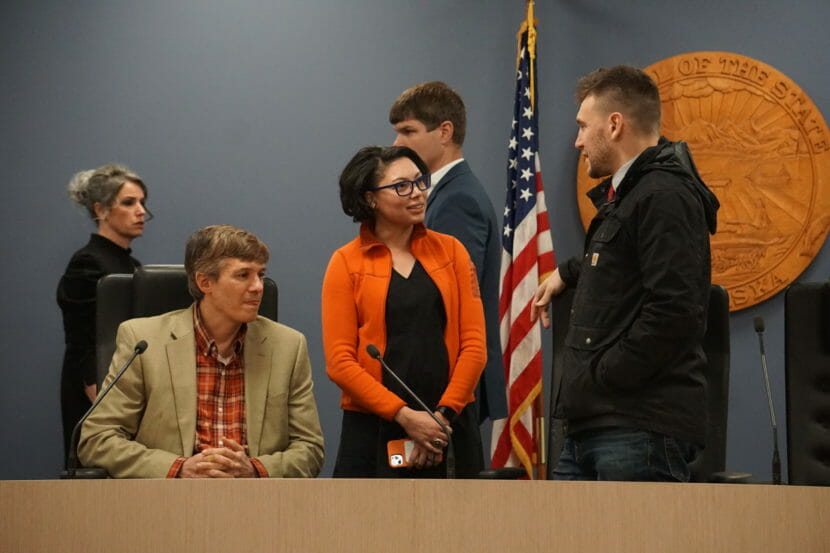
Members of the newly formed 17-member bipartisan Senate majority mingle before the start of an Anchorage news conference late Friday. From left are Republican Kelly Merrick, Democrat Bill Wielechowski, Democrat Loki Tobin, Republican Jesse Bjorkman and Democrat Forrest Dunbar. Wielechowski, who was reelected, was named as chairman of the Rules Committee. Merrick is moving from the House to the Senate, and Tobin, Bjorkman and Dunbar will be new members of the legislature. (Photo by Yereth Rosen/Alaska Beacon)
Shower echoed those sentiments. “Their arrangement is hard to justify considering roughly two-thirds of first place votes in the Senate races went to Republicans,” he said in the statement.
Giessel said she has been in the three senators’ position. When Stevens was last Senate president, in 2011 and 2012, she was considered one of the most conservative senators — and was one of the four members outside of the majority. That approach is not productive, she said.
“You know, what I learned from that two-year period was that nothing gets done unless you work with everyone,” she said at the news conference, recounting later successes through cooperation with Democrats. “Over the years, my health care legislation was always passed by assistance from House Democrats. It’s a learning process that we all undergo, I think, coming in with our own ideas and our own narrow perspective and realize, wait a second, there’s a whole world out there with other ideas that are just as valid.”
The bipartisan approach reflects voters’ preferences, Giessel said.
“One message that came through loud and clear is that Alaskans are looking for people in the Legislature who will work together to get something done, to get those important things done that Alaskans are waiting to have accomplished,” she said.
Sen. Elvi Gray-Jackson, a Democrat from Midtown Anchorage, noted that a majority of Alaska voters are unaffiliated with any political party. “So the fact that we have committed ourselves to working together, as far as I’m concerned, is representative of what the citizens of the state of Alaska want to see,” she said at the news conference.
The state House also has a history of cross-party majority coalitions, as was the case in the past legislative session. Now, with 21 of the House’s 40 seats to be held by Republicans in the coming session, the organizational makeup is yet to be determined.
Whatever the configuration of their leadership, lawmakers in the coming session will have to manage what might be future budget troubles.
Oil prices have fallen, and recent monthly estimates from the Department of Revenue forecast slips in expected money into the treasury over the current and coming fiscal years.
The most recent estimate, released on Nov. 16, forecasts total fiscal 2023 revenue available for state spending will be $372 million less than what was expected when the year’s budget was passed last spring. The November estimate also forecasts revenue for budget that begins in July 2023 will be $580.6 million less than last spring’s estimate.
Through the current fiscal year, which ends on June 30, Alaska North Slope oil prices are expected to average $94.65 a barrel. If the average for the year winds up below about $87 per barrel, the current year’s budget would fall into a deficit that would have to be filled with savings.
The current fiscal year’s budget was based on last spring’s assumed oil price average of $101 a barrel; the most recent Department of Revenue estimate adjusts that downward. Since the start of October, ANS oil prices have ranged between about $89 and $99 a barrel, according to the department.
The drop is worrisome, said senators in the majority coalition.
“We need to really start paying attention if oil drops below $90,” Stedman said in a brief phone interview after the news conference.
While all majority members have agreed to work on the budget and support the product that ultimately emerges, there is not yet agreement on how to address the challenges posed by sliding oil prices.
Wielechowski said the majority will “put our partisan differences aside” to find solutions, which he said will “require compromise on all sides.”
“We’re all going to have very different ideas on how to solve this problem, how to solve many of these problems, but I think what you’ll see – what I’m hoping you will see – is that we will all work together,” he said at the news conference.
Voters choose their “I Voted” stickers at the polling location Glacier Valley Baptist Church, Juneau Alaska, Nov. 8th 2022. (Photo by Paige Sparks/KTOO)
When Cheryl-Ann Leslie is arraigned on felony counts of casting more than one ballot, she will become just the second person charged with voter fraud related to Alaska’s 2020 election.
Despite claims by some Alaskans that fraudulent voting changed the state’s election results two years ago, no evidence of fraud on that scale has been uncovered by investigators.
After the 2020 election, Sen. Mike Shower, R-Wasilla, was among those who collected information about possible fraudulent votes and forwarded it to state investigators.
In January 2022, Gov. Mike Dunleavy said three cases of possible voter fraud were being investigated by state troopers.
The Florida case was the result of a special group of Florida investigators assigned specifically to election-related crimes. Patty Sullivan, a spokesperson for the Alaska Department of Law, said the Alaska Division of Elections assisted Florida’s investigation and referred the issue to law enforcement here.
It wasn’t clear whether the case was one of the three mentioned by Dunleavy. The governor’s office referred a question to the Department of Law and the Department of Public Safety.
According to a public records request with the Alaska Court System, only two voter misconduct cases have been filed since 2020.
One remains sealed by a judge’s order, making details of the case impossible to determine. The other case involves a Copper Center man who signed absentee ballots with an anti-gay epithet.
Terry Anthony Bell was initially charged with five felonies but pleaded guilty to just one misdemeanor count of voter misconduct as part of a plea deal with prosecutors.
Sullivan said she could not say whether any other cases will be filed by prosecutors.
“Other than what’s public record, we cannot confirm the existence of active criminal investigations until criminal charges have been brought forward,” she said.
Before the 2020 election, prosecutors accused Rep. Gabrielle LeDoux, R-Anchorage, her chief of staff, and the chief of staff’s son of voter misconduct related to elections in 2018 and 2014.
In part because of courtroom closures during the COVID-19 pandemic, the case against LeDoux and the two others has not gone to trial.
The next hearing in the case is scheduled for Dec. 12.
Gov. Mike Dunleavy, standing at the entrance of the Alaska Federation of Natives convention arts and crafts fair on Thursday, shakes the hand of a convention attendee. (Photo by Yereth Rosen/Alaska Beacon)
Republicans hold 21 of the 40 seats in the Alaska House of Representatives after the first full run of Alaska’s new ranked choice voting system.
The 21-person total includes two candidates who had been trailing before votes were tabulated Wednesday evening. Incumbent Republican Rep. Tom McKay of Anchorage trailed Democrat Denny Wells entering the day but now leads Wells by four votes in the state’s closest race.
In East Anchorage, Republican Julie Coulombe leads nonpartisan candidate Walter Featherly after trailing him at the start of the day.
The results are unofficial and the Division of Elections expects to certify them on Nov. 29. Recounts are possible. State law allows a losing candidate to request one in any race, but the candidate must pay for the recount unless the result is within 0.5%.
All three incumbents for statewide office won reelection handily.
Gov. Mike Dunleavy became the first Alaska governor reelected to office since Tony Knowles in 1998 and the first Republican to do so since Jay Hammond in 1978. He finished with more than 50% of the vote, avoiding the need for a ranked choice voting redistribution in his race.
For the U.S. Senate, incumbent Republican Lisa Murkowski led three challengers before the final tabulation, then had 53.7% of the vote after the ranked choice process. Her closest challenger, Republican Kelly Tshibaka, had 46.3%.
Incumbent Democratic Rep. Mary Peltola likewise led three challengers and after final tabulation had 54.9% of votes. Her closest challenger was Republican Sarah Palin with 45.1%.
In the Alaska Senate, former Senate President Cathy Giessel, R-Anchorage will return to office after defeating incumbent Republican Sen. Roger Holland, the man who defeated her in 2020.
She was among 11 Republicans elected to the 20-person Senate.
Four of those Republicans, including Giessel, were elected despite the disapproval of local party officials, who preferred other Republican candidates.
Moderate Republicans, including Giessel, are expected in the coming days or weeks to announce the formation of a coalition Senate majority that includes the Senate’s nine Democrats.
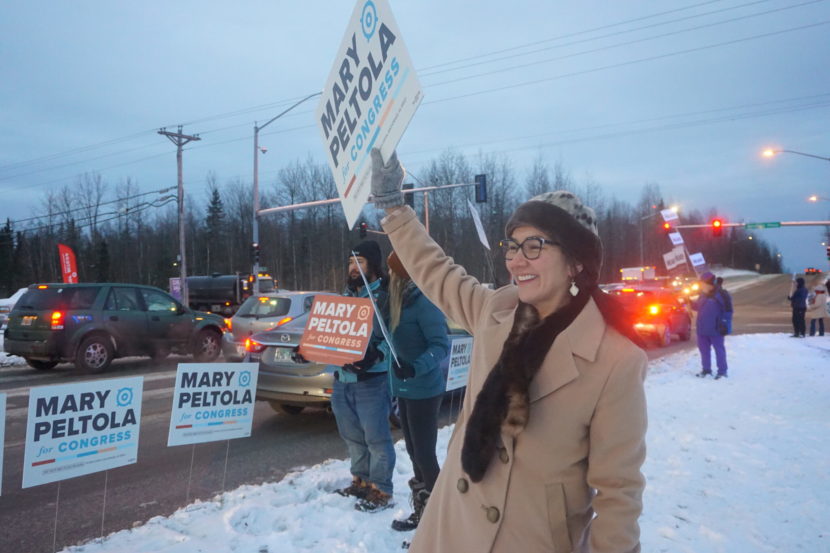
Rep. Mary Peltola waves campaign signs at passing motorists in East Anchorage on the morning of Election Day. The sealskin and otter-fur hat she is wearing was a gift from friends in Juneau. (Photo by Yereth Rosen/Alaska Beacon)
All three incumbents likely clinched final victory in Alaska’s statewide elections Friday, as the Alaska Division of Elections updated results with thousands of additional absentee, questioned and early ballots from this fall’s general election.
Final unofficial results will not be available until 4 p.m. Wednesday, when the division implements the state’s new ranked choice sorting system, but voting trends have made the results clear in most races.
With 264,994 votes counted, incumbent Republican Gov. Mike Dunleavy had 50.3% of the vote for governor, well above his leading challenger, Democratic candidate Les Gara, who had 24.2%. Independent candidate Bill Walker had 20.7% and Republican challenger Charlie Pierce had 4.5%.
Friday was the deadline for absentee ballots sent from within the United States to arrive and be counted. Ballots are counted by the elections division’s five regional offices, and by the end of the day Friday, most offices had finished counting all ballots that had arrived through Wednesday.
A few hundred ballots sent from international destinations could be added to the count if they arrive by Nov. 23, but it appears all but certain that the remaining ballots are too few to alter the governor’s race, where Dunleavy has a margin large enough that ranked choice sorting will not take place.
In races where no candidate earns at least 50% of the vote, the lowest finisher is eliminated, and voters who supported that person have their votes redistributed to their second choices. That process continues until only two candidates are left, and the person with the most votes wins.
In the U.S. Senate and U.S. House races, no candidate is expected to finish with more than 50% of the vote.
For U.S. House, Democratic incumbent Mary Peltola had 48.7% of the vote, ahead of Republican challengers Sarah Palin (25.8%) and Nick Begich (23.4%) and Libertarian challenger Chris Bye (1.7%).
While the combined totals of Palin and Begich would surpass Peltola’s tally, a special election in August showed the number of Begich voters willing to support Palin with second-choice votes was too small for her to overtake Peltola. Pre-election opinion polling showed little change in opinions since August.
In the race for U.S. Senate, incumbent Republican Lisa Murkowski led all challengers with 43.3%. Her main challenger, Republican Kelly Tshibaka, led on Election Day, but Murkowski erased that deficit by the end of the day Friday with late-counted absentee and early votes. By the end of the day Friday, Tshibaka had 42.7%, trailing by 1,658 votes out of 259,747 cast in the race.
When ranked choice voting begins, Murkowski is expected to receive the majority of the second-choice votes cast by supporters of the third-place finisher, Democratic candidate Patricia Chesbro (10.4%). Many supporters of the fourth-place finisher, Republican Buzz Kelley (2.9%), are expected to back Tshibaka, but those votes are not expected to be sufficient for Tshibaka to win.
Legislative races
Of the 59 races on the ballot for the state House and Senate, nine were unresolved Friday night, including two in the state Senate and seven in the state House.
Complete tossups
In South Anchorage, former Republican Senate President Cathy Giessel narrowly leads a three-way race that also features incumbent Republican Sen. Roger Holland and Democratic candidate Roselynn Cacy.
Giessel had 33.6% of the vote, Holland 33.1% and Cacy 32.9% as of Friday night. Elections officials said they had counted all early votes, questioned ballots and absentee ballots received through Wednesday, Nov. 16.
A relative handful of ballots remain uncounted in the race, which will be decided when elections officials calculate ranked choice sorting on Nov. 23.
Democrats and moderate Republicans seeking to create a coalition majority in the Senate have said they are waiting on the results of Giessel’s race.
“Because of that, there’s really not been a lot of definitive movement on (Senate organization),” said Sen. Donny Olson, D-Golovin, and the only legislator not on this year’s ballot.
In the state House, two Anchorage races and one in the Mat-Su had no likely winner.
For the district surrounding the Alaska Zoo, nonpartisan candidate Walter Featherly has 45.5% of the vote, followed by Republicans Julie Coulombe (38.7%) and Ross Bieling (15.4%). Ranked choice voting will decide the winner of the race; if sufficient Bieling supporters chose Coulombe as a second choice, she will overtake Featherly.
In the district around Campbell Lake, Democratic candidate Denny Wells has 46.6% of the vote, leading incumbent Republican Rep. Tom McKay, who has 38.8% of the vote. A third Republican has 14.1% of the vote. Ranked choice sorting will result in many of those votes going to McKay.
In the Matanuska-Susitna Borough, four Republicans are competing for a newly redrawn Wasilla district. Republican Jesse Sumner has 36.7% of the vote, but three other Republicans have substantial totals, and the race will be decided with Wednesday’s ranked choice sorting.
Likely winners
In addition to the four tossup races, there are five races that are unresolved but have likely winners based on voting patterns.
In the Matanuska-Susitna Borough, incumbent Republican Sen. David Wilson has 44.5% of the vote in his race for re-election, but Republican challenger Stephen Wright has 29% of the vote and could overtake Wilson if he receives enough second-choice votes when fellow Republican challenger Scott Clayton (25.3%) is eliminated in ranked choice sorting.
In the House district covering Anchorage’s Government Hill and Joint Base Elmendorf-Richardson, Republican incumbent Rep. David Nelson has 44% of the vote, ahead of Democratic challengers Cliff Groh (35.3%) and Lyn Franks (20.3%), but Groh is expected to receive the second-choice votes of most Franks supporters. Those are expected to make Groh the winner.
In northeast Anchorage, just south of Joint Base Elmendorf-Richardson, Republican Stanley Wright has 50.7% of the vote in a head-to-head race against Democrat Ted Eischeid, who has 48.9%. The difference between the two candidates is just 67 votes, and late-counted absentee ballots have favored Democrats, but there likely are too few ballots remaining to be counted in the district for Eischeid to overtake Wright.
In East Anchorage, Democratic candidate Donna Mears has 50.1% of the vote in a head-to-head race against Republican Forrest Wolfe, who has 48.8%. The margin between the two candidates is 152 votes, and late-counted votes have gone in Mears’ favor, but some ballots remain uncounted.
In the district around Big Lake, in the Matanuska-Susitna Borough, incumbent Republican Rep. Kevin McCabe has 45% of the vote. Republican challenger Doyle Holmes has 34.4% and Democratic challenger Joy Mindiola has 20%. It isn’t clear who — if anyone — Mindiola’s supporters have picked as their second choice.
Legislative victors
The remaining 50 races had clear winners as of Friday night:
Senate races
Senate District A – Incumbent Sen. Bert Stedman, R-Sitka, defeated Republican challenger Mike Sheldon, 68.8%-30.5%.
SD B – Incumbent Sen. Jesse Kiehl, D-Juneau, was unopposed.
SD C – Incumbent Sen. Gary Stevens, R-Kodiak, had 56.2%, defeating two Republican challengers.
SD D – Republican Jesse Bjorkman had 45.8% of the vote in a three-way race also featuring Republican Tuckerman Babcock (41.6%) and nonpartisan candidate Andy Cizek (11.7%), each seeking to replace Republican Senate President Peter Micciche in the northern Kenai Peninsula. Cizek’s supporters are expected to favor Bjorkman with second-choice votes, and Babcock conceded victory to Bjorkman on social media the day after the election.
SD F – Rep. James Kaufman, R-Anchorage (54.5%), defeated Democratic challenger Janice Park (45.3%) in a race to replace Sen. Josh Revak, R-Anchorage.
SD G – Sen. Elvi Gray-Jackson, D-Anchorage, won re-election to a midtown Anchorage seat, defeating Republican challenger Marcus Sanders by 13 points.
SD H – Sen. Mia Costello, R-Anchorage, conceded defeat to Rep. Matt Claman, D-Anchorage, on Friday in a West Anchorage race that was one of the most closely watched Senate races in the state. Claman had 51.9% of the vote to Costello’s 47.8%.
SD I – Democratic candidate Löki Tobin defeated undeclared-party challenger Heather Herndon by 34 points in the race to replace Senate Minority Leader Tom Begich, D-Anchorage.
SD J – Forrest Dunbar, a Democratic member of the Anchorage Assembly, had just over 50% of the vote in the race for a newly created state Senate district in Anchorage, defeating Democratic challenger and Rep. Geran Tarr (16.7%), and Republican challenger Andrew Satterfield (32.7%).
SD K – Sen. Bill Wielechowski, D-Anchorage, won re-election, defeating Republican challenger John Cunningham by 16 points.
SD L – Rep. Kelly Merrick, R-Eagle River, defeated Rep. Ken McCarty, R-Eagle River, by almost 17 percentage points in the race to replace Sen. Lora Reinbold, R-Eagle River.
SD M – Senate Majority Leader Shelley Hughes defeated Democratic challenger Jim Cooper by more than 52 points, one of the widest results in the state.
SD O – Sen. Mike Shower, R-Wasilla, defeated Republican challenger Doug Massey, 51.8-47%.
SD P – Sen. Scott Kawasaki, D-Fairbanks, defeated two Republican challengers by earning 51.1% of the vote.
SD Q – Sen. Robb Myers, R-North Pole, was re-elected after earning 62.6% of the vote against a nonpartisan challenger and a member of the Alaskan Independence Party.
SD R – Sen. Click Bishop, R-Fairbanks, defeated a Republican challenger and an AIP challenger with 56.8% of the vote despite being censured by local Republicans.
SD S – Sen. Lyman Hoffman, D-Bethel and the longest-serving member of the Alaska Legislature, won another term after receiving 64.6% of the vote.
SD T – Sen. Donny Olson, D-Golovin, was the only legislator not subject to re-election this year. In all 59 other races, redistricting changed the boundaries of the legislative district enough to mandate a new election.
House races
House District 1 – Rep. Dan Ortiz, I-Ketchikan, defeated Republican challenger Jeremy Bynum, 52.4-47.3%.
HD 2 – Nonpartisan candidate Rebecca Himschoot defeated Republican Kenny Skaflestad, 58.3-41.4%, in the race to replace Rep. Jonathan Kreiss-Tomkins, D-Sitka.
HD 3 – Rep. Andi Story, D-Juneau, was unopposed.
HD 4 – Rep. Sara Hannan, D-Juneau, won re-election by almost 60 percentage points.
HD 5 – Speaker of the House Louise Stutes, R-Kodiak, defeated Republican challenger Benjamin Vincent by more than 22%.
HD 6 – Rep. Sarah Vance, R-Homer, won re-election with 52.1% of the vote against two challengers.
HD 7 – Republican candidate Justin Ruffridge, a pharmacist, defeated Rep. Ron Gillham, 52.6-46.5%.
HD 8 – Rep. Ben Carpenter, R-Nikiski, won re-election unopposed.
HD 9 – Rep. Laddie Shaw, R-Anchorage, defeated Democratic candidate David Schaff, 54.2-45.6%.
HD 10 – Republican Craig Johnson, a former member of the Alaska House, will return to the House after earning 51.5% of the vote in a race against a Libertarian and a Democrat.
HD 12 – Rep. Calvin Schrage, I-Anchorage, defeated Republican Jay McDonald, 59-40.1%.
HD 13 – Rep. Andy Josephson, D-Anchorage, defeated Republican Kathy Henslee by 5% in a race that had been expected to be close. Henslee trailed by just 86 votes after Election Day, but late-counted absentee, early and questioned ballots favored Josephson.
HD 14 – Nonpartisan candidate Alyse Galvin, a two-time candidate for U.S. House, won election to the state House by getting 67% of the vote against Republican Nick Danger.
HD 16 – Democratic candidate Jennie Armstrong had 55% of the vote against Republican Liz Vazquez. Armstrong’s eligibility for office could be questioned in a lawsuit; a judge on Friday dismissed a legal challenge targeting Armstrong but suggested that it could be refiled after the race is certified complete.
HD 17 – Rep. Zack Fields, D-Anchorage defeated Rep. Harriet Drummond, D-Anchorage, by just under 14% after the two Democrats in or near downtown were placed in the same legislative district during the once-per-decade redistricting process. Theirs was the only race where redistricted incumbents, put in the same district, both sought re-election. In all other cases, one of the incumbents dropped out before the election.
HD 19 – Democratic candidate Genevieve Mina defeated fellow Democrat Russell Wyatt by more than 52%.
HD 20 – Democratic candidate Andrew Gray had 54% of the vote in this four-way race that also included two Republicans and a Libertarian.
HD 23 – Jamie Allard, a Republican member of the Anchorage Assembly, won election with 61.5% of the vote in this race that also featured Republican Roger Branson.
HD 24 – Republican Dan Saddler, formerly a member of the state House, will return to the chamber after earning 52.6% of the vote in a three-way race that included Democratic candidate Daryl Nelson and another former Republican legislator, Sharon Jackson.
HD 25 – Rep. DeLena Johnson, R-Palmer and one of the longest-serving Republican members of the House, won re-election with almost 78% of the vote in a two-way race that featured another Republican.
HD 26 – House Minority Leader Cathy Tilton won re-election by the widest margin of any race in the state, defeating Libertarian Daniel Stokes by more than 62%.
HD 27 – Rep. David Eastman, R-Wasilla, won re-election with 51.4% of the vote against two Republican challengers. Eastman still faces a legal challenge to his eligibility, and a trial has been set for December. Certification of his victory will remain on hold until the case is resolved.
HD 29 – Rep. George Rauscher, R-Sutton, won re-election by 49%.
HD 31 – Democratic candidate Maxine Dibert had 49.1% of the vote in a race against Republican incumbent Rep. Bart LeBon (29.4%) and Republican Kelly Nash (20.7%). LeBon is not expected to pick up enough second-choice votes from Nash supporters in order to pass Dibert. Nash campaigned aggressively against LeBon and told supporters to not rank him second.
HD 32 – Republican Will Stapp won the race to replace Rep. Steve Thompson, R-Fairbanks, by earning 51.5% of the vote.
HD 33 – Rep. Mike Prax, R-North Pole, ran unopposed for re-election.
HD 34 – Republican Frank Tomaszewski has 49% of the vote against Democratic incumbent Rep. Grier Hopkins, D-Fairbanks (43.1%). A third Republican candidate is also in the race, and Tomaszewski will earn enough votes in ranked choice calculations to defeat Hopkins.
HD 35 – Democratic candidate Ashley Carrick has 53.5% of the vote in this West Fairbanks district, enough to win a four-way race to replace Rep. Adam Wool, D-Fairbanks.
HD 36 – Rep. Mike Cronk, R-Tok, won re-election with 65.4% of the vote in this vast Interior Alaska district.
HD 37 – Rep. Bryce Edgmon, I-Dillingham, ran unopposed for re-election.
HD 38 – Democratic candidate Conrad “C.J.” McCormick ran unopposed to replace Rep. Tiffany Zulkosky, D-Bethel. A registered write-in challenger received less than 16% of the vote.
HD 39 – Rep. Neal Foster, D-Nome, won re-election with 51.2% of the vote thanks to late-arriving absentee ballots that leaned in his favor. At one point on Friday, he was ahead of AIP challenger Tyler Ivanoff by just three votes. Exiting the day, he leads by 108 out of 3,583 cast.
HD 40 – Independent Rep. Josiah Aullaqsruaq Patkotak ran unopposed for the seat and has won re-election.
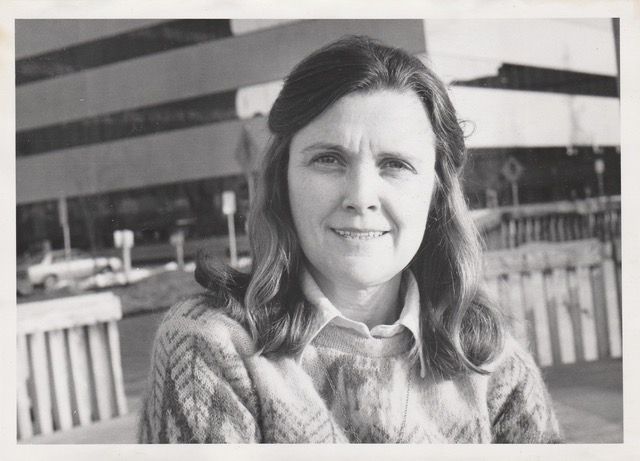
Dr. carolyn Brown sits outside her obstetric-gynecologic practice in Palmer with the Valley Hospital in the background. This photo was taken sometime in the mid-1980s. (Photo by Sally Mead)
Written in large letters across a billboard displayed in the Alaska Right to Life booth at the 1981 State Fair in Palmer was this question: “Does your Doctor kill babies?” Underneath that question was a list of several names – including Dr. carolyn Brown.
This billboard along with things published in Alaska Right to Life’s newsletter — like calling Brown “baby-killer Brown” — were part of a libel lawsuit that would go on to reach the Alaska Supreme Court. She would lose the lawsuit, which touched on principles central to debates over free speech.
From the late 1970s to the late ’80s, Brown was a gynecologist and obstetrician in Palmer. She delivered thousands of babies, which she was known and praised for. She also performed abortions, which she was known and praised for — and vilified for. She remembers being told, “how bad it was, how evil it was that I was killing babies, and that God would get me for that and I would burn in hell and all the other stuff that people say to people.”
However, Brown herself has questions. As she reflects on her past as an abortion provider, she struggles with how to define the beginning of personhood. And she’s relieved she no longer has to decide when it’s OK to perform an abortion. But despite this uncertainty, she continues to support a right to an abortion.
A long interest in medicine
Brown was born in 1937 and raised in Hereford, Texas, about 50 miles southwest of Amarillo. Her parents divorced when she was around 9 and her mom left, so Brown and her brother went to live with their grandmother. She knew when she was 10 she wanted to be a doctor.
“I was working in a cotton patch and there were a whole bunch of other people working in that cotton patch and here I am this little kid with a 6-foot cotton sack that I’m pulling behind me and I decided I don’t think I want to do this all my life,” Brown said, adding that she isn’t sure why she chose to be a doctor at that time. “Maybe I’ve been to a movie. I didn’t have any books to read. My growing up and background was a little bit challenging, I will say. But I decided at that point that I really was interested in becoming a doctor.”
When she was introduced to a library at age 12, she read everything in the children’s part of the library.
“I read a lot of biographies and … I was just mesmerized with medicine. That really made more firm what I was going to do,” Brown said.
She took all the science classes that were possible for her to take in middle and high school, and went to college at Hardin-Simmons University in Abilene, Texas, where she majored in chemistry and biology, and graduated magna cum laude.
When it came to deciding what medical school to go to, Brown was sure of only one thing: “Whatever I have to do, I had to get out of Texas,” she said.
She didn’t want a big medical school and she didn’t want to go too far north, “Because I was too much of a hick. And I knew that. And I was poor as Job’s turkey,” Brown said.
Growing up, Brown did not think highly of herself.
But she got into all the medical schools in Texas at the time. Still, she decided to go outside the state — to Bowman Grey School of Medicine in Winston-Salem, North Carolina.
Brown met her husband George Brown there, and the two doctors came to Alaska in 1965. They worked as public health doctors with the U.S. Public Health Service. They were based out of Anchorage but traveled all over the state. The two then went to Hawaii, where Brown did her first residency in public health and preventive medicine at the University of Hawaii. Afterward, they returned to Alaska.
Brown had a long list of jobs during that time, including working at the Anchorage Municipal Health Department. Brown was inundated with women who had a lot of health questions about women’s issues – questions Brown couldn’t always answer. So, she decided to go back to the University of Hawaii to do a second residency.
One of the boys
Throughout this whole time, Brown didn’t have any strong feelings about abortion. In fact, she didn’t really think about it at all during college, medical school, or her first residency. It wouldn’t come up until her second residency in obstetrics and gynecology.
It was 1975. The U.S. Supreme Court had decided on Roe v. Wade two years prior, ruling that the constitutional right to privacy includes the right to access an abortion.
The University of Hawaii wanted to teach all OB-GYN residents how to perform abortions.
“When I got there, I had a choice,” she said. “You were offered it. They suggested it. And if you didn’t want to do it, and there were some who, based on religious background, chose not to do it, then they were given other kinds of work. Grunt work, we call it.”
Brown said it was an excellent teaching program — but, as one of the first women to go through that program, she said it was also extremely misogynist. So Brown had to make a choice — was she going to be one of the boys and perform abortions, or would she go do grunt work?
She decided to be one of the boys. Even then, she still didn’t have an opinion about abortion.
“I didn’t have a decision about — What did I really think about it? I said, ‘OK,’ because I hadn’t really processed what that really meant,” Brown said.
Brown knew that she wouldn’t have an abortion. She had to ask herself: What am I doing? It weighed on her, but she didn’t have much time to dwell on it.
“Except once in a while I did think about it, and I went to church. And I did all of those things that I sort of grew up doing way back in the day. But I had to come to some peace with myself,” Brown said. “But I never could decide for myself that an egg and a sperm was a person because a person is a philosophical definition. A sperm and an egg when they come together, that’s tissue up to a certain point. And then you got the whole philosophical thing is when does the soul enter the sperm and the egg? I didn’t know and I still don’t know. But I’ve struggled with that for all of these many, many years.”
During Brown’s days at the clinic, she did 10 to 14 abortions a day.
Setting up a practice in Palmer
When she was done with her residency in Hawaii, she, her husband George Brown and their two kids returned to Alaska in 1978. The couple started Women and Children’s Health Associates, a nonprofit that operated an obstetric-gynecologic and pediatric practice in the Mat-Su Valley. Brown’s office was based in Palmer and her husband’s pediatric office in Wasilla.
Brown initially worked out of the Valley Hospital, though she didn’t have a proper office.
“But the hospital had a little front room, just off of the waiting room when you go into the hospital and it was maybe 16-by-16 square feet. And so we found a table with stirrups on it and a desk and a chair and a screen. And I didn’t have a secretary, I didn’t have an assistant, I had nothing, but the people started coming,” Brown said.
Brown had a very active OB-GYN practice. She eventually moved her office to its own building, just outside the hospital’s parking lot. She said she would work 100-hour weeks and she didn’t make payment a barrier.
“In those days, I gave stuff free. I did free C-sections, I took bear meat, I took salmon. You know, it was the old-fashioned way of doing whatever it is you had to do,” she said.
She also provided abortions. Brown saw all kinds of patients, including Medicaid recipients, and people from all over the state — like Fairbanks, the Aleutians, Kotzebue, Juneau, Utqiagvik — were referred to her.
“Literally every quadrant of the state and people would call the office or they would call whatever practitioner they knew, or from way out in the villages, they would contact the public health nurse,” Brown said.
At this time, Brown said there weren’t ultrasounds. She had to tell how far along someone was from doing a pelvic exam. It was up to her to determine if a woman was, for instance, eight weeks pregnant or 22 weeks.
In the late 1970s, doctors in Alaska could perform abortions up to 150 days, or about 21 and a half weeks. To provide an abortion beyond that, state regulation allowed doctors to use “reasonable judgment.” Brown said she stuck with the 150-day limit and was “worse than OCD on that sort of thing.” This meant she sometimes had to turn people away, like a woman who had traveled from Utqiagvik to Palmer.
“She got there and, bless her heart, when I did the exam… she was more – 150 days is 21 weeks and four days – and that was 22-weeker and I said, ‘I can’t do this. I can’t do this,’” Brown said.
By this time, Brown said performing abortions was as normal as any other OB-GYN medical procedure. Though she performed abortions up to 21 and a half weeks, Brown said more than 90% of the abortions she did were done in the first trimester – the first 13 weeks.
She estimates she did three to five abortions a week in the Valley Hospital, though there were peaks and dips. And she said she had a good safety record.
“I wasn’t having any bad events, any failures, any disasters. I was very, very, very conservative about what I did,” Brown said.
‘There goes the baby killer’
Brown and her family were part of the community. They went to the Presbyterian church. The two kids attended middle and high school in Palmer. It wasn’t a secret that Brown performed abortions. She said the board of her and George’s nonprofit was very supportive, but not everyone in the community was.
Throughout her time in Palmer, starting a couple months after they arrived, Brown recalled being harassed. She received hate mail and phone calls in the middle of the night. Air was let out of her tires. People against abortion rights went to her work place.
“When I would come to work, go in to make rounds, they would hiss and boo. That was still at a time when I had the little office in the hospital there. So they would come in and sit around and say whatever it is they had to say. And line up just like a march as it were,” Brown said.
She heard comments like, “There goes the baby killer. Is that the baby killer?”
“It was awful. It was really awful, but you have to carry on,” Brown said. “I’d come to work and get ready to go down to the other end of the hospital to do a C-section or to do whatever it was I was going to do. Well, it’s got to go on.”
She said that people’s behavior toward her was egregious and filled with vindictiveness. But she never felt unsafe. In the decades after she practiced in Palmer, several abortion doctors were murdered around the country, which led Brown to think that if she had been an abortion provider later, she might’ve been shot.
On the outside, Brown was calm and collected. But inside, she said she was a basket case. Most people didn’t know that, she said.
“Of course I had to be in charge in the operating room. I had to be in charge when a person was in labor, screaming their heads off or whatever. I got to the place where I could almost talk a woman through her delivery, just my soft voice and sitting there. And I knew that was happening and she knew that was happening. And I knew I was very good at that. But nobody knew what was going on inside. The fear of God Almighty, what if this woman dies? What if this baby dies? Oh, my God. All the horrible things that you could possibly think of, I went through them all a great deal of the time,” Brown said.
At the same time Brown was performing abortions and being called a baby killer, she was also delivering lots and lots of babies. And she was really good at it. “We never lost one,” she said.
There were also colleagues at the hospital who didn’t want to work with her.
Brown recalls a person who worked in the lab and refused to draw blood for abortion patients due to his religious objections. There were also nurses who wouldn’t work with Brown when she was providing abortions. “A few of the nurses, religious or otherwise, just simply could not help,” she said.
The lawsuit
In April 1981, Brown submitted her name to Gov. Jay Hammond for appointment to the Alaska State Medical Board. The board regulates the practice of medicine, including abortion procedures.
According to court documents, “The appointment process resulted in some confusion in the governor’s office.” A letter appointing Brown to the medical board dated in May was signed by Hammond’s signature machine. The letter wasn’t supposed to be sent until the governor actually gave his approval and it wasn’t sent; Brown never received this letter from the governor. But the governor’s press secretary announced Brown’s appointment and the lieutenant governor sent Brown a congratulatory letter. It was also reported in local newspapers.
In response, the Alaska Right to Life wrote about Brown in a June newsletter. It said: “Stop baby-killer Brown.” It called her “the Mat-Su Valley’s No. 1 Abortionist,” and instructed its readers to contact the governor to urge him not to appoint Brown to the Alaska State Medical Board.
The newsletter article said, “We cannot believe that Governor Hammond will bow to anti-life pressure to appoint an abortionist whose methods were so horrible as to cause a boycott by every nurse employed at Valley Hospital.”
Hammond eventually sent Brown a letter and apologized for the “erroneous announcement” of her appointment. He wrote that he had decided to follow his past practice of appointing a person recommended by the Alaska State Medical Association. According to court documents, the association had not recommended Brown because it thought that vacancies on the State Medical Board, which previously had been held by Anchorage doctors, should again be filled by Anchorage doctors.
In September 1981, Brown filed a lawsuit against Bill Moffatt, the primary author of the newsletter article, and Alaska Right to Life, alleging they had libeled her. In the lawsuit, Brown said that the defendants intimidated the governor and caused him to withdraw her appointment, resulting in damage to her professional reputation and career. Brown was joined by other doctors in the lawsuit.
The complaint also alleged defamation based on the state fair sign, what was written in the newsletter, and press conferences where they called Brown a “killer of babies.”
“It was very defamatory. That’s why I decided to sue them,” Brown said. “I was so horrified that somebody would say this about me because that wasn’t who I was.”
Sally Mead was horrified too. In September 1981, Mead was pregnant, and a patient of Brown’s. Mead lived in a two-story log cabin that she’d built in Bird Creek, which is south of Anchorage. Which means she’d drive past Anchorage in her hour-and-15-minute drive to Palmer for her appointments with Brown. That’s also where she delivered her baby, at the Valley Hospital.
It wasn’t an easy delivery, Mead said. It took around 12 hours and went through the night.
“And in the end, [Brown] said, ‘I think his head is bumping into your pelvic bone. So I know you didn’t really want to go into the O.R. But let’s just try and see if we can help him get out.’ So she takes me into the O.R. and of course I’m having contractions like crazy and been having them for hours,” Mead said. “she takes the forceps she puts them there, lowers the baby’s head down and – boink – out he comes. That’s all it took.”
In the moments after her son was born, as she was waiting for him to get cleaned and brought to her, Mead had a thought. She knew Brown performed abortions and she had seen the Right-to-Life display at the state fair. In her mind, Brown was being attacked. Mead had also heard about the lawsuit.
“And it was somewhere in that point of the delivery that I just had a flash. You know, this was something I could do to help. I could help to create a legal fund for her and support this effort.
Mead started the carolyn Brown Legal Fund (Brown’s legal first name begins with a lowercase “c”). At the time, Brown was paid $36,000 – just over 50% above the typical family income. Today, obstetricians on average make nearly 350% of typical incomes.
Mead made a pamphlet detailing Brown’s position, wrote letters, made phone calls and held gatherings to raise money, which she doesn’t recall as being that difficult.
“There was a large community, particularly of women but some men, who really felt this was an issue that needed to be spoken to. Because you know, we’d all go to the state fair, so we’d all see these exhibits from Right to Life,” she said.
Speech about abortion
But in that court case, Brown started to lose. In 1984, the Superior Court dismissed several of Brown’s claims against Right to Life, but not all of them. Bill Moffatt and Alaska Right to Life pushed for a summary judgment to end the rest of the case. The Superior Court denied the motion, setting up an appeal.
The matter eventually reached the Alaska Supreme Court in the case Moffatt v. Brown, which would have implications for not only Brown, but for free speech.
Besides the two parties and their lawyers, attorney John McKay was also involved in the case as a friend of the court. McKay has practiced law in Alaska since 1978, mainly representing news media. (A disclosure: The Alaska Beacon employs McKay when legal issues come up.)
McKay represented the Alaska Press Club in Moffatt v. Brown. McKay said the case could have affected the press’ ability to do its job.
“We wanted to basically take the position in the court that whatever way this came out, we wanted the court to be looking beyond the interest of Dr. Brown or the Right to Life. To say that this case, dealing with the standards in libel law, really probably affects us — the press in Alaska — really more than more than the parties in a sense; it’ll have a longer impact,” he said.
McKay said people saw Moffatt v. Brown as a case about abortion, “but I really think this is a case about talking about abortion. So it could be talking about any other issue too, but abortion was then and remains a really, you know, hot button issue. … And I think that the First Amendment and the same constitutional provision in the Alaska Constitution guarantees free speech, free press. And if you can’t talk freely about these things because you’re worried that people are going to sue you, then you’re going to be less likely to take on those important issues.”
What McKay wanted to ensure was a standard that made it clear that free speech and freedom of the press were protected.
The alleged statement of defamation the Alaska Supreme Court was looking at claimed that Brown’s abortion “methods were so horrible as to cause a boycott by every nurse employed at Valley Hospital.”
That statement was inaccurate. Some nurses wouldn’t work with Brown on abortions, but not all. However, Brown’s side also had to prove that the statement was made with “actual malice,” because according to the courts, Brown was a public figure.
“They said carolyn Brown submitted a letter to the governor asking to be put on the medical board. She put herself in that position of becoming a public figure for at least the limited purposes of dealing with … the abortion question and the issues that came up around whether she should be on the board or not,” McKay said.
In the 1964 U.S. Supreme Court case New York Times vs Sullivan, the court placed certain constitutional limitations on state defamation laws. To recover damages for libel, which is what Brown was suing for, a public figure must prove two things: first, that the statement was false, and second, that the false statement was made with “actual malice.”
Though Bill Moffatt’s assertion about “a boycott by every nurse at Valley Hospital” was not accurate, he said he did not know it was inaccurate, and the court agreed. Moffatt had gotten his information from Robert Ogden, the hospital administrator.
Robert Ogden testified in a deposition that “most, but not all, of the nurses on the nursing staff at Valley Hospital refused to participate in Dr. Brown’s second-trimester abortions.”
He described the situation as escalating gradually, that at first a number of nurses were willing to help and but as time went on, there became fewer and fewer that would help on second-trimester abortions.
Brown’s side was not able to successfully prove that Moffatt wrote the inaccurate statements with malice.
The Alaska Supreme Court sided with Moffatt and the Alaska Right to Life. The opinion again referred to the N.Y. Times case, which stressed a “national commitment to the principle that debate on public issues should be uninhibited, robust, and wide-open, and that it may well include vehement, caustic, and sometimes unpleasantly sharp attacks on government and public officials.”
John McKay said it was a good result from the perspective of the press. He explains what the judge wrote:
“This after all is not a case about whether abortion is acceptable or might be punished but about whether public speech about abortion was acceptable and could be punished,”
Learning to be at peace
In 1988, the Browns sold their Mat-Su practice, gave the profits to their nonprofit’s board and left Alaska for Vermont. There, carolyn Brown was an assistant professor of the OB-GYN department at the University of Vermont medical school, where she trained others to perform abortions.
The couple stayed in Vermont until 2001, when carolyn Brown was asked to be the assistant director for the Alaska Division of Public Health. They returned to Alaska, to Juneau this time. After about a year and a half, the new governor, Frank Murkowski, gave Brown the pink slip, so she moved on.
In 2004, George and Brown went to Kenya for two years to set up a program that cared for HIV patients. When they returned to Juneau, Brown worked at a number of clinics, but was winding down her medical career.
Now, she is very active in the League of Women Voters and AARP, and stays connected with what’s happening in the Capitol on issues like prison healthcare, suicide prevention and opioid abuse. She’s also a voracious reader.
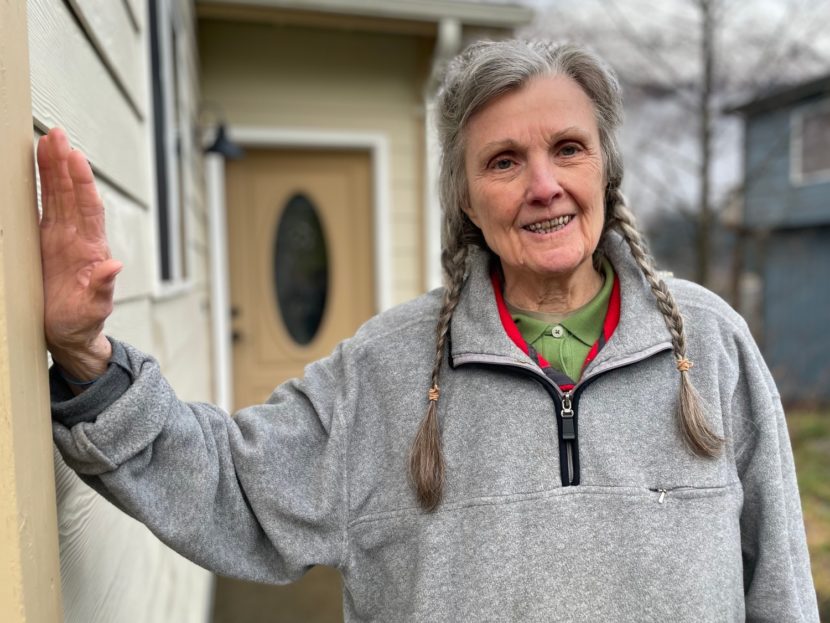
carolyn Brown stands outside her home in Juneau. (Photo by Lisa Phu/Alaska Beacon)
Brown said she is still learning to be at peace with what is.
“I went through a time of anger, rage, anger, vitriolic hate for the people who were the head honchos of the Alaska Right to Life. It took me a long time to get over that but I was only destroying myself by doing that, but the tincture of time does a lot of things for people,” she said.
These days, she reads a lot of philosophy and is interested in learning about different religions. One thing she doesn’t do is attend abortion-rights rallies.
“I remember when I first moved here in 2001 and we would have those rallies on Roe v. Wade day and I was asked to speak at them. I cannot do that, never could,” Brown said.
Brown said she went one year and just stood there. Brown is clear that she’s pro-abortion rights. But it’s not a simple topic to speak about.
“I don’t know. I still have to ask myself questions. What have I done? What is right? What is right? What is life? I know what life is and I know that this tissue here is human. That I know. Whether it’s a person – that’s my struggle. What’s the difference in humanity and personhood? Potential person? There’s so many unknown questions,” she said.
“I’m just glad that I don’t have to make those decisions anymore. That’s a gift to me for myself. It doesn’t mean I’m against abortions. I just don’t know what is a person. I don’t know. It’s complicated, isn’t it?” she said.
Ultimately, Brown said, abortion and what constitutes a life “is not black and white,” it’s not a yes or no question. Instead, it’s complicated and ever changing, and dependent on so many different factors – like a person’s background, spirituality, family history.
And that decision on what abortion is, what personhood is, is not for her to determine, Brown said. She doesn’t think it’s for the U.S. Supreme Court to determine either, or for all the other people who usually end up getting involved in these discussions and decisions. There’s no simple way to put it, she said; it’s just complex.