
Alaska Beacon

Alaska Beacon is part of States Newsroom, a network of news bureaus supported by grants and a coalition of donors as a 501c(3) public charity. Alaska Beacon maintains editorial independence. Contact Editor Claire Stremple for questions: info@alaskabeacon.com. Follow Alaska Beacon on Facebook, Bluesky and Twitter.

Alaska’s two U.S. senators vote to advance federal same-sex marriage protections

Sen. Dan Sullivan in Anchorage in July 2021. (Photo by Jeff Chen/Alaska Public Media)

Alaska’s two U.S. senators voted on Wednesday in favor of ending debate on a bill intended to protect same-sex and interracial marriage rights, advancing the bill toward final passage in the U.S. Senate.

Sen. Lisa Murkowski and Sen. Dan Sullivan, both Republicans, joined 10 other Republicans and all 50 Democratic Senators on a “cloture” vote needed to end debate. The final vote was 62-37, making final passage — which requires just 51 votes — certain.

After the vote, President Joe Biden urged members of Congress to finish work and send it to his desk.

If signed into law, the bill would not have a significant immediate effect; same-sex marriage rights were guaranteed by the U.S. Supreme Court in a 2015 decision.

Earlier this year, Supreme Court Justice Clarence Thomas wrote that the court should re-examine that decision. His remarks sparked congressional action.

If the bill becomes law and the Supreme Court reverses its 2015 decision, states would be allowed to choose whether to ban same-sex marriage but would be required to recognize same-sex marriages from other states and those performed in their states when the practice was legal.

In Alaska, the state constitution still contains an amendment prohibiting same-sex marriage; that amendment has been legally suspended since 2014 but could be reactivated if the Supreme Court reverses itself.

The bill also requires the federal government to recognize same-sex marriages. It reverses Clinton-era legislation that defined marriage as between a man and a woman.

Wednesday’s vote came after a slightly different version of the bill passed the U.S. House in July. The Senate postponed consideration until after the midterm elections.

Part of the reason for the delay was the need to gain more support from Senate Republicans. While Murkowski was among a handful of Republicans who indicated that they would vote for the House’s bill, others, including Sullivan, said they were likely to oppose it.

That presented a problem for supporters, who needed at least 10 Republican votes to advance the bill.

To garner those votes, supporters amended the bill and added provisions stating that religious organizations are not required to host, accommodate or participate in same-sex wedding ceremonies.

The bill adds a legal shield preventing lawsuits against those organizations if they refuse to host same-sex weddings.

Ben Dietderich, a spokesperson for Sullivan, said that component was the result of research by Sullivan’s staff and others, and its inclusion was key.

“By doing that, it secured the senator’s vote, and I think it also helped get other Republicans on board as well,” Dietderich said.

In a prepared written statement, Sullivan said that he continues to believe the bill is unnecessary because of the Supreme Court’s 2015 decision but believes the religion-related provisions are worth supporting.

“While I’ve long held that marriage should be an issue left up to the states, the Supreme Court nationalized the issue in Obergefell. I said then that I would respect the Court’s decision, but would also continue to fight for and respect and defend the religious liberty of all Americans. This bill makes important advances in doing that,” Sullivan said. “Finally, in the very unlikely event that Obergefell is overturned in the future, this bill would still respect state laws, like Alaska’s constitutional provision on traditional marriage, and it would only require states to provide full faith and credit recognition to all lawful marriages from other states.”

This article originally appeared in the Alaska Beacon and is republished here with permission.

With more votes counted, Alaska House races are split 20-20 between Republicans and others

East Anchorage House candidates Democrat Donna Mears, left, and Republican Forrest Wolfe, right, appear in a photo composite. Mears took the lead over Wolfe in an updated vote count on Tuesday, Nov. 15. (Mears photo by Andrew Kitchenman/Alaska Beacon; Wolfe campaign photo provided by Wolfe)

Democratic candidate Donna Mears overtook Republican candidate Forrest Wolfe in a closely watched Alaska House race as the Alaska Division of Elections counted 27,178 early, absentee and questioned ballots, about three-fifths of the number outstanding from the Nov. 8 general election.

Additional absentee ballots are expected to arrive in the coming days, and the Division of Elections’ next scheduled count is Friday.

With Mears taking a lead, the 40-seat Alaska House is split exactly in half.

In 20 seats, Republicans lead. In the other 20, Democratic or independent candidates are leading.

Since 2016, the House has been led by a predominantly Democratic coalition that includes independents and moderate Republicans. If Mears and other non-Republican candidates maintain their leads, the odds of a continued coalition increase.

Subsequent vote counts, including Alaska’s first-of-its-kind ranked choice sorting on Nov. 23, are expected to change some results and could alter the split in the House.

In northern Anchorage, for example, Rep. David Nelson, a Republican, leads two Democratic challengers. In the ranked choice sorting process, preliminary results indicate that one of the Democrats will be eliminated, and ranked choice voting allows supporters of the eliminated candidate to put their support to a second candidate, likely the other Democrat.

Elsewhere in Anchorage, the sorting process may benefit Republicans. Democratic candidate Denny Wells has 46% of the vote in the House seat representing Anchorage’s Taku-Campbell Anchorage, but two Republicans in the district have a combined 54% of the vote.

In the district surrounding the Alaska Zoo, nonpartisan candidate Walter Featherly has 45% of the vote but two competing Republicans have more than 55% of the vote combined.

Elsewhere in the state, Tuesday’s ballot counts did not result in any lead changes.

Statewide, incumbent Republican Gov. Mike Dunleavy has more than 51% of the vote in the race for governor, precluding the need for a ranked choice sorting process that involves his challengers.

In the race for the U.S. House, Democratic candidate Mary Peltola has more than 48% of the vote, less than the combined totals of her two Republican challengers, Sarah Palin (26.1%) and Nick Begich (23.8%), but in the Aug. 16 special general election that featured all three candidates, many of Begich’s supporters did not list Palin as a second choice.

For the U.S. Senate seat on the ballot, Republican challenger Kelly Tshibaka saw her lead over Republican incumbent Lisa Murkowski dwindle to just 565 votes, or two-tenths of 1 percentage point.

Many Democratic voters are expected to back Murkowski as a second choice when ranked choice sorting takes place Nov. 23 and Democratic candidate Pat Chesbro is eliminated.

Among state legislative races:

  • Sen. Scott Kawasaki, D-Fairbanks, now has more than 50% of the votes in his re-election contest against Republicans Jim Matherly and Alex Jafre. That margin means the race will likely not go through ranked choice sorting on Nov. 23 and Kawasaki is much more sure of victory.
  • Rep. Andy Josephson, D-Anchorage, extended his 86-vote Election-Day lead over Republican challenger Kathy Henslee. Josephson now leads by 215 votes out of 5,400 cast.
  • In South Anchorage, a three-way state Senate race among Republican incumbent Roger Holland, Republican challenger Cathy Giessel and Democratic challenger Roselynn Cacy is divided almost exactly equally. Giessel had 33.7% of the vote Tuesday night, Holland had 33.3% and Cacy 32.7%. Giessel is expected to have a majority of the second-choice votes from Holland and Cacy supporters, meaning that she would win as long as she remains out of third place and is not eliminated first in ranked choice sorting.
  • The lead of Republican Frank Tomaszewski (pronounced Thomas-shefsky) over Democratic incumbent Grier Hopkins, D-Fairbanks, has dropped to just over 6%, with Tomaszewski’s share of the ballots dropping to 49.1%. That means the race will go through ranked choice sorting on Nov. 23. Tomaszewski is still the favorite: The third candidate in the race is Republican Nate DeMars, and many of his voters are believed to have picked Tomaszewski second.
  • Sen. Mike Shower, R-Wasilla and one of the leading conservative members of the state Senate, likely locked up re-election after early and absentee votes failed to diminish his lead over former Alaska Wildlife Troopers leader Doug Massie in a Republican-Republican head-to-head contest.
  • Justin Ruffridge, a Soldotna pharmacist who ran as a moderate alternative to Rep. Ron Gillham, R-Soldotna, appears likely to defeat the incumbent. With early votes and absentees through Nov. 11 counted in that district, he leads by 6 percentage points.
  • The Division of Elections did not add votes from its Nome office, but there was a slight adjustment in the totals in the race between Rep. Neal Foster, D-Nome, and Alaskan Independence Party challenger Tyler Ivanoff. Foster’s total went up by three votes and Ivanoff’s fell by one, which increased Foster’s lead from six votes to 10. It’s the closest race in the state, and if Ivanoff were to win, he would be the first AIP candidate to serve in the Legislature.

This story originally appeared in the Alaska Beacon and is republished here with permission.

Dead bowheads in Beaufort and Chukchi point to increased killer whale presence in Arctic

Two killer whales breaching
Killer whales are seen swimming in Alaska waters in 2005. As sea ice diminishes, killer whales are increasing their presence in farther north waters. Studies confirm they are preying on bowheads in the eastern Chukchi Sea and western Beaufort Sea. (Photo by David Ellifrit/National Oceanic and Atmospheric Administration)

There are new signs that killer whales, which are swimming farther north and staying for longer periods of the year in Arctic waters, are increasingly preying on Alaska’s bowhead whales.

A newly published study found that 2019, an especially warm year in the region, also seems to have been an especially dangerous year for bowheads targeted by killer whales.

That year, 11 dead bowheads were found in the eastern Chukchi and western Beaufort seas, with seven of them identified as killer whale victims and the others with causes undetermined. That compares to the 33 dead bowheads found floating or beached in the region in the previous decade, from 2009 to 2018. Eighteen of them were identified as killer whale victims, according to a previous study by the same authors.

Along with the sheer numbers, the new study had another interesting finding about 2019, a year known for its warm Arctic Alaska waters and associated effects like seabird die-offs: a “drastic shift” from the eastern Chukchi to the western Beaufort as a place where bowhead carcasses were found, said lead author Amy Willoughby of the University of Washington and the National Oceanic and Atmospheric Administration’s Marine Mammal Laboratory in Seattle.

The new study detailing 2019 numbers and the previous 2020 study detailing 2009-2018 numbers comprise the first project to systematically examine causes of death for Alaska bowheads killed outside of the traditional Inupiat subsistence hunts. The project uses information gathered in the Aerial Surveys of Arctic Marine Mammals program that is funded by multiple federal agencies.

The authors, along with Willoughby, are other University of Washington and NOAA scientists, as well as colleagues from the North Slope Borough and University of Alaska Fairbanks.

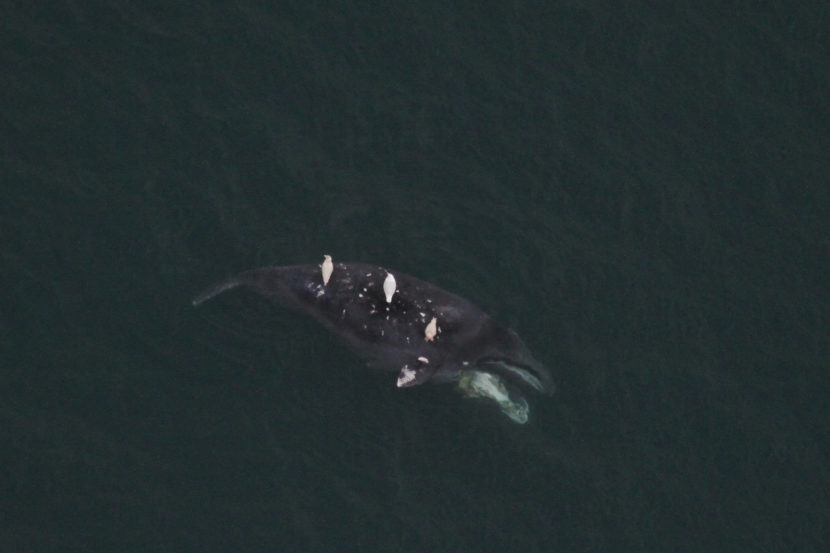
A dead bowhead whale floating on its side
A dead bowhead calf, spotted floating in the Chukchi Sea in 2015, was found upon close analysis to have the tell-tale signs of killer whale predation. This calf was among several dead bowheads in the Chukchi and Beaufort seas that were determined to have been killed by killer whales. (Photo by Lisa Barry/National Oceanic and Atmospheric Administration)

Willoughby and her colleagues were also the first to assemble direct proof of killer whale predation on Alaska bowheads – a dead bowhead calf photographed in 2015 with bite marks on its flipper, mouth and jaw.

On its own, the new study holds too little information to show a trend. “Unfortunately, we do not have comparable data before 2009 in this portion of bowhead whale range, so we cannot determine what is normal or establish patterns without future data,” Willoughby said by email. Also unknown, she said, is how many dead bowheads went undetected – and how many of those were killer whale victims.

Still, the findings fit into a larger pattern, emerging in Alaska and elsewhere, of killer whales spending more time in Arctic waters and preying on marine mammals there. “This is likely because summer sea ice is moving farther north, sea water temperatures are rising, and sea ice is breaking up earlier in the spring and forming later in the fall,” Willoughby said.

Numerous studies and Indigenous whalers’ reports are documenting more killer whales spending more time and making more predation attempts in far-north waters.

2017 study led by Craig George, a longtime North Slope Borough biologist, found an increased frequency over time of killer whale-inflicted scars on subsistence-harvested bowheads. That study examined the body conditions of 514 bowheads harvested from 1990 to 2012.

A study published in 2018 tracked an increasing frequency of killer whale calls in the Chukchi in the fall months. The acoustic monitoring showed that they have substantially increased their post-summer presence, said the study, by Kate Stafford of the University of Washington.

On the Atlantic side of the Arctic, killer whales have been increasingly seen preying on narwhals. One recent study estimated that killer whales could kill more than 1,000 narwhals a year.

This story originally appeared in the Alaska Beacon and is republished here with permission.
Long-running dispute over Izembek road to get another review in court-ordered rehearing

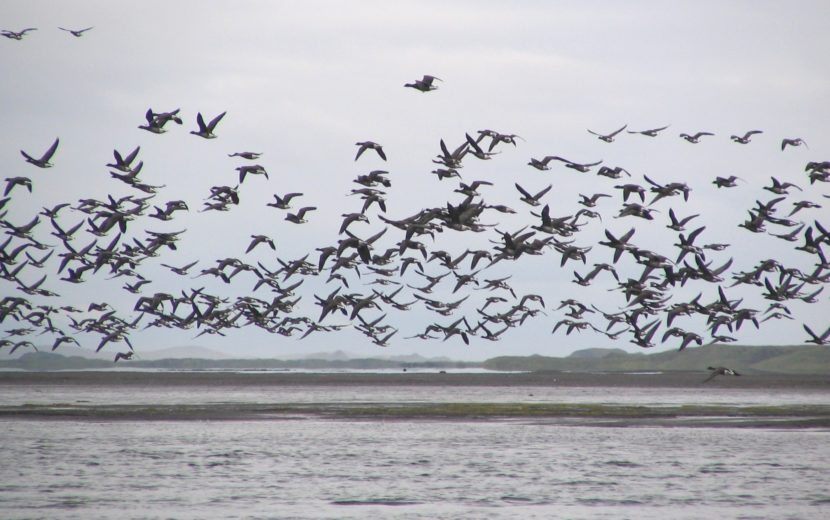
A flock of seabirds flying over a lagoon
Pacific black brant fly above Izembek Lagoon at Izembek National Wildlife Refuge on Dec. 27, 2013. The refuge is used as a migratory stop for nearly the entire global population of Pacific black brant. For decades, a debate has raged over a plan to put a road through a portion of the refuge. Izembek’s importance to migratory birds is invoked by road opponents, while road supporters say the project is needed to help residents of the nearby village of King Cove. (Photo by Kristine Sowl/U.S. Fish and Wildlfie Service)

A back-and-forth legal saga over a proposed road through a national wildlife refuge in Alaska took another turn on Thursday when the 9th U.S. Circuit Court of Appeals ordered a rehearing of the issue, a move that could possibly squash the project.

The case involves a land trade that would enable construction of a gravel road through a section of designated wilderness in the Izembek National Wildlife Refuge in southwestern Alaska. Thursday’s three-sentence order from the full panel of the circuit court vacated a March ruling by a three-judge appeals panel that would have helped clear the way for road construction.

The 2-1 ruling found that the Trump administration’s Department of the Interior was acting lawfully when it approved a swap of land between the U.S. Fish and Wildlife Service and the local village Native corporation, the King Cove Corp. Under the deal, which is currently in limbo, corporate-owned coastal land would be added to the refuge in exchange for a stretch of land within the refuge that would be used for the approximately 12-mile road.

Residents of King Cove, an Aleut village of about 850 people, have argued for decades that they need a road across the refuge to reach a jetliner-capable airport in Cold Bay, an even smaller community to the west. The Cold Bay airport, now operated by the state, is a World War II legacy; its 10,000-foot runway is one of the longest in Alaska and is sometimes used by jetliners that divert for emergency landings.

Opponents of the road and the land trade that would enable its construction argue that the road would damage globally important bird and wildlife habitat. They say the deal would set a bad precedent for all national wildlife refuges. They also argue that emergency evacuation services can be provided in alternative ways. Additionally, many have said they believe the road’s true purpose is commercial, to benefit segments of the seafood industry.

The debate over the land trade and the road it would enable has ricocheted for years through the administrative processes and the federal courts.

The Alaska congressional delegation pushed for legislation in the 1990s that would enable a land exchange. A 2009 appropriations bill launched a full environmental review of the project. In 2013, Sally Jewell, the Obama administration’s Interior secretary, issued a decision rejecting the land swap, concluding that process. In 2018, the Trump administration reversed Jewell’s decision and approved the trade. In 2019, U.S. District Court Judge Sharon Gleason struck down that approval, finding that Trump administration’s Interior secretaries, Ryan Zinke and David Bernhardt, exceeded their legal authority.

The March 16 appeals ruling reversed Gleason’s decision, finding that Bernhardt had acted within his authority. The Biden administration, so far, has supported the Trump administration’s approval of the land trade.

This article originally appeared in the Alaska Beacon and is republished here with permission.
Internal Republican divides complicate leadership of Alaska House and Senate

""
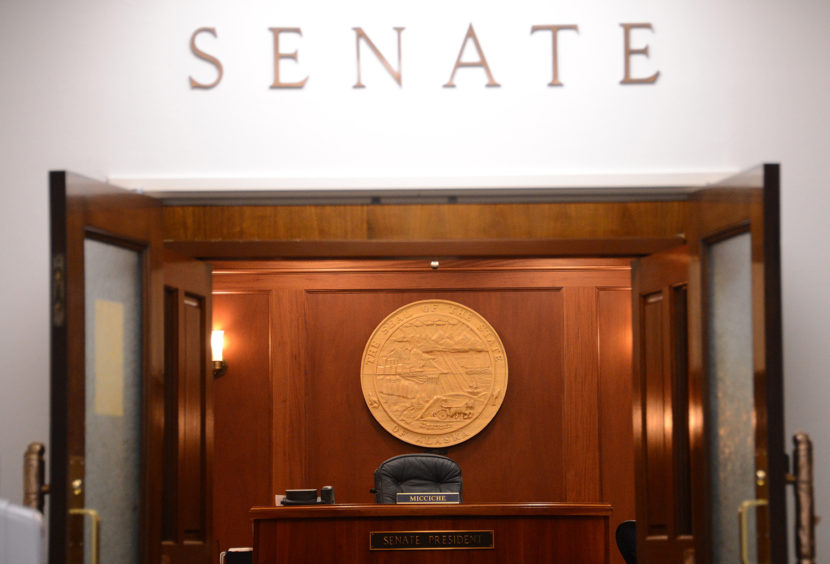
The Senate chambers are seen at the Alaska State Capitol on Friday, May 13, 2022 in Juneau, Alaska. (Photo by James Brooks/Alaska Beacon)

Republicans almost certainly will win a majority of the 60 seats in the Alaska Legislature.

Whether they will control the state House and Senate will come down to which Republicans win.

This year, as has been the case for much of the past decade, the party’s candidates are split. There are many differences, but they tend to fall into two groups:

  • One group’s members eschew compromise as they pursue conservative positions on social issues and seek a Permanent Fund dividend larger than any in recent years.
  • Members of the second group say working with Democrats and independents is essential to improve the state, and they prioritize limits on spending from the Permanent Fund, low (or no) taxes and maintaining or growing spending on services and construction, even if it causes a smaller dividend.

“There’s always been moderates within the Republican ranks who want to just work and move forward,” said Sen. Scott Kawasaki, D-Fairbanks. “And then there’s been sort of the ultra-conservative wing that has sort of a blood oath before they come down (to Juneau).”

Speaker of the House Louise Stutes, R-Kodiak, sees it more simply: “Well, you’ve either got your moderate Republicans, or you’ve got your far-right Republicans. It’s just pretty simple.”

The divide can be seen in legislative races across the state but is also visible in the statewide race for U.S. Senate. There, the Republican Party endorsed insurgent Republican Kelly Tshibaka, but some voters and local party officials backed incumbent Republican Lisa Murkowski.

But for the past several years, the divide has been particularly significant in the state House and the state Senate, affecting who controls those bodies.

House control

Since 2017, the state House has been controlled by a coalition that includes Democrats, independents and some moderate Republicans.

Republicans won a majority of the House in 2018 and 2020 but failed both times to coalesce into a majority. After a month of impasse, in both 2019 and 2021, a handful of Republicans joined independents and Democrats to continue the coalition.

This time around, the path will be harder. One of the two coalition Republicans, Eagle River Rep. Kelly Merrick, is running for Senate and will almost certainly be replaced by Jamie Allard, an adamant supporter of a Republican-led majority.

After Election Day, Republican candidates led in 21 of the House’s 40 races, and they have the potential to gain more leads as additional votes are counted and ranked choice races are sorted.

The last remaining coalition Republican is Stutes, who said before the election that she isn’t certain if she will continue as a member.

“I don’t think anybody’s going to know anything until the fat lady sings,” Stutes said.

Will Stapp is a Republican from Fairbanks and the winner — based on Election Day results — of the race to replace retiring Rep. Steve Thompson.

“I would probably say that it appears to most people that I have talked to that you might be looking at a coalition in the Senate, and probably a Republican majority of 23-ish in the House,” Stapp said. “That would be my guess. But, you know, the voters get to say, right?”

The results of the 2018 and 2020 elections created a leadership deadlock in the House as Republicans repeatedly attempted and failed to create a majority caucus.

Those deadlocks lasted a month into the opening legislative session and ended only when some Republicans joined the predominantly Democratic coalition.

This time around, candidates say that if Republicans hold only a narrow majority in the House, internal divides could create another deadlock in early 2023.

It isn’t yet clear whether that will happen.

Senate control

The situation in the Senate is more clear-cut, in part because most races have definitive winners. As of Wednesday morning, Democrats lead in nine of the Senate’s 20 seats. If those leads hold up, the party would gain two seats from the pre-election standings.

That leaves Republicans with 11 seats, the narrowest possible majority, but for the past several years, Senate Republicans have been divided by budgetary issues, and the Senate has passed a budget only because Democrats voted in favor of a document crafted by moderate Republicans on the Senate Finance Committee.

“We’ve kind of seen the party structure, to some extent, break down around here,” said Sen. Robert Myers, R-North Pole.

On Wednesday, Democratic senators and senators-elect gathered in Anchorage for a strategy session intended, in part, to determine whether it will be possible to work with those moderate Republicans and others.

Unusually, Sen. Gary Stevens, R-Kodiak, and Sen. Bert Stedman, R-Sitka, were in Anchorage for Election Day and remained in the city afterward. Both men are believed to be likely members of a coalition majority. Stevens served as Senate president from 2009 to 2013, the last time a coalition majority existed in the chamber.

Stevens said it’s “premature at this point” to say whether a coalition will form but said that “it’s possible that within a week,” Alaskans may have an answer to the Senate leadership question.

Sen. Jesse Kiehl, D-Juneau, was among the legislators who flew to Anchorage and said it takes three things for agreement in the Legislature — alignment on politics, policies and personalities.

“The definition of coalition is different in different people’s minds,” he said.

Sen. James Kaufman, R-Anchorage, is the likely winner of the race to replace Republican Sen. Josh Revak, R-Anchorage, and said senators and senators-elect have been trading phone calls and text messages.

“I’m in conversations, but I’m not really ready to say too much,” he said when asked his thoughts about Senate organization.

Kawasaki said he expects negotiations to take place quietly.

“The confirmation will be when the press release comes out,” he said.

This story originally appeared in the Alaska Beacon and is republished here with permission.
Republicans lead in majority of Alaska House seats, with potential for more

""
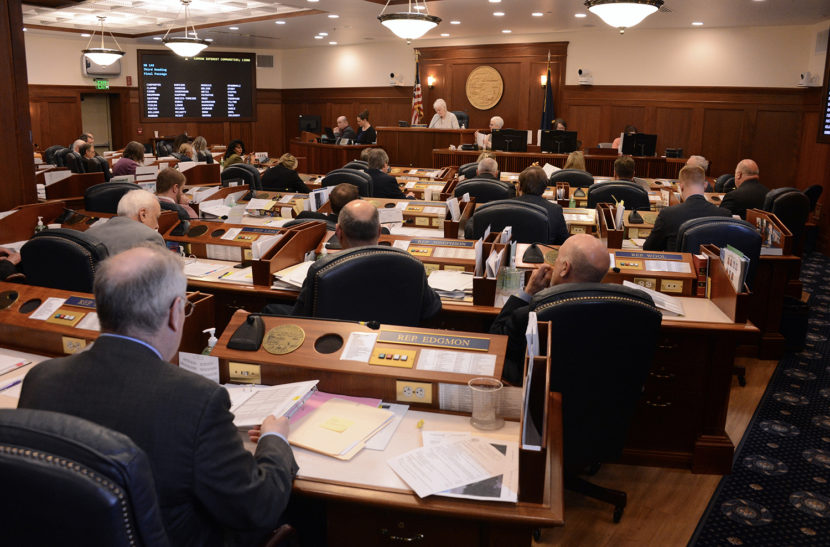
The Alaska House of Representatives is seen in session on Wednesday, May 11, 2022 at the Alaska State Capitol in Juneau, Alaska. (Photo by James Brooks/Alaska Beacon)

Republicans led 21 of the 40 races for Alaska state House seats in preliminary results early Wednesday morning and have a chance to take additional leads as more votes are counted and ranked choice sorting takes place.

The results increase the chances that Republicans will take over the House from a multipartisan coalition that has controlled it since 2017, but that remains uncertain.

Republicans filled a majority of the House’s seats throughout the past six years, but divides within the Republican ranks caused some members to leave the Republican caucus for the coalition, allowing it to survive.

Tens of thousands of absentee and early votes remain to be counted. If a race has no candidate with a majority of votes, it uses ranked choice voting, and the final sorting will not take place until Nov. 23.

That sorting will be most important for three Anchorage state House seats:

  • In House District 11, which covers the area around the Alaska Zoo, nonpartisan candidate Walter Featherly has 43.9% of the vote. His two Republican challengers combined have over 50%.
  • Incumbent Republican Rep. Tom McKay is trailing Democratic challenger Denny Wells, who has 45.1% of the vote in a district that includes Campbell Lake. Third-place Republican finisher David Eibeck has almost 15% of the vote. If he is eliminated and his voters’ second preference is McKay, the incumbent will win.
  • In the district that covers Government Hill and Joint Base Elmendorf-Richardson, incumbent Republican Rep. David Nelson has just under 44% of the vote. He faces two Democratic challengers, one with about 36% of the vote, the other with about 20%. If the ranked choice vote consolidates that support, Democrat Cliff Groh, currently in second, will win.

Uncounted absentee and early votes could change the equation for those three races and several other close contests.

Among head-to-head races, none is closer than the one in western Alaska, where ballots counted through 3 a.m. Wednesday morning showed Democratic incumbent Rep. Neal Foster in a close race with Alaskan Independence Party candidate Tyler Ivanoff, the Shishmaref man who nearly beat Foster in the Democratic primary two years ago.

With 25 of 28 precincts reporting, Ivanoff trailed Foster by just 44 votes.

House District 13, in Midtown Anchorage, was the second-closest House race in the state. There, longtime Democratic incumbent Andy Josephson led Republican challenger Kathy Henslee by just 86 votes. That result could change as more votes are counted.

Also in Anchorage, Republican Forrest Wolfe led Democratic candidate Donna Mears by 135 votes out of 6,018 cast. That margin is also close enough that the result could change as more votes are counted.

In Fairbanks, Republicans and Democrats appeared likely to trade control of a pair of seats. Redistricting put incumbent Democratic Rep. Grier Hopkins into a Republican-leaning district, and Republican challenger Frank Tomaszewski led Hopkins and a second Republican, Nate DeMars, with just over 50% of the vote on Election Day.

In downtown Fairbanks, incumbent Republican Rep. Bart Lebon trailed Democratic challenger Maxine Dibert, who had 47.5% of the vote in that district.

LeBon and fellow Republican Kelly Nash have more than 50% of the vote combined, which could help LeBon in a ranked choice sort, but Nash urged her supporters to not rank LeBon second.

In downtown Anchorage, redistricting placed Democratic incumbent Reps. Zack Fields and Harriet Drummond into the same district. Fields had 56.4% of the vote and was on pace to defeat Drummond.

Two former state legislators appear on course to return to the House. In Anchorage’s Taku-Campbell neighborhood, former Republican Rep. Craig Johnson has 53% of the vote; and in Eagle River, former Republican Rep. Dan Saddler also has 53% of the vote.

Post-election legal challenges could affect the makeup of the House as well, but those outcomes are even more uncertain than the result of vote-counting.

In House District 16, Democratic candidate Jennifer Armstrong has a significant lead over Republican Liz Vazquez, but Armstrong’s eligibility for office has been challenged in court, and a judge could disqualify her, awarding the race to Vazquez.

The eligibility of Rep. David Eastman, R-Wasilla, has also been questioned by a lawsuit. A December trial is set to decide whether Eastman’s membership in the Oath Keepers militia group violates the disloyalty clause of the Alaska Constitution.

As of Election Day, Eastman led a three-way, all-Republican race with just under 52% of the vote in his Wasilla district.

This story originally appeared in the Alaska Beacon and is republished here with permission.
Site notifications
Update notification options
Subscribe to notifications