Alaska Beacon

Alaska Beacon is part of States Newsroom, a network of news bureaus supported by grants and a coalition of donors as a 501c(3) public charity. Alaska Beacon maintains editorial independence. Contact Editor Claire Stremple for questions: info@alaskabeacon.com. Follow Alaska Beacon on Facebook, Bluesky and Twitter.

Alaska crab fishery collapse seen as warning about Bering Sea transformation

""
Bering Sea snow crab support an iconic Alaska seafood harvest, but a crash in population since 2018 has triggered the first-ever closure of the fishery. (Photo provided by National Oceanic and Atmospheric Administration)

Less than five years ago, prospects appeared bright for Bering Sea crab fishers. Stocks were abundant and healthy, federal biologists said, and prices were near all-time highs.

Now two dominant crab harvests have been canceled for lack of fish. For the first time, the Alaska Department of Fish and Game in October canceled the 2022-2023 harvest of Bering Sea snow crab, and it also announced the second consecutive year of closure for another important harvest, that of Bristol Bay red king crab.

What has happened between then and now? A sustained marine heat wave that prevented ice formation in the Bering Sea for two winters, thus vastly altering ocean conditions and fish health.

“We lost billions of snow crab in a matter of months,” said Bob Foy, director of the National Oceanic and Atmospheric Administration’s Alaska Fisheries Science Center, at a public forum held Dec. 12 at the Anchorage Museum of History and Art. “We don’t have a smoking gun, if you will. We don’t have one particular event that impacted the snow crab — except the heat wave.”

That heat wave is now over, but its effects linger. A NOAA survey showed an 80% decline in Bering Sea snow crab, from 11.7 billion in 2018 to 1.9 billion this year. It could take six to 10 years to recover, experts told members of the North Pacific Fishery Management Council, which wrapped up a 10-day meeting in Anchorage on Wednesday.

Snow crab may be the “poster child” of climate change, council member Bill Tweit said during deliberations on a rebuilding program that was ultimately approved at the meeting, but much more will be affected by the long-term changes in the ocean.

“It’s going to be more and more a problematic question for us among a broader range of species than just snow crab,” Tweit said.

In the short term, loss of the snow and red king crab harvests is devastating. Direct losses from harvest cancellations this year amount to $287.7 million, according to state estimates. Local governments are suffering, too, like the Aleut community of St. Paul, which relies on the crab harvests for more than 90% of its tax revenue.

""
Close-up view of an Alaska king crab is seen in 2019. (Photo by Julia Brownlee/National Oceanic and Atmospheric Administration)

There are limits to what the North Pacific Fishery Management Council can do to manage crab stocks. Crab harvests are managed by the state, even for stocks existing in federal waters, though the council and federal agencies provide support and scientific information to assist and cooperate in that management. However, the council and associated federal agencies do have the power to regulate other fisheries that might affect the crab – and that is what crab fishermen and crab-dependent communities asked them to do.

Alaska Bering Sea Crabbers, a nonprofit trade organization, petitioned the council to use its emergency powers to ban all fishing for six months in areas designated as protected zones for red king crab. In those areas, crabs mate and molt, spending much of their time in a vulnerable soft-shell stage. That puts the crabs at high risk for being crushed and killed by trawl nets that hit or scrape the seafloor, the organization argued.

Warm temperatures may have wiped out much of the crab population, but that is not something that can be corrected immediately, said Jamie Goen, Alaska Bering Sea Crabbers’ executive director.

“Our concern as crab fishermen is we need to focus on the things we do have control over, and that’s really fishing impacts and habitat protections,” she said at the museum forum, which was organized by the Anchorage Daily News and the Seattle Times.

The council ultimately declined to take such emergency action, which critics said might not be effective and would have unintended consequences. They include pushing the trawl fleet into different territory, where there might be higher incidental catch of salmon or other problems. Instead, the council opted for a plan to study alternatives that include possible fishery closures in the key red king crab mating and molting areas. And the snow crab rebuilding plan it approved leaves open the possibility of a small harvest conducted as the stock recovers, which is important to industry representatives who voiced concerns about losing their position in the wider seafood markets.

“Once you lose that space at the buffet table and they fill it with shrimp or lobster, it’s really hard to get that back,” said John Iani, president of the North Pacific Crab Association, a Seattle-based organization of processing companies.

There is plenty of competition for the market slice held by Alaska snow crab and red king crab.

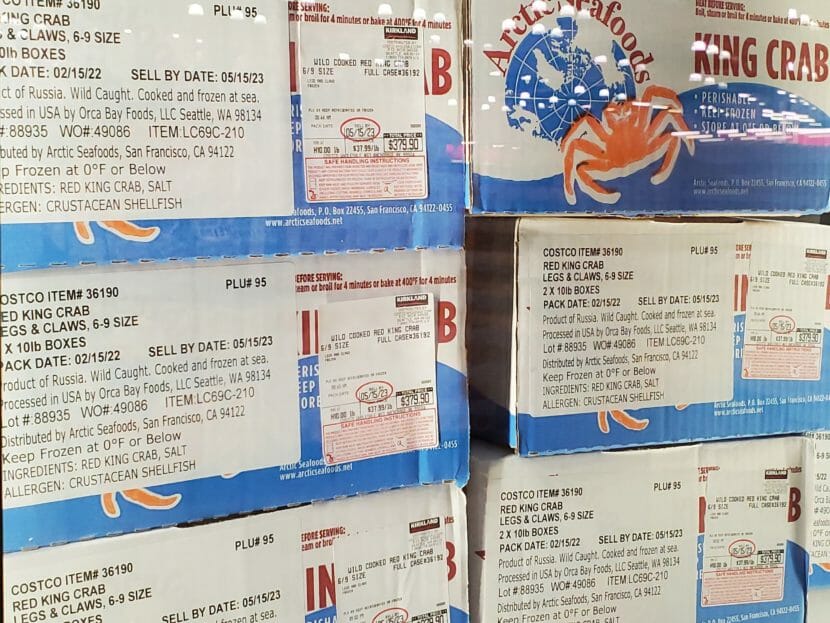
Stockpiles of Russian king crab are still being sold – even recently at an Anchorage Costco – though the U.S. government has banned further imports of Russian fish due to Russia’s invasion of Ukraine. Snow crab is harvested in eastern Canada, where stocks remain healthy, and in the Barents Sea off Scandinavia, where it is a relatively new species.

There is other Alaska crab on the market, too, though not as celebrated. Harvests of golden king crab, a species smaller than red king crab, are proceeding, and a relatively small harvest of red king crab in Norton Sound, in the Nome area, that is expected to open in 2023, though in two recent years it was shut down because of low stocks. Dungeness crab harvests continue in Alaska, as in other West Coast states. The Alaska Department of Fish and Game last week announced that a tanner crab season will open in 2023 in the Aleutians area.
A stack of boxes of king crab
Russian king crab is displayed at a Costco in Anchorage on Nov. 14. The crab, from the Barents Sea, was distributed by Arctic Seafoods of San Francisco, and was part of inventory stockpiled before the U.S. government banned fish important from Russia. (Photo by Yereth Rosen/Alaska Beacon)

There are other positive signs in the Alaska marine environment, according to the ecosystem reports presented to the council.

After successive years of low ice and high temperatures, a normal freeze returned to the Bering Sea last winter, scientists told the council. That resulted in the return this summer of an average-sized “cold pool” – the section of ultra-chilled water that serves as a thermal barrier separating habitats in the northern and southern Bering Sea. Seabird populations, many of them substantially reduced in recent years, are now showing reproductive successes, the scientists said. Some fish populations, including pollock and Bristol Bay-bound sockeye salmon, have actually thrived in the warmer conditions, the scientists said.

But there are also persistent signs of trouble. Ocean temperatures in certain areas, like the Aleutians, remain high. Steller sea lions, an endangered population in western Alaska, continue to decline in the western Aleutians. Northern fur seals, which congregate in the Pribilof Islands, are in a long-term decline.

The future of the Bering Sea appears to depend on whether humans take action to reduce greenhouse gas emissions that are warming the planet, NOAA fisheries biologist Elizabeth Siddon told the council on Dec. 11.

A “high-mitigation” scenario, with big reductions in greenhouse gas emissions, will result by the end of the century in “a Bering Sea that’s only slightly warmer but pretty similar to current conditions,” Siddon said. But under a business-as-usual scenario, with very little progress to reduce greenhouse gas emissions, the Bering Sea will be “much warmer than we would have observed to date,” she said.

Foy, speaking at the museum event, said the peak Bering Sea temperatures seen during the heat wave are unlikely to become normal anytime soon. But marine heat waves are expected to become more frequent, overlaying an ongoing and gradual rise in ocean temperatures, he said.

“It’s the impact on an ecosystem of those heat waves that worry scientists the most,” he said. “Because the data shows that the animals can’t adapt. If they can’t move, if they can’t grow, if you don’t get enough year classes in a row to sustain a fishery, then that’s when we have difficulty of fishery and communities and large-scale economic issues.”
Alaska, source of carbon-emitting fossil fuels, aims to raise money by storing carbon

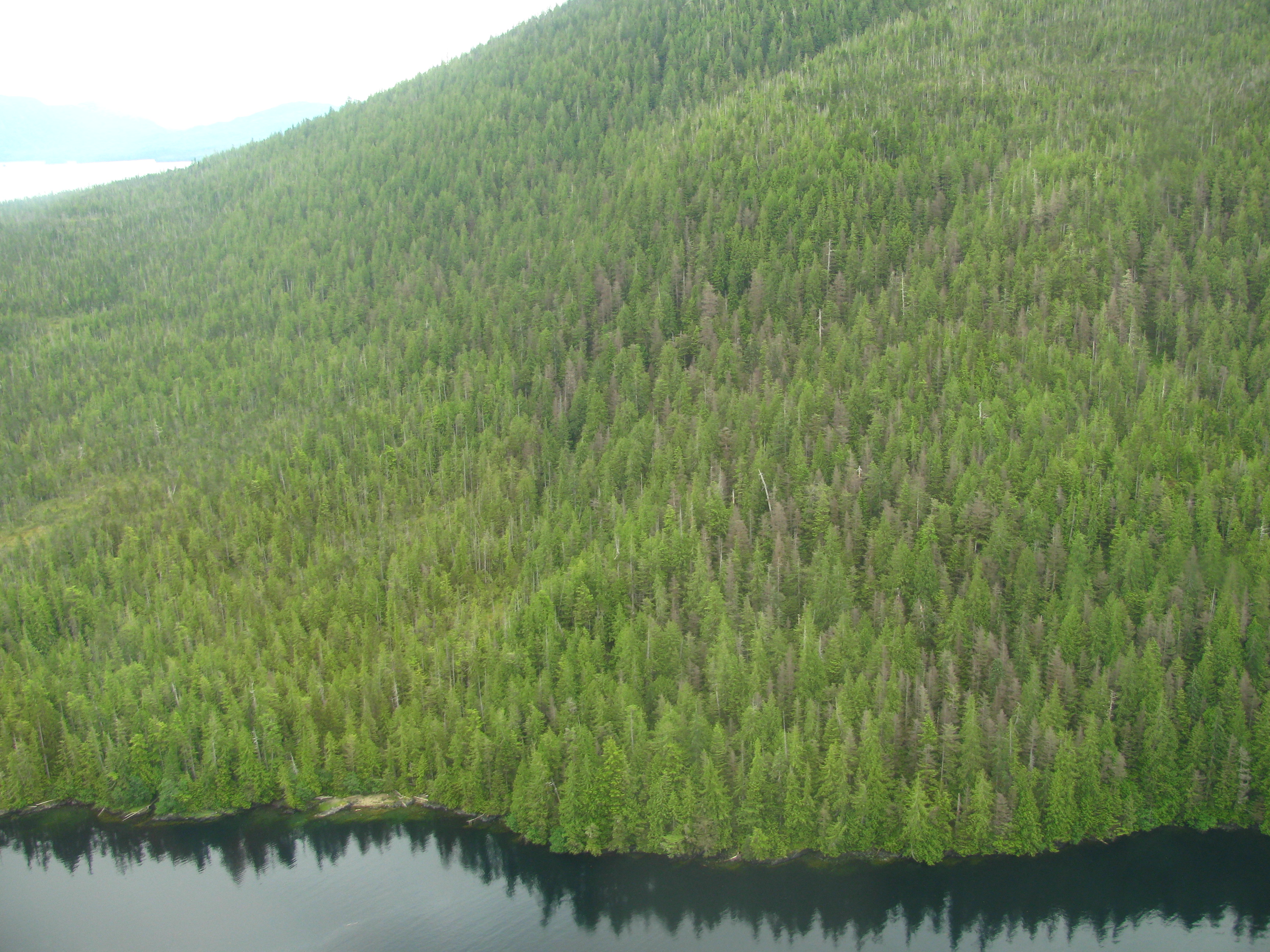
Aerial view of the trees in the Tongass National Forest (Photo courtesy of Elizabeth Graham/National Forest Service)

Alaska’s state government raises hundreds of millions of dollars each year through the sale of oil that when burned contributes to climate change. Now the state is looking to also make money by preventing some of these gasses from entering the atmosphere.

Gov. Mike Dunleavy plans to introduce a bill this upcoming legislative session aimed at turning the state’s capacity to absorb and store carbon into a source of revenue. And he said it could  bring in several hundred million to a billion dollars in revenue a year.

“Alaska has a real opportunity to sequester carbon in many different ways in the state – through our forests, through our depleted oil and gas basins, as well as the potential for seaweed sequestration off our coasts,” Dunleavy said during a press briefing Thursday where he and his cabinet released the proposed budget for the fiscal year that starts in July 2023.

Carbon sequestration is the process of capturing and storing atmospheric carbon dioxide, which is the most commonly produced greenhouse gas. Sequestration is one method of reducing the amount of carbon dioxide in the atmosphere.

Dunleavy said Alaska’s depleted basins, like Cook Inlet, are perfect places to sequester carbon. He said Cook Inlet could store upwards of 50 gigatons of carbon.

“As a matter of fact, Alaska probably has more capacity to sequester carbon underground than anywhere on the West Coast,” he said.

Dunleavy also mentioned Alaska’s forests and coastlines as assets for carbon monetization. Tree and forests take in carbon dioxide from the atmosphere, and that absorption can become carbon credits that are sold to companies interested in offsetting environmental impacts. Alaska Native corporations, like Sealaska and Ahtna, developed forest carbon projects several years ago. And research has shown seaweed cultivation could be a carbon removal strategy.

Dunleavy said the bill he plans to introduce this coming session will be a starting point to figure out what carbon sequestration would look like in the state and explore things like how the state can contract with companies and other entities, what’s in the contract, and what lands, basins and coastlines could be involved.

Meredith Trainor, executive director for Southeast Alaska Conservation Council, said the organization is encouraged to hear the governor thinking about the opportunities presented by carbon sequestration in Alaska, “but, of course, the devil is in the details.”

“From our perspective at SEACC, the easiest way to increase carbon sequestration in Alaska is to protect the Tongass National Forest. That’s not necessarily up to Gov. Dunleavy, but seeing the governor think more broadly about ways to protect forested areas over which the state does have influence would be critical, although we think it’s equally as important that the governor not seek to remove land from federal holdings in the process of doing so,” Trainor said.

Dunleavy said he hopes to see action on a broad bill that will enable the state to start to entertain potential contracts with entities. No potential entities at this point have been identified, his office said later.

The multi-year revenue option “doesn’t gore any ox,” Dunleavy said.

“For years the conversation on revenue was: Whose ox are we going to gore? Are we going to do an income tax on the people of Alaska. Are we going to do corporate taxes? With the advent of the monetization of carbon, we have a real possibility of receiving revenue that doesn’t gore any ox,” Dunleavy said.

No revenue from carbon sequestration is included in the proposed budget, but a target for potential new revenue is included in Dunleavy’s 10-year plan. It imagines $300 million in fiscal year 2024, $500 million the next year, increasing to $750 million the year after, and leveling out at $900 million in subsequent years – revenue that would help balance out what is needed to keep the state functioning.

State Sen. Bert Stedman, R-Sitka, doesn’t think revenue from carbon sequestration will come in that quickly.

“That’s a big issue that’ll take quite a bit of analysis and discussion,” he said. “My guess is it’s a two-year process.”

Stedman said successful legislation could create an opportunity for “multigenerational contracts” between the state and investors, so lawmakers should be careful.

“If we make a mistake, it could be very expensive for the development opportunities,” he said.

James Brooks contributed reporting to this story.

Dunleavy offers $7.3 billion Alaska budget, opening negotiations with wary legislators

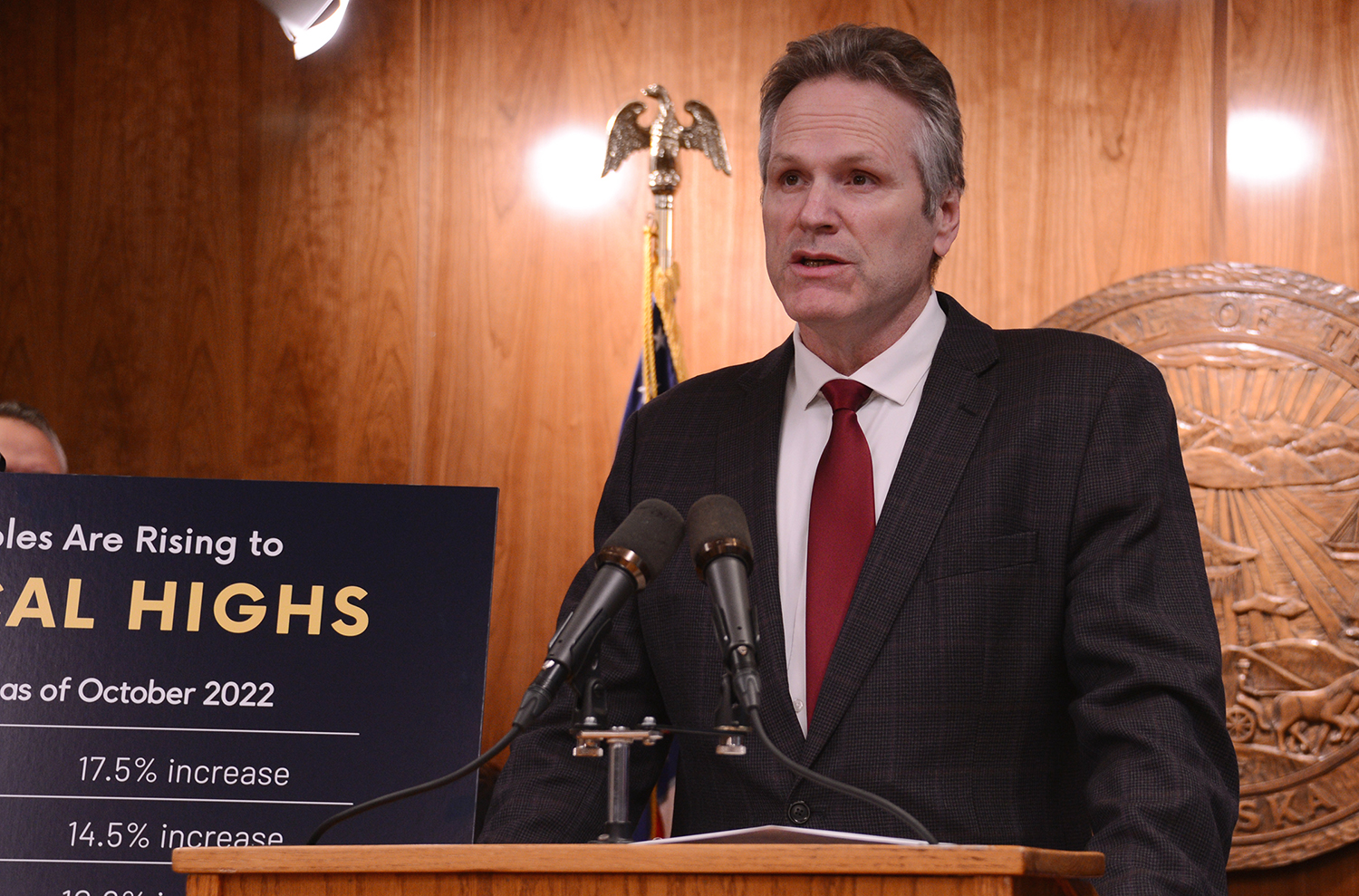
Alaska Gov. Mike Dunleavy speaks at a news conference on Thursday, Dec. 15, 2022, at the Alaska State Capitol in Juneau. (Photo by James Brooks/Alaska Beacon)

Gov. Mike Dunleavy introduced a first-draft $7.3 billion state budget on Wednesday, meeting a legally required deadline but acknowledging that the document is likely to change significantly as the administration negotiates with lawmakers in the upcoming legislative session.

“This budget that we’re submitting, as always, is a talking point with the Legislature,” Dunleavy said. “It also reflects values, what our revenue picture looks like, and where we’re headed.”

The biggest single expense is $2.5 billion for Permanent Fund dividends — enough for a payment of about $3,860 per recipient this fall.

To accommodate that cost, the governor’s proposal relies on some spending from savings. It also cuts the state’s capital budget — used for construction and renovation projects — by two-thirds and proposes no increases to spending on K-12 education, something sought by school districts and many legislators.

The proposed budget covers Fiscal Year 2024, which begins July 1 and runs through June 30, 2024. Lawmakers will begin considering the proposal when they convene in January.

“There’s some definite needs that are not being addressed,” said Sen. Bert Stedman, the Sitka Republican who chairs the Senate Finance Committee on operating budget issues.

Stedman said it would be fair to think of the governor’s proposal as a starting point for further negotiations.

If oil prices remain flat, the proposal puts legislators in an awkward bargaining position: Increasing school funding or the amount spent on maintenance and construction would require either spending from savings or reducing the size of the dividend.

New revenue plans, such as a carbon sequestration program proposed Thursday by the governor, would require years to implement.

The draft budget unveiled Thursday includes no major cuts to ongoing services but does allow one-time funding increases to expire, shrinking some agencies. The University of Alaska, for example, would see its budget shrink by $17.3 million, or more than 5%, because of the end of one-off programs.

In a prepared statement, university President Pat Pitney noted that without increases, “it does not include priorities including cybersecurity, rising costs and urgent deferred maintenance.”

She said the university will continue to advocate for those priorities during the upcoming legislative session.

State revenue expectations are down

Oil accounts for between one-third and half of the state’s general-purpose revenue, depending on prices and production, and a new forecast released Thursday alongside the budget shows a significant decrease in oil revenue.

In the upcoming fiscal year, the forecast projects $6.9 billion in general-purpose revenue, a drop of $700 million from a preliminary projection this spring.

The Department of Revenue also lowered expectations for the current fiscal year. This spring, the state had forecast $8.3 billion in revenue for Fiscal Year 2023, which started in July and ends in June 2023. That’s been lowered to $7.2 billion.

The reduction affects the upcoming Fiscal Year 2024 as well. This spring, lawmakers allocated an extra $1.2 billion for education funding, effectively saving that money to cover K-12 schools in FY24. With oil prices and production lower than forecast, that savings has all but evaporated. The state Office of Management and Budget expects only $48 million of the $1.2 billion to actually survive.

Education spending likely to grow, Dunleavy says

Though his budget contains no increases to K-12 funding, something that school administrators have requested to combat years of flat-funding and real budget cuts once inflation is considered, Dunleavy said he expects negotiations with the Legislature to result in increases.

It’s “highly likely, yes,” Dunleavy said.

When asked why he didn’t include some increase to start with, Dunleavy responded that any figure that he picked would be the wrong one.

“For me to put a number in the budget, some would say it’s too little, some would say it’s too much,” he said. “Right now, it’s a blank piece of paper for all of us to work on.”

Dunleavy suggested that changes to the state’s foundation formula — the amount the state pays school districts per student — could be in the works, possibly including changes to the amounts used to calculate energy and salary costs.

He personally would want to include an “accountability component,” he said, some mechanism to require improved performance.

Budget subject to change

Dunleavy called Thursday’s proposal a “beginning budget” and said the final version will depend on the price of oil as well as the result of negotiations with the Legislature.

“Next week, we could be up another 17%, 20% in oil prices and revenue, depending on the chaotic conditions in the world. We could be down 20%. So this, again, is a beginning budget and we look forward to the discussions,” he said.

At legislative eligibility trial, Eastman confirms membership in anti-government militia

""
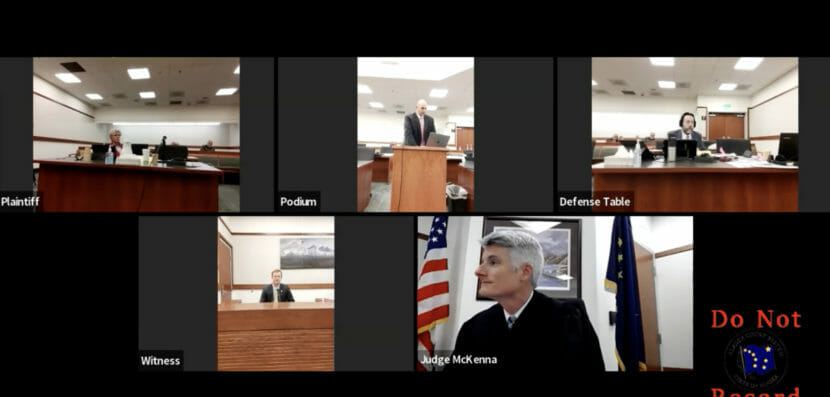
In this Alaska Court System screenshot, Rep. David Eastman, R-Wasilla, takes the witness stand (bottom left window) on Wednesday, Dec. 14, 2022, during his legislative eligibility trial in Palmer. (Screenshot)

In sworn testimony Wednesday, Alaska Rep. David Eastman said he remains a member of an anti-government militia, one of two key criteria for his disqualification from the Alaska Legislature under a 67-year-old clause of the Alaska Constitution.

Eastman, a Republican from Wasilla, confirmed his membership during the second day of a trial intended to determine whether he belongs to the Oath Keepers, a group linked to the Jan. 6, 2021, insurrection at the U.S. Capitol, and whether that group advocates the overthrow of the U.S. government by force.

If Judge Jack McKenna concludes that the answer to both questions is yes, Eastman could be disqualified from the Legislature despite his reelection in November.

McKenna must also rule on the legality of the Alaska Constitution’s disloyalty clause, which may violate the First Amendment of the U.S. Constitution. Opening Tuesday’s hearing, he asked attorneys on all sides for additional written briefing on the subject, due Monday.

Randall Kowalke, a Matanuska-Susitna Borough resident, filed suit against Eastman and the Alaska Division of Elections in July, challenging the division’s decision to certify Eastman as a candidate.

On Tuesday, Goriune Dudukgian, representing Kowalke, called Eastman to the witness stand. After presenting Eastman’s lifetime membership certificate in the Oath Keepers and other communications with members of the group, he asked Eastman, “sitting here in court today, you’re still a member of the Oath Keepers, right?”

“I believe so. I have not heard from anyone at the Oath Keepers about my membership … in several years,” Eastman said.

In response to subsequent questions, Eastman said he has not renounced his membership or withdrawn from the group.

During the trial’s first two days, Dudukgian has attempted to connect Eastman to members of the Oath Keepers who have been convicted of — or have pleaded guilty — to crimes associated with the Jan. 6 insurrection.

Attorney Joe Miller, representing Eastman, has attempted to divorce the convicted members from the rest of the group, saying they are not representative of the group as a whole, or of Eastman, who was in Washington, D.C., on Jan. 6 but did not enter the restricted area around the U.S. Capitol.

Eastman has not been convicted or even accused of a crime, but Alaska’s constitutional disloyalty clause doesn’t require criminality: It only requires that someone belong to or aid an organization that advocates the overthrow of the U.S. government by force or violence.

Jon Lewis, a research fellow at the Program on Extremism at George Washington University, said Tuesday during testimony that it is not uncommon for a group to have a small core membership backed by a larger pool of members who contribute financial or logistical support.

“I think it is important to recognize that it is not uncommon for small subsets of these groups, typically the most active, most willing individuals to be the ones who actually mobilize a much larger support base — whether it’s financial or ideological — behind them,” he said.

Dudukgian relied on testimony from Lewis and Matt Kriner, a senior research scholar at the Center on Terrorism, Extremism, and Counterterrorism at the Middlebury Institute of International Studies at Monterrey, to make the case that the actions of Jan. 6 show that the Oath Keepers advocate the overthrow of the U.S. government.

“My expert opinion is that the Oath Keepers have consistently displayed and spoken to a desire to see the U.S. government — in certain conditions — removed, with the goal of having their personal political views replace the system that is currently in place,” Kriner said.

Miller, defending Eastman, is expected to make his opening remarks on Thursday as the plaintiffs rest their case and the defense takes over.

According to preliminary witness lists, Miller intends to call several members of the Oath Keepers to testify, but he said Wednesday that may be difficult, because many are in prison.

This story originally appeared in the Alaska Beacon and is republished here with permission.

Ahead of first-draft state budget, oil prices are driving a tighter Alaska fiscal picture

""
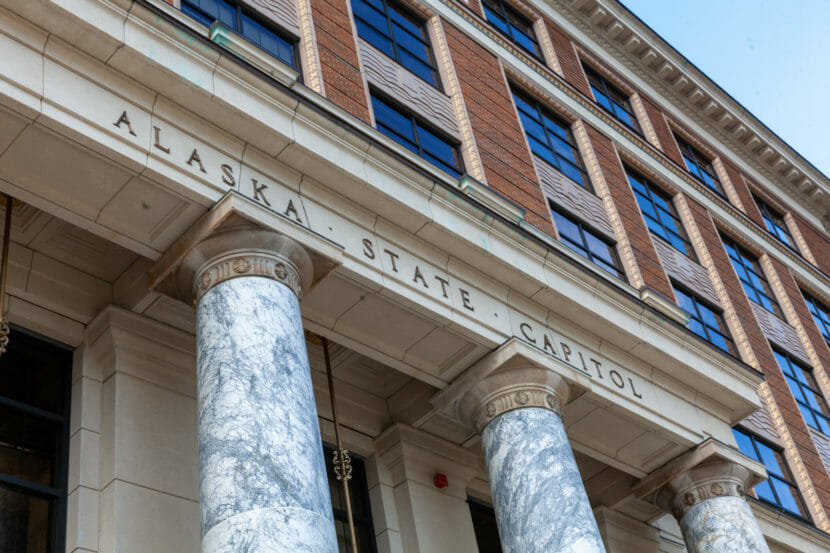
The Alaska State Capitol on April 22, 2022, in Juneau, Alaska. (Photo by Rashah McChesney)

The lowest crude oil prices of the year are coming at a bad time for Alaska.

This week, as required by state law, Gov. Mike Dunleavy will unveil his first budget plan of his second term. Accompanying that plan will be a significantly smaller state revenue forecast.

This spring, the Legislature passed — and Dunleavy signed — a budget that anticipated $8.3 billion in general-purpose revenue.

With Dunleavy preparing to release his first draft for the budget for the 12 months starting in July 2023, preliminary indications are that the state will have less than $7 billion to spend, a significant decrease.

Oil prices will go up and down, Dunleavy said Tuesday, shortly before the annual holiday open house at the Governor’s Mansion in Juneau, and in the end, the budget will be a collaboration between his office and the Legislature.

“We’re just going to have to work with the Legislature on what we want to fund and how we want to fund that,” Dunleavy said.

The governor’s draft proposal will be released Dec. 15, and Dunleavy said without specificity that he intends to introduce revenue-generating legislation. During his first term in office, the governor adamantly opposed new taxes without a statewide vote and studied the legalization of gambling in Alaska.

Oil revenue accounts for about a third of the state’s general-purpose income, and since 2019, the state has relied on a five-day average of global oil futures markets to estimate the future price of Alaska oil. The futures market is an auction for oil to be delivered on a future date.

Those markets now indicate a price in the high $70s or low $80s per barrel, well below expectations earlier this year and lower than an interim estimate one month ago.

With futures markets trading lower, that will mean a lower revenue forecast and less money to spend in the state budget during the coming year on dividends and other expenses.

This spring, the Alaska Department of Revenue predicted $3.5 billion in unrestricted petroleum revenue for the budget starting in July, known as Fiscal Year 2024 or FY24.

Now, based on the price of oil, the forecast is expected to be in the range of $2.7 billion.

Consultant Brad Keithley, who tracks Alaska oil conditions, said oil production may also contribute to a lower number: The amount of oil being produced from the North Slope has declined over the past few months and is running below expectations.

Most of the state’s general-purpose revenue continues to come from the earnings of the Alaska Permanent Fund, and for FY24 that figure is solid: $3.5 billion, according to the Alaska Permanent Fund Corp.

For the past few years, the state has expected about $400 million to $500 million in other tax revenue and fee income. Dunleavy said on Tuesday that

Aggravating the decrease in anticipated income is a shortfall in current income. The budget that passed the Legislature this spring was built on an estimate of $102 per barrel of oil.

That’s an average for the entire fiscal year, which runs from July 1 through June 30.

Through Monday, prices have averaged $96.27, according to figures collected by the Department of Revenue.

That shortfall was at least partially foreseen by lawmakers, who forward-funded K-12 schools, effectively allocating two years’ worth of public school funding in one.

If income falls short of expectations, that forward-funding will be reduced. As long as oil prices remain above $87 per barrel this fiscal year, the budget will remain balanced and there will be at least some advance funding remaining for FY24, reducing the need to spend on public schools that year.

This story originally appeared in the Alaska Beacon and is republished here with permission.

Alaska lawmaker can’t block public from social accounts based on their views, judge rules

""
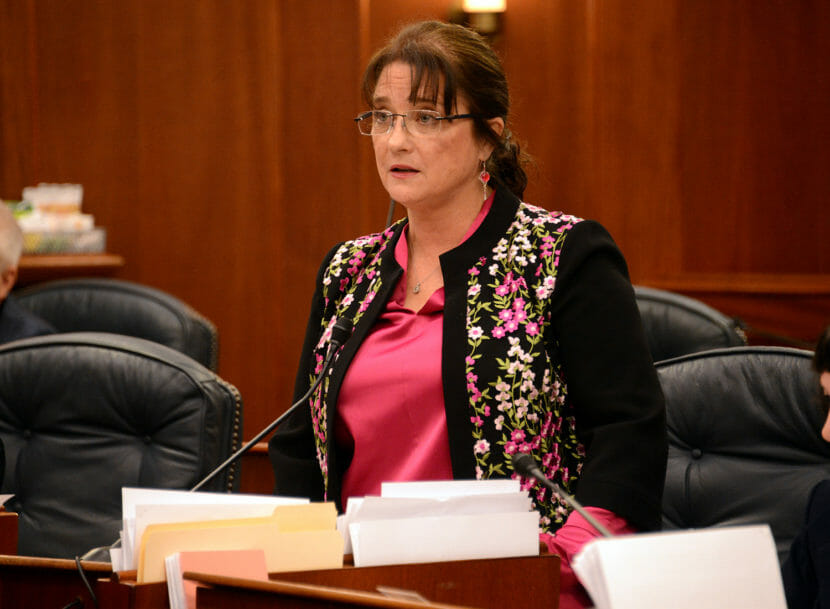
Sen. Lora Reinbold, R-Eagle River, speaks Tuesday, May 10, 2022 on the floor of the Alaska Senate at the Alaska State Capitol in Juneau, Alaska. (James Brooks/Alaska Beacon)

An Alaska state legislator can’t block members of the public who they disagree with from commenting on a social media account the lawmaker maintains in connection with her elective office, a judge has ruled.

Anchorage Superior Court Judge Thomas Matthews said in a decision he issued Friday that the account is a limited public forum where the legislator can’t discriminate against someone based on their viewpoint.

The ruling was in the case of Eagle River Republican Sen. Lora Reinbold, who a constituent sued after being blocked on a Facebook page that Reinbold kept under the name “Senator Lora Reinbold.”

Matthews ruled that Reinbold was a “government actor” when she banned Bobbie McDow from the page, which was different from another page Reinbold kept without her legislative title. And he ruled that it was a limited public forum, which means that Reinbold could only impose narrow and viewpoint-neutral restrictions.

But Matthews stopped short of resolving the case, since he said there are still some facts that are in dispute over why Reinbold blocked McDow.

McDow said Reinbold blocked her after she criticized Reinbold’s response to COVID-19. Reinbold said she blocked McDow because she had engaged in religious discrimination and called for Reinbold to resign.

Reinbold’s term ends on Jan. 3 – she did not run for re-election, citing legal expenses in defending herself in the lawsuit as one reason. Reinbold made national news when she was banned by Alaska Airlines for refusing to follow its COVID-19 mask requirement.

The Legislative Council, which includes members of both the Senate and House, adopted a policy in September that if legislators remove constituents’ comments or block them on social media, they may forfeit state-paid legal protection.

Nick Feronti, McDow’s lawyer, said Matthews’ ruling would have significant implications for how legislators handle their social media accounts.

“I think he made a very free-speech-friendly ruling today and now all that’s left is to sort out the discrimination part,” Feronti said.

He expressed confidence it was clear that Reinbold discriminated against McDow based on her having different views.

He said that to McDow, “it’s very much about an important principle, which is just, you’re allowed to talk online and not have someone delete your comments or block you” from an elected official’s account.

Reinbold said she would have to talk with her lawyer before commenting on the ruling.

This story originally appeared in the Alaska Beacon and is republished here with permission.

Site notifications
Update notification options
Subscribe to notifications