Alaska Beacon is part of States Newsroom, a network of news bureaus supported by grants and a coalition of donors as a 501c(3) public charity. Alaska Beacon maintains editorial independence. Contact Editor Claire Stremple for questions: info@alaskabeacon.com. Follow Alaska Beacon on Facebook, Bluesky and Twitter.
This symbol is inside of the Alaska Department of Corrections office on Sept. 7, 2022, in Douglas, Alaska. (Photo by Lisa Phu/Alaska Beacon)
Paul Harris, 69, died on Oct. 23 at Goose Creek Correctional Center, becoming the 16th person to die in the state’s prison system this year, according to an Alaska Department of Corrections press release on Tuesday.
With this death, Corrections surpassed the highest number of in-custody deaths the department has seen in the past decade, the time period for which records are immediately available. In 2015, 15 people died in Corrections custody. That’s in contrast to four people who died in custody in the decade low of 2019.
In its release, Corrections stated that Harris, who was sentenced, had been in custody since June 14, 2016. The release said Harris’ death was “expected.”
Of the 16 deaths this year, several individuals have been in their 20s or 30s, and died after only a short time in state care. Two deaths in August occurred after less than 24 hours. At least two people have died by suicide — 20-year-old Kitty Douglas, as reported by Alaska Public Media, and 31-year-old James Rider. The American Civil Liberties Union of Alaska has identified through its research a third death by suicide and suspects more. Several who died this year had not been sentenced.
The ACLU of Alaska on Oct. 14 formally requested that Gov. Mike Dunleavy initiate an independent review of the deaths of Alaskans while in Corrections custody. An ACLU spokesperson said the governor has not responded to the request.
At a press conference last week, Dunleavy said none of the people to die in Corrections custody this year through then “died as a result of others,” like murder or “otherwise inappropriate dealings with the individuals in prison.” Acting Corrections Commissioner Winkelman said at the press conference the deaths are “not unusual.”
At the Alaska Federation of Natives’ forum for the candidates for governor on Saturday, Dunleavy said, “we always have, unfortunately, folks that pass away in our care in corrections.”
Harris’ next of kin has been notified, and no foul play is suspected. The Alaska State Troopers investigate every in-custody death and the State Medical Examiner’s Office determines the cause. Citing confidentiality, Corrections does not release medical information.
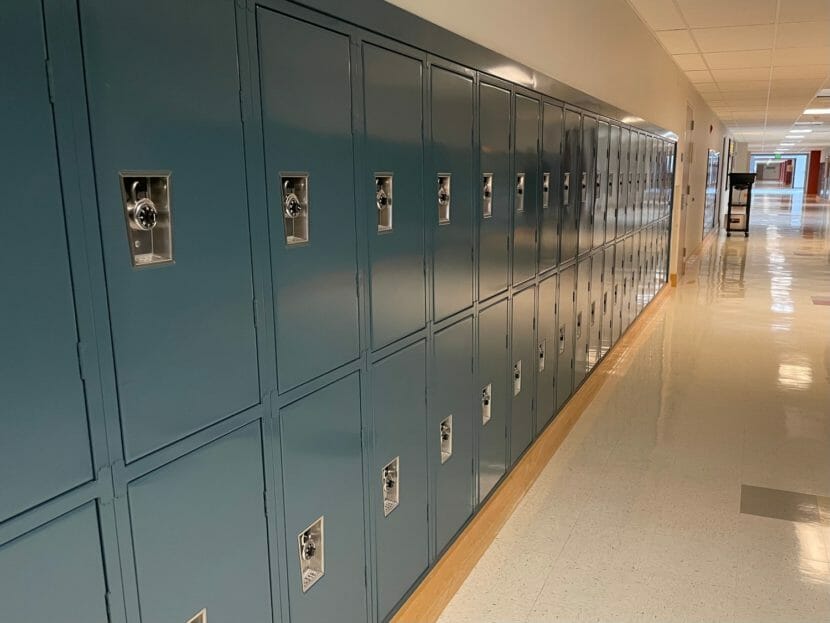
An empty hallway inside a Juneau public school. (Photo by Lisa Phu/Alaska Beacon)
Math scores were down this year for students in Alaska from pre-pandemic 2019, according to results from the National Assessment of Educational Progress released Monday. The change in math scores mirrored a trend seen across the country.
Reading scores, on the other hand, for Alaska students stayed about the same.
The national average score declines in mathematics for students in 4th and 8th grades were the largest ever recorded in that subject. No state saw any improvement in math.
In reading, the average score for 8th grade students in Alaska this year, 252.55 (out of 500), was slightly higher than it was three years ago, 252.39. For 4th graders, the average reading score for 2022 was slightly lower than 2019 — 203.83 from 204.37. Reading scores for both grade levels in Alaska remain lower than the national average.
Fourth graders in Alaska dropped about 6 points in math in the three years — 226 in 2022 from 232 in 2019. Eighth graders dropped 4 points — 270 from 274. Scores, again, were lower than the national average.
Lisa Parady, executive director of the Alaska Council of School Administrators, said the numbers tell a story educators already know — students were impacted by the disruption to their learning caused by the pandemic, and it will take a while to work through those effects. Still, students and teachers continue to show up and do the hard work of learning and teaching, she said.
“The direct crisis of the pandemic has been worsened at every level by inadequate access to internet and crisis level educator turnover. Despite these challenges, teachers have provided immense social and emotional support to students, families and communities throughout the pandemic and continue to provide that empathy and care today. To look at test scores now would be shortsighted when the focus of Alaska’s schools must be squarely on growth and recovery,” Parady said.
Roughly a quarter of Alaska students performed at or above the assessment’s proficient level in 4th and 8th grade reading, which is not significantly different from 2019. Proficiency levels in math were lower between 2019 and 2022 – in 4th grade, a drop from 33% to 28%, and in 8th grade, a drop from 29% to 23%.
In 2022, 4th and 8th grade male students in Alaska had average reading scores that were lower than that for female students by 13 points and 16 points, respectively, according to the results. Scores between male and female students were not significantly different in math.
Students from low-income families in Alaska performed between 25 to 30 points lower than their peers across 4th and 8th grade reading and math, the results showed.
The national tests are given every two years, but the pandemic delayed the 2021 test. The NAEP is designed to provide a common yardstick to measure what students know and are able to do at the national, state and school district levels. Scores are released by the U.S. Department of Education’s National Center for Education. See Alaska’s state profile here.
COVID-19 has caused the reported deaths of 758 children from 5 to 17 years old in the United States, and studies have found that children contributed to the spread of the virus, which has caused the death of more than 1 million Americans reported so far.
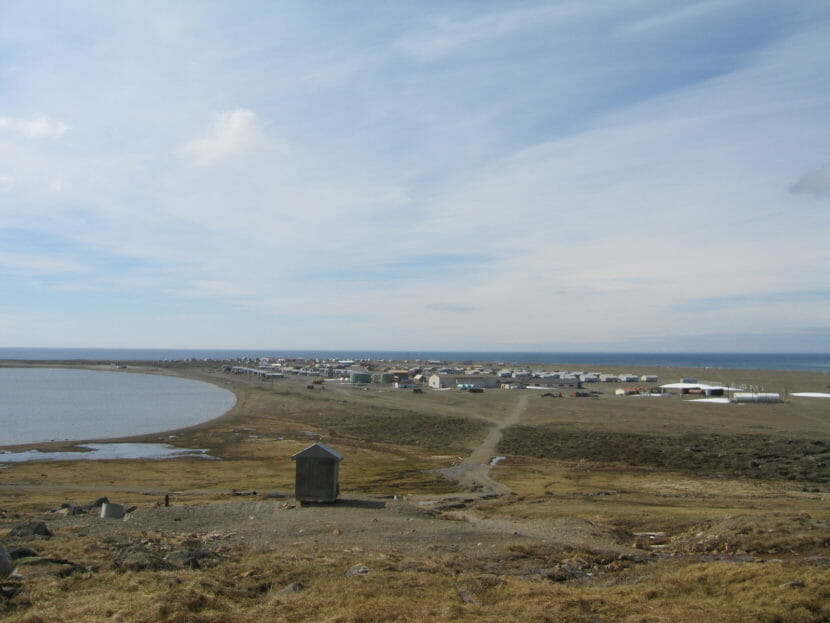
A hillside view of Gambell, one of the two communities on St. Lawrence Island in the northern Bering Sea, is seen in 2005. Two Indigenous men sailed from Russia’s Chuktoka region, arriving in Gambell in early October. Upon arrival, they asked for asylum. (Photo provided by the Alaska Division of Community and Regional Affairs)
U.S. Sen. Lisa Murkowski on Saturday provided some details about the two asylum seekers who traveled from the Russian Far East to Alaska’s St. Lawrence Island earlier this month to avoid being conscripted into the nation’s military. The two men are Indigenous Siberians, and they said Putin’s government is targeting ethnic minorities in rural areas, like themselves, to fight in Ukraine.
They were “so much in fear of their own government that they risked their lives and took a 15-foot skiff across those open waters. That says a lot,” she said. “It is clear that Putin is focused on a military conquest at the expense of his own people. He’s got one hand on Ukraine, and he’s got the other on the Arctic. So we have to be eyes-wide-open on the Arctic.”
Murkowski raised the topic of the asylum seekers during the forum for U.S. Senate candidates during the Alaska Federation of Natives convention. She talked about them while highlighting the importance of security in the Arctic region.
In an interview later in the day, Murkowski said she had spent about 45 minutes with the two Russians in Anchorage, where they had been sent after arriving at Gambell, a village on St. Lawrence Island. She spoke with them through and interpreter. Then two have since been taken to the Lower 48.
Murkowski said the two are from a coastal community in the general area of Provideniya, a city in Chukotka, the peninsula closest to Alaska.
Provideniya is about 230 miles west of Nome. Indigenous groups in Chukotka include the Chukchi and the Inuit.
The men’s exact identities and locations were being kept confidential for the men’s safety, she said.
“They shared with me that Putin has been targeting rural communities that are minority populations, that are Indigenous populations,” Murkowski said.
That account is consistent with other reports from Russia, she said.
Elsewhere in that country, there have been reports of Tatars, Buryats and Tuvans being targeted for conscription.
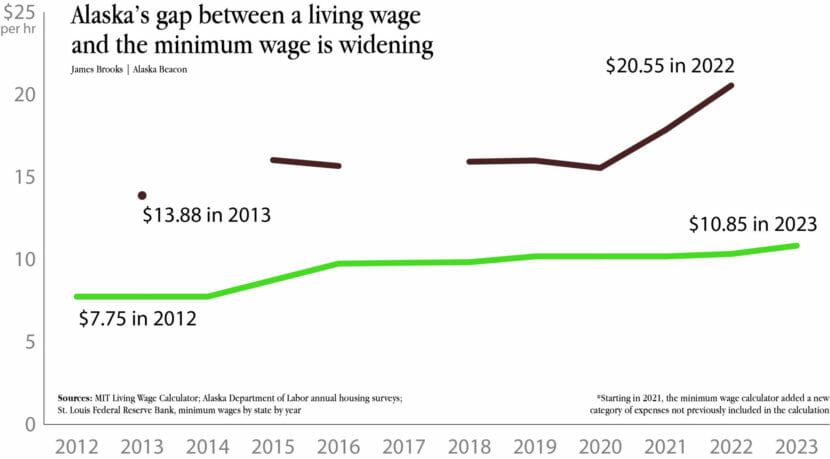
This chart shows the change in Alaska’s minimum wage and the estimated living wage in Anchorage between 2012 and 2023. Data for the living wage is drawn from the MIT Living Wage Calculator, annual rental estimates published by the Alaska Department of Labor, and is based on 12% tax withholding. (Graphic by James Brooks/Alaska Beacon)
Alaska’s minimum wage will rise 51 cents, to $10.85 per hour, starting next year.
The adjustment, announced Friday by the Alaska Department of Labor and Workforce Development, is intended to compensate for a 5% rise in the cost of living in Anchorage. Alaska law requires the minimum wage to be adjusted each year for inflation. Despite the increase, the minimum wage remains well below a widely used measure of a living wage in Alaska.
In Anchorage, the median apartment rental price is $1,339 per month, according to a survey conducted this year by the Alaska Housing Finance Corp. and the Department of Labor. That figure includes rent and utilities and rose 14% from last year.
Taking into account 12% withheld for taxes, someone earning minimum wage would have to work 35 hours per week in a four-week month to cover the cost of housing.
The MIT living wage calculator identifies $1,554 in other costs per month, including food, transportation and other expenses. That figure is based on estimates from various federal sources.
At minimum wage, an individual adult would have to work another 41 hours per week to cover those costs.
Altogether, estimates indicate someone earning minimum wage would have to work 71 hours per week to meet their basic needs in Anchorage.
If that person had one child, they would have to work an additional 20 hours per week at minimum wage to cover the cost of child care, according to the MIT estimate. Each additional child is estimated to cost another 20 hours of work per week.
A living wage is defined as the minimum amount needed to pay for basic needs while working a standard 40-hour workweek. In all of Alaska’s cities and boroughs, the minimum wage is significantly below the living wage amount.
In the Matanuska-Susitna Borough, someone would have to work 69 hours per week at minimum wage to meet basic needs. In Fairbanks, it’s 75 hours. In Juneau, it’s 74 hours.
Based on current estimated costs, the minimum wage would need to be above $18.08 per hour in order to be a living wage in Anchorage.
No state’s current minimum wage is at or above the statewide living wage.
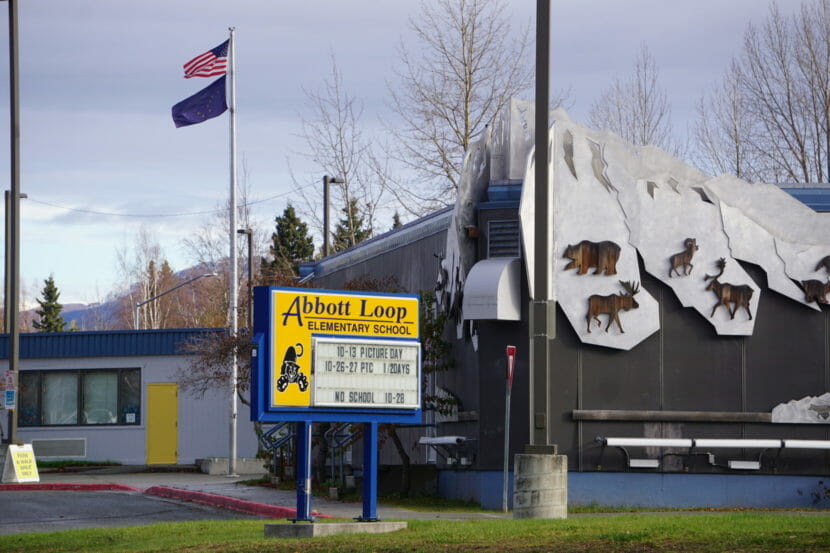
The front of Abbott Loop Elementary School in Anchorage is seen on Wednesday. The school is one of several being considered for closure in Anchorage because of a large budget gap. (Photo by Yereth Rosen/Alaska Beacon)
Anchorage isn’t the only district facing a major fiscal problem. At the end of the last school year, Fairbanks closed three schools. In Juneau, the school board is considering whether to fire specialists intended to help students recover reading skills lost during the COVID-19 pandemic. In rural Alaska, districts are trying to balance their books while dealing with high transportation and heating costs.
Local and statewide officials say these decisions are rooted in the same Alaska-wide problem: Most school funding is delivered by the state, and the state’s per-student funding formula has failed to keep pace with inflation.
“Everything costs more. It costs a tremendous amount to heat our buildings, provide electricity, provide transportation. Everything has gone up. Liability insurance, health care insurance have been huge drivers, and we haven’t kept up with it,” Kenai Peninsula Borough School District Superintendent Clayton Holland said.
“We are definitely having the same budget problems that others are around the state, trying to do just the same amount with deflated dollars,” said Brian Holst, a member of the Juneau school board.
Federal relief funding forestalled the need for major action during the COVID-19 pandemic, but most districts have exhausted that aid or will by next year. Meanwhile, school enrollment is less than what it was before the pandemic, exacerbating a problem created by a funding formula that pays districts per student.
“I think a lot of school districts in the state found the (federal relief) money to be basically the only thing that’s stopping the absolute bleeding of our school districts,” said Wrangell Public Schools Superintendent Bill Burr. “We’re facing a squeeze point.”
School districts have incrementally cut staff and services to keep pace with inflation, but in many cases, those cuts have reached a limit, and the issue is coming to a head as districts prepare their budgets for the next fiscal year.
“Districts are planning their budgets for fiscal year ’24, and they’re just projecting huge deficits, and school board members have to make decisions based on the future projection,” said Rep. Andi Story, D-Juneau.
“School board members have to have a balanced budget, and they have to start working on it now,” said Story, who served on the Juneau school board before joining the Legislature.
Persistent problems with funding
Even before the COVID-19 pandemic, the state was spending less than the national average per pupil, once Alaska’s cost of living is included in the calculation. (In unadjusted dollars, the state spent the sixth-most per student in 2019.)
“I hear a lot of people say Alaska spends more per pupil than any other state, and if you just look at straight dollars, it’s not true,” said Dayna Defeo, director of the Center for Alaska Education Policy Research.
“When you adjust for (cost of living), our per pupil spending is less than the national average, and we’ve been kind of falling,” she said.
This year, state legislators and Gov. Mike Dunleavy approved a sweeping education reform bill known as the Alaska Reads Act. That bill includes a small increase – half of 1% – in the amount the state pays districts per student, a figure known as the base student allocation, or BSA.
Until that adjustment, the state hadn’t changed the BSA in six years, allowing inflation to eat away at its value.
“Flat funding really is education cuts, year after year after year after year,” said Jim Anderson, chief financial officer of the Anchorage School District.
Story proposed legislation this year to increase the BSA and a separate bill to tie it to inflation. Neither bill passed the Legislature.
“Having good schools for our children is just so important to families. It’s so important to the business world. I just can’t say that enough. It’s so important to our economy,” Story said.
She said she wanted to increase the BSA by 8%, the amount of inflation between 2017 and spring 2022, but she halved that figure to 4% in order to get more support. It didn’t help.
In the Legislature, conservative Republicans said they first wanted to see improved performance from public schools before increasing spending. Alaska schools perform at or near the bottom of the nation in standardized math and reading tests.
That meant there was support for the Alaska Reads Act, which imposes new reading standards, but not for Story’s funding increase.
“Yes, that was important,” Story said of the reading bill, “but we also need to take care of these base costs for districts.”
The student-funding increase in the reading bill worked out to $30 per student.
“I was so discouraged about that,” Story said.
Enrollment woes exacerbate the problem
Alaska’s public-school enrollment peaked in the 2016-2017 school year, with 130,295 students enrolled, according to state statistics.
Since then, enrollment has declined, bottoming out in the pandemic-affected 2020-2021 school year at just over 127,000 students. Enrollment rose slightly last school year, and figures for the current year are not yet available, but administrators say the preliminary figures are mixed.
Some districts have had more severe drops than others. In Anchorage, enrollment is down by almost 10%, from almost 48,000 students in 2016 to less than 43,000 last school year.
Wrangell, a small island community in Southeast Alaska, faced the largest percentage drop in the state between anticipated and actual enrollment in fall 2020. Instead of 308 students, the district’s three schools had only 178. It’s since risen – to 257 last fall and about 263 this fall. But that’s close to 50 students that are no longer in the system.
“A 50-student drop is pretty significant, even if it’s spaced out over over three years, because they just aren’t here,” Wrangell Superintendent Burr said.
Some of the changes appear driven by demographic trends: Alaska’s population is aging, more people are moving out than moving in, and adults are having fewer children per couple.
Enrollment at correspondence schools and in homeschool programs is also down, ruling that out as a possible reason for the decline.
Laurel Shoop, a special assistant at the Alaska Department of Education and Early Development, said the state hasn’t analyzed the causes of the enrollment decline and isn’t aware of any third-party research on the issue.
The decline exacerbates school districts’ problem: Not only have per-student payments failed to keep pace with inflation, districts are getting fewer of those per-student payments because there are fewer students.
“You certainly are getting less money because you have less students, but the buying power of that less money is even smaller per student,” Anderson said of declining enrollment and lack of inflation proofing. “It’s just complicated by both of them at the same time running together and colliding.”
District effects across the state
School districts received millions in federal relief funding during the pandemic, which offset the fiscal cliff many districts are facing or will soon face. Anderson said COVID funding insulated the problem and budget holes got hidden with one-time funding.
“It makes it invisible, especially the last two and a half years with the federal funding that we used in lieu of an inflation-improve fix at state level; it really just hid that gap,” he said.
Anderson said the state has prioritized other requirements over education.
“If we had not had the federal dollars, what we’re going through this year, we would have gone through two or three years ago,” Anderson said.
Aside from using one-time state or federal funding, the district has taken other measures to manage the budget gaps, like merging programs and reducing staff. The district closed two schools in recent years – Mount Iliamna Elementary School in 2016 and Mount Spurr Elementary in 2018.
Potentially closing six additional elementary schools at the end of this school year could save the district $3 million to $4 million. The district still needs to find savings elsewhere. The school board has options to choose from, including dipping into savings and making more cuts. Staff make up 88% of the district’s budget, Anderson said.
If the state “would have inflation-proofed the BSA, the district would not be in this situation,” he said.
Karen Melin is chief school administrator for the Fairbanks North Star Borough School District, which closed three schools at the end of last school year, partly due to a tightening budget.
Melin said the district examined how they were using facilities, some decades old and not at capacity.
“We took a pretty comprehensive look at it and said, ‘Okay, this isn’t an efficient use of square footage in dollars.’ So we made that shift. And I think we’ll see more of that happening across the state,” Melin said.
Melin said pandemic relief funding bought them time but it’s not a way to fund a budget. The state had cautioned districts against using the money for operating funds, she said.
“But in reality, it was the money we had and so it was the money we had to use. So, it just kicked the can down the road. And now that the CARES funding is coming to an end, we’ve kicked the can all the way down the road to where, now, we’re out of road.”
Melin said the district has already trimmed “to lean,” made efficiencies in many areas and will look to identify more.
“There’s just no way to balance a $14 million deficit in a budget that has 86% personnel without it dipping into personnel. So how that’s going to look, I don’t know yet,” she said. “We can have a lot of really expensive staff, or more less-expensive staff, and that’s kind of the balance that we have to look at.”
The Kenai Peninsula Borough School District will likely be considering cuts when its federal funding runs out next year.
“We’re going to be facing this fiscal cliff. For us, that means that we’re really looking at the possibility of laying off or not filling 65 to 70 positions with the Kenai Peninsula Borough School District, teaching positions,” district superintendent Holland said.
Terri Walker is superintendent of the Northwest Arctic Borough School District, which has schools in 11 communities not connected by roads spread out over 39,000 square miles. The district serves about 1,900 students.
Walker said the district has made many cuts over the past several years – to positions in the district office, to programs like Career-Technical Education, and to pre-kindergarten.
“And we cut counselors so then sites had to share counselors. Some of our villages are close to each other, close meaning between 10 to 70 miles apart. The local airline here flies to a couple of the villages and then returns, and so we just had them share counselors so the counselor would spend time at one site and then spend some time at the other site,” Walker said.
Many of the cuts have been restored due to one-time federal funding or funding from NANA Regional Corporation and the borough. Funding for pre-K, CTE teachers and counselors are not coming from the district’s general fund, Walker said.
“We do need the state to step up,” she said.
The district is also dealing with rising freight costs. All the schools in the district qualify for free meals from the federal government, so the district gets fully reimbursed for the cost of the food. But it costs an additional $1.2 million to ship the food, Walker said. Right now, those freight costs are being paid with federal school emergency relief. When that funding stops, she said the district will have to pay those shipping costs.
“We’re gonna have to figure out something because we cannot not feed kids,” Walker said. “So we’re gonna have to put that money back into our general fund.”
Issue reaches the governor’s race
The school funding issue has become a major issue in this year’s governor elections. In a televised debate Wednesday night, Democratic candidate Les Gara called the situation “the worst crisis in public education in state history.”
“Education in Alaska, as far as I’m concerned, is swirling the drain,” said independent candidate Bill Walker. “That’s how bad it’s gotten.”
He said a reliable state fiscal plan would help the state “fully fund” education.
Gara has advocated automatic inflation adjustments for the base-student formula and said he is the only candidate to do so.
He and Walker criticized incumbent Dunleavy, a Republican, for not acting on the problem.
In the debate, Dunleavy responded by saying that this year’s state budget contains funding for education a year ahead of time. That money is dependent upon the price of oil staying high.
He also said that districts have benefited from federal relief money and the reading bill.
“I’d be more than happy to sit down with a number of the school districts and have a discussion as to why they are short on their budgets,” Dunleavy said. “Do they have a school district that was geared for thousands of more students? There’s a number of things we can take a look at — plenty — and money is certainly something that they’ve gotten this year.”
Republican candidate Charlie Pierce, who also participated in the debate, said he doesn’t support raising the base-student formula.
“I think it’s really more of a school board issue,” he said.
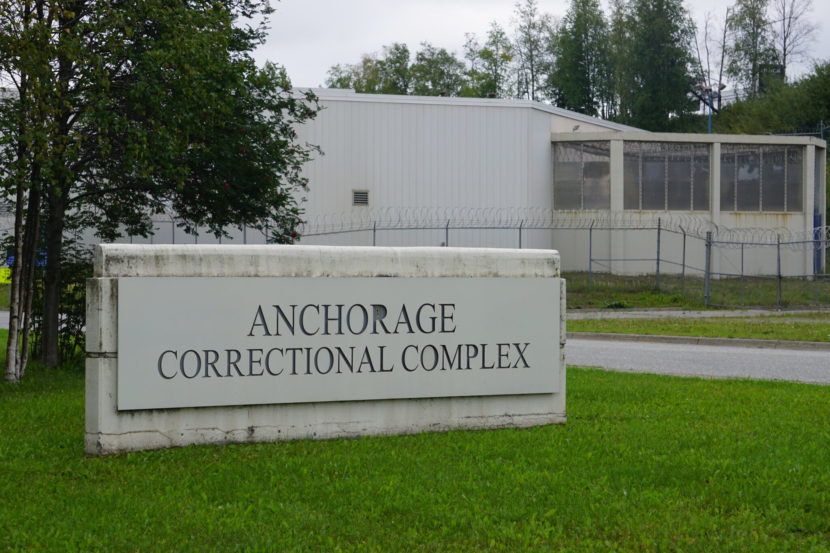
The entrance to the Anchorage Correctional Complex is seen on Aug. 29, 2022. The complex was the site of the recent death of Austin Wilson who went into custody on Aug. 4 at 5:05 p.m. and was pronounced dead on Aug. 5 at 1:20 p.m. (Photo by Yereth Rosen/Alaska Beacon)
None of the 15 people to die in Alaska Department of Corrections custody in 2022 so far “died as a result of others,” according to Gov. Mike Dunleavy. Acting Corrections Commissioner Jen Winkelman also said the deaths were not “unusual.”
“The investigations of deaths indicate that none of these inmates at this time have died as a result of others; in other words, murders or otherwise inappropriate dealings with the individuals in prison,” Dunleavy said at the beginning of a press conference Monday.
The Alaska State Troopers division investigates every in-custody death. John Skidmore, deputy attorney general for the Alaska Department of Law in the Criminal Division, said those deaths are investigated in the same way that officer-involved shootings are investigated.
“And all of those investigations then are referred over to the Office of Special Prosecutions when there’s ever any concern that it may rise to the level of any sort of criminal conduct. And what I can tell you is that today, we do not have any cases at this time that have presented themselves as rising to the level of criminal conduct,” Skidmore said.
Megan Edge said the governor and his administration are downplaying the severity of the deaths and are deflecting responsibility. Edge is communications director for the ACLU of Alaska and director of the ACLU of Alaska’s Prison Project.
“Just because somebody’s life wasn’t taken at the hands of another individual does not mean their life wasn’t taken because of failures in the system. That doesn’t address concerns about the medical screening process, the system being overburdened, mental health; it doesn’t address any of those issues. All that tells me is that somebody else’s hands did not cause that person’s death. It does not mean the system is not responsible for their dying,” Edge said.
Edge said it was disappointing that the governor and his staff didn’t offer solutions or proactive plans of what they’ll do to keep people safe and prevent further deaths.
The ACLU of Alaska on Friday formally requested that Dunleavy initiate an independent review of the deaths of Alaskans while in Corrections custody. Dunleavy did not address the request at the press conference Monday. Governor spokesperson Jeff Turner said in an email afterward, “The ACLU request was received, and it will be responded to in due time.”
Edge said the ACLU of Alaska is working with other members of the legal community to figure out a litigation strategy.
Fifteen people have died while in Corrections custody so far this year, which is the highest number of deaths in custody since 2015. Nine of these 15 people have died since Aug. 4. Of these deaths, several individuals have been in their 20s or 30s and died after only a short time in state care. Two deaths in August occurred after less than 24 hours. At least two have died by suicide – 20-year-old Kitty Douglas, as reported by Alaska Public Media, and 31-year-old James Rider. The ACLU of Alaska has identified through its research a third death by suicide, and suspects more. Several who died this year had not been sentenced.
Acting Corrections Commissioner Winkelman said the deaths are not unusual.
“While it’s unfortunate to have any death, it is not unusual and it is not a reflection on our staff’s ability to care. We have over 30,000 people that enter and leave our facilities every year, and it’s often a very sick population. Eighty percent have not had medical care within the prior year. The average number of deaths over the last 10 years is nearly 12 deaths per year,” Winkelman said.
Deputy Attorney General Skidmore also said federal law prohibits the state from giving details of why a person died “because that gets into their personal medical histories.”
“Under federal law, it prohibits any provider of medical services, which includes the Department of Corrections, from disclosing information about people’s health records. And so we’re not allowed to go into the details of what sort of ailment or illness someone may have had,” he said.
Dunleavy emphasizes that the issue of deaths in Corrections custody “is taken very seriously by this administration, by the individuals that work for this administration.”
“All of these investigations will be thorough. And, again, we will follow all applicable law and we will make sure that we don’t violate anyone’s privacy rights,” Dunleavy said.
Edge said protecting privacy is important and critical, “but also when people are dying pretrial, they’re denied their right to due process, they’re denied their right to equal protection, they’re denied their right to rehabilitation. So there’s other rights here that people don’t have once they’ve died.”
Close
Update notification options
Subscribe to notifications
Subscribe
Get notifications about news related to the topics you care about. You can unsubscribe anytime.