Alaska Beacon is part of States Newsroom, a network of news bureaus supported by grants and a coalition of donors as a 501c(3) public charity. Alaska Beacon maintains editorial independence. Contact Editor Claire Stremple for questions: info@alaskabeacon.com. Follow Alaska Beacon on Facebook, Bluesky and Twitter.
Questioned ballot box at Mendenhall Library, Aug 16th 2022 Juneau AK (Photo By Paige Sparks/KTOO)
This year’s Alaska general election absentee ballot is a hefty document, weighing in between 1.1 and 1.2 ounces.
If it were an ordinary letter, that’s weighty enough to need two stamps. But if voters forget, officials at the Alaska Division of Elections and the U.S. Postal Service say this year’s absentee ballots will still be carried — and counted — with just one stamp.
“If a return ballot is nevertheless entered into the mailstream with insufficient or unpaid postage, it is the Postal Service’s policy not to delay the delivery of completed absentee balloting materials, including mail-in ballots,” said James Boxrud, a spokesman for the U.S. Postal Service’s western region.
Tiffany Montemayor, public relations manager for the Alaska Division of Elections, pointed to USPS Publication 632, which states, “Shortpaid and unpaid absentee balloting materials will not be returned to the voter for additional postage. Postage is collected from the election office upon delivery or at a later date. The Postal Service will not delay delivery of balloting materials with insufficient postage.”
The current price for one first-class stamp is 60 cents.
The first absentee ballots for the Nov. 8 general election have already been sent, and the design of the return envelope includes a box for only one stamp, but fine print in the absentee ballot instructions says to attach 84 cents’ worth of postage.
That dissonance led to concerned posts on social media, some containing erroneous information.
Montemayor said there’s no statutory requirement that a ballot have a certain amount of postage to be counted. Ballots dropped off at a polling place or one of the regional elections offices don’t need to have postage, for example.
“Ballots that meet statutory requirements are eligible to be counted. Those requirements are: The voter is eligible to vote; (the ballot) has a voter signature, one voter identifier, witness signature, is postmarked on or before Nov 8, and arrives within the statutory timeframe following the election (10 days if postmarked within the US and 15 days if postmarked outside the US),” she said.
Nineteen states prepay postage for their absentee ballots, according to records kept by the National Conference of State Legislatures.
Alaska is not one of the 19, and a proposal to change that failed to pass the Alaska Legislature as part of a broader election-reform bill this year.
Ballots in the June 11 special by-mail primary election for U.S. House were postage-paid, but that was because federal law requires postage-paid envelopes for so-called UOCAVA voters — members of the military and Americans living overseas. They’re covered by the Uniformed and Overseas Citizens Absentee Voting Act.
In the June primary, which was held on short notice following the death of Rep. Don Young, there wasn’t time to set up a system to determine who got free postage and who didn’t, so the Division of Elections gave it to everyone.
In the November general election, when absentee voters request a ballot, they check a box indicating whether they’re a UOCAVA voter — and thus eligible for free postage — or not. Most Alaskans don’t check that box and don’t receive free postage.
The deadline to request an absentee ballot by mail is Oct. 29. To request one, apply online or call the Division of Elections at 907-270-2700 or 877-375-6508.
The ballot must be delivered to a polling site, put into a dropbox or postmarked by Nov. 8. Ballots mailed from rural Alaska may take several days to reach Anchorage, where most mail is postmarked. Ballots may also be hand-postmarked by a clerk in a postal office.
A student texts on a cellphone in this stock photo. President Joe Biden announced Monday that student loan borrowers can begin to apply for debt relief through a new online application. (Photo by Ariel Skelley/Getty Images)
WASHINGTON — President Joe Biden announced Monday that student loan borrowers can begin to apply for debt relief through a new online application.
Biden said the application is easy and fast. It will allow every borrower with an income of $125,000 or less ($250,000 for married couples) to have up to $10,000 in debt forgiven, or $20,000 forgiven for those with Pell Grants. Those income levels have to have been during 2020 or 2021.
No documents need to be uploaded with the application, Biden said.
Late Friday, a beta version of the student loan forgiveness application was released by the Department of Education. Biden said 8 million borrowers were able to fill out the application “without a glitch.”
The White House estimated that 43 million borrowers would qualify for some relief.
Those who qualify have until December 31, 2023, to fill out the application.
GOP lawsuit
The president called out Republicans for attacking the debt relief program, as well as Republican-led states that filed a lawsuit to prevent borrowers from applying for financial relief. The suit argues Congress did not approve the debt cancellation and the Department of Education is misusing its emergency authority.
“Their outrage is wrong and hypocritical,” Biden said. “I don’t want to hear from Republican officials who had hundreds of thousands of dollars, even millions of dollars, in pandemic relief loans—PPP loans—who now attack working class Americans for getting relief.”
U.S. Secretary of Education Miguel Cardona also joined the president for the announcement. Cardona said the department is working to also include borrowers with private loans to qualify for debt relief.
“We are working on pathways there to support those,” Cardona said. “But we’re moving as quickly as possible to provide relief to as many people as possible.”
The administration quietly dropped a section of borrowers—nearly 800,000—from qualifying for the student loan forgiveness plan if they have loans administered through the now-defunct Federal Family Education Loan program, or Perkins loans, following a lawsuit from half-a-dozen Republican-led states.
A Missouri judge will issue a decision on the lawsuit filed by attorneys general from Missouri, Nebraska, Arkansas, Kansas and South Carolina and on behalf of Iowa’s governor.
Another lawsuit, filed in Texas, seeks to block the program, arguing that the Biden administration did not ask for public comment before moving forward with its action
More than 43 million Americans have student loan debt, and the Federal Reserve estimates that the total U.S. student loan debt is more than $1.75 trillion.
Watch out for scams
Biden also warned of a scam in which callers will pretend to be from the federal government, asking about assisting a borrower with student loan debt.
“Let’s be clear,” Biden said. “Hang up. You never have to pay for any federal help from the student loan program.”
He said student loan repayment, which has been paused since early 2020, will resume in January.
Those borrowers who continued to pay off their loans during the student loan freeze in the early stages of the pandemic are allowed to get reimbursed for payments made beginning of March 13, 2020, by contacting their loan servicers to request a refund.
James Rider is sitting in an undated photo. He died in early September in Alaska Department of Corrections custody. (Photo provided by Mike Cox)
Ever since his brother, 31-year-old James Rider, became the 12th person to die while in Alaska Department of Corrections custody, Mike Cox has been trying to get the department to answer his questions.
“I want to know what their procedures are and how they intend on fixing them, so this doesn’t keep happening,” Cox said.
Alaska State Troopers arrested Rider in Wasilla on Aug. 30 and brought him to Mat-Su Pretrial, a Department of Corrections facility. Six days later, on Sept. 5, he was found in his cell having attempted suicide, according to details in an Alaska State Medical Examiner’s Office report. The medical examiner’s office determines the cause of in-custody deaths. The report, which Rider’s family requested, said Rider was transported to Mat-Su Regional Medical Center where he showed “no signs of recovery” and was pronounced dead on Sept. 9.
Of the 15 people to die in Corrections custody so far this year, at least two have died by suicide – 20-year-old Kitty Douglas, as reported by Alaska Public Media, and Rider. The American Civil Liberties Union of Alaska has identified through its research a third death by suicide, and suspects more, according to an ACLU of Alaska spokesperson. Cox wants to know how Corrections handles people who are suicidal and what’s being done to prevent these deaths from occurring.
“I don’t want it to happen to anybody else’s brother or father or sister or mother or cousin or anybody else. I want policy changes. I want people held accountable for mistakes being made. These are people’s lives. They’re not just criminals sitting in a warehouse. These are people’s family members,” Cox said.
In response to questions from the Alaska Beacon, state officials cited privacy laws in saying they are limited in what they can say publicly about individuals.
When asked how many of the 15 in-custody deaths this year were due to apparent suicide or are being investigated as suicides, Corrections did not directly answer the question. Instead, Corrections public information officer Betsy Holley said in an email, “in accordance with state statute, the State Medical Examiner releases cause of death.”
When posed with the same question, a spokesperson for the Department of Health – which the State Medical Examiner’s Office is part of – said in an email, the office “does not release death investigation reports, the identity of deceased individuals, or any combination of this information to the public.” This information can only be released to family and law enforcement, he said.
A brother’s questions
Cox said he has called the Department of Corrections and Mat-Su Pretrial trying to get a hold of facility superintendent Sheri Olsen, or anyone else who might be able to answer his questions.
“We’ve called the various numbers for anybody in the administrative part of the DOC who can maybe answer some questions. I have left messages with everybody from the administration to the guards, and the only person that keeps reaching out and contacting me is the chaplain, who doesn’t have answers,” Cox said. “I would like to talk to the superintendent and know what she’s doing.”
According to Holley, Corrections can “discuss matters with the personal representative determined by the Court. If Mr. Cox is that individual, he needs to share the paperwork with the facility.”
Corrections evaluated Rider when he was booked into prison on Aug. 30. He was “placed on a suicide precaution watch” and “remained under precaution for one day,” according to the State Medical Examiner’s Office report. Cox said he already knew this from having talked to Rider a day before he took his life.
The report said Corrections moved Rider to a different cell with two other inmates. Then, on Sept. 5, Corrections transferred Rider to another cell “where he was the sole individual in the cell.” That evening, he was found in a manner that was deemed “an apparent suicide attempt.” Two suicide notes were in the cell and “there was no suspicion of foul play.”
“We want to know who signed off on his suicide watch. Who was in the position to put him in there in the first place? Is that an actual doctor who’s doing that? And then, who made the call to move him to a cell by himself within five days of him saying he was suicidal? I think there was a breakdown in procedure,” Cox said. “Somebody dropped the ball. This should have never gotten this far and it should have never happened.”
Their last conversation
When Cox talked to his brother on the phone a day before he took his own life, Cox said Rider described how Corrections conducted suicide precaution watch. Cox said Rider was “stripped naked,” put in a “turtle coat” – also called a suicide smock – to prevent him from hurting himself and thrown in a padded room alone.
“That’s degrading to do that to somebody who already doesn’t want to live,” Cox said. “When they tell you that they’re suicidal, that is a cry for help; not a cry for torture.”
Due to that experience, Rider said he would never tell Corrections staff he was suicidal ever again, Cox said.
According to the procedures, all people in custody are screened for potential suicide risk by health care or security staff soon after arrival or booking. “When a prisoner is identified as being at risk for suicide, the prisoner shall be placed on suicide prevention status,” the procedures state. “Suicide prevention status may be ordered by mental health staff, or if mental health staff are unavailable, by the Superintendent or designee.”
When someone is placed on suicide prevention status, that means “staff shall not leave the prisoner unattended,” and staff shall “remove any items that may be used to inflict harm” and “ensure the prisoner is housed in a suicide prevention cell on the appropriate suicide prevention status.” The procedures state that a suicide prevention cell is “as suicide resistant as reasonably possible, free of obvious protrusions and that provides full visibility.”
Suicide prevention status “shall be removed as soon as the prisoner no longer presents at risk of self-injury or suicide,” according to the procedures. The order for removal should be documented on a form, which is completed by the mental health staff. When a mental health staff is unavailable, a member of the nursing staff, in consultation with the psychiatric provider, can also discontinue suicide prevention status.
Holley noted, which the Beacon has reported before, “DOC takes every death seriously. DOC remands nearly 30,000 individuals a year. Unfortunately inmates are (an) exceptionally ill and complex patient population. The Department takes a multidisciplinary approach to ensure the safety of individuals within our custody that includes security, medical, treatment and support staff.”
“It cannot be stressed enough that DOC recognizes that every prisoner is someone’s mother, father, brother, sister, daughter, son,” Holley added. “Whether it be a medical emergency, a mental health crisis or potential death, staff members know each inmate and respond to each trauma with respect and professionalism.”
A request for preserving evidence
Cox and his family are working with the ACLU of Alaska to ensure that all records and other types of evidence regarding Rider’s death are preserved. He wants the phone call he had with his brother to be saved.
“I don’t want them destroying any records of what happened,” Cox said.
That includes any videos relevant to his brother’s death. “I want to see these videos. I want other people to see these videos to know that this is how they treat people. Or don’t treat them. They neglect them,” Cox said. “They throw them in a cell alone, which is crazy to me.”
According to its death of prisoner policies and procedures, Corrections does certain things “following the unexpected death of a prisoner.” This includes photographing the death scene “from as many angles and perspectives as possible” and photographing all property removed by the Alaska State Troopers, which investigates every in-custody death, including any documents such as suicide notes; identifying and securing documentation of any suicide precautions; ensuring that all staff involved with the death or death scene, including medical staff, complete a special incident report; and securing all medical records at the institution and a number of other institutional logs.
An interim policy and procedures memo from 2017 clarifies how video evidence is treated. It says the superintendent “shall immediately preserve all video recordings of the prisoner’s death scene including all video evidence leading up to the death.” At a minimum, video of the 24 hours preceding the death until the death scene is released by the troopers must be preserved. It also says that any evidence or video identified as relevant to the death or investigation “is preserved indefinitely,” or as directed by the troopers.
An offer to other families
Cox lives with a lot more than grief for his brother’s death.
“The more I find out, my anger takes over my sorrow and my grief that I have for losing my little brother. I’m mad this happened. It should have never come to this,” he said.
Cox’s anger isn’t just for his brother’s death, but for other in-custody deaths that he believes could have been avoided. Rider was Corrections’ 12th in-custody death of the year through early September. Two more individuals died after a short time in Corrections custody later that month. Corrections reported its 15th death on Oct. 3. Of these deaths, several individuals have been in their 20s or 30s and died after only a short time in state care. Two deaths in August occurred after less than 24 hours.
“Unless it was an actual, like, heart attack or something that is totally unavoidable, then maybe I could understand. But I think all these deaths are neglect,” Cox said.
Cox is determined to learn more about how and why his brother died, but he also wants to offer anything he’s learned about this process to other families going through the same thing.
“Anything that’s going to help other families or other people. James was a giver, like, gave everything. He may not have had much but he would have given you the shirt off his back, and I think we’re going to carry that on in his name.”
If you or someone you know is in emotional distress or considering self-harm or suicide, you can call or text 988 to access a trained crisis counselor.
Ben Stevens, then Gov. Mike Dunleavy’s chief of staff, talks to Sen. Lyman Hoffman, D-Bethel, after the State of the State address in January 2020 in Juneau, Alaska. Stevens died this week. (Photo by Rashah McChesney/KTOO)
Ben Stevens, a former Alaska Senate president once linked to, but never charged, in the Veco corruption scandal, has died at age 63.
A Facebook post by a leading Anchorage Republican group attributed Stevens’ death to a heart attack and said he was hiking with his wife when he abruptly collapsed.
The Alaska State Troopers said Stevens was on Lost Lake Trail in the Chugach National Forest, outside of Seward, and died on Thursday evening despite CPR and a helicopter response by Lifemed.
Stevens, the son of former U.S. Sen. Ted Stevens, served as chief of staff to Gov. Mike Dunleavy before leaving that role in February 2021 for a job at ConocoPhillips Alaska.
The company’s president, Erec Isaacson, issued a statement saying that the company is “deeply saddened by the sudden passing of our friend and colleague, Ben Stevens.”
“Ben was a valued leader at ConocoPhillips Alaska and leaves a significant legacy in the state of Alaska. Ben will be deeply missed not only by his family and colleagues, but in the broader Alaska community,” the statement said.
Born in Washington, D.C., in 1959, Stevens attended high school in New York, earned a degree in economics from Arizona State, and received an MBA from George Washington University.
After graduation, he worked in the commercial fishing industry and managed a consulting firm before Gov. Tony Knowles appointed him to a vacant state Senate seat in 2001.
Stevens went on to serve as the Senate’s majority leader and as Senate president.
In 2006, Stevens was one of six state legislators whose offices were raided by the FBI in a sweeping bribery investigation, and Rick Smith, a former vice president for the oilfield services company Veco, testified that he had bribed Stevens.
Stevens was never charged with a crime in that investigation, or in a separate federal investigation that examined consulting fees he received from fishing companies that benefited from legislation supported by his father in Congress.
Stevens did not seek re-election in 2006 and went on to management roles in a series of transportation companies before briefly considering a 2018 run for governor. After he decided against that run, he joined the Dunleavy administration.
Spawning salmon swim on Sept. 7, 2005, in the Grand Central River on western Alaska’s Seward Peninsula. Salmon-dependent villagers in western Alaska believe trawlers harvesting pollock and other groundfish in the Bering Sea are intercepting too many salmon that would otherwise return to rivers and lakes to spawn. (Photo by Christian Zimmerman/USGS Alaska Science Center)
In the search for a solution to the problem of bycatch, the unintended at-sea harvest of non-target species, the stakes in Alaska are high.
Now a special task force is nearing the end of a year-long process to find solutions that satisfy competing interests to the problem of bycatch, which refers to fish that are caught incidentally by commercial fishers who are targeting other fish.
Many of the mostly Indigenous residents of western Alaska who depend on now-faltering salmon runs in the Yukon and Kuskokwim rivers have said strict rules to reduce at-sea bycatch are needed to help alleviate a crisis. Disasters have been declared for these fisheries.
Serena Fitka, the executive director of the Yukon River Drainage Fisheries Association who grew up in the Yup’ik village of St. Mary’s near the Bering Sea coast, said she has not been able to harvest river salmon for three years.
It’s not only about lost food, she told the task force at a meeting in Anchorage on Wednesday. “It’s also very important for rural communities because it’s our culture, which includes mental, social consequences,” she told the task force at a meeting on Wednesday. “Every single person in our communities relies on that salmon.”
Stakes are also high for the commercial industry and for communities that depend on trawling, representatives said. Trawling is a term for fishing with a large, wide net that a ship drags, often to harvest groundfish near the sea bottom.
“I’m very sympathetic to what’s happening in the Bering Sea with salmon and subsistence. But in the same token, I’m concerned for my own community that I live in,” Julie Bonney, executive director of the Kodiak-based Alaska Groundfish Data Bank, a group advocating for groundfish harvesters, told the task force. About 60% of the fish that crosses the docks at Kodiak, a major fishing port, is trawl-caught, she said.
“I want to see Kodiak prosper into the future. So trawling is an important component of the economics of the town that I live in,” she said.
The Alaska Bycatch Review Task Force meets on Oct. 12 at the William A. Egan Civic and Convention Center. Jon Warrenchuk, senior scientist with Oceana, is at far left, testifying about research needs; Doug Vincent-Lang, commissioner of the Alaska Department of Fish and Game, is at far right. The task force is due to present its final report to Gov. Mike Dunleavy by the end of November. (Photo by Yereth Rosen/Alaska Beacon)
The Alaska Bycatch Review Task Force, created by Gov. Mike Dunleavy last November, is due to release its final report by the end of next month. At least two additional meetings are to be held between now and then.
At Wednesday’s meeting, task force members reviewed and took public testimony on all the consensus recommendations made by the group’s various committees, with a goal of agreeing on a final set of recommendations to Dunleavy.
Possibly most striking is a draft recommendation for a firm numerical cap on chum salmon taken as bycatch in the Bering Sea’s industrial-scale pollock trawl fishery, a measure that managers have been reluctant to take in the past.
In 2021, the Bering Sea pollock fishery – one of the world’s largest seafood harvests – netted about 540,000 chum salmon as bycatch, along with halibut, crab and other species. At the same time, western Alaska subsistence fishers have been struggling with such poor returns that, at times, they have not been able to catch any fish. The runs of chum salmon, a species that is particularly important as food for Yukon and Kuskokwim villages, have been some of the lowest on record.
There are caveats on the chum-cap recommendation. Any cap must be “scientific-based,” and the recommendation suggests a phased-in approach.
Kuskokwim River Chinook salmon, harvested for traditional subsistence use, dries on a rack near Bethel in 2001. Salmon runs on the river have crashed to record or near-record lows since then, and at times even subsistence fishing was prohibited. (Photo provided by the U.S. Fish and Wildlife Service)
Related recommendations are for enhanced science on myriad potential threats to fisheries happening from the open ocean, where prolonged heat waves have ravaged various marine populations, to the spawning grounds far inland in the upper Yukon and Kuskokwim rivers, where rising temperatures have been linked to increases in parasitic infections of salmon and to die-offs from heat stress. Much of that research is underway, but some projects have limited funding or funding that is set to expire.
Scientists have pointed to climate change as a likely cause of the fish problems, but the task force is focusing on issues the state can more directly control.
A special focus of research is the role that Asian-origin hatchery fish play in bycatch and the overall health of Alaska salmon stocks.
Of the more than 540,000 chum salmon netted in 2021 by the pollock fishery as bycatch – a total that was twice the 10-year average – the vast majority were from Asian hatcheries, and less than 10% were of western Alaska origin, according to a genetic analysis by the National Marine Fisheries Service.
Any effective chum bycatch cap should be focused on preserving Alaska-origin fish – and therefore depends on better information about fish genetics, said task force member Doug Vincent-Lang, commissioner of the Alaska Department of Fish and Game.
“I don’t really care that much if we’re catching a whole bunch of Asiatic chums,” Vincent-Lang said of bycatch at Wednesday’s task force meeting. Lack of information was one of the reasons that the North Pacific Fishery Management Council declined in the past to establish a chum bycatch cap, said the commissioner, who is one of Alaska’s six members on that 11-member federal council. “If we’d instituted one, we may just be saving a bunch of Asian hatchery chum salmon,” he said.
Around 3 billion hatchery chum are now released annually into the North Pacific Ocean, and they may be overtaxing the resources and depleting food sources needed by Alaska-based salmon, according to some theories.
“They’re using the eastern Bering Sea as a pastureland to fatten up and go back to Asia and to get caught,” Brent Paine, executive director of United Catcher Boats, a trade group of more than 60 trawlers, told the task force on Wednesday.
The fishing vessel Gold Rush, which harvests pollock and other groundfish, is docked on Oct. 3 at Trident Seafood’s Kodiak plant. Trawling is an important part of Kodiak’s fisheries-based economy, and one industry representive expressed concerns about new restrictions aimed at reducing bycatch. (Photo by Yereth Rosen/Alaska Beacon)
Though the science on the subject is preliminary, there is some evidence to back up the hypothesis. A 2012 study by the U.S. Geological Survey used modeling to find that a big increase in the population of adult hatchery chum was linked to a 72% decline of wild Norton Sound chum. A later study, published in 2018, considered all hatchery salmon in the North Pacific Ocean and found that about 60% of the chum salmon in the North Pacific between 1990 and 2015 was of hatchery origin, with Japanese hatcheries dominant.
To others, the Asian hatchery fish are proverbial red herrings.
Focusing on hatchery fish does not address the disproportionate nature of the suffering endured by western Alaska subsistence fishers, said Lindsey Bloom of SalmonState, another environmental group. “The solutions that are being presented by the bycatch commission are not addressing the problem, which is equity,” she said.
“We see it as something that’s an injustice, something that’s unfair,” Martin Nicolai, a subsistence fisherman from the Kuskokwim River village of Kwethluk, said in online testimony Wednesday. “It’s hitting our hearts. It’s hurting our hearts.”
As long as subsistence fishers are denied access to salmon in their rivers, trawlers should face the same fate, he said. He called for a five-year moratorium on Bering Sea trawling. “As we are talking, the destruction is continuing,” he said. “You don’t need more studies and studies for decades and years.”
Western Alaska salmon runs are not the only concern of the task force. It is examining bycatch issues for all commercially important fish, including crab and halibut, in both the Bering Sea and the Gulf of Alaska.
Fishing boats line the dock in Kodiak’s St. Paul Harbor on Oct. 3. One recommendation being considered by the Alaska Bycatch Review Task Force is a conversion to a quota-share “rationalization” system for Gulf of Alaska trawlers to encourage more careful harvesting. But the idea has been controversial in Kodiak and other Gulf of Alaska towns. (Photo by Yereth Rosen/Alaska Beacon)
Bycatch of crab in particular is gaining more attention because Bering Sea crab stocks have crashed. On Monday, the Alaska Department of Fish and Game announced that there will be no fishing allowed in the 2022-23 seasons for Bering Sea snow crab or Bristol Bay red king crab, two of the major Alaska crab harvests.
Among the recommendations for the Gulf of Alaska is that trawl fisheries there be reformulated into a quota-share system, which the industry refers to as “rationalization,” to encourage more careful harvest practices. Such quota systems are widely used for other Alaska fisheries, with shareholders assigned predetermined amounts of fish they are allowed to harvest over specific seasons. But the trawl fisheries in the Gulf of Alaska, which mostly target pollock, remain on a system that allows all permitted participants to catch whatever amounts they can up to a total fleet cap, leading to what critics say is a dangerous rush to harvest. Defenders of the current system, however, argue that a switch to quota systems would erect more barriers to participation by less-wealthy fishers.
Another Gulf of Alaska recommendation is for full observer coverage on trawlers. That is a mandate in the larger Bering sea fisheries, where NMFS-credentialed observers are on board large vessels to monitor bycatch and other fishery practices. Opponents of a Gulf of Alaska observer mandate argue that it would be too expensive for that fleet.
Whatever the task force winds up recommending, there are worries that any resulting actions on bycatch will be too slow.
“The changes we’re experiencing in the ecosystem are occurring faster than our ability to respond,” said Lauren Mitchell, a Sitka fisher who is a member of the North Pacific Fishery Management Council’s advisory panel.
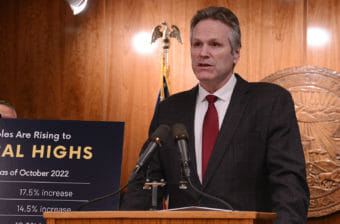
In this screenshot from an online video stream on Wednesday, Oct. 12, 2022, the commissioners of the Alaska Public Offices Commission consider whether to grant an expedited hearing request for a complaint against a group supporting the re-election of Alaska Gov. Mike Dunleavy. (Screenshot)
The Alaska Public Offices Commission will act before the election to hear a campaign finance complaint against incumbent Gov. Mike Dunleavy and backers of his re-election bid, the commission ruled Wednesday.
In a hearing that begins at 1 p.m. Friday, the state’s campaign finance regulator will hear evidence for and against the complaint, which alleges Dunleavy’s campaign illegally coordinated with a third-party group called A Stronger Alaska by having Brett Huber simultaneously serve in both Dunleavy’s campaign and A Stronger Alaska.
“The public at large has a compelling need to know whether coordination occurs or continues to occur related to A Stronger Alaska and its forthcoming expenditures,” said Anne Helzer, chair of the commission.
Helzer spoke after the five members of the commission heard arguments for and against expedited consideration of the complaint. Had they decided against a speedy hearing, it would not have been considered until after the election.
It was not immediately clear on Wednesday when the commission will rule on the merits of the complaint.
In this screenshot from an online video stream on Wednesday, Oct. 12, 2022, attorney Scott Kendall urges the Alaska Public Offices Commission to grant an expedited hearing for a complaint against a group supporting the re-election of Alaska Gov. Mike Dunleavy. (Screenshot)
A Stronger Alaska is funded by the national Republican Governors Association, which has already allocated at least $3 million to support Dunleavy’s re-election. State law prohibits third-party groups from coordinating with campaigns.
A ruling in favor of the RGA and Dunleavy’s campaign would clear the way for A Stronger Alaska to spend its money on the election in the last month before Alaskans vote on Nov. 8.
If commissioners rule against the groups, they could force A Stronger Alaska to pause its spending until it takes additional action, such as disbanding the group, refunding contributions and then re-forming the group.
That process could be done quickly enough to allow spending before the election, but it would require the Republican Governors Association to disclose the donors behind the $3 million it gave to A Stronger Alaska.
Currently, those donors are hidden because the RGA gave to A Stronger Alaska before Ballot Measure 2 took effect in February 2021. That measure requires third-party groups to disclose the true source of money behind their income.
In an extreme case, A Stronger Alaska could dissolve permanently. That was the result in September, when a complaint was filed against a third-party group backing Anchorage Democratic Rep. Harriet Drummond. Drummond’s husband was listed as a deputy treasurer for the group. After the complaint was filed, the group dissolved, donors were refunded, and the group has not been re-created.
The complaint against A Stronger Alaska was filed in September by the Alaska Public Interest Research Group and the 907 Initiative, a pair of nonprofits.
At the heart of their complaint is the role of Brett Huber, a former Dunleavy adviser.
On May 31, the Anchorage Daily News published an article revealing that Huber had been awarded a no-bid contract by the governor’s office while simultaneously serving as a deputy treasurer of Dunleavy’s re-election campaign and the third-party group A Stronger Alaska.
Huber said at the time that he had not done any work for the governor’s campaign since being hired by the third-party group.
Attorney Richard Moses, representing A Stronger Alaska, said on Wednesday that Huber’s listing as a deputy treasurer for the governor’s campaign was “an oversight on some paperwork.”
“It was completely unintentional and completely unknowing,” Moses said.
Asked whether a law can be violated by mistake, Moses said, “It depends on the law.”
Attorney Tom Amodio, representing the Dunleavy campaign, said on Wednesday that in order for there to be a violation of the law, there has to be cooperation and coordination in the expenditure of funds and that the complainants haven’t demonstrated that.
Scott Kendall is the attorney representing the complainants and said after Wednesday’s hearing that he intends to demonstrate that on Friday.
“The public at large has a compelling need to know,” he said.