Alaska Public Media is one of our partner stations in Anchorage. KTOO collaborates with partners across the state to cover important news and to share stories with our audiences.
Debris sits in piles in Kwigillingok after the remnants of Typhoon Halong brought widespread devastation to the region. (Brea Paul)
Local officials are continuing to search for two people missing from a Western Alaska village after remnants of Typhoon Halong left one dead and much of the region devastated by high winds and flooding.
However, large-scale search and rescue efforts are largely on hold pending new information.
The U.S. Coast Guard, Alaska State Troopers and Alaska National Guard said they were unable to locate a floating house and its occupants before they suspended their active search Monday evening.
The search covered dozens of square miles around the village of Kwigillingok using helicopters, planes, drones and more, according to Coast Guard Capt. Christopher Culpepper.
“Suspending an active search is always a tough decision to make, and it is especially difficult in this situation where the Kwigillingok community is already suffering so much,” he said.
Alaska State Troopers identified the missing people as 71-year-old Vernon Pavil and 41-year-old Chester Kashatok and said they had located the body of 67-year-old Ella Mae Kashatok. All three were residents of the hard-hit village of Kwigillingok and members of the same family.
Brea Paul, a court administrator in Kwigillingok, said in an interview that she knew the family well. She saw their house floating off its foundation as floodwaters rose on Sunday.
“They were the most kindest people I’ve ever met. They didn’t have much, but they always, always had a positive mindset and they always greeted anyone — they welcomed everyone to their home,” Paul said. “They deserve to be searched (for). Their names deserve to be heard.”
Village public safety officers with the Association of Village Council Presidents and volunteers are continuing to look for the two men, the organization said in a post on social media.
“Teams continue operations with drag bars, sonar equipment, and coordinated volunteer efforts,” the group said. “Our commitment to this mission is unwavering: no one is giving up.”
All are accounted for in Kipnuk, another community that saw widespread devastation, troopers said.
Hundreds of people remain sheltered in village schools scattered throughout the Yukon-Kuskokwim Delta. State officials say they’re rushing aid to the region and working to evacuate residents of Kipnuk and Kwigillingok.
Alaska Air National Guard C-17 Globemaster III aircrew, assigned to the 176th Wing, evacuate approximately 300 displaced Western Alaska residents following Typhoon Halong, Oct. 15, 2025. (Staff Sgt. Joseph Moon/Alaska National Guard)
A mass evacuation is underway for Kipnuk and Kwigillingok, where a thousand people were sheltering in schools after Sunday’s huge storm.
Reached by phone Wednesday afternoon, Kipnuk tribal administrator Buggy Carl said he was focused on one thing.
“Right now, just trying to convince everybody to go before the next storm hits,” he said.
Shelter conditions in the two communities were rough. The toilets weren’t working at the Kwigillingok school. Power and telecommunications were spotty in Kipnuk, and fuel to heat the school was running low. Nearly all the homes in both towns were damaged. It’s unsafe to stay, Carl said. Still, some people are reluctant to leave.
“I know their mindset, that their heart is here,” he said. “They don’t know anywhere else to go.”
It’s more than just familiar. Carl said it’s where they know how to make a living as subsistence hunters and harvesters. Carl said he heard some say they were afraid to go somewhere else.
“And then there is a possible thought that we will be able to come back, for those who want to come back, and still continue to help clean up,” he said.
Alaska Army National Guard personnel unload belongings from a Black Hawk helicopter at the Bethel Alaska Army National Guard Armory on Wednesday, Oct. 15, 2025. (Eric Stone/Alaska Public Media)
Carl said houses that were pushed off their foundations are scattered across Kipnuk. He was in a house with 14 family members during the storm, six of them children, when the four-bedroom house started drifting around 2 a.m. At one point he yelled at his family to brace when it looked like they were going to strike another house. He estimates his home traveled half a mile before it came to rest.
“We only floated down a few minutes. It felt like hours, because the time was really slow,” he said. “My adrenaline was like out of the roof.”
Kwigillingok tribal court administrator Brea Paul said a substantial portion of her town has already been flown to Bethel.
“We’re going to be one of the last families to leave so we can let the ones with no homes go first. But as of right now, we don’t know where we’re gonna go. We don’t know what to do,” she said.
The first evacuees were taken to the Bethel Armory, but that shelter quickly filled.
On Wednesday afternoon, evacuees were seen boarding a C-17 transport plane at the Alaska Army National Guard hangar in Bethel.
A Guard spokesperson said that 300 people from both Kipnuk and Kwigillingok were being evacuated to Anchorage.
The Alaska National Guard said the evacuees were being flown to Joint Base Elmendorf-Richardson, where agencies will be available to direct them to shelter, food and medical care.
Residents and their dogs in Kipnuk navigate high waters on Oct. 12, 2025, as the remnants of Typhoon Halong collide with the community. (Jacqui Lang)
More than a thousand people in Western Alaska are sleeping in their local school after a massive storm Sunday made their homes unlivable.
But some of the schools aren’t livable either.
In Kwigillingok, some 400 people were sheltering at the school, without functioning toilets, the Alaska Department of Homeland Security and Emergency Management reported Monday.
Nearly 600 were staying at the school in Kipnuk, where the water plant wasn’t working and electricity was limited.
Mark Roberts, the state incident commander, said Tuesday they’ve begun evacuating the medically vulnerable to Bethel.
“We’re moving as fast as we can,” he said. “We know that folks are miserable.”
The storm struck two communities very hard, Kipnuk and Kwigillingok, with record-breaking storm surge and damage to nearly every home. But many more communities along the Yukon-Kuskokwim Delta and farther north suffered flooding. Complicating rescue efforts, some airports are closed to fixed-wing planes, some power plants and phone systems are down and none of the communities are on a road system. Also, another storm is expected to bring high winds this week.
About 60 people have been evacuated to a shelter established at the Bethel National Guard Armory, Roberts said. For everyone else still stuck in their village school, State Troopers and National Guard are flying in supplies like water, food and satellite communications equipment while the state figures out what to do.
“We need to have places for people to go safely, where they can be warm and fed and taken care of. We’re moving quickly to have that established, but it’s taking some time,” Roberts said. “So some folks are in some really uncomfortable places. We’re doing everything we can to push in support to them, where they are.”
Bethel, he said, doesn’t have the capacity to shelter everyone who needs it, so the state is considering other places, including Anchorage and Fairbanks.
The longer-term outlook is more uncertain. Roberts says the state needs to evaluate each house in the flooded communities, in conjunction with the Association of Village Council Presidents, the Yukon-Kuskokwim Health Corp. and tribes.
“If folks’ homes are viable and the water goes down, and we can get the power back on and get them proper sanitation and reestablish some of their subsistence foods, then they can stay in their homes,” he said.
Where possible, he said, crews from the National Guard and Alaska’s Organized Militia will do rapid repairs to get homes ready for winter. Other residents, he said, can register to receive state assistance and seek temporary housing outside the community.
The storm has killed one person, left two missing, displaced hundreds and destroyed or damaged dozens of homes, especially in the hardest-hit communities of Kipnuk and Kwigillingok.
Here’s how you can help.
Financial support: The Western Alaska Disaster Relief Fund
The Alaska Community Foundation, an Anchorage-based nonprofit, has partnered with organizations serving people throughout the Yukon-Kuskokwim Delta region, Norton Sound and the Northwest Arctic to funnel financial donations to people affected by the storm.
“The thing that’s unique about this fund is that we have partnered with local and regional organizations to make sure that the money goes to the areas that it’s needed most,” the Alaska Community Foundation’s Ashley Ellingson said in an interview. “Since we are not on the ground, we rely on those partnerships to make sure that the gifts and donations are the most impactful.”
The Alaska Community Foundation is partnering with the Alaska Federation of Natives, the Association of Village Council Presidents, the Alaska Native Tribal Health Consortium, Yukon Kuskokwim Health Corp., Kawerak, Inc. Maniilaq Association and a number of other local, regional and statewide groups.
The foundation embarked on a similar effort in the wake of 2022’s Typhoon Merbok. As of 1 p.m. Tuesday, the fund had raised more than $300,000 from 3,550 donors, Ellingson said.
Cash donations are a better option than goods, since storing and transporting items can present challenges of their own, said Jenni Ragland, chair of Alaska Voluntary Organizations Active in Disaster.
“While it may seem impersonal, cash really is the best opportunity to help meet those immediate needs that are coming our way,” she said at a news conference Tuesday. “It provides flexibility for us to purchase exactly what’s needed, to procure those items quickly and to get them into the hands of disaster survivors.”
Other donations
A variety of organizations, though, are taking goods to distribute to survivors or contributing in other ways. Organizers request that donations include new and unused items only, and that the donations be limited to water, diapers, wipes, formula, non-perishable food, bedding, toilet paper, hand sanitizer, portable phone chargers and flashlights.
The Alaska Federation of Natives says it’s gathering supplies Friday, Oct. 17, from 1 p.m. to 5 p.m. at the Dena’ina Center’s Room 6, on the second floor. Donations will also be accepted Saturday, Oct. 18, from 8 a.m. to 2 p.m.
The Alaska Native Heritage Center is holding a benefit concert at Williwaw Social, 609 F St. in Anchorage, on Saturday, Oct. 18 from 6 to 10 p.m. Tickets are on sale online, and the group says it’s donating 25% of proceeds to relief efforts.
Alaska Children’s Urgent Care, at 751 East 36th Ave. in Anchorage, says it is taking children’s items, such as diapers, wipes, pediatric care supplies, socks, shoes and warm clothing for children of all sizes. Donations will be accepted 11 a.m. to 5 p.m. through Friday, Oct. 17.
Susitna Energy Solutions says it is collecting supplies at its office at 1432 Ingra St. in Anchorage from 9 a.m. to 6 p.m. Monday through Friday.
Alaska Discount Outfitters is offering a 10% discount to customers that bring donations to its location at 3401 Commercial Drive in Anchorage. Donations will be accepted Wednesday through Friday from noon to 7 p.m. and Saturday and Sunday from 10 a.m. to 7 p.m.
GCI says it is accepting donations at its C Street, Dimond Center, Muldoon and Abbott retail locations in Anchorage, as well as in Wasilla and Fairbanks.
The Fairbanks nonprofit Straw for Dogs is fundraising to provide doghouses and straw for families in the region.
The Association of Village Council Presidents is requesting that donations be dropped off at the Bethel Search and Rescue building at 499 State Highway in Bethel.
The Yute Commuter Service dispatch office in Soldotna is accepting donations through Saturday night at 627 Funny River Road at the local airport.
Editor’s note:This story has been updated to reflect that Lynden Air Cargo is no longer asking that donations not be brought to Anchorage airport cargo terminals, instead directing donations to GCI retail stores and the AFN convention.
If you are organizing a resource that we missed, please email news@alaskapublic.org
Gov. Mike Dunleavy and numerous state and federal officials held a news conference on Monday, Oct. 13, 2025, in Anchorage to discuss the devastating impacts of the weekend storm. (Matt Faubion/Alaska Public Media)
The U.S. Coast Guard commander for Western Alaska compared the devastation in Southwest Alaska villages over the weekend to the aftermath of Hurricane Katrina.
“Several of these villages have been completely devastated, absolutely flooded, several feet deep,” Coast Guard Capt. Christopher Culpepper said at a news conference Monday. “This took homes off of foundations. This took people into peril, where folks were swimming, floating, trying to find debris to hold onto in the cover of darkness.”
The remnants of Typhoon Halong barreled into remote, coastal communities in the Yukon-Kuskokwim Delta on Sunday, bringing hurricane-force winds and record flood waters. Coast Guard and National Guard crews have rescued at least 51 people so far from two of the hardest-hit communities: Kipnuk and Kwigillingok. Three people remain missing from Kwigillingok. Hundreds of survivors are in community shelters.
“It’s been very scary — very, very scary — for folks,” said State Emergency Operations Center head Mark Roberts.
Roberts and other officials at Monday’s news conference said they’re still taking stock of the damage, but said the storm destroyed dozens of homes. Some of them floated off their foundations with families still inside. Several people called the state’s emergency operations center for help.
“The folks that were in houses that were floating and didn’t know where they were was one of the most tragic things our folks in the state EOC have ever faced,” Roberts said.
Kipnuk on Sunday morning, Oct. 12, 2025. (Courtesy of Alaq Hinz)
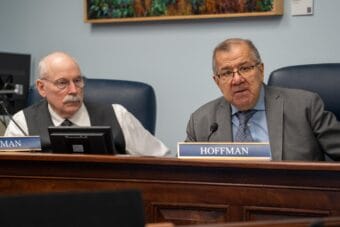
The storm also cracked Kipnuk’s runway so planes cannot land and snapped a lot of utility poles in half, leading to continued power outages, Bethel state Sen. Lyman Hoffman said.
Massive search and rescue effort continues
Locating every missing person is the state’s top priority, Roberts said.
Alaska National Guard Adjutant General Maj. Gen. Torrance Saxe said he has activated every member of the state’s National Guard and Alaska State Defense Force living in Western Alaska, totaling 60 to 80 people. State officials are also calling up more personnel largely from Fairbanks and Anchorage, he said.
“This may end up being the largest off-the-road-system response for the National Guard in about 45 years,” Saxe said.
Dozens of nonprofit organizations, businesses and faith-based groups, including the Salvation Army, Red Cross, Samaritan’s Purse and World Central Kitchen, are also coordinating recovery efforts with the state, Roberts said.
“We’re coming,” Roberts said. “We’re going to have folks there to help you.”
Mark Roberts, head of the State Emergency Operations Center. (Matt Faubion/Alaska Public Media)
Gov. Mike Dunleavy has declared a disaster for the region, easing access to additional resources.
“We know you need help. We’re going to continue to get the help to you,” he said. “We’re going to do everything we can to get everything up and running as quickly as possible, and we will continue to help — not just today, tomorrow, but weeks and months on and until we get things back to what used to be at least considered semi-normal.”
Record flooding
The storm surge broke records in the hardest hit communities, said meteorologist David Kramer of the National Weather Service. At Kipnuk, the water reached 6.6 feet above the normal highest tide mark, he said.
“The previous record was 4.7 feet, and that was back in 2000. So almost two feet higher than what we have seen before,” Kramer said.
The surge at Kwigillingok was also several feet higher than the last record high water, Kramer said.
Despite its fierceness, this storm was more focused than Merbok, the big disaster that hit Western Alaska in 2022.
“Merbok was, I’ll say, more extended on the coast,” said Gen. Saxe. “This really did hit certain areas very hard, and we want to get our help there, as I said, very quickly.”
Coast Guard assess environmental impacts
In addition to its search and rescue mission, the Coast Guard is also focused on the potential for a marine disaster. By midday, the only pollution reported was a light sheen in the flood waters, but the area of storm damage includes dozens of bulk fuel tanks and other fuel storage facilities, Culpepper said.
“These facilities are those that which the communities rely upon for home heating oil, subsistence through winter, for travel, for fuel, for vehicles, boats, aircraft, and they’re critical assets,” he said.
Coast Guard teams will conduct assessments and decide where the greatest danger is, he said.
Dunleavy said spilled oil is a low priority for the state right now.
“We’ve got to take care of people quickly. We have to take care of their needs quickly,” he said. “We have to take care of water, food, sanitation, electricity.”
Gov. Mike Dunleavy. (Matt Faubion/Alaska Public Media)
Oil and gasoline spills can be addressed later, he said.
‘More and more warming that is disrupting lives’
Dunleavy said he didn’t know how much climate change may have contributed to the intensity of the storm. Alaska has seen big storms in past decades, too, he said.
“We certainly had a couple stacked on top of each other last couple of years,” he said. “At least two under under my watch.”
Hoffman, who represents the region and grew up in Bethel, said its climate has changed, forcing the village of Newtok to relocate.
“There has been more and more warming that is disrupting lives in the Y-K Delta from the last 25 years that I can tell,” he said.
Adam Crum, then the commissioner of the Alaska Department of Revenue, applauds during Gov. Mike Dunleavy’s State of the State Address at the Alaska State Capitol in Juneau on Jan. 30, 2024. (Eric Stone/Alaska Public Media)
Former Revenue Commissioner Adam Crum defended his decision to invest $50 million from the state’s main savings account in an outside private equity fund in an interview Thursday. The investment with the infrastructure firm DigitalBridge has raised concerns among lawmakers, who have asked their auditor to investigate it.
The investment also raised eyebrows within the Department of Revenue.
Crum’s successor, acting Revenue Commissioner Janelle Earls, expressed concern over the process that led to the investment, a spokesperson said. In response, Gov. Mike Dunleavy ordered an independent third-party review of the investment to determine “whether there were in fact any violations of policy and make process recommendations as appropriate,” Department of Revenue spokesperson Aimee Bushnell said by email Wednesday. Bushnell said DigitalBridge was cooperating with the review but that the contract Crum executed could not be canceled.
The scrutiny was a surprise, Crum said.
Crum, who is a Republican candidate in the 2026 race for governor, said in an interview that the investment was an effort to boost the state’s investment returns. It represents about 1.7% of the roughly $3 billion in the state’s Constitutional Budget Reserve.
“The idea behind this was to put it into things that we know that there’s going to be more of,” Crum said by phone. “These are companies that own cell phone towers, digital assets, AI data centers, and as the world’s growing that direction, (it) seemed like an opportunity to actually get the state to invest in that.”
Crum had been working on the investment for more than a year and delayed his planned resignation to complete it, he said. The state committed the $50 million on July 28, three days after Crum announced that he would resign.
Crum said he’d followed state policy and procedure throughout the process.
“There was Department of Law sign-off, governor’s office sign-off, all of that was there throughout,” he said. “This was not something that was done by fiat.”
Bushnell, with the Department of Revenue, said Crum had approached the governor’s office with the idea, but she said Dunleavy’s staff “cautioned that any investments made needed to be in accordance with established investment policies and procedures.” The Department of Law did not respond to a request for comment.
The vast majority of the reserve is invested in low-risk products like short-term U.S. Treasury bills, which can be easily and quickly sold when the state needs to access the money. That’s been the case since July 2020, when an analysis showed that the fund could be depleted within 12 to 18 months.
“For a budget reserve account that needs to fund the day-to-day operations of government in the event that the price of oil declines, you really need to be holding your investments in cash or Treasury bills or some similar asset that you can turn into cash quickly when you need it,” former Deputy Revenue Commissioner Brian Fechter said in a phone interview.
State law does, however, allow a portion of the Constitutional Budget Reserve known as the “subaccount” to be invested to yield higher returns. Lawmakers created the subaccount in 2000 in pursuit of higher returns but emptied it in 2015 to reduce risk.
Alaska is no stranger to private equity investments, which allow the state to invest in companies not listed on public stock exchanges. The state’s retirement funds hold more than $5 billion in private equity, and the Alaska Permanent Fund nearly $15 billion, according to public documents. Permanent Fund managers have said private equity and other alternative investments are a major driver of growth.
Private equity investments typically come with lock-up periods that make the assets difficult to access on short notice. The industry standard is five to 15 years, Crum said.
Senate President Gary Stevens, a Kodiak Republican and House Speaker Bryce Edgmon, a Dillingham independent, said in a joint statement earlier this month that their risk and inaccessibility makes them an inappropriate choice for the state’s rainy-day fund.
“The (Constitutional Budget Reserve) was created to provide stability during times of deficit and emergency, ensuring that schools, public safety, and essential services remain funded when state revenues fall short,” they wrote. “Placing tens of millions of dollars into an illiquid, high-risk investment undermines that purpose and raises serious concerns about accountability, transparency, and fiscal responsibility.”
The state has drawn on the account repeatedly in recent years to fill gaps in its budget, and lawmakers have said they’re concerned uncertainty around oil revenue and federal spending could require more spending from the Constitutional Budget Reserve in the coming years.
It’s unclear how much of the $50 million committed to the private equity investment would be available in an emergency. Crum said he believed the contract with DigitalBridge included “fire sale” provisions that would allow the state to withdraw its money at a steep discount. To make its money back and see some additional return would take “probably five years,” Crum said.
Crum, though, said it was unlikely the state would need to access the money before then. He said the Legislature’s scrutiny was “amusing” and chalked up the governor’s review to an effort to build a better relationship with state lawmakers.
“If we are actually at the point to where we’re arguing over our last $50 million as a state, then we are already completely done,” he said.
Close
Update notification options
Subscribe to notifications
Subscribe
Get notifications about news related to the topics you care about. You can unsubscribe anytime.