Alaska Public Media is one of our partner stations in Anchorage. KTOO collaborates with partners across the state to cover important news and to share stories with our audiences.
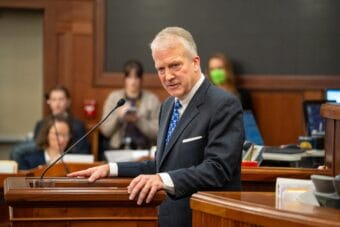
Sen. Dan Sullivan addresses the Alaska Legislature on Feb. 21, 2024 (Clarise Larson/KTOO)
WASHINGTON — President Trump is sending military troops to Chicago, over the objections of the elected leaders there, and U.S. Sen. Dan Sullivan thinks it’s a good idea.
Sullivan says Chicago’s violent crime rate justifies the deployment.
“It’s just horrendous that you have young, mostly African American kids who are killed every single weekend in Chicago. I think Labor Day weekend there’s like, maybe 10,” he said. “So something needs to be done. And these are tough issues, but, you know, most Americans would want whatever we can do to bring down crime rates.”
Sullivan spoke Saturday in Wrangell. A KSTK reporter asked what he thought of sending military troops to fight crime in Chicago and Portland, where elected leaders don’t want them.
“I think when you get more resources to law enforcement, to bring down crime, to bring down drug dealing, to help our communities, I think it’s important,” he said.
Trump’s deployment of troops to police Democratic-led cities raises legal questions, and it challenges the principle that the military shouldn’t be used for political purposes. Sullivan comes to the issue with a substantial background in both law and the military. He served as attorney general of Alaska and was also a colonel in the Marines until last year.
In a nearly three-minute answer to KSTK, Sullivan expressed no reservation about the Chicago deployment, then just getting underway.
Trump has given several reasons for sending troops to Chicago and Sullivan endorsed two of them — to protect federal buildings or agents from violence, and to reduce homicides.
Illinois Gov. JB Pritzker, a Democrat, has called it an invasion and said Trump is punishing states that didn’t vote for him.
Sen. Lisa Murkowski considers the Chicago deployment inappropriate.
“I have concerns, again, about bringing in our military without the consent, without the agreement of a governor, and really taking over the role of law enforcement, at the direction of the president,” she said on “Talk of Alaska” Tuesday.
Aside from the legal questions it raises, Murkowski is skeptical that it lowers crime rates in the long run.
Alaska Congressman Nick Begich declined an interview request but sent a statement saying the troops are filling a gap created “by mayors, governors and district attorneys who have put criminals above law-abiding citizens.” Begich’s statement says the troops are “ensuring every resident’s freedom of movement.”
KSTK reporter Colette Czarnecki contributed to this story from Wrangell.
An Island Air Cessna Caravan flies toward Old Harbor, a village of about 200 people in the Kodiak Archipelago, July 2, 2024. (Brian Venua/KMXT)
Funding for a program subsidizing rural air travel is set to continue through early November despite the ongoing government shutdown, the U.S. Department of Transportation told airlines on Wednesday.
U.S. Transportation Secretary Sean Duffy said Monday that funding for the Essential Air Service program, the source of the subsidy, could lapse as soon as Oct. 12. That date has now been pushed back to Nov. 2, according to notice to air carriers from Principal Deputy Assistant Secretary Daniel Edwards.
“Air carriers must continue to fulfill their obligations under existing contracts unless or until the Department notifies air carriers otherwise,” the document reads.
Essential Air Service subsidies are meant to ensure small communities have access to air travel, even if commercial flights aren’t necessarily profitable. The program supports more than 170 routes in 34 states and Puerto Rico with grants that total nearly $600 million a year, according to an October report from the Transportation Department.
That includes 65 Alaska communities at a cost of $41.7 million per year, most of which are not connected to the road system.
“Of all of the Essential Air Service communities around the country, we are the ones that really define what it means when we say essential,” Sen. Lisa Murkowski said on the call-in program Talk of Alaska on Tuesday.
The extended deadline is a relief to airlines serving the state, Alaska Air Carriers Association head Will Day said in an interview.
“That’s hopeful, from an industry perspective. It gives time for the government to recover and appropriate those funds,” he said. “We’re cautiously hopeful that funding will be restored before Nov. 2, and business continues as usual.”
Even if funding does run out, some airlines serving Alaska communities say they’re not expecting disruptions, at least in the short term. But the impacts would be uneven, Day said.
Smaller airlines would face an especially difficult path forward. Day said a small carrier serving the Interior community of McGrath would be forced to nearly quadruple its fares for a one-way flight to or from Anchorage.
Alaska Airlines, which receives about 40% of the state’s total subsidy for routes serving Adak, Cordova, Yakutat, Gustavus, Petersburg and Wrangell, said Essential Air Service funding is “necessary to maintain this vital community service” in a statement from spokesperson Tim Thompson.
But flights would continue even if funding lapsed, he said.
“Despite this potential uncertainty, Alaska Airlines currently plans to continue operating reliable flights as scheduled while the federal government works to resolve the shutdown,” Thompson said.
In Southeast Alaska, Alaska Seaplanes Marketing Manager Andy Kline said the subsidies helped keep fares down but made up a relatively small portion of the smaller carrier’s overall revenue. The company receives some $2.1 million per year for routes from Juneau to Angoon, Kake, Tenakee Springs, Elfin Cove and Pelican.
“We are ‘steady as she goes’ with all of our regular deliveries and will be that way for the foreseeable future,” Kline said in an email.
Island Air Service, which receives $1.3 million yearly to operate 13 Essential Air Service routes from Kodiak, also plans to continue flying as scheduled through at least mid-November, co-owner and operations director Erik Howard said in an interview.
“We’re going to do our best to just kind of keep providing service to the Essential Air Service communities as best we can uninterrupted, and hopefully the government figures it out,” he said. “But if it does go more than a month, then we might have to reevaluate and see from there.”
The state’s second-largest Essential Air Service carrier, Grant Aviation, offered support for the program and said it was advocating for funding to be restored but did not say whether passengers should expect disruptions.
Day, with the Alaska Air Carriers Association, said he hoped the shutdown would be resolved ahead of the early November deadline.
“At this time, we’re just paying a lot of attention and hoping that things get resolved quickly,” he said. “Towards the end of the month, we’ll start to be more concerned.”
Democrats and Republicans each blame each other for the shutdown, which shows little sign of resolving anytime soon.
Republicans need 60 votes to pass a government funding bill through the Senate, which requires support from some Democrats. Democrats, meanwhile, have said they are not willing to end the shutdown without an extension to expiring health care subsidies, a rollback of some health care cuts included in President Donald Trump’s signature One Big Beautiful Bill Act, and limits on the president’s power.
Alaska’s lone U.S. House member, Republican Rep. Nick Begich III, said Democrats were holding programs like Essential Air Service “hostage” and that their demands amounted to a “$1.5 trillion-dollar partisan spending spree.”
“The stark reality here is that this shutdown didn’t have to happen,” Begich said in a statement. “Republicans passed a clean, responsible bill to keep the government open and ensure programs like EAS continue uninterrupted.”
Republican U.S. Sen. Dan Sullivan also blamed the shutdown on Democrats and said in a statement that he was “actively working with the Secretary of Transportation and his team to ensure funding disruptions are avoided if at all possible.”
“I’m also pressing more of my Senate Democratic colleagues to come to their senses and quickly pass our clean, bipartisan continuing resolution to reopen the government and safeguard these and other vital programs that millions of Americans rely upon,” he said.
Murkowski offered support for negotiations to end the shutdown.
“We’re trying to figure out, can we get this off of dead center? Because there is no win, in my view, for either side. There is no win for anybody in a government shutdown,” she said.
Editor’s note: The graphics in this story were generated using an AI tool and verified by an editor and reporter. Alaska Public Media’s news team follows NPR’s ethics policy. You can find their AI section here.
Senate President Gary Stevens, R-Kodiak, greets Gov. Mike Dunleavy while standing alongside House Speaker Bryce Edgmon, I-Dillingham, in the House chamber at the Alaska State Capitol in Juneau on Jan. 28, 2025. (Eric Stone/Alaska Public Media)
Top state lawmakers say they’re investigating why $50 million from the state’s primary savings account was invested in an outside private equity fund.
Former Revenue Commissioner Adam Crum committed to investing $50 million in state dollars in the fund shortly before his resignation took effect, according to his successor. The political website Alaska Landmine first reported the news and identified the outside fund as DigitalBridge, a digital infrastructure investment firm. Crum, who is running for governor, did not respond to a request for comment on Monday.
Senate President Gary Stevens, a Kodiak Republican, said in an interview that he and House Speaker Bryce Edgmon, a Dillingham independent, learned about the investment on a call with Gov. Mike Dunleavy on Sept. 30. They’ve asked the legislative auditor to look into it, he said.
“We’re not accusing anybody of anything. We’re trying to find the truth right now,” he said. “We’re in an investigative stage right now, as is the governor. I mean, he was very forthright in talking to us about this.”
Stevens and Edgmon issued a joint statement on Friday saying state officials should not make similar “high-risk investments” in the future without involving the Legislature.
“Regardless of whether the action was technically permissible under statute, decisions of this magnitude must not occur outside the view of the Legislature or the public,” the pair wrote.
Dunleavy’s office and the Department of Revenue did not respond to a series of questions seeking more information on the investment and whether it’s consistent with the state’s investment policies.
The money for the investment comes from the state’s main rainy-day fund, the roughly $3 billion Constitutional Budget Reserve. Unlike the Permanent Fund, the reserve is typically invested in safe, cash-equivalent assets that are easy to sell quickly, like short-term U.S. Treasury bills. Lawmakers have repeatedly drawn from the account in recent years to fill gaps in the state budget.
But private equity investments tend to be far less liquid — and Stevens said that undermines the purpose of the savings account.
“We’re concerned (about) what we’ve heard, whether it’s a proper investment, whether we are tying up monies that we shouldn’t be tying up,” Stevens said. “We just have limited savings these days, and we need to be very careful about protecting those savings.”
Stevens says he expects lawmakers will hold hearings on the issue.
IGA Foodland grocery store in Juneau on Dec. 20, 2022 (Photo By Paige Sparks/KTOO)
Among the most vulnerable Alaskans to the ongoing federal shutdown could be thousands of parents who depend on WIC (wick) to help them buy food.
WIC is the acronym for Women, Infants and Children, a federal program administered by the state. It provides food benefits to women who are pregnant or breastfeeding, and families that include a child under 5, as long as the household meets income limits.
Jeff Turner, a spokesman for Gov. Mike Dunleavy, says Alaska has enough money in the program to last through the first week of the shutdown. Whether cash reserves last beyond then is unclear.
In past funding lapses, Alaska found the money to keep paying WIC benefits. A statement from the governor says the state will have to reassess if the shutdown goes on beyond a month.
Nationally, WIC depends on money Congress must appropriate each year. In that way it is unlike the larger SNAP food program, which is considered an entitlement.
More than 8,000 Alaska households receive WIC benefits. For now, WIC offices around the state are open.
Congress seems no closer to passing a funding bill. The Senate adjourned until Monday.
Former Anchorage Mayor Dave Bronson speaks at a campaign launch event at the Sullivan Arena in Anchorage on Friday, Oct. 3, 2025. (Matt Faubion/Alaska Public Media)
Former Anchorage Mayor Dave Bronson is joining the race for governor. He announced his candidacy Thursday as he kicked off a two-day series of events in Fairbanks, Wasilla, Anchorage and Soldotna.
“I’ve tackled crime, I’ve taken on homelessness, I brought record investment to our city and I’ve shown that when you put the people first, government can work in the way it was intended,” Bronson said at the Anchorage event Friday morning. “That’s why I’m running for governor. To put Anchorage first, to put Alaska first, and to fight for a smarter, stronger government that serves the people, not the other way around.”
Bronson is running as a Republican and said in a news release that he plans to focus on economic growth, infrastructure, affordable housing, education and “protecting the Permanent Fund Dividend.”
In a crowded field that includes 12 Republicans, Bronson said he shared many of his competitors’ values and policy priorities, but he said his experience as mayor sets him apart.
“I’m the only one that’s had that executive experience,” he said. “Others have legislative experience, and that is important, don’t get me wrong, and others had some small business experience, but at the end of the day, chief executive experience within the government realm is fairly unique.”
Bronson rode a wave of pandemic-induced frustration to be elected to lead the state’s largest city, serving as Anchorage mayor from 2021 to 2024. He frequently clashed with the left-leaning Anchorage Assembly over the city’s approach to COVID-19 and homelessness, and faced accusations of creating a hostile work environment, resulting in numerouswrongfultermination lawsuits and high amounts of staff turnover across departments.
He lost a bid for reelection to former Assembly chair Suzanne LaFrance last year.
Bronson said he expected to work closely with Republican caucuses in the state Legislature if elected.
“I’ve worked with the Legislature as mayor, many of the same folks in Juneau, and they’re far more reasonable and rational than the Assembly was,” he said. “I think it’ll be easier. It’ll be tough, but it won’t be irrational.”
Gov. Mike Dunleavy appointed Bronson head of the Anchorage International Airport in January. He left the role in September.
Dunleavy is term-limited and cannot seek reelection. Candidates have until June 1 to join the race.
Unalaska is the largest community in the Aleutian Chain. Its port is Dutch Harbor. (Berett Wilber/KUCB)
Months after Congress defunded public broadcasting, 14 public media stations in Alaska got some good news this week.
The Interior Department has put them on the list to be funded through a program that supports tribal stations, to make up for the money they’re no longer getting from the Corporation for Public Broadcasting.
Lauren Adams, general manager of KUCB in Unalaska, got an email Wednesday with the exact figure: $282,728.
“So roughly the amount that we received in our CPB Community Service Grant,” she said.
That gets KUCB through the year. But it is a one-time grant, so Adams still has a big challenge ahead.
Meanwhile, the plight of the little station in the Aleutians won the hearts of public radio supporters around the country.
Alerted by stories in the New York Times and other national media outlets, contributors found their way to the donate button on KUCB’s website. Others were matched through an organization called Adopt A Station. More than 100 people sent contributions from afar, Adams said, and the station gained roughly $25,000 in membership fees. The accompanying notes buoyed the staff.
“A lot of the comments were really, really touching. And just saying that ‘the local work you do in your community makes a difference. Keep doing it. Keep up the good work,'” she said. “Really morale boosting.”
It was a similar story for KYUK in Bethel. General Manager Kristin Hall said contributions from afar helped cheer the staff, even if they didn’t approach the value of the federal funds the radio and TV station lost. The new Interior Department grants make KYUK whole, at least for one year. They come to nearly $250,000 for radio operations and more than $800,000 for TV, Hall said.
“This funding that has been earmarked for stations, they are truly some of the most vulnerable in our country at this moment,” she said.
KYUK and KUCB are not tribally owned, but they partnered with their local tribes to receive the grants. There’s one more hurdle though: Hall said she thinks her station won’t actually get the money until the government shutdown ends.
Editor’s note: KTOO is not one of the stations included in the grants. Those stations are KNBA, KBRW, KYUK, KCUK, KDLG, KRFF, KZPA, KIYU, KOTZ, KSKO, KSDP, KUHB, KNSA and KUCB.
Close
Update notification options
Subscribe to notifications
Subscribe
Get notifications about news related to the topics you care about. You can unsubscribe anytime.