Alaska Public Media

Alaska Public Media is one of our partner stations in Anchorage. KTOO collaborates with partners across the state to cover important news and to share stories with our audiences.
New poll shows Peltola neck-and-neck with Sullivan, if she were to run for U.S. Senate

Mary Peltola
Rep. Mary Peltola at a campaign event in Bethel, March 15, 2024. (Sage Smiley/KYUK)

The last Democrat elected to statewide office, former Alaska Congresswoman Mary Peltola, is about even in a head-to-head match with Republican U.S. Sen. Dan Sullivan, a new poll shows.

Peltola hasn’t declared her intention to run in any race for 2026 but is considered a potential candidate for Senate or governor.

The progressive firm Data for Progress conducted the poll, at its own expense. Jason Katz-Brown, an Anchorage-based advisor at the firm, said the results in the Senate race are largely holding steady from its last poll.

“Earlier this summer we had her down by one (percentage point). Now we have her up by one, but that’s well within the margin of error,” he said. “I think we can’t conclude anything about that race. It’s just super, super close, if Peltola were to run for Senate.”

The poll also had Peltola leading in a field of nine candidates for governor – the others being Republicans who actually are running for the office.

It shows Anchorage businesswoman Bernadette Wilson in second place. But once lower-ranking Republicans are removed, former Anchorage Mayor Dave Bronson comes in second.

A large factor is name recognition, Katz-Brown said.

Pollster Ivan Moore of Alaska Survey Research said the Data for Progress results mostly track his own findings – that Peltola leads the field in the governor’s race. But, Moore points out, the other candidates have not had a chance to campaign yet.

“So the idea that this is going to be a cake walk and she can just stroll into the governor’s office is misguided,” Moore said. “She’s just streaks ahead of everyone else because she’s built this following, but it’s not going to be the same in a year.”

The latest poll found Alaskans evenly split on whether they have a favorable opinion of President Donald Trump. The poll had 823 respondents and the pollsters used weighted averages to better reflect Alaska voters.

Wasilla Sen. Mike Shower says he’ll resign to campaign for lieutenant governor

Man speaking in legislative chamber
Sen. Mike Shower, R-Wasilla, speaks in the Alaska Senate on March 25, 2024. (Eric Stone/Alaska Public Media)

Alaska Senate Minority Leader Mike Shower plans to resign to focus on his campaign for lieutenant governor alongside gubernatorial candidate Bernadette Wilson.

In an interview, Shower said he was concerned his duties as a legislator would create roadblocks in the campaign. For instance, state law prohibits sitting lawmakers from fundraising during legislative sessions.

“Going to the Legislature and being sequestered for four months in Juneau, and then maybe a special session or two next year, would limit my ability to fundraise and campaign,” he said. “You can violate the law if you’re not careful, right? You can really make a mistake there.”

The Wasilla Republican represents a large chunk of the Matanuska-Susitna Borough and some other communities, including Talkeetna, Willow, Sutton and Valdez. He leads the all-Republican minority that makes up about a third of the state Senate. He’s been in the Senate since 2018.

Once Shower’s resignation takes effect on Nov. 3, Gov. Mike Dunleavy will have 30 days to appoint a new Republican to serve until the 2026 election.

Shower declined to say who Dunleavy should appoint to replace him, and the governor’s office didn’t immediately respond to questions on the subject. But he said he’d like it to be someone who shares his conservative views.

“What I think is important is that that person represents the values of my district,” he said. “My district is very conservative. It’s one of the most conservative, politically, in the state.”

Since Shower is a Republican, state law requires Dunleavy to appoint a Republican to replace him. The appointment is subject to confirmation by other Senate Republicans.

Sutton Republican Rep. George Rauscher has registered as a candidate for Shower’s seat. Big Lake Republican Rep. Kevin McCabe, who also lives in Shower’s district, has also filed campaign paperwork that would allow him to run for Shower’s seat, as has former Alaska Wildlife Troopers head Doug Massie.

From food to financing, Alaska Native organizations feel the shutdown’s pinch

AFN President Ben Mallott testified to the Senate Indian Affairs Committee Oct. 29, 2025 about the impact of the goverment shutdown on Alaska Native communities.
AFN President Ben Mallott testified to the Senate Indian Affairs Committee Oct. 29, 2025 about the impact of the goverment shutdown on Alaska Native communities. (Liz Ruskin/Alaska Public Media)

WASHINGTON — The government shutdown is creating a lot of uncertainty and disruption for Alaska Native communities, and for tribal organizations that administer federal programs.

These include SNAP, for food assistance, and the Low Income Home Energy Assistance Program, which subsidizes energy bills.

Ben Mallott, president of the Alaska Federation of Natives, said the prospect that both of those programs would run out of money, just as winter begins, puts some Alaskans in a life-threatening bind.

“Without LIHEAP, without SNAP, our communities, our tribal citizens will have to decide between fuel and food,” he testified to the Senate Indian Affairs Committee Wednesday.

During the pandemic, the Federal Subsistence Board allowed emergency hunting to improve food security. Now, with the government shutdown, Mallott said the Subsistence Board can’t even meet to consider it.

Since the second Trump administration began, advocates for Native American and Alaska Native people have stressed that programs that help them aren’t D.E.I. initiatives but the result of promises, treaties and laws. Now, between the administration’s cuts to government services and the shutdown, they say the government is dodging its responsibilities.

Hearing witnesses said tribal Head Start programs will run low on money if the shutdown extends into November, and that many agency experts tribes normally turn to have lost their jobs.

Pete Upton testified about the Trump administration’s plan to abolish a fund at the Treasury Department called the Community Development Financial Institutions Fund. Upton runs the Native CDFI Network, whose Alaska members include the Cook Inlet Lending Center. He said tribal communities are often in banking deserts.

“Native CDFIs are typically the only financial institutions serving these communities, providing access to capital, credit and financial education where no alternative exists,” he said.

Early in the shutdown, the Treasury Department fired the entire staff of the CDFI Fund. With no one at the federal office to certify the CDFIs, Upton said it’s hard for the community finance organizations to attract private-sector and philanthropic investment.

Certification is “a stamp for investors to say that ‘you are investable,'” Upton said. With it, “we bring in private capital at a rate of eight to one.”

Sen. Lisa Murkowski, chair of the Indian Affairs Committee, said tribes face enormous uncertainty as the stalemate in Congress nears the one-month mark.

“We can’t figure out the path forward right now on our spending bills, although I am a little bit more optimistic on that today,” she said.

She didn’t elaborate but said earlier this week that senators are engaged in productive talks.

Dog evacuations continue from Western Alaska villages hit hard by remnants of Typhoon Halong

Army National Guard aviator carrying dog
Alaska Army National Guard Sgt. Hunter Lorenz, a CH-47 Chinook helicopter crew chief, carries a dog during recovery operations at Bethel, Alaska, Oct. 16, 2025. (Staff Sgt. Joseph Moon/Alaska National Guard)

As evacuees from villages like Kipnuk, Kwigillingok, Nightmute and Tuntutuliak boarded military helicopters bound for safety, many had no choice but to leave their dogs behind.

The mass evacuations from Western Alaska villages in the wake of ex-Typhoon Halong are mostly over. More than 600 people were airlifted to Anchorage aboard military helicopters and transport planes.

But a parallel effort to shuttle dogs and other pets out of storm-damaged villages aboard everything from Cessnas to cargo planes is continuing — and many of them are coming to Anchorage.

“People know how they would feel if this happened to them, so they want to help,” said Julie St. Louis, the cofounder and director of The August Foundation for Alaska’s Racing Dogs. She started the nonprofit to find long-term homes for retired sled dogs, she said, and today, the group takes rescue dogs of all ages and connects them with families.

Now, she said, planeloads of dogs are arriving on cargo flights just about every day. Twenty-nine arrived in Anchorage Wednesday night.

But reuniting those dogs with their families is a complicated task. So Anchorage Animal Care and Control on Tuesday started taking in dogs at an emergency shelter set up in a long, sandy-brown heated tent outside its main facility. The idea is for it to serve as a hub, said the agency’s community outreach manager, Joel Jorgensen.

“We specifically are being told to get involved because no one knows how to go about finding their dogs without calling 10 different rescues,” he said. “So, at this point, Anchorage would like to funnel the animals that are coming to the Anchorage city into Anchorage Animal Care and Control, and then disperse them out from there.”

Anchorage Animal Care and Control Assistant Shelter Manager Logan Robinson, left, and Community Outreach Manager Joel Jorgensen stand outside a temporary emergency shelter set up for dogs arriving from Western Alaska on Oct. 23, 2025. (Eric Stone/Alaska Public Media)

The emergency shelter keeps dogs isolated from one another and from the shelter’s other dogs before they can be checked for diseases like Parvo. Once they get to the shelter, a veterinarian gives them a quick health exam and checks their vaccine records before connecting them with rescues and foster homes, Jorgensen said.

“The animals wouldn’t stay here for hopefully more than 24 hours, is the goal,” he said.

As of Thursday, the agency appeared to be meeting that goal. They wouldn’t let the public inside for health reasons but Jorgensen said the emergency shelter was empty.

Jorgensen said some volunteers have stepped up to provide long-term fostering for people who won’t be able to return to their homes for months, or longer.

“You would hate to lose out on a family pet just because of a natural disaster like this,” he said. “But we have folks lined up that are willing to hold on to animals for six months, and then when that six months is over, they get their animal back and they have the happy ending they all deserve. ”

As local animal shelters and rescues coordinate evacuations and reunifications, other groups are taking on support roles. Alaska Rural Veterinary Outreach, a nonprofit that provides vet service to rural communities, is shipping out dog food and airline crates to places like Kotzebue, Nome, Bethel and Aniak. Board member Christine Witzmann said it’s all part of an important mission.

“I think people just want to make sure that the animals are treated humanely, and that they get rescued too, and that they are valued — they are valued as a living being,” she said.

St. Louis, with the August Fund, said there have been some hiccups along the way as everyone involved figures out the best way to handle the complex task — the kinds of hiccups you might expect in a disaster. She said she’s grateful for everyone who’s stepped up to help.

“Stand by, I guess, and be patient, is the best thing I can can tell people,” she said. “We’re all working really hard and are going to get the dogs out.”

How you can help

Anchorage Animal Care and Control is taking supply donations at its facility at 4711 Elmore Road, including:

  • Unopened bags of kibble and cans of wet food
  • Gallon jugs of water
  • Toys
  • Leashes
  • Collars
  • Blankets
  • Airline-approved kennels

Alaska Rural Veterinary Outreach has a dog food collection site at South Side Animal Hospital in Anchorage.

Best Friends Animal Rescue, a Wasilla-based group helping with the effort, also has an extensive list on its Facebook page.

‘We got hope’: The few who remain in storm-ravaged Kipnuk race to rebuild

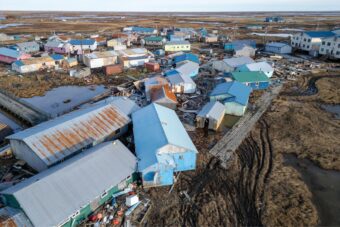
Debris sits in a pile in storm-ravaged Kipnuk, Alaska on Oct. 19, 2025, a week after the remnants of Typhoon Halong brought catastrophic flooding and hurricane-force winds to the village.
Debris sits in a pile in Kipnuk, Alaska on Oct. 19, 2025, a week after the remnants of Typhoon Halong brought catastrophic flooding and hurricane-force winds to the village. (Eric Stone/Alaska Public Media)

It’s Sunday in Kipnuk.

And like a lot of folks on Sundays, Tony Paul is headed to the hardware store.

“We’re making progress every day, seems like,” he said.

Unlike a lot of folks, he needs a boat to get there.

“It floated away,” he said, gesturing upriver. “There’s a couple stores down past that way, a bunch of houses.”

A week earlier, on Sunday, Oct. 12, Kipnuk endured the worst storm anyone can remember. It’s one of dozens of communities in Western Alaska working to restore essential infrastructure and repair damaged homes after the remnants of Typhoon Halong devastated coastal communities.

According to preliminary damage assessments, Kipnuk fared the worst.

The few residents who remain are determined to rebuild — but the task ahead is immense, and the future is unclear.

Homes and other buildings that floated off their foundations in Kipnuk, Alaska rest on tundra miles upriver on Oct. 19, 2025, a week after the remnants of Typhoon Halong brought record flooding and high winds to the Western Alaska village. (Eric Stone/Alaska Public Media)

In this village, four miles from the Bering Sea on the east bank of the Kugkaktlik River, Halong’s high winds and storm surge left a catastrophe. Halong’s hurricane-force winds pushed seawater more than six and a half feet above the normal high tide line.

Water poured into houses. It lifted homes off their foundations and deposited some of them miles away. It toppled four-wheelers and snowmachines, and left freezers full of food for the winter without power.

The state Department of Transportation estimates that 90% of the structures in the community were destroyed. Most of Kipnuk’s residents evacuated on military helicopters in the days after the storm.

Now, Kipnuk is in ruins. Piles of debris are everywhere.

Houses and other buildings sit jumbled and surrounded by debris in Kipnuk on Sunday, Oct. 19, a week after the remnants of Typhoon Halong brought record flooding and high winds. (Eric Stone/Alaska Public Media)
A building sits on a boardwalk among other debris on Oct. 19, 2025 in Kipnuk, Alaska, a week after the worst storm on record. (Eric Stone/Alaska Public Media)
An all-terrain vehicle sits overturned on a boardwalk in Kipnuk on Sunday, Oct. 19, a week after the remnants of Typhoon Halong washed ashore. (Eric Stone/Alaska Public Media)

Anna Kashatok was with her boyfriend, his family and her two kids when the storm hit.

“We floated away pretty far,” she said. “A mile or two.”

They escaped from a window and trudged to the community’s school. She recalled seeing the destruction for the first time.

“So heartbreaking, devastating,” she said. “Kipnuk’s not Kipnuk anymore.”

Kashatok was only back in town for a couple days, retrieving some belongings and important documents from her parents’ house. It also floated away with them inside. She evacuated to the hub community of Bethel with her boyfriend, parents, and two children.

Only a handful of people remain in this village that just a week ago was home to 700.

In spite of the widespread destruction, the school remains a place of refuge. It escaped major flood damage. It’s elevated on pilings with a dedicated backup generator.

All-terrain vehicles and a dog sit outside the Chief Paul Memorial School in Kipnuk, Alaska on Oct. 19, 2025. (Eric Stone/Alaska Public Media)


Supplies sit in the lobby of the Chief Paul Memorial School in Kipnuk, Alaska on Oct. 19, 2025, a week after the remnants of Typhoon Halong devastated the community. (Eric Stone/Alaska Public Media)

James Paul III sat at a table in the cafeteria, speaking with a local Yup’ik teacher.

“It happened so fast. Everything changed, like in a day,” he said. “The rest of their lives are changed in one day.”

The school remains, but the kids are gone. Many evacuated to Anchorage. Others are with friends and family in Bethel, surrounding villages or other communities around the state.

So for now, the Chief Paul Memorial School is a hub for the recovery effort. Packaged food lines the walls. Cafeteria workers prepare hot meals — chili was on the menu for dinner.

The state Department of Transportation told Paul some heavy equipment was on the way, he said, things like small excavators, skid-steers and all-terrain vehicles. That would help crews working to connect the school and a water treatment plant to power, he said.

“That’s our main objective right now,” he said.

James Paul III poses for a photo in the cafeteria of Kipnuk’s Chief Paul Memorial School on Oct. 19, 2025. Paul is one of a handful of residents racing to rebuild Kipnuk after the remnants of Typhoon Halong struck a week earlier. (Eric Stone/Alaska Public Media)

But time is running short. Winter is well on its way. Bits of frost lined ponds on the tundra. That, and an oily sheen.

State emergency officials say they believe the fresh water supply is contaminated. A stiff breeze brought some relief Sunday from what residents said had been a lingering stench of fuel and sewage.

A big question looms ahead: Can evacuees return before winter — or at all?

“The way that their houses are right now, I don’t think they want to come back, especially people whose houses were pulled off their foundation,” Paul said.

There are a few dozen homes built on pilings that survived the storm and are still livable. They number 40 or 50, Paul estimated.

Paul wants to stay in Kipnuk if he can, he said. He’s spent most of his life here.

“Kipnuk means family, (it) means values, traditions. It’s my culture. I grew up here, and my dad taught me to hunt and live off the land here,” he said. “I do know some about city life, but I’d rather be here.”

From left to right, Tony Paul, Anna Kashatok, Benjamin Kugtsun, Logan Paul and Joshua Dock stand outside the Chief Paul Memorial School in Kipnuk, Alaska on Oct. 19, 2025. (Eric Stone/Alaska Public Media)

Outside the school, standing with a group of young men working to restore basic services to the community, Benjamin Kugtsun was unequivocal.

“We’re going to stay here in the winter,” he said. “We can survive. How did our ancestors survive? Without nothing. But they did.”

But when — or whether — large numbers can return is unclear. Gov. Mike Dunleavy, in a request to the federal government, said some evacuees from villages across the vast, low-lying Yukon-Kuskokwim Delta might not be able to return for 18 months.

For now, Kugtsun and his crew are taking it one day at a time. One task at a time. One boat ride to the hardware store at a time.

But he’d like to see more residents return to help out.

“With teamwork, it can happen,” he said. “We got hope.”

Last year’s Alaska tourism season was a record year — but just barely

The Norwegian Joy docks in downtown Juneau on Saturday, April 26, 2025. (Photo by Clarise Larson/KTOO)

Over 3 million people visited Alaska during the tourism season that ended in April 2025 marking a new record for the state, according to data released at the Alaska Travel Industry Association’s annual convention in Anchorage Tuesday.

The Alaska Visitor Volume report includes data over the 12-month period starting in May 2024. It shows 33,000 more visitors came to Alaska compared to the previous travel season, an increase of 1.1%.

The association’s president and CEO, Jillian Simpson, said the increase was driven by the cruise sector, and that a few smaller communities saw big increases in visitation.

“There are some ports of call outside of Seward and Whittier that actually saw really big jumps in cruise visitation, and that is Kodiak, Alaska. But they were outdone by, can you guess who? Unalaska,” Simpson said.

Data in the report was gathered by McKinley Research Group. It found 88% of travelers that came to Alaska did so in the summer. Over half of visitors arrived on a cruise ship, followed by airline travel.

Juneau’s port had the highest number of passengers at 1.7 million – almost 4% higher than the previous year, according to the report. The majority of people who flew to the state came into Anchorage.

Winter travel to Alaska has been increasing over the long-term, but it dipped 5.5% last year, according to the report. Simpson said it’s the first decline since the association started tracking winter visitors in 2006. Fewer than 400,000 people came to the state during the winter months – a decline of 21,700 winter travelers from the previous season.

It’ll be months before tourism data for summer 2025 is available, but Simpson said early indicators show a slight decrease in cruise visitors and airline travel.

“On the cruise sector side, we did see essentially flat this year, which is what we were predicting with capacity,” she said. “It was ever so slightly down.”

The tourism sector supported 48,000 jobs in Alaska last year, according to the presentation.

Correction: This story previously has an incorrect byline. 

Site notifications
Update notification options
Subscribe to notifications