Alaska Public Media is one of our partner stations in Anchorage. KTOO collaborates with partners across the state to cover important news and to share stories with our audiences.
Moonrise over the U.S. Capitol in 2021. (Brett Davis)
WASHINGTON — We’re only one month into election year 2026 and it’s already clear that the incumbents in Alaska’s federal races have a lot of money to defend their seats.
U.S. Sen. Dan Sullivan raised nearly $7.5 million last year, according to his latest campaign finance report.
“We’re feeling incredibly strong about where our campaign is,” campaign spokesperson Nate Adams said. “Our fundraising is on track, and our support continues to grow.”
The campaign of Democratic challenger Mary Peltola is also touting its fundraising success. Peltola has only been in the race a few weeks and hasn’t had to disclose her contributions yet. But a Peltola campaign press release says she raked in $1.5 million on the first day after she announced. The campaign declined an interview request.
Campaign strategist Jim Lottsfeldt, who led a 2020 group that tried to unseat Sullivan, said the senator’s $7.5 million actually doesn’t give him much of a head start.
“Mary Peltola is in the middle of a money bomb, and she will raise every bit of that and more, and I think ultimately outspend Dan Sullivan,” Lottsfeldt said.
The U.S. Senate race is, so far anyway, a referendum on how people feel about President Trump, he said, and money doesn’t tell the whole story.
“The problem with money in this race is there’s going to be so much of it that most people will shoot their TVs and their computers,” he said. “And I’m not sure how it’s going to all get spent in a way that actually is effective.”
In the U.S. House race, Congressman Nick Begich’s campaign raised $3.2 million last year. Paul Smith, a consultant to the Begich campaign, said that’s an Alaska record for a U.S. House race in a non-election year.
“We feel really good about it and are proud of the start that he has to this election cycle, on the fundraising side,” Smith said.
Democratic challenger Matt Schultz, an Anchorage pastor, filed to run against Begich in October. He reported contributions of $300,000 by year’s end.
Schultz campaign manager Mai Linh McNicholas, said it’s a good foundation, with contributions from more than 2,000 people. She said Schultz set a fundraising record, too.
“It’s the most that any first-time candidate has raised, in an off-year, for this seat in Alaska,” she said.
An Independent candidate is also running for U.S. House — fisherman and retired educator Bill Hill. He hasn’t had to file a campaign finance report yet but his team says he’s raised, like Schultz, more than $300,000, and he did so in his first week.
The reports show Sullivan and Begich, like most incumbents, get significant money from Political Action Committees affiliated with corporations, trade associations and political groups. About half of their 2025 contribution totals are from individuals. The rest largely came from PACs, or “other authorized committees.”
The U.S. Capitol building. (Photo by Liz Ruskin/Alaska Public Media)
WASHINGTON — The U.S. Senate on Friday passed a bill funding the departments of Defense, Health, Labor and Transportation, among others, with both Alaska senators voting yes.
Still, hours later, at 8 p.m. Alaska time, funding will lapse for those departments, comprising much of the government. The U.S. House still has to pass the bill, and House members don’t return to the Capitol until Monday.
The shutdown, or lapse in funding, could last just one weekday. That would be minimal compared to the 43-day shutdown in 2025, the longest in U.S. history.
Nonetheless, the Office of Management and Budget says it will follow its usual shutdown practices.
Unless they’re told otherwise, all federal employees who would normally report to work on Monday should still go, according to the OMB’s plans. It’s standard practice on the first weekday after a funding lapse for federal workers to be on duty to launch the orderly shutdown procedures.
Then, if the shutdown continues, agencies are expected to notify their employees if they are essential and have to come to work, or if they will be put on furlough.
This time, the impact on Alaskans will be more limited than the shutdown last fall, because Congress has already funded many departments for the rest of the fiscal year. Those include NOAA and the departments of Commerce, Interior, Justice and Veterans Affairs.
Democrats held up a funding bill for the Department of Homeland Security. They demanded reforms to curb the kind of harsh immigration enforcement tactics deployed in Minneapolis, where agents shot and killed two U.S. citizens.
Now, Congress and the White House have two weeks to reach an agreement on what those reforms will be. Both of Alaska’s senators say they support some type of reform.
Sitka independent Rep. Rebecca Himschoot speaks in support of House Bill 93 on the House floor on Jan. 30, 2026. (Eric Stone/Alaska Public Media)
The Alaska House of Representatives passed a bill Friday that would tighten residency requirements for Alaskans buying hunting or fishing licenses.
House Bill 93 aims to ensure that only people who spend enough time each year in Alaska to qualify for a Permanent Fund dividend can buy resident hunting and fishing licenses, which tend to cost less and offer higher bag limits than nonresident licenses.
State law currently limits resident licenses to people who are physically present in Alaska with no plans to leave, do not claim residency in another state and have maintained a home in the state for 12 consecutive months. But it does not require that resident hunters and fishermen actually live in the state for a full year.
Rep. Rebecca Himschoot, a Sitka independent who sponsored the bill, said that definition leaves a big loophole.
“The last point means that we allow someone who rents a room in a home from friends, or someone who has a liveaboard boat that’s on a trailer but actually is in the state for less than a month — less than two months, potentially less than a week — to hunt and fish and enjoy the higher bag limits that are reserved for residents who are here year-round, shoveling snow, volunteering in their communities and putting their kids in our schools,” Himschoot said.
Himschoot’s bill seeks to close that loophole. If the bill becomes law, Alaskans would have to be physically present in the state for at least 180 days each year to get resident licenses, though there would still be numerous exemptions, including for military servicemembers, students and others allowed to be outside the state while remaining eligible for Permanent Fund dividends.
In some cases, people ineligible for dividends would still be eligible for resident hunting and fishing licenses. For example, new Alaskans moving to the state would be eligible for resident licenses 12 months after they arrive. Permanent Fund dividend eligibility rules generally require new residents to live for an entire calendar year in the state, from Jan. 1 to Dec. 31, before applying for a dividend.
People who do not qualify for a resident license would have the option to buy a nonresident license instead.
The deputy director of the Alaska Wildlife Troopers, who enforce fish and game laws, told a House committee in 2024 that the current definition makes it difficult to prosecute people who violate the residency requirements. By contrast, state prosecutors often bring charges against people who fraudulently apply for Permanent Fund dividends.
“The problem is that our enforcement officers don’t have the right tools,” said Rep. Donna Mears, an Anchorage Democrat.
A wide range of local governments, tribes and fish and game advisory committees spread across the state backed the bill.
Twelve House Republicans opposed the bill, including Big Lake Rep. Kevin McCabe, who said he was concerned the bill would exclude some Alaskans from the benefits of a resident license.
“What about those pilots that have vacation homes elsewhere, that would like to go spend two months in Hawaii, say, and then they have to fly out of state for 15 days a month?” McCabe said.
The bill, however, had broad support and passed with a bipartisan two-thirds majority in favor.
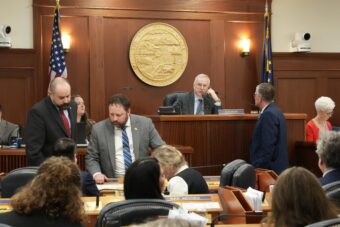
A board shows the final vote on House Bill 93 on Jan. 30, 2026. (Eric Stone | Alaska Public Media)
“Is there a problem? I think that we all acknowledge there is,” said Rep. Dan Saddler, an Eagle River Republican. “Is this a solution? I think it is. Is it the perfect solution? No, it’s not. But we don’t deal in perfect and ideal. We do what’s best and what we can do.”
“An Alaskan is and always will be an Alaskan,” Himschoot said. “But if you live outside Alaska, and you enjoy those lower prices at the grocery store and other costs of living that are much reduced compared to what we experience here in Alaska — if that is you, we ask you to please hunt, fish and trap as a nonresident.”
Rep. Sarah Vance, R-Homer, sits in the House chamber at the Alaska State Capitol in Juneau on Feb. 14, 2024. (Eric Stone/Alaska Public Media)
The Alaska state House’s ethics committee has launched an investigation into whether Homer Republican Rep. Sarah Vance illegally used state resources when she successfully pushed the local newspaper to remove and revise a story.
Vance objected to a Homer News article about a vigil she helped organize after the assassination of conservative activist Charlie Kirk. The article described Kirk’s views as “racist and controversial” and said Kirk promoted conspiracy theories.
Vance accused the paper of “hate-baiting” and raised concerns about the impact of what she called the newspaper’s “partisan spin” on the paper’s financial viability. She listed her objections in a letter on state letterhead that she posted to her official Facebook page.
The newspaper’s owner, Alabama-based Carpenter Media Group, then removed, revised and reposted the story without the reporter’s byline. Carpenter, now the U.S.’s fourth-largest newspaper operator, told the Columbia Journalism Review that the article did not meet its standards.
State law prohibits legislators from using public resources for “nonlegislative” or partisan political purposes.
The House Subcommittee of the Select Committee on Legislative Ethics said it had received “numerous complaints” about Vance’s conduct and that the allegations, if true, would violate state ethics laws. It opened an investigation in November and determined the scope of its review on Jan. 15.
“There is credible information to indicate that further investigation and proceeding is warranted,” reads a portion of a document outlining the investigation obtained by Alaska Public Media.
Two lawmakers serving on the committee — Republican Rep. Kevin McCabe and independent Rep. Alyse Galvin — declined to comment on the investigation.
In an interview, Vance defended the move and said she was asking to have the complaint dismissed.
“I believe that I was acting within my legislative duties,” Vance said.
Vance said she was aware of advisory opinions from the ethics committee covering “many examples of similar instances,” including one that allowed the use of state letterhead for political endorsements.
In a 1984 opinion, the ethics committee said it was not a violation of ethics laws to use official letterhead to endorse a candidate for office. However, lawmakers have significantly tightened state ethics laws since then, including in 1998, when the Legislature explicitly prohibited lawmakers from using state resources for partisan political purposes.
Ethics committee investigations are typically confidential, but Vance waived that protection in the interest of transparency, she said.
“I consider this a form of lawfare, using the ethics committee against me for something that they disagreed with,” she said.
The committee is asking Vance to provide copies of her communications with Carpenter Media, an explanation of the “legislative purpose” of the letter and why it was posted to her official social media account on state letterhead, how the letter was drafted, and what funds were used to draft and distribute it.
Vance’s letter and Carpenter’s response led to an exodus of editorial staff at the company’s three Alaska newspapers, including its top editor in the state, and indirectly to the creation of a new nonprofit online news outlet, the Homer Independent Press.
Vance applauded the new outlet.
“We need local journalism,” Vance said. “People in the community have come together and said, ‘We want a local paper to talk about local issues,’ and I fully support that, because we need that local voice in our small community.”
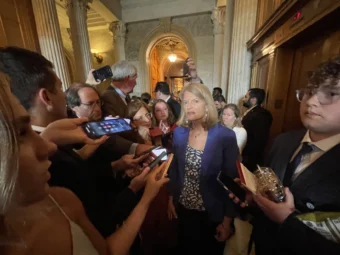
Sen. Lisa Murkowski was surrounded by reporters outside the U.S. Senate chamber last year. (Liz Ruskin/Alaska Public Media)
WASHINGTON — Sen. Lisa Murkowski said Secretary of Homeland Security Kristi Noem should be held accountable over a fierce immigration crackdown that has killed two citizens in Minneapolis and that she should resign.
“She has — through her words, and I think in her actions — she’s taken a direction that has not been helpful to the situation, and I don’t think that it helps the country,” Murkowski told reporters.
She said Noem has an obligation to maintain control of what the agencies in her jurisdiction are doing. Instead, Murkowski said, Noem has inflamed tensions. She noted that almost immediately after Border Patrol agents shot and killed nurse Alex Pretti, Noem claimed, without evidence, that Pretti was a “domestic terrorist.”
Murkowski spoke to reporters on her way to a Senate vote as lawmakers returned to the Capitol from a week away. She called it a good sign that the administration has removed top Border Patrol official Gregory Bovino from Minneapolis. But, she said, accountability rests with Noem.
Reporters pressed her on whether Noem should resign.
“I voted for her,” Murkowski said, referring to Noem’s Senate confirmation. “I think the President needs to look at who he has in place as a secretary of Homeland Security. I would not support her again, and I think it probably is time for her to step down.”
Murkowski was among the first Republicans in Congress to openly criticize the tactics of the immigration enforcement operation after agents killed Pretti. The group of GOP critics remains small.
But minutes before Murkowski spoke, Sen. Thom Tillis, R-N.C., also castigated Noem. He said the enforcement operations need to focus on the serious criminals President Trump promised to target and not pursue nonviolent people.
“I think that what she’s done in Minnesota should be disqualifying. She should be out of a job,” Tillis said of Noem. “And I mean, really, it’s just amateurish. It’s terrible. It’s making the president look bad on policies that he won on.”
Tillis is retiring from the Senate after his term ends in a year. He’s become one of the more outspoken Republicans in Congress when it comes to criticizing and voting against the Trump administration.
Unlike Murkowski and Tillis, Sen. Dan Sullivan, R-Alaska, didn’t issue a social statement or a press release this weekend to condemn Pretti’s death or call for reform.
His office provided a statement to reporters on request. Sen. Sullivan “strongly supports our law enforcement and their ability to do their jobs,” it says, while calling any loss of life tragic. It also says he hopes that “the temperature in Minnesota on both sides can be lowered.”
On his way to the Senate chamber to vote Tuesday, Sullivan held his phone to his ear as he walked through a crowd of reporters, fending off approaches.
Gov. Mike Dunleavy speaks to reporters during a news conference on May 19, 2025. (Eric Stone/Alaska Public Media)
Gov. Mike Dunleavy introduced a series of bills on Friday and Monday that he says would stabilize the state’s finances. The most prominent pieces of Dunleavy’s plan are a statewide sales tax and a new formula for Permanent Fund dividends.
“I want to stop our fights over the PFD and the Permanent Fund, and I want to minimize arguments over how much we’re going to spend each year and how we’re going to control the growth of government,” Dunleavy said in his State of the State speech on Thursday, before the bills were unveiled.
The governor did not take questions on the plan on Monday. His press office declined requests to interview members of his administration and did not respond to questions sent by email Monday afternoon.
Debates over the state budget have routinely dominated legislative sessions in Juneau in recent years. Alaska has not followed a formula in state law specifying the amount of the dividend since 2015, after a crash in oil prices sharply reduced the amount of money flowing into state coffers.
The new dividend formula would split the state’s annual Permanent Fund drawdown 50-50 between state services and dividends. If the 50-50 formula were in effect this year, next year’s PFD would cost the state roughly $2 billion and provide each eligible Alaskan with about $3,200.
A constitutional amendment requires a two-thirds majority in both the House and Senate. If lawmakers approve, voters would be asked to ratify it.
Dunleavy also proposes a variety of tax changes, most of them temporary. As a whole, they’d raise more than $900 million in annual revenue from mid-2027 through mid-2032 as the measures begin to phase out.
“Alaska has prosperous years ahead,” the governor wrote in a letter sent alongside the tax bill. “Starting in (mid-2032), Alaska is projected to see higher revenue due to expected increases in pipeline throughput and the Alaska LNG Project.”
The sales tax, proposed Monday in Senate Bill 227, would be set at 4% from April through September and 2% for the remainder of the year. As written, the sales tax would expire in 2034. That would provide the majority of the revenue from the tax package, between $735 million and $815 million each year.
“All who benefit from Alaska’s public services — residents, workers and visitors — will share in supporting those services,” Dunleavy wrote.
The bill would also seek to extract additional revenue from the North Slope’s oil and gas industry by raising the minimum tax companies must pay on each barrel of oil for as many as five years. The tax would end sooner if North Slope oil production increases to 650,000 barrels a day, roughly 40% more than current volumes.
It also includes elements of a bill the governor vetoed last year that seek to bring in more revenue via corporate income taxes from out-of-state companies that sell to Alaskans. It would eliminate the state’s corporate income tax in 2031.
A separate piece of the plan, laid out in House Bill 274 and Senate Bill 222, would require legislators to periodically vote on whether to continue various government programs, known as a “sunset review.”
Another element of Dunleavy’s plan would set a stricter limit for the growth of government spending in state law, reducing the allowable increase in state spending from 5% to 1% . A sunset review and a spending limit have been priorities for some of Dunleavy’s Republican allies in the state House and Senate.
The tax bill would not take effect unless the constitutional amendment, spending limit and sunset review bill each pass.
Anchorage Democratic Sen. Bill Wielechowski expressed reservations about the plan on Monday. He said he’d rather the state lean more heavily on the oil industry and Outside tech billionaires to raise revenue.
But Wielechowski said Dunleavy’s proposal will get “serious consideration” in the Senate.
“I’m glad the governor put something out. I think it’s the basis for discussion,” he said. “It’s hard to pass any of these major bills without the governor actively engaged, and this shows that he’s actively engaged.”
The new statewide sales tax would mean big changes for local governments, many of which already collect a sales tax.
The head of the Alaska Municipal League, Nils Andreassen, said on a video call Monday that Alaska’s local governments broadly support a plan to stabilize the state’s budget. But a statewide sales tax could have a variety of “unintended consequences,” especially for communities that already have a local sales tax, he said.
“The addition of a state-level (tax) is definitely a burden that some communities will feel more than others,” he said. “There will be calls from those residents to lower not the state’s rate, but the local (rate), which will diminish revenues at the local level.”
Dunleavy’s plan would also do away with so-called “tax caps” that limit sales taxes in some communities and set a statewide list of sales tax exemptions, Andreassen said. For example, it would likely override a local ballot measure in Juneau exempting most groceries and utilities from sales taxes.
Medical care, rent, groceries purchased with federal SNAP or WIC benefits, jet fuel, insurance premiums and business purchases would be among items exempt from sales tax under Dunleavy’s proposal.
It’s too soon to say if the governor’s plans will pass the Senate this year, Wielechowski said. Leaders in the House said earlier this month they’re not optimistic Dunleavy’s plans will pass this year, his last as governor.
Editor’s note: This story has been updated with additional information about the revenue the tax package would raise.
Close
Update notification options
Subscribe to notifications
Subscribe
Get notifications about news related to the topics you care about. You can unsubscribe anytime.