Alix Soliman

Climate & Environment Reporter, KTOO

“I write stories that shine a light on environmental problems and solutions. In the words of Rachel Carson, ‘The public must decide whether it wishes to continue on the present road, and it can do so only when in full possession of the facts.’”

When Alix isn’t asking questions, you can find her hiking, climbing or buried in a good book.
Car buyers and dealers in Alaska face limited options with new EV shipping restrictions

Lonnie Khmelev stands before a row of electric vehicles at his Juneau dealership. He’ll continue selling EV’s but may have to do so through a ferry— limited at two at a time. (Photo courtesy Olena Kot)

Listen to this story:

Lonnie Khmelev owns Affordable Auto Sales in Juneau, and until last week, he got all of his EVs shipped through Alaska Marine Lines. That’s true for all of the car dealerships in Juneau. Khmelev currently has 50 cars on the lot and nearly half are EVs.

“I would say we sell probably about 40% EV,” he said.

But AML stopped shipping electric vehicles to Alaska at the beginning of September due to the fire risk posed by lithium ion batteries. This came after two other major shipping companies Matson and Tote Maritime suspended their EV shipments to the state for the same reason.

Khmelev said he’ll probably ship EVs on the ferry, which has a limit of two at a time.

“I do think that we’re going to continue selling EVs, and we’ll find ways to get them here and ship them out if need be,” he said. “I’m staying positive on that.”

Because his operation is small, Khmelev said getting just a few cars in per week is plenty.

But down the road at the Juneau Auto Mall, the largest dealership in town, Manager Kody Richardson is less optimistic.

“Without a detailed workaround to get cars here, it will definitely affect our ability to grow EV sales in Southeast Alaska,” he said.

Richardson said EVs have made up less than 5% of the company’s sales so far this year, but even that demand may be hard to keep up with.

AML didn’t agree to an interview for this story, spokesperson Ryan Dixon wrote in an email that the company still ships hybrid vehicles that don’t plug in, and will reassess its ability to safely ship EVs and plug-in hybrids as industry standards and safety procedures improve.

The decision came after a cargo ship carrying electric, hybrid and standard vehicles caught fire and burned for days before sinking off the coast of Adak in June. All Twenty-two crewmembers evacuated on a lifeboat and were rescued by another vessel.

Steve Behnke leads Renewable Juneau, a nonprofit that advocates for clean energy. He said he hears the shipping companies’ safety concerns, but “as we understand it, the circumstances are just totally different in terms of the shipping that AML is doing,” he said. “They’re using open barges. They’re not cramming a bunch of vehicles down in the hold of a cargo ship.”

Behnke said EVs make good sense for Alaska’s capital city, which runs on relatively cheap hydroelectric power, has a small network of roads and a moderate climate that isn’t rough on the car batteries.

“Juneau is a Goldilocks zone for EVs,” he said.

It’s unclear if car dealerships are facing the same problem in the rest of the state. A handful of dealerships in Anchorage didn’t respond to interview requests for this story. But anecdotally, it may be harder to buy an EV in the state’s largest city. Anchorage resident Maggie Miller ran into roadblocks when she explored buying one in August.

Miller’s teenage son totaled the family’s 2013 Toyota Highlander while learning to drive.

“We had been intending to buy an EV next fall when he turned 16,” she said. “So when this total happened, we were like, well, maybe we should go ahead and get the EV.”

The Millers called Continental Subaru to see about the Solterra. That’s when they heard that the dealership can’t get them because shipping companies won’t transport EVs to Alaska anymore.

Miller said she was surprised.

“I was really disappointed, because I just understood this was something we were trying to do as a country,” she said. “We were trying to make a change and it’s something that we totally can support.”

Miller’s often shuttling her two kids and nephews to their sports and other activities, and needed a car to replace the totaled one. So she ended up just buying another gas-powered Highlander.

“It’s just a bummer that there’s…improvements in technology, but there are all these barriers to taking the steps to do the right thing,” she said.

Miller said that she hopes dealerships can find a way to get EVs to Anchorage, either with additional charging stations on the Alcan Highway or a change in shipping policy.

Italian researcher who died on Mendenhall Glacier was studying planetary landscapes

Riccardo Pozzobon was a planetary geologist. (Photo courtesy of EuroPlanet)

Listen to this story:

Riccardo Pozzobon, a 40-year-old planetary geologist from the University of Padua in Italy, died on the Mendenhall Glacier last week.

He had journeyed onto the glacier with two other Italian researchers to study ice fracture patterns in an effort to better understand the icy moons of Jupiter and Saturn. The research is part of Project GEMINI and is funded by the National Geographic Grant Program. Pozzobon was also an instructor in the European Space Agency’s astronaut training course.

His companions on the expedition told rescuers that Pozzobon tripped over his crampon and fell into a stream of water that swept him down a moulin, which is a vertical hole in the ice that funnels surface meltwater underneath the glacier. 

After he disappeared into the moulin, Pozzobon’s colleagues walked about a quarter mile to the NorthStar helicopter landing zone on the ice near Mount McGinnis and Stroller White. There, they found Jonathan Tuttle, director of guiding and glacier safety for NorthStar.

“They told me that their friend was the only one that had an inReach and phone device, so they had no phones on them,” Tuttle said. 

Tuttle’s team called 911 and Juneau Mountain Rescue, and in the meantime, went to try to help. 

“It was pretty quickly determined that the moulin that he went in, there was no safe entrance to, so we set a rope about 500 feet below to a moulin that was dry — that the water used to flood into — and repelled down to see if it might connect and there’d be any chance at a recovery effort,” Tuttle said. 

Once he had descended about 150 feet down the second moulin, Tuttle said he could see it didn’t connect to the one Pozzobon disappeared down.

A dry moulin that Tuttle descended to search for Pozzobon. (Photo courtesy of Jonathan Tuttle)

When Juneau Mountain Rescue arrived, they called off the rescue because descending into the hole filled with rushing water was too dangerous.

Tuttle called it a tragedy, and said the research team was experienced in this terrain. At least one member of the research group had done a lot of technical spelunking in both rock and ice caves.

“From a professional standpoint, it’s pretty easy to get complacent with the hazards around you and this was a good wake-up call to all of our staff and kind of everyone else on the glacier of just how quickly things can escalate,” Tuttle said.  

Tess Williams, a spokesperson for the Alaska Department of Public Safety, said she’s not sure whether Pozzobon was equipped with safety gear at the time of the fall.  

“The information that Troopers have is that he was not roped to his companions when he fell, and that we don’t believe he had safety gear on him,” she said. 

Tuttle said Pozzobon’s companions reported they had stopped for lunch and sheltered in a canyon near the moulin to get out of the wind. 

The moulin that Pozzobon fell into on Mendenhall Glacier. (Photo courtesy of Jonathan Tuttle).

Pozzobon’s colleagues at the University of Padua declined an interview, but highlighted his gentle and generous character in a news release

“Riccardo was a brilliant researcher with a limitless passion for geology,” wrote Francesco Sauro, a colleague who was not on this expedition. “He was also a generous person who was always willing to share his expertise with enthusiasm and infectious happiness.”  

EuroPlanet, a European planetary science society of which Pozzobon was a member, reports that he is survived by a wife and young son. 

Alaska DOT drone team livestreamed Juneau’s glacial outburst flood to emergency managers

Drone image of Marion Drive during the 2025 glacial outburst flood on August 13, 2025. (Photo courtesy of Alaska DOT)

Listen to this story:

During Juneau’s record-breaking glacial outburst flood last month, the Alaska Department of Transportation completed one of its most complex drone missions to date. 

A handful of DOT drone pilots filmed Juneau’s temporary levee consistently during the major flood stage of the event, including overnight footage using infrared cameras. The agency livestreamed that footage to keep emergency managers informed as floodwaters rose, crested and receded. 

Patrick Dryer, an avalanche and geohazard specialist at DOT in Juneau, said this was a new feat for the department.

“We were able to essentially monitor this remotely, without having personnel, you know, in the field for a 12-hour period there,” Dryer said.

He said they were able to do that because the drones they used, called Skydio X10, connect to Starlink and wireless broadband and can fly long distances in urban areas.

Christopher Goins, a regional director at DOT, said that observing a disaster in real-time without putting staff in danger wouldn’t have been possible a few years ago. 

“The world is suddenly changing for us,” Goins said. “This is a big deal.” 

He said that surveillance was focused on infrastructure — the HESCO barriers that make up the temporary levee and bridges over the river — not on people. 

People did appear in the livestream incidentally, “whether that was being on the barriers, hanging out behind the barriers, laser pointing the drones,” Goins said. 

Goins said that if the levee broke — which would have triggered a flash flood — the drone teams would have pivoted to assist rescue operations. The drones are equipped with thermal cameras that can pick people out, even in the dark. 

“If we saw somebody in the water, we were to stay with them,” Goins said. 

Then they would call Capital City Fire/Rescue and hover there until rescue arrived. 

Goins said DOT uses drones regularly for construction and maintenance, so he hopes to expand the department’s capacity to help local emergency managers in the region quickly respond to disasters like floods, landslides and avalanches. 

Correction: An earlier version of this story said the flood happened earlier this month. The flood happened in August. 

Gold exploration success extends Kensington Mine life for five years

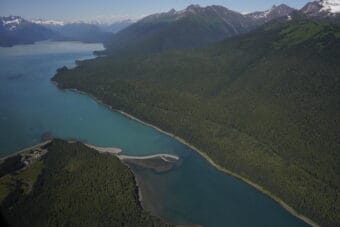
Coeur Alaska’s Kensington Mine. Lower Slate Lake is tucked in the trees on the left and the port is on the bottom right (Photo by Alix Soliman/KTOO)

A gold exploration project at Coeur Alaska’s Kensington Mine north of Juneau has revealed thousands more ounces of precious metals. The high-grade gold deposits will extend the mine’s life through 2029. 

Steve Ball, the general manager at Kensington, said the company spent a few years and nearly $90 million drilling to discover more gold. Now those efforts have paid off. 

“We increased our reserves from a low point of 261,000 ounces at the end of year 2022, to 501,000 ounces at the end of year 2024.” 

Ball said those new reserves, which they’ve already started excavating, represent around five years of mine life.

Brian Holst is the executive director of the Juneau Economic Development Council. In an email, he said this is promising for workers here, since the mining industry is one of the community’s largest private employers.

“Both Kensington and Greens Creek Mine provide some of Juneau’s highest paying jobs, averaging over $120,000 a year, so knowing that Kensington Mine has a longer future of work in Juneau ahead of them is great news for the workers and our community,” he said. 

Kensington employs around 380 people and roughly 40% of them live in Southeast. The mine is also Juneau’s second largest taxpayer after Hecla Greens Creek Mine. 

Kensington mine is located about 45 miles northwest of Juneau in the Berners Bay Mining District. It’s owned by Coeur, a multinational company based in Chicago, Illinois, which began operating it in 2010.

The mine has raised environmental concerns. Last year, it reported a tailings spill. Separately, it was potentially responsible for a fish die-off downstream. In 2019, the U.S. Environmental Protection Agency fined Coeur more than $500,000 for multiple environmental violations

The price of gold is on the rise. As of today, it’s at roughly $3,600 per ounce. 

Deantha Skibinski is the executive director of the Alaska Miners Association. She said the positive trend makes Alaska a more attractive place to drill, given how expensive it is to establish gold mines here. 

“That certainly incentivizes companies to do that exploration in Alaska to hopefully bring more mines online,” she said. “So it really is a positive driver in terms of growing our industry here.”

Ball said that Kensington staff have already started more exploratory drilling with the hopes of extending the mine’s life even further. 

New maps show where Alaska’s migrating seabirds overlap with high vessel traffic

A bird storm strikes the R/V Tiĝlax̂ near Kasatochi Island in 2003. (Photo courtesy of Jeff Williams/USFWS)

Listen to this story:

Ships could pose a risk to seabirds migrating through Alaska’s waters. Researchers mapped where ship traffic overlapped with bird traffic to pinpoint areas where flocks are more likely to smack into vessels, a phenomenon called “bird storms.”

In the early 2000s, a group of researchers got caught in a bird storm. Jeff Williams was retrieving fishing nets on a research vessel in the Aleutian Islands when, suddenly, hundreds of fork-tailed storm petrels descended on the scientists. 

Williams leads the Alaska Maritime National Wildlife Refuge at the U.S. Fish and Wildlife Service. The refuge spans waters from the Inside Passage through the Aleutians and north to the Chukchi Sea. 

“It was around one of the breeding colonies, and we had to have the lights on to retrieve the nets,” he recalled. “It was one of these foggy nights, birds just come flying in.”

The birds seemed attracted to the ship’s lights like moths to a flame. So the scientists shut them off. Then they blew hair dryers to warm up the dazed, wet and cold storm petrels before releasing them. It was autumn, so many of them had just fledged their nests. 

A bird storm strikes the R/V Tiĝlax̂ near Kasatochi Island in 2003. (Photo courtesy of Jeff Williams/USFWS)

He said the birds fluttered down onto the boat and not many of them died. But other flocks aren’t as lucky. 

“Some birds like eiders … larger waterfowl, they’re flying really fast. If they have a collision with a boat, they’re going so fast that they probably die,” he said. 

Williams said these so-called ‘bird storms’ happen multiple times a year in the Aleutians, especially when massive colonies gather to feed and breed.

But he said there isn’t much data on how many birds actually die when they interact with boats in Alaska’s waters, or how often that happens. 

A paper published in the journal Conservation Biology last month made a first attempt at assessing the potential risk to birds by mapping where they are most likely to interact with vessels in much of Alaska’s waters from the Gulf of Alaska, through the Aleutian Islands to the Arctic.  

Williams said the findings track with what he’s experienced and plenty of anecdotes he’s heard.  

“We’re kind of in the early periods of just recognizing some of that — what’s going on,” he said. “We know it happens. Even on vessels that try to do the right thing, it still happens.”

The researchers overlapped seabird observations from the North Pacific Pelagic Seabird Database between 2006 and 2022 with Automatic Identification System data, which tracks large boats. The analysis included about 1.3 million bird observations and 1 billion vessel location pings from thousands of boats. 

Kelly Kapsar, a postdoctoral researcher at Michigan State University, crunched the data and made a risk score from zero to 100 based on the overlap.

“If it’s zero, no seabirds there, no vessels,” she said. “One hundred was the maximum amount of seabirds and the maximum amount of vessels that we saw.”

She found bottlenecks where that overlap was highest, and two spots jumped off the map: Unimak Pass and the Bering Strait. Auklets, shearwaters and northern fulmars were most exposed to vessel traffic in these areas.

Unimak Pass is a narrow pathway through the Aleutian Islands notorious for its frequent bad weather and ship wrecks. It’s one of the primary routes for cargo ships traveling between Asia and North America, and oil tankers moving south from the Arctic. The Bering Strait separates Russia and Alaska and is an important international pass for ships heading for the Arctic Ocean.

Marine traffic is increasing. As the climate warms, some productive fisheries are shifting north and Arctic sea ice is melting, opening up the high latitudes for longer periods. 

The International Maritime Organization established areas to be avoided through Unimak Pass and the Bering Strait in an effort to reduce ship wrecks and damage to the environment. But there is no guidance for where or when crews should adjust ship lights to avoid attracting birds.

Ben Sullender, the director of geospatial science at Audubon Alaska and one of the authors of the paper, said these passageways are vital for millions of migrating seabirds. He suggests measures ships could take to try to avoid them. 

“Make sure that that light is aimed at the deck where you need it, not up into the sky where it can draw in birds from a much further area,” he said. “There’s other things like changing the wavelengths of the light,” since some birds can be attracted to higher-energy wavelengths on the light spectrum like blue, green and ultraviolet. 

But he said this research is simply a first stab at seeing where the overlap could become a conservation problem. The study doesn’t identify any actual impacts of vessels on birds, he said, since there wasn’t enough data to analyze that statewide. 

The analysis also did not include Southeast Alaska due to data gaps, but the research team is hoping to make similar maps for the region in the future.

The Roadless Rule is on the chopping block, and the public has less than a month to comment on it

Logging roads crisscross the Tongass National Forest near Excursion Inlet. (Photo by Alix Soliman/KTOO)

Listen to this story:

The Roadless Rule protects more than half of the Tongass National Forest from road development, and it’s on the chopping block again. Tribes and environmental groups are strategizing to keep it in place. 

A host of Alaska Native communities in Southeast Alaska, which rely on the Tongass National Forest for their food and culture, say they want to make the Roadless Rule permanent. 

Tlingit advocate Xaawk’w Tláa Yolanda Fulmer presented one tactic at the Southeast Tribal Environmental Forum in Juneau this week. She explained how a bill that was reintroduced to the U.S. House of Representatives this summer called the Roadless Area Conservation Act, or RACA, could codify the Roadless Rule once and for all.

“The current situation is a political struggle between the proposed repeal of the Roadless Rule and the introduction of RACA,” Fulmer said. “The outcome of RACA will determine the future protection of vital national forest lands, including the Tongass.”

She said that if the bill passes into law, it could end the political ping pong between promoting extractive industries and preserving traditional foods and practices in National Forests. 

“Road construction often leads to logging, mining, forest fires and development — development which fragments ecosystems,” she said. “The Roadless Rule helps maintain intact forests, streams and shorelines where traditional foods thrive.”

The Roadless Rule has flip-flopped multiple times since it was established to protect undeveloped lands in 2001. It was rolled back during President Donald Trump’s first term before being reinstated in 2023 by former President Joe Biden. 

The proposed rollback aligns with Trump’s executive order earlier this year to end a ban on constructing roads in undeveloped areas of the forest. The USDA’s announcement comes on the heels of Representative Nick Begich’s visit to Juneau, where he said that he supports the expansion of logging in the Tongass National Forest. 

“This is something I hear from folks from Ketchikan all the way up to Yakutat on a regular basis,” he said. “How do we bring timber back?”

Tribal leaders at the forum in Juneau spoke to the value of keeping the forest ecosystem intact. Joel Jackson is President of the Organized Village of Kake, an Alaska Native tribe based on Kupreanof Island. He said it’s vital to keep the forest healthy, in part because the salmon that feed his tribe rely on it. Old growth trees shade the streams, making the water cold enough for salmon to swim up.

“If the stream isn’t cool enough, those fish aren’t going to be able to spawn,” Jackson said.

After the fish spawn and die, their decaying bodies feed the forest with nutrients they gathered at sea — and the cycle continues.

The U.S. Department of Agriculture announced Wednesday that the public can comment on the proposed rollback from Friday through Sept. 19. 

“This administration is dedicated to removing burdensome, outdated, one-size-fits-all regulations,” said U.S. Secretary of Agriculture Brooke L. Rollins in a press release. 

Nathan Newcomer advocates for the Tongass with the Southeast Alaska Conservation Council. He worries that the USDA won’t listen to the public’s wishes to keep the rule in place. 

“We know what they’re going to do,” Newcomer said of the department. “They’re not going to listen to anybody, but we still need to get on the record and make it sure and clear that people in Southeast Alaska and across the nation want to see the Roadless Rule kept in place.”

When the first Trump administration rolled back the Roadless Rule in 2020, people had about 90 days to comment and nearly all of the public comments were in favor of keeping the rule.

Newcomer said that he’s organizing quickly since the federal government has expedited the public process to allow for less than a month of public comment. 

Kate Glover is an attorney at Earthjustice, an environmental law firm that has challenged past rescissions of the Roadless Rule on behalf of tribes, conservation nonprofits, tourism and fishing groups. She said a few weeks is not enough time for a meaningful public process.

“It doesn’t allow time for the agency to meet its obligation to consult with tribes on a government-to-government basis,” she said. “Typically, at least 120 days is needed for that.” 

Glover said she had not seen such short comment periods before this administration.

Site notifications
Update notification options
Subscribe to notifications