Anchorage Daily News

Anchorage Daily News is our partner in Anchorage. KTOO collaborates with partners across the state to cover important news and to share stories with our audiences.

Alaska Legislature will sue Gov. Mike Dunleavy over lapsed appointments

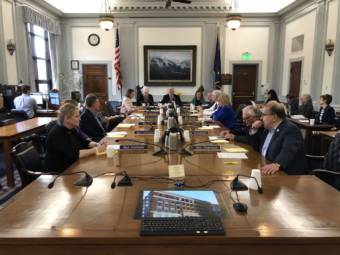
The 14-member bicameral Legislative Council meets Thursday, June 13, 2019 in the Alaska State Capitol. The council takes action for the Legislature while lawmakers are not in session. (James Brooks / ADN)

A panel of Alaska legislators voted 11-1 on Tuesday afternoon to sue Gov. Mike Dunleavy over his decision to bypass legislative confirmation for his picks for state boards and commissions.

“He is assuming he has the authority to keep people who have not been confirmed in their duties, and legally, that’s just not true,” said Sen. John Coghill, R-North Pole and one of the 11 legislators who voted in favor of the lawsuit.

The deadline for confirmation was extended this year because of the coronavirus pandemic but expired earlier this month.

Tuesday’s decision by the joint House-Senate Legislative Council authorizes council chairman Sen. Gary Stevens, R-Kodiak, to direct a lawsuit against the governor. Each expect a suit to be filed as soon as Wednesday. The governor’s office did not immediately respond to questions about the lawsuit.

Coghill and Stevens said that if the governor continues to use unconfirmed appointees, someone could challenge any and all actions taken by boards and commissions that include unconfirmed appointees. Actions taken by state Revenue Commissioner Lucinda Mahoney could also be challenged, Stevens said.

A scheduled Wednesday vote on Arctic National Wildlife Refuge oil leases by the Alaska Industrial Development and Export Authority could be among the challenged decisions.

Because of the coronavirus pandemic, the Alaska House and Senate failed to meet together this spring and consider Dunleavy’s nomination of Mahoney for state revenue commissioner and dozens of nominations for boards and commissions.

Mahoney has designated former state Sen. Anna MacKinnon to fill a spot on the board. Dunleavy chief of staff Ben Stevens said that because MacKinnon was designated earlier this year, her status isn’t in doubt. Some lawmakers aren’t sure. Coghill said there could be “question marks” around her status if challenged in court.

Normally, unconfirmed appointees immediately lose their positions once the legislative session ends, but because of the pandemic, the Legislature passed (and Dunleavy signed) a law with a new deadline: 30 days after Alaska’s coronavirus emergency expired. The emergency expired Nov. 15. Dunleavy has twice extended parts of the emergency in new disaster declarations, but the deadline for confirmations did not change.

After it passed earlier this month, Dunleavy told the Associated Press that he believes a provision of the Alaska Constitution allows his appointees to continue working.

Legislators disagree. They say the governor can reappoint his nominees after the next Legislature begins, but until then, there is a one-month gap when an interim official must do the work.

“Any decisions made by these people during that interim period could be recalled or made void. I think they should be very careful what all boards and commissions do in that one-month time,” Stevens said.

Among the legislators voting on Tuesday were several who lost their elections this year. Coghill, who lost in August’s Republican primary, acknowledged that it is “awkward” to take severe action during a lame-duck session, but it was unavoidable.

“I would say that whatever’s in front of you, you deal with it,” he said.

The lawsuit could be dropped after the new Alaska Legislature convenes Jan. 19 and a new Legislative Council is selected. Neither the House nor Senate have picked leaders for the new legislative session, which makes that possibility uncertain.

This will be the second lawsuit filed by the Legislative Council against Dunleavy since he took office in 2018. The first involved education funding, and the council won at a lower-court level.

This story was originally published by the Anchorage Daily News and is republished here with permission.

The first doses of a COVID-19 vaccine could be distributed nationwide in just a few weeks. Here’s what we know so far about Alaska’s plans.

A person being injected as part of the first human trials in the UK to test a potential coronavirus vaccine, untaken by Oxford University in England. (Oxford University Pool via AP, File)

The first shipment of a COVID-19 vaccine could be arriving in Alaska in just a few weeks, state health officials say.

The early batches of vaccine will be prioritized for essential workers in health care, assisted living and emergency medical settings, officials said Monday. Vaccines will be in limited quantity initially, and probably won’t be available to the general public until around March. The state is still working on plans to prioritize vaccine supplies once they’re more broadly available.
The mid-December timeline for vaccines is based on new announcements made by two drug companies — Pfizer and Moderna — who say their vaccines are more than 90% effective against COVID-19, a stunningly high effective rate for vaccines developed in record time, health officials say.

A third vaccine from an England-based pharmaceutical company called AstraZeneca announced early Monday that its vaccine was also up to 90% effective.

The high efficacy rates of these vaccines is “such a triumph,” said Joe McLaughlin, a state epidemiologist. For comparison, influenza vaccine effectiveness typically range from between 40 and 60%, he said.

Pfizer on Friday submitted an application for emergency authorization use of their vaccine that still needs approval from the Food and Drug Administration as well as a recommendation from the the federal Advisory Committee on Immunization Practices, which will then make recommendations for how the vaccine should be distributed.

Moderna has said it intends to submit its own application for emergency authorization use within weeks, and AstraZeneca also said it planned to apply for early approval as soon as possible.

With these final bars left to clear, questions abound about who will get access to the vaccine and when, how safe it is, and how distribution could work in Alaska, a state with unique geographic challenges and limited health care access.

Here’s what we know so far about Alaska’s plans.

What is the most likely timeline for vaccine distribution in Alaska, and what does it depend on?

The state has not definitively decided a timetable for distributing the vaccine, but it will be done in phases, with front-line health care workers being prioritized for the first doses, said Tessa Walker Linderman, the co-lead with the Alaska COVID Vaccine Task Force, during the Monday briefing.

Based on the latest timeline of meetings scheduled by federal agencies, the very soonest the Pfizer vaccine could be shipped is Dec. 10, with Moderna likely about a week behind, said Dr. Anne Zink, the state’s chief medical officer, on the same call.

The next phase could include those who are high-risk or critical-infrastructure workers, while the general public likely won’t have access to a vaccine until March or April, she estimated.

Pregnant women and children, however, were not included in any of the trials, so they’ll have to wait even longer to get access to a vaccine.

Front-line health care workers are being defined as critical hospital workers, frontline EMS staff, and long-term care facilities staff, Walker Linderman said.

The state does not know how much vaccine it will be receiving, and officials are currently planning for three different scenarios: one in which the state initially receives less than 5,000 doses, one around 10,000 doses, and one around 20,000.

“We have not been provided any specific numbers, but these are our three potential scenarios that we are planning on working through,” she said during a call with potential vaccine providers last week.

What are the challenges to rolling out a vaccine in Alaska?

Vaccine distribution has always been a logistical challenge in a state where many communities are accessible only by plane, boat or snowmobile.

A tight timeline for distribution — especially in the case of Pfizer vaccine, which must be stored at minus 70 degrees Celsius, and can then only be refrigerated for five days after it’s thawed — complicates things further, officials say.

“There are very few freezers in Alaska and across the country that have that capacity,” said Joe McLaughlin, an epidemiologist with the state health department. “And so it makes a logistically a little more difficult how to get that vaccine out to more rural areas,” he explained.

Fortunately, the Moderna vaccine has a bit easier-to-achieve temperature range, he said; more in the range of minus 20.

The AstraZeneca vaccine doesn’t have to be stored at ultra-cold temperatures at all.

State health officials said one of their main priorities is making sure rural Alaskans have equal and equitable access to a vaccine.

“This is a highly talked about conversation right now,” Zink said. “We know that rural health outcomes are generally worse.”

On both a federal and state level, conversations about equitable access to vaccine distribution are being had, she said.

A team of 40 people, including state and Alaska Native Tribal Health Consortium representatives, are working “around the clock” on plans to receive, distribute and administer the vaccine, Walker Linderman said.

So which of the vaccines will Alaska choose to distribute?

Alaska has not yet decided which vaccine it will receive, but that will depend on which is ultimately determined to be safest and most effective, and which is logistically easiest for distribution in the state, McLaughlin said.

They also might see differential effectiveness of these vaccines by sub-populations — for example, one might work better on older adults or those who are higher-risk. That will influence their decision, too.

How safe are the vaccines, especially given the sped-up timeline? Are there known side effects?

Dr. Liz Ohlsen, a physician with the state health department, said on a call late last week that although the development of a COVID-19 vaccine has moved much more quickly than is typical, neither drug companies have skipped any steps for their clinical trials.

There are a couple reason for the sped-up timeline, none of which involve safety or efficacy compromises, Ohlsen said.

“Labs all around the world dropped everything they were working on and switched to this,” she said. “So there’s been a lot of information sharing in ways that we’ve never seen before.”

Both drug companies have now completed their phase three clinical trials, she said. Tens of thousands of people have now been tested, with scientists looking closely at how safe they are and how well they work.

Ohlsen said people should be aware that according to the data published so far on the two vaccines, it appears that both can cause mild side effects within the first few days.

“So these are things like fatigue, headache, joint pain and chills,” she said. The second dose usually provokes more of an “immune response,” she said, which is why those side effects are most substantial then.

These symptoms simply show that your body is “mounting a response,” and are not a sign that the vaccine is hurting you, she said.

Still, “it’s important that people know beforehand that it would not be unexpected side effects to have these adverse effects in the first one to three days of getting the vaccine,” she said.

More will be known once all data from the clinical trials becomes publicly available, she said.

Will there be a cost to get vaccinated?

There should be no cost for patients receiving a vaccine, said Walker Linderman. However, health care providers will likely be able to bill insurance for an administration fee.

The federal Centers for Disease Control and Prevention has also said that cost will not be an obstacle to getting the vaccine and that supplies will be distributed by the federal government at no cost to enrolled COVID-19 vaccination providers.

What does the vaccine likely mean for how soon life could go back to normal?

Despite the hurdles that remain, Alaska officials say the news of a vaccine on the horizon is reason to feel hopeful.

“We’re incredibly excited by the opportunity for possible vaccination in the near future,” said Zink.

Still, she reminded Alaskans that a vaccine is not a magic cure, and Alaskans still need to be following all public health guidelines right now to help control the spread. There still record amounts of virus circulating in the state, she said. The effects of the vaccine will not be felt immediately.

“I kind of think of it like the sun,” she said. “Alaskans are used to dark winter, and we’re also used to the fact that Dec. 22nd doesn’t feel much lighter than the 21st. And I think the vaccine is going to feel the same way.”

First, you won’t notice it, she said. By February, it will feel like something’s changing.

“And by summer solstice, it’s going to be like, the sun is out, and it is different than it’s been before,” she said.

This story was originally published by the Anchorage Daily News and is republished here with permission.

ADN reporter Zaz Hollander contributed to this story.

Woman says top Dunleavy official knew of attorney general’s misconduct, was slow to act

This article was produced in partnership with ProPublica as part of the ProPublica Local Reporting Network.

Alaska Gov. Mike Dunleavy, right, and former state Attorney General Kevin Clarkson in 2019. (Marc Lester / ADN)

Officials in the office of Alaska Gov. Mike Dunleavy, including his chief of staff, knew for months that his appointed attorney general had sent unwelcome personal text messages to a low-level staffer but told the woman to keep it quiet, the staffer told the Anchorage Daily News and ProPublica.

In her first media interview, the woman said that Tara Fradley, the office manager in the governor’s Anchorage office, helped her compose a text to then-Attorney General Kevin Clarkson on April 4 asking him to stop inviting her to his home at night, something he had done at least 18 times. The woman also said that Dunleavy’s chief of staff, Ben Stevens, became aware of the texts by early April but that no human resources investigators contacted her until two months later, after a whistleblower wrote an anonymous letter that was obtained by the news organizations and by an attorney working on an effort to recall Dunleavy from office.

“I was like: ‘The chief of staff knew about this for months. For months. And now you expect me to believe you care about me?’” the woman said, recalling her first meeting with a human resources manager in the state Division of Personnel and Labor Relations in mid-June.

“I said, ‘I’ll be honest with you, I think you’re only doing this because you’ve been exposed,’” said the woman, who asked not to be named because she was the target of workplace misconduct and does not want to become a public figure.

The woman said she spoke directly with Stevens, a former state senator and Republican Party leader, to discuss the attorney general’s overtures multiple times and met with the governor in June.

In the meeting with Dunleavy, the woman said, she was tearful and the governor seemed sympathetic, telling her she had done nothing wrong.

Clarkson resigned on Aug. 25, two hours after the Daily News and ProPublica reported that he sent hundreds of text messages to the junior state employee and had quietly been placed on unpaid leave for the month of August. In a statement at the time, Clarkson apologized for what he called “an error in judgement, which I recognize as wholly and only mine.”

Clarkson did not respond to interview requests or specific questions for this story. Fradley declined to be interviewed.

Stevens, in a phone interview, said he worked to protect the junior employee but could not talk in detail about how he and the governor’s office responded after the woman first reported to her supervisor that Clarkson’s invitations were making her uncomfortable. He said he considers any claim that he would act against the woman’s best interests in order to protect the attorney general to be a “personal insult.”

“I will say this right now. For what reason would I do anything to prevent the truth from coming out for anybody, other than the fact to follow the law?” Stevens said. “The law says not to discuss what’s going on inside an investigation.”

He said Dunleavy opponents, chiefly those working on the recall drive, are fueling efforts to criticize the administration’s response to Clarkson’s text messages. A spokesman for Dunleavy, a Republican, noted that one of the attorneys who worked on the recall now represents the junior state employee in settlement negotiations with the state.

With Clarkson gone, Dunleavy and his administration refused for months to answer questions about what they knew about the attorney general’s behavior and when they knew it, citing the privacy of personnel matters.

Dunleavy’s office and the Department of Law have denied certain public records requests as burdensome “fishing expeditions,” tried to stop reporters from asking questions about the attorney general at news conferences and, as Stevens most recently asserted Monday, said that Alaska law prevents Dunleavy from speaking about the matter.

[Alaska’s attorney general sent hundreds of ‘uncomfortable’ texts to a female colleague]

On Tuesday, after the Daily News and ProPublica presented the governor’s office with a timeline of events related to Clarkson based on interviews and a proposed settlement agreement between the junior employee and the state, spokesman Jeff Turner provided a statement that described elements of certain meetings and discussions.

The woman and the governor’s office disagree on the timing of some events, and Stevens declined to discuss what was said in the meetings. But they generally agreed on the sequence of events: that the woman notified her supervisor of Clarkson’s advances by early April, that the supervisor helped her compose a text that the woman sent to the attorney general on April 4 and that Stevens was made aware of that text soon after.

A series of meetings began in June after word of the misconduct leaked outside the governor’s office.

“My final straw”

The woman was working in the governor’s Anchorage office in March when Clarkson began to send her an average of 20 texts per day. The 558 notes included invitations to come have dinner or sip wine at his house at night. He peppered the messages with kiss emoji, workplace selfies and comments on the woman’s beauty.

Clarkson occasionally visited her at Dunleavy’s office, the woman said, stroking her hair or kissing her on the top of the head. She said she regrets not telling the married attorney general to stop the behavior earlier but feared for her job.

His advances began just six weeks after Dunleavy made headlines by seeking President Donald Trump’s help in clearing immigration hurdles facing Clarkson’s wife and stepson. The governor praised Clarkson’s commitment to conservative values and marital devotion in a letter to the president.

The junior staffer said she felt she needed to turn Clarkson down tactfully.

“I was so incredibly uncomfortable with the calls at night,” she said in an interview. “My final straw came when I blocked him for a few days.”

A text exchange between Clarkson and the woman between March 31 and April 4. (Obtained by ProPublica and Anchorage Daily News)

The woman said her supervisor, Fradley, whom she had already told about Clarkson’s overtures, could see she was bothered by the attorney general’s arrival.

“Her desk overlooks mine, and she could see him staring at me,” the woman said.

[Alaska attorney general resigns following report that he sent hundreds of texts to state employee]

Finally, on April 4, the woman sent Clarkson a carefully worded text that she said had been ghostwritten by Fradley. It read:

“I apologize for not responding to your calls or texts in the past few days. I’ve had a lot on my mind and needed to give myself some time to navigate my thoughts. First and foremost, I have the utmost respect for you as the AG. We both work in the highest level of state serving the Governor and our constituents. That being said, I think it’s time I set clear boundaries in order to maintain the best work relationship & professionalism. You are no doubt gifted in the kitchen! And while I thank you for inviting me to your home for dinner, I don’t think it’s appropriate, nor do I feel comfortable going to your home. Please remember that this is my personal phone.”

She added that if Clarkson had any work-related questions, he could call her at her office number or her state of Alaska email address.

“I don’t accept evening or late night calls on my personal cell phone,” she wrote.

It’s unclear if Clarkson tried to reply, because the woman said she blocked his number. In a statement accompanying his resignation, Clarkson said he ceased his messages to her at that time.

Around the time the text was sent, Fradley told Stevens, the chief of staff, about Clarkson’s behavior, according to interviews with the woman who received the texts and the proposed settlement agreement with her that was written by the state.

The governor’s office says that Stevens did not meet with the woman directly to talk about Clarkson at any point in March or April and that Stevens “never discussed the text communications with the complainant.”

“The complainant’s supervisor informed Stevens that a message ‘setting boundaries’ was sent to Clarkson and no other issues about the complainant were brought to Mr. Stevens’ attention until June 1,” Turner wrote on Tuesday.

In the following weeks, throughout April and May, the woman said, she tried to avoid being in the governor’s office whenever Clarkson visited, finding excuses to leave the room. The woman said that Fradley, in the meantime, told her she would need to deal with these occasional, continued visits from the attorney general.

Fradley “clearly could see I was trying to avoid him,” she said.

“He wanted me to just deny it”

In early June, the Daily News and ProPublica obtained a copy of an anonymous whistleblower letter describing Clarkson’s interactions with the state employee. It said Dunleavy and Stevens were aware the attorney general had been sending inappropriate messages and inviting the woman to his home but had refused to sanction him.

On June 5, the newsrooms filed a public records request to the governor’s office and the Department of Law asking for all text messages between Clarkson and the woman.

The woman who had received the messages said she began to get the cold shoulder in the governor’s office. People were polite but wouldn’t look her in the eye, she said.

She said she approached Fradley and asked her if anything was wrong.

Fradley “pulled me into an empty office. She just said: ‘Look, there is an anonymous letter that went out.’” (Stevens never actually saw the letter, he said. “I heard people talk about it, but I never saw it.”)

The woman said she did not write the whistleblower letter and told Fradley so.

“I have two kids to provide for and a mortgage. Like, why would I put myself in a situation to potentially lose my job? I have too much to lose,” she said.

The woman said she met with Stevens to talk about Clarkson in June. She asked the chief of staff how she should respond to a reporter’s questions about the Clarkson situation.

Stevens shrugged his shoulders, she said. “He said, ‘Just say, “What situation?’ ”

“I was like, ‘Excuse me?’ And he just said, ‘Say, “What situation?’ “ she said.

“He wanted me to just deny it. And I said ‘OK,’ but I didn’t do what he said. … I just stayed quiet.”

When a reporter described that conversation to Stevens, Stevens said he would not discuss what exactly he said to the woman in June, citing the human resources investigation.

“It makes no sense that we would, that this office would do anything to protect the attorney general,” Stevens said. “And to say that we suppressed, and that there was an effort to suppress it on anything, is an insult.”

The governor’s office says Stevens first met with the woman to talk about Clarkson on June 7. At that meeting, “Stevens mentioned she needed ‘thick skin’ in response to several inquiries from the press and Scott Kendall,” head of the Dunleavy recall effort, a spokesman for the governor wrote..

At a later meeting, the woman asked Stevens to place her in a job paying $80,000 a year, a significant pay raise, according to the governor’s office. Stevens said he would help her get in contact with potential employers, Turner wrote.

Ben Stevens, Dunleavy’s chief of staff. (From Alaska governor’s website)

Like Clarkson, Stevens is one of Alaska’s most powerful unelected public officials. The heads of each state department report to him, and he wields the power of the governor to run day-to-day state operations.

Stevens had served as the majority leader and Senate president and is the son of the late U.S. Sen. Ted Stevens. Dunleavy named him chief of staff in July 2019, replacing former Alaska Republican Party Chairman Tuckerman Babcock. Clarkson at the time oversaw state civil litigation and criminal prosecutions. He served as the governor’s ethics supervisor, and as chief legal counsel he worked to defend Dunleavy from the ongoing recall effort.

Opponents of the governor launched a recall petition in July 2019 in response to Dunleavy’s cuts to the state budget. The Division of Elections rejected the recall petition, based on Clarkson’s legal advice, but Alaska courts have ruled the effort could proceed. It has not yet qualified for the ballot.

“He just didn’t take the hint”

A flurry of meetings followed the appearance of the anonymous letter in June. At Fradley’s suggestion, the woman said, she met directly with Dunleavy about Clarkson. One of Dunleavy’s special assistants was also present.

Dunleavy “asked me, ‘What was going on?’ And I said: ‘I’ve been feeling really uncomfortable around the attorney general. He’s made many, many invitations for me to come over to his home. I told him, I thought if I kept making enough excuses, he would probably get the clue. But it never happened. He just didn’t take the hint.’”

Dunleavy told the woman she hadn’t done anything wrong and told her he’d think about what to do next.

Before leaving the meeting with the governor, the woman said, she played a voicemail that she had received from Kendall, who had worked as chief of staff for Dunleavy’s predecessor Bill Walker. Kendall had received a copy of the anonymous letter.

Kendall said he left the voicemail on June 1 telling the woman that while they didn’t know each other, he had read a letter describing harassment by the attorney general and offered to put her in touch with a lawyer if she needed one. She never responded, he said.

According to a timeline of the events written by the Department of Law and included in the proposed settlement agreement with the woman, the governor’s office did not request a human resources investigation until June 11, at least 68 days after the woman’s supervisor in the governor’s office became aware of the misconduct and informed Stevens.

A human resources manager within the state Division of Personnel and Labor Relations, Camille Brill, asked the woman to meet. The woman did not know the exact date of the meeting but said it was in early to mid-June, based on her correspondence with Brill. (The proposed settlement agreement, written by state officials, lists a June 12 meeting between the woman and a human resources investigator.)

The woman said Brill told her that she was reaching out at the request of Stevens, the chief of staff, and that Stevens was concerned about her. The woman said she was guarded and skeptical. “I said: ‘Why is he doing it now? Is it because the press has a hold of this?’”

It was Brill whom the woman said she told, “I think you’re only doing this because you’ve been exposed.”

The woman said she refused to give Brill copies of her text exchanges with Clarkson. The attorney general, in the meantime, had also declined to hand over any text messages to his colleagues at the Department of Law.

Brill said she could not comment on her conversations with the woman or any other personnel matter.

On June 19, months after Fradley told Stevens about the April 4 text message the junior employee sent to Clarkson about setting boundaries, the Department of Law responded to the Daily News and ProPublica request for any text messages between Clarkson and the woman with a blanket denial.

“The Department has no records,” the denial letter said.

“Sincerely, Kevin Clarkson, Attorney General,” it concluded.

The state made no attempt to determine if Clarkson was telling the truth. Alaska public records law works on a kind of honor system.

If the attorney general had work-related public records on his phone, including those that might demonstrate misconduct, he was expected to hand them over, said Chief Assistant Attorney General Alan Birnbaum, who handled the request. When Clarkson claimed no such records existed, no further effort was made to obtain the texts.

“The attorney general does not have and did not have, and therefore did not delete, public records that he sent to or received from (the employee) on his state-owned or personal devices,” Birnbaum wrote.

Asked what steps the Department of Law took to avoid a conflict of interest, given that Clarkson was the head of the department and the records request denials were issued in his name, Birnbaum wrote on June 26 that “no reason exists to question the accuracy of the attorney general’s response.”

According to the governor’s office, Stevens and the junior employee met again in mid-July. Stevens told the woman the administration was at that time “willing to financially assist her with counseling expenses or legal expenses to help her with press inquiries,” Turner wrote.

“Oddly, the complainant did not inform Stevens that she had already engaged Susan Orlansky, an attorney that is also involved with the Recall Dunleavy effort,” the Dunleavy statement said.

Orlansky, who was one of the lead attorneys on the recall, said in a phone interview that she began representing the state employee when her original attorney, who worked at the same firm, became unavailable.

An “unprecedented lack of transparency”

Clarkson was placed on unpaid leave in August, an action that the state intended to keep private. The governor and his communications staff initially claimed they could not reveal information about Clarkson’s misconduct because of personnel privacy laws or regulations.

The Daily News and ProPublica published a report on Clarkson’s text messages and his suspension on Aug. 25. Dunleavy soon issued a statement saying Clarkson had resigned. Dunleavy said he was deeply disappointed by Clarkson’s conduct and would “continue to insist upon professional conduct from all our employees, regardless of their position in state government.”

He also said he couldn’t comment on the matter.

“State law provides guidelines and protections for all state employees including confidentiality on personnel matters. The governor’s office is bound by and conforms to those laws,” the statement said.

On Sept. 1, at the governor’s first news conference following the resignation, Dunleavy spokesman Turner prevented a Daily News reporter from participating when the reporter would not tell him, ahead of time, what questions would be asked.

The governor did not hold subsequent weekly press conferences for seven weeks after reporters made it clear they would continue asking basic questions about Clarkson’s actions and the state’s response over the past eight months. (A spokesman said Dunleavy was out of the office for part of September on two hunting trips and granted one-on-one interviews unrelated to Clarkson during the press conference blackout.)

The Daily News and ProPublica have requested interviews with Dunleavy, to talk about Clarkson’s conduct, numerous times since learning of the text messages in June. All requests have been denied. Anchorage’s NBC affiliate, Alaska’s News Source, reported that Dunleavy declined the station’s requests to interview him on Sept. 7, 8 and 14.

On Oct. 9, the Alaska Press Club, a nonprofit that serves reporters and newsrooms statewide, wrote an open letter to the governor describing an “unprecedented lack of transparency” from the administration.

In response to a Daily News and ProPublica request for text communications among governor’s office employees, the state refused to fulfill the request.

“Searching for, collecting and duplicating public record text messages, if any, would not benefit the public enough, if at all, to justify the diversion of state resources to provide the records,” wrote Birnbaum, the chief assistant attorney general.

An Oct. 30 analysis by the state’s nonpartisan Legislative Research Services division concluded that claim appears to violate the state public records act. The records act makes no exception for cases in which searching for a public record “would require the state to work hard,” the analysis found.

“The Alaska Supreme Court has never held that a record requested under the (Alaska Public Records Act) can be withheld merely because producing it would be an administrative burden on the state, and nothing in the APRA authorizes withholding a public record for that reason,” legislative counsel Daniel Wayne wrote.

A separate analysis by the same agency concluded that as the head of his department within the executive branch, Clarkson is “exempt from confidentiality provision of the State Personnel Act.” In other words, the governor is free to discuss the matter, the analysis found.

“Of course that begs the question, why won’t they talk about it?” said Adam Marshall, a staff attorney for the Reporters Committee for Freedom of the Press who reviewed the state’s claims. “And why were they citing this bogus legal provision as purported justification for refusing to talk about it?”

The woman to whom Clarkson sent all those texts, in the meantime, changed jobs Sept. 30 after a series of negotiations between her lawyer, Orlansky, and Acting Attorney General Ed Sniffen, email records show.

As of Tuesday, she was considering a proposed settlement offer from the state. The proposed agreement indicates that the state determined she was not qualified for the higher-paying position she asked Stevens about in June.

She eventually accepted an offer in a different department at the same salary she was making in the governor’s office.

When she first complained about Clarkson’s behavior, she didn’t necessarily want it to become public, she said, only for the invitations and messages and visits to stop. She said she is no longer directly supervised by Dunleavy, Stevens or the governor’s office staff but worries she will be fired or see her job defunded now for speaking out.

“Had it not been for this anonymous letter, it would have most likely just been swept under the rug,” she said.

This story was originally published by the Anchorage Daily News and is republished here with permission.

On election night, many Alaska candidates and campaigns expect to start a long wait instead of declaring victory

Competing signs for and against Ballot Measure 1 at the corner of East Northern Lights Boulevard and the Seward Highway, Nov. 2, 2020. (Emily Mesner / ADN)

This year, there will be no big Election Day party at the Captain Cook Hotel and no grand “Election Central” where candidates and campaigns gather to watch results on a screen.

Blame COVID-19, but also blame Alaska’s ballot-counting schedule. More than 120,000 ballots will not be counted until next week at the earliest. Candidates and campaigns across Alaska said there’s no point in celebrating on Election Day if you don’t know what you’ll be celebrating.
“Anybody that’s drawing conclusions tomorrow night is kidding themselves,” said David Keith, campaign manager for Al Gross, the Democratic-backed independent candidate for U.S. Senate.

Gross will be watching results in his backyard with friends, family and campaign staff.

Republican incumbent Sen. Dan Sullivan has a small election night watch party planned for friends, family, campaign volunteers and media.

“There certainly is a possibility that we may have clarity in this race on Tuesday evening, sometime late,” said Sullivan campaign manager Matt Shuckerow. “But if not, we may have more clarity down the road.”

U.S. Senate candidate Al Gross, center, waves to passing cars while waving campaign signs alongside supporters and campaign team members on the corner of North Bragaw Street and Mountain View Drive in Anchorage on Nov. 2, 2020. (Emily Mesner / ADN)
Sen. Dan Sullivan shows a thumbs up to a passing car adorned in Trump 2020 flags as the driver turns left from the Seward Highway onto East Northern Lights Boulevard and waves to Sullivan in Anchorage on Nov. 2, 2020. (Emily Mesner / ADN)

‘A year to stay home’

A record number of Alaskans, worried about COVID-19 and long lines at polling places, have already voted. Through 8 a.m. Monday, 152,585 Alaskans had voted. That’s 47.5% of the turnout four years ago.

Most of those ballots will not be counted until at least a week after Election Day because of security checks performed by elections workers. That will leave close races in limbo until Nov. 18, the deadline for ballot counting.

“If there ever was a year to just stay at home, this would be it,” said Rep. Lance Pruitt, R-Anchorage.

Pruitt is defending his state House seat against Democratic challenger Liz Snyder. It’s the most expensive Legislative race in the state, with more than $750,000 spent by both sides and independent expenditure groups.

“With all the absentees — we really should have an election-night party on the 10th, once they’ve counted the absentees,” Pruitt said.

With few exceptions, all ballots cast on Election Day are counted on Election Day. The 37,995 early votes cast through Friday morning will also be counted then.

Early votes from Friday through Tuesday will be counted starting Nov. 10, alongside absentee ballots that were returned by mail and fax, special-needs ballots cast with the help of a second person, and questioned ballots cast with some doubt about a person’s registration.

Absentee ballots can arrive as late as Nov. 13 and will be counted as long as they were postmarked by Election Day. If an absentee ballot was sent from outside the United States, it can arrive as late as Nov. 18.

Calvin Schrage, the independent candidate challenging Republican incumbent Rep. Mel Gillis in Anchorage House District 25, said he’s been making a last push to get voters to return their absentee ballots.

“We’re calling, texting. Some of those folks are even on my walk list when I’m out door-knocking,” he said.

He hasn’t given much thought to an election-night party.

“We’ve been so focused on this final sprint toward the election, we frankly haven’t put much thought into it,” he said.

Young, Galvin have confidence in results despite slowness

Two years ago, Alyse Galvin watched the results from her race against Rep. Don Young while celebrating at 49th State Brewing. In this year’s rematch, she will hold a virtual party over Facebook Live.

Campaign spokeswoman Bridget Galvin said because of the COVID-19 situatiuon, the campaign decided against an in-person event.

Bridget Galvin said they do not expect conclusive results Tuesday night. She encouraged the public to listen to the Alaska Division of Elections as it counts the votes.

“We have complete confidence in the Division of Elections to fairly count every vote,” Bridget Galvin said. “As appropriate, we’ll observe the process and we’ll verify that the proper controls are in place to ensure that an accurate vote count does occur.”

Young’s campaign manager, Truman Reed, also said that their campaign has faith in Alaska’s election system and does not expect hiccups. In an email, he said Young’s watch party will be limited to staff and volunteers due to the pandemic.

“We’re expecting the results on election night to be a clear expression of Alaskans’ desire for Don Young to continue his fight on their behalf in Congress,” Reed said.

Ballot measures will wait for results

The votes on ballot measures 1 and 2 cut across party lines, meaning both sides of each measure will likely have to wait until next week for success or failure.

Both sides of the citizen-led measure to boost oil taxes on Alaska’s leading producers said the battle is close.

Kara Moriarty, campaign manager for OneAlaska-Vote No one One, the leading opposition group to Ballot Measure 1, said there will be no large election-night party.

Instead the group will hold a small, private meeting with only core staff — face masks in place — watching results roll in, she said.

“For any race that will be close, and ours will be close, there is a likelihood it won’t be known or decided (for another week),” she said.

She said momentum is favoring the opposition.

David Dunsmore, campaign manager for Vote Yes for Alaska’s Fair Share, said his side is encouraged by high turnout in regions such as the Interior.

But he also said the outcome likely won’t be known until at least Nov. 10.

The Vote Yes side will feature a small gathering of maybe 10 people to watch results at the group’s headquarters in downtown Anchorage.

“We’ll be analyzing numbers as they come in,” he said.

The groups for and against election-reform Ballot Measure 2 also aren’t planning any major event. Scott Kendall, the attorney representing vote-yes group Alaskans for Better Elections, said his side canceled plans for an in-person party about a week ago because of coronavirus concerns.

“We are expecting to see high, maybe unprecedented turnout from Alaskans, and there’s no way we’re know results, especially in statewide races, until the 10th,” he said.

Brett Huber, chairman of Defend Alaska Elections-Vote No on 2, said he expects to attend some small events on Tuesday night but doesn’t think he’ll know the results until the election is certified later this month.

“Everybody’s a prognosticator on election night, but in the end, only one number matters,” he said.

This story was originally published by the Anchorage Daily News and is republished here with permission.

Alaska’s ‘him too’ moment: When politicians and allies come with accusations of their own

From left to right: Former Alaska state Rep. Zach Fansler, his aide Benjamin Anderson-Agimuk and Willy Keppel, who is running for Fansler’s former seat. (Photo illustration by Shoshana Gordon/ProPublica; source images: Marc Lester and Loren Holmes/Anchorage Daily News, Facebook)

Before sunrise one overcast morning in 2018, a woman sat in the parking lot of a Juneau urgent care clinic, her head ringing from a ruptured eardrum. The man who hit her was an Alaska state representative, Zach Fansler, who soon resigned from office because of the drunken encounter.

Democrats in the region Fansler represented, which includes Bethel and other communities in Western Alaska, chose one of Fansler’s aides to become district party chairman and help select a replacement. That former legislative staffer and district party leader, 27-year-old Benjamin Anderson-Agimuk, is now charged with raping an 11-year-old girl.

This is a political district where the U.S. attorney general met with village leaders last year before declaring a national public safety emergency, in a region where Alaska’s sexual abuse epidemic is statistically most pronounced, and more people have died of domestic violence during the pandemic than of the coronavirus itself.

In some cases, the same self-professed agents of change are, according to police, also the abusers. Fansler once worked as a legal advocate for Bethel’s domestic violence shelter, Tundra Women’s Coalition, attended candlelight vigils and, as a member of the Jesuit Volunteer Corps, managed a “Teens Acting Against Violence” program. Anderson-Agimuk spoke in interviews about valuing Indigenous women and on Instagram posted calls for the protection of vulnerable Alaska children.

“Just because someone puts on a good face in public, that’s almost one of the hallmarks of people who use abuse. They can be very charismatic and manipulative,” said Dr. Ingrid Johnson, an assistant professor and researcher for the Justice Center at the University of Alaska Anchorage.

A third of Alaska women have experienced sexual assault,” she said. For a crime that is often considered an act of power and control, it might not be surprising to see people who seek power in their professional lives to also be among the offenders.

Rep. Tiffany Zulkosky, who replaced Fansler and who is the only Alaska Native woman serving in the state Legislature, said the accusations made her realize you don’t know people as well as you think.

“It’s really unfortunate that women continue to experience mistreatment and then are also asked to clean up after men who behave unacceptably,” said Zulkosky, a Bethel Democrat who is running for reelection Nov. 3.

Zulkosky’s opponent is a man who has been named in restraining orders by four women, was temporarily banished from a village and has been placed under a tribal court domestic violence protective order until 2022.

The candidate, former Bethel City Council member Willy Keppel, says all the accusations made in the restraining orders are outright false or rooted in disputes over money and property.

“I have my rough edges, there’s no doubt about that,” Keppel said when asked about his own court records and the conviction of Fansler and the felony sexual abuse charges against Anderson-Agimuk. “But I ain’t nothing like them two friggin’ idiots.”

Anderson-Agimuk, who is now awaiting trial at the Yukon Kuskokwim Correctional Center, refused an interview request. He has pleaded not guilty to the charges against him. Fansler did not respond to emails, phone messages and Facebook messages. His attorney said Fansler had no comment.

Fansler is one of three Alaska state lawmakers who resigned or abandoned reelection campaigns after accusations of harassment, misconduct or assault over the past three years. The former lieutenant governor quit in 2018 when a woman reported he propositioned her in a hotel. The state attorney general resigned in August, two hours after the Anchorage Daily News and ProPublica published an investigation revealing he’d sent inappropriate text messages to a female state employee.

Separately, the state’s top elected Democrat, Anchorage Mayor Ethan Berkowitz, resigned on Oct. 13 after admitting to an “inappropriate messaging relationship” with a local television news anchor in a scandal that included a bizarre series of public accusations and a nude photo of the mayor shared across social media. (While the case resulted in yet another Alaska politician felled by his personal behavior, the anchor provided no evidence the mayor had committed a crime as she originally alleged.)

Johnson, the university researcher, has been interviewing and surveying survivors of sexual violence statewide for more than two years. Social media support networks have arisen in places from Nome to Greensboro to encourage and protect those willing to come forward, an environment that might explain more cases exploding into view.

“As women see powerful men being taken down, like Harvey Weinstein, etc., they start to see that maybe speaking out will do something,” she said.

She noted that some of the recent cases that ended the careers of men in Alaska politics were noncriminal, involving harassment or consensual but inappropriate messaging. Nowhere in recent years have the accusations been more serious than against Fansler and Anderson-Agimuk in House District 38, an Iowa-sized area home to about 18,600 people. About a third of voters live in Bethel, with the rest spread across 29 surrounding villages.

‘He was asking if I was gonna cry’

Fansler in 2016. (Marc Lester/Anchorage Daily News)

On Jan. 13, 2018, Fansler was in his first term representing the district and a few days shy of his 39th birthday when he met with friends at a Juneau bar known as the Triangle.

One of the people in the group was a woman in her late 20s who’d been on one prior date with the Bethel lawmaker. They’d texted ahead of time and agreed to hang out that night. After an hour at the bar, Fansler and the woman parted ways, but they met up later that night at the hotel where Fansler was living while in Juneau for the legislative session.

A transplant from Pennsylvania, Fansler was a Bethel attorney who had served on the City Council and as manager for a popular local sled dog race, the Kuskokwim 300, before his election to the Legislature. A friend had warned the woman that Fansler might have a drinking problem, she said in a recent phone interview. (The Juneau Empire first reported the encounter that followed. The victim is speaking here publicly for the first time since Fansler’s sentencing, though she requested anonymity.)

Rep. Dean Westlake, another Democrat representing a rural district that includes the North Slope and several northwest Arctic villages, had resigned a month earlier. Seven women accused him of unwanted sexual advances, and comments and court records revealed he fathered a child with a then-16-year-old girl when he was 28. Westlake has apologized to the women but did not respond to questions about the sexual relationship with the teenage girl. He declined to comment when reached by phone for this story.

The 2016 election victories of Westlake and Fansler had helped deliver Democrats leadership positions in a majority coalition in the 40-member Alaska House. The victories were portrayed at the time as a potential sea change in the world of Alaska politics, where more than 57% of registered voters have declined to publicly choose a party but Republicans win most statewide races.

When Westlake stepped down under pressure from party leaders, Fansler even applauded the resignation as a necessary signal to survivors.

“Hopefully it’s sending the message that this won’t be tolerated,” he told KYUK at the time.

His date with the Juneau woman came three weeks later. After the night out with friends, the two went to Fansler’s hotel room but did not have sex, the woman said. Fansler was drunk.

“I thought, ‘We’ll fall asleep and we’ll just fool around in the morning,’” she said.

The pair kissed but remained clothed, the woman said. Fansler struck the woman on both sides of the head late that night in his hotel room.

According to the charges, the woman told police that it felt as if the legislator hit her as hard as he could with both his right and left hands. Her face burned. She heard a ringing in her ears.

“He was saying things after he hit me that, like, he wanted to beat me. He was asking if I was gonna cry, but it wasn’t in a concerned way, it was like in an excited way,” she said. “So I could tell this was part of sex for him.”

In a charging document later filed against Fansler, prosecutors wrote that, “Throughout the course of the evening, there had been no discussions about the nature of the type of sexual activity Fansler liked, and Fansler had not requested any permission to engage in any sort of aggressive sexual activity.”

Later, in a text, Fansler indicated his interest in BDSM, as if to explain the violence. But the woman said she never consented to any form of violent encounter. She said it has been hard to see the event described in public as “a romantic encounter” that somehow went wrong.

“A ‘romantic encounter’ is quite the euphemism for someone trying to beat the shit out of me,” she said. “Those phrases don’t really describe how scary it was.”

She received treatment for her ruptured eardrum a day later, according to a list of medical expenses the victim provided to prosecutors. (All told, treatment included at least seven visits to urgent care and audiologists for exams and hearing tests.) After police investigated and the case was referred for prosecution, she said she didn’t hear anything for months. “I had no idea what was happening.”

Paul Miovas, director of the state Department of Law’s Criminal Division, said he personally contacted the victim in May 2018. One matter that complicated the investigation, he said, was that prosecutors needed to seize the lawmaker’s phone to obtain any messages he had exchanged with the woman.

“Care had to be taken to not seize legislative communications that were privileged by law while searching for evidence of this crime, so it was a slightly more cumbersome and time consuming process,” Miovas said.

In a plea deal, Fansler agreed to pay the woman’s medical bills as restitution, including visits to an audiologist. He admitted to a misdemeanor count of harassment.

“I do not think it was harassment,” the victim said. “I think it was assault.”

But she said she did not fight the prosecution’s plan to allow Fansler to plead to the lesser charge because what she wanted most was for him to admit he’d done something wrong.

“He left Alaska, he said he was guilty, he paid restitution. That’s what I wanted,” she said.

Miovas, the head of the state criminal division, declined to say why Fansler wasn’t charged with assault, citing “work-product privilege” held by prosecutors.

“I will note that the case was thoroughly vetted with many very experienced prosecutors and we did speak and correspond with the victim multiple times prior to making any final charging decision,” he said.

‘The colonized world teaches us to become aggressive’

Upon Fansler’s resignation in early 2018, Alaska Democrats in the Bethel region selected Anderson-Agimuk to become the district party chairman and to begin looking over applications for a replacement.

Not only was Anderson-Agimuk a rising star within the state party, he’d helped Fansler get elected by introducing him to voters and campaigning in villages, said Olivia Garrett, a former legislative aide for a House Democrat who first publicly raised concerns about Westlake.

“The Young Democrats were very involved in the Fansler and Westlake races that year,” Garrett said.

Anderson-Agimuk in 2018. (Loren Holmes/Anchorage Daily News)

Western Alaska Democrats, led by Anderson-Agimuk, recommended Zulkosky for appointment by the governor. Like Fansler and Keppel, she had served on the Bethel City Council and in 2008 became Bethel’s youngest mayor at just 24. Zulkosky worked as rural director for former U.S. Sen. Mark Begich and is now communications director for the Bethel-based Yukon-Kuskokwim Health Corp.

Anderson-Agimuk, nine years younger than Zulkosky, was also raised in the Yukon-Kuskokwim Delta and was gaining momentum in state and party politics. He’d studied political science at the University of Alaska Fairbanks and, according to his LinkedIn profile, “organized Alaska Native outreach for Begich’s 2014 Senate campaign.”

While remaining district party chairman, Anderson-Agimuk worked for Zulkosky as an aide from March 12 to Dec. 14, 2018. He served as her campaign manager when, as an appointed candidate, she had to run for election as Fansler’s two-year term came to an end.

Meantime, the regional Association of Village Council Presidents and the statewide Alaska Federation of Natives each bestowed Anderson-Agimuk with awards for youth leadership. He spoke to statewide audiences about his efforts to overcome childhood traumas and succeed in state politics.

“I know what poverty is. I know what hunger is. I know what addiction in the family is,” he told the crowd of the 2018 Alaska Federation of Natives convention. “But I also know what love is.”

Zulkosky won the district, defeating a Republican challenger. A month later, Anderson-Agimuk left his job as a legislative aide and began working for the state Department of Commerce as a “local government specialist” in Bethel.

He continued to serve as district party chairman for the Democrats, advocating on social media for Alaska Native children who grew up in foster care.

“Escaping the traumatic situations of my childhood doesn’t take care of anything. If anything, our demons must stare us in the face, telling us, ‘now that you’re comfortable, you have the ability to face us, and take care of us,’” he wrote in a Feb. 6 Instagram post. “This is my responsibility. This is my journey as a Native man in this colonized world. If we don’t take care of what’s inside of us, the colonized world teaches us to become aggressive and hurt our own people.”

Despite the seriousness of the charges filed in early April, the case against Anderson-Agimuk drew little statewide attention, arriving as Alaska scrambled to enact emergency measures to slow the spread of COVID-19.

But even before the pandemic, 2020 began as a year of heartache in Western Alaska. The FBI arrested a well-liked Bethel elementary school principal in December on suspicion of sexual abuse of a minor. (A Daily News, KYUK and ProPublica investigation found the school district had allowed the principal, who has pleaded not guilty, to remain on the job despite repeated warnings and even prior police investigations.)

In the village of Quinhagak, near Bethel, a 10-year-old girl went missing in March. Troopers say she was kidnapped, raped and killed by an 18-year-old. The defendant in that case has pleaded not guilty. Across the region, five people died from domestic violence within a 10-day span in June.

Amid the tragedies, on March 5, Bethel police received a report of a 16-year-old girl passed out at a home across from the Russian Orthodox Church.

The girl’s mother met a police investigator at the house and said Anderson-Agimuk had given her daughter alcohol and had sex with her. “When confronted, Benjamin just looked down and wouldn’t respond,” the officer wrote in an affidavit filed in superior court. “He told (the mother) that even if he did have sex with her she was 16 it was legal.”

Anderson-Agimuk was taken to the police station as the investigator applied for a warrant that would allow him to take DNA samples. Before the warrant could be obtained, Anderson-Agimuk left the police station on the advice of an attorney. When police later tried to find him to serve the warrant, the district chairman could not be found.

Anderson-Agimuk’s employment with the state Commerce Department ended a week later.

On April 2, Bethel police received another 911 call. This time police found two girls lying on the ground in front of the local library. One girl was 11, about to celebrate her 12th birthday. She told police that she and the other girl, 14, had been drinking and smoking pot with Anderson-Agimuk, and that he had raped her.

The younger girl said she’d protected the older girl from being sexually assaulted, according to felony charges filed against Anderson-Agimuk in superior court.

Zulkosky said she’d seen no indication he was capable of such behavior and had heard no prior accusations of sexual assault or harassment made against him. She felt a “deep, deep sadness,” she said. “It was just really shocking and disappointing.”

After prosecutors filed the charges of sexual abuse of a minor in April, Anderson-Agimuk’s sister wrote in a public Facebook post that her brother, like so many Alaskans, was a survivor of childhood sexual abuse.

Anderson-Agimuk has pleaded not guilty to sexually assaulting the 11-year-old. The Bethel district attorney said police referred the earlier March 5 case, involving the 16-year-old, for prosecution and that case is still under consideration.

A candidate for office this year

Keppel (via Facebook)

Now Keppel is campaigning to represent the district in the future. While he has not been charged with a domestic violence crime or sexual assault, a tribal court in the village of Quinhagak on Aug. 17 issued a protective order barring him from interacting with a local woman for two years.

He pleaded no contest to a felony drug charge in 1997 and has been named in requests for restraining orders by an Alaska Native village corporation and four different women, including a woman who told Bethel police he sexually assaulted her. Keppel denied having non-consensual sex with the woman and was not charged after a police investigation, court and Bethel Police Department reports show. The woman who filed the report declined to comment through her attorney.

Keppel, who is certified to appear on the Nov. 3 ballot as the Veterans Party of Alaska candidate, said he’s never had sex with anyone without consent.

Asked if he has ever committed an act of domestic violence, he said, “Not that I recall.”

If you or someone you know needs help, here are a few resources:

• Contact the Alaska Network on Domestic Violence & Sexual Assault at 907-586-3650 or online 

• Contact the National Sexual Assault Hotline at 800-656-HOPE (4673) or online 

• Call STAR Alaska’s 24-hour crisis line at 907-276-7273 or its toll-free crisis line at 800-478-8999


This story was originally published by the Anchorage Daily News and is republished here with permission. This article was produced in partnership with ProPublica as part of the ProPublica Local Reporting Network.

State may have illegally directed $5 million contract, former officials tell Alaska Legislature

Alaska State Capitol
The Alaska State Capitol is seen on Friday, March 6, 2020. (James Brooks / Anchorage Daily News)

Three former state employees told state legislators this week that they believe a $5 million state contract for efficiency planning and technology help was so narrowly written that it was illegal.

“They for sure violated statute. Absolutely violated statute,” said Barry Jackson after a hearing on Tuesday of the House State Affairs Committee, which oversees state procurement.

The Department of Administration, which declined to participate in the hearing, said in a written statement afterward that Jackson is drawing “inaccurate conclusions.”

Jackson, contracting and facilities manager of Alaska’s Division of General Services until 1999, spoke to the committee along with former assistant attorney generals Jim Baldwin and Ross Kopperud.

At issue is a contract awarded last year by the Alaska Department of Administration to Alvarez & Marsal, an international firm that provides a wide variety of services. The contract is separate from a pandemic-preparedness effort by Washington-registered contractor Tandem Motion that has also drawn critics’ attention.

In September 2019, the Alaska Department of Administration sought help for the new AAPEX program, which consolidates identical services across state agencies in order to save money. Instead of having separate offices for things like employee travel, printing and bill collection in each state department, there will be one travel office or one collections office.

The department needed advice and issued a request for proposals. Any firm that met the standards would be eligible for a consulting contract worth as much as $5 million.

State law says proposal requests “may not be unduly restrictive,” but the department required companies to either be members of a program operated by the National Governors Association or have 25 years of experience with information technology and expertise in nine different fields.

Jackson obtained a draft document that indicates Commissioner Kelly Tshibaka herself changed the request for proposals to say “25 years.”

That’s an extraordinarily high hurdle, Jackson said.

“It frankly raises my eyebrows — what the heck is going on here?” he said.

“The appearance is not good. It leads one to suspect there was an intent to restrict the number of firms that could qualify to make an offer,” Baldwin said.

The department, invited to speak by the committee’s chairman, refused to attend.

Department officials and its commissioner, Tshibaka, did not answer direct questions emailed after the hearing but provided a written statement:

“The Department of Administration disagrees with the mischaracterization of the state’s procurement process and the inaccurate conclusions drawn by Mr. Barry Jackson during his closed testimony before today’s House Staff Affairs Committee hearing,” the statement said.

“In fact, the department’s dedicated procurement officers follow long-established contracting protocols specifically designed to protect the interests of the state and the public. Over the last several months, we’ve received a number of information requests regarding the AAPEX and pandemic preparedness contracts, including several from Mr. Jackson himself, and have provided timely and transparent responses. To further assist the public’s review of our work, we’ve also posted this background material online at the DOA’s website, “What’s New in DOA” tab.”

According to a timeline compiled by Jackson, only two firms responded to the request for proposals by Oct. 11, 2019, the state’s deadline. Two other companies asked for an extension in order to apply, but the state said no.

The Department of Administration disqualified one firm for failing to list expertise in “legal services,” one of the nine fields it requested. That left Alvarez & Marsal. Six days later, the state issued a formal statement that said it would award the contract.

“All the evidence that I’ve seen indicates a set of circumstances and restraints on bidding that yielded a single contractor who had a perfect ability to meet those restraints, no matter how outlandish they were,” Jackson said after the hearing.

State law allows a 10-day period for losing bidders to protest, but the Department of Administration signed the contract less than a week after its formal statement.

The losing firm protested but was rejected. Its appeal was also denied. Jackson said the denial was incorrect — the state can’t contract for legal services unless it has written permission from the attorney general’s office. He wasn’t able to find that permission.

Rep. Jonathan Kreiss-Tomkins, D-Sitka, asked whether Jackson had seen similar things before.

No, he said, calling it “so far off the normal path that it’s stunning.”

Jackson investigated the contract on his own after speaking with Fairbanks journalist Dermot Cole and learning about it. He submitted several public records requests in the process, he said, but was denied access to others.

After Jackson testified, Rep. Steve Thompson, R-Fairbanks, said, “It’s good information, but it’s one-sided. Are we doing a witch hunt, or what are we up to?”

Committee chairman Zack Fields, D-Anchorage, responded that he invited the Department of Administration to attend.

“They declined to participate at any time. I would certainly welcome their participation at a subsequent hearing,” he said.

Asked afterward whether the hearing was intended to influence the upcoming general election, he said it was not.

“We’ve been having oversight hearings in State Affairs since the Legislature adjourned,” he said. “And I’m sure we’ll have more after the election.”

This story was originally published by the Anchorage Daily News and is republished here with permission.

Site notifications
Update notification options
Subscribe to notifications