Anchorage Daily News

Anchorage Daily News is our partner in Anchorage. KTOO collaborates with partners across the state to cover important news and to share stories with our audiences.
Alaska Republican events continue in person after Trump’s COVID-19 diagnosis

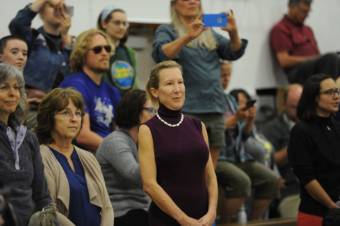
Heath Hilyard, chief of staff to Rep. Cathy Tilton, R-Wasilla, takes a picture of Republican candidates for the Alaska House of Representatives during a fundraiser Wednesday, Sept. 30, 2020 in a hangar at Lake Hood Seaplane Base. The event took place one day before President Trump’s coronavirus infection was publicized. Other events have continued since then. (James Brooks / ADN)

Despite President Donald Trump’s coronavirus diagnosis and public health recommendations from Gov. Mike Dunleavy’s administration, Alaska Republicans are continuing indoor campaign events ahead of the Nov. 3 general election.

Republican candidates for Alaska’s House of Representatives gathered in an airplane hangar at Lake Hood Seaplane Base on the day before the president’s infection became public knowledge.

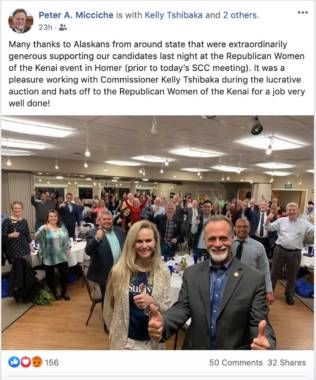
On Friday, Kenai Republicans welcomed U.S. Sen. Dan Sullivan to a fundraiser in Homer, holding their thumbs up side by side in a picture that spread on social media afterward.

No cases of COVID have been linked to campaign fundraisers this year in Alaska, a state health official said.

Alaska Democrats have canceled indoor gatherings and most outdoor events. Door-to-door campaigning has continued for candidates of all political leanings.

On Saturday, the state reported more than 100 new cases for the 10th consecutive day. It’s the longest such streak in the pandemic.

In a July 31 opinion article published in the Daily News under the headline “Only you can stop the spread of COVID-19,” Dunleavy, the state’s health commissioner, and the state’s chief medical officer encouraged Alaskans to stay six feet from people, avoid crowds and wear cloth face coverings. The advice reflects the state’s current public health guidelines for indoor gatherings.

“If everyone — even those of us with no symptoms — makes a habit of wearing face coverings in public places and keeping our social units smaller for now, we can decrease the virus’ transmission,” they wrote.

A Facebook post by Sen. Peter Micciche shows Commissioner of Administration Kelly Tshibaka and other Alaska Republicans gathered in Homer on Friday.

‘Choices best for them’

In the photo taken at the Kenai event, Sen. Peter Micciche, R-Soldotna, stood unmasked, side-by-side with Kelly Tshibaka, commissioner of the Department of Administration. Tshibaka’s agency is in charge of anti-coronavirus measures in state buildings.

“At these dinner events, everyone was informed and made choices best for them,” Tshibaka said by text message, explaining that she was speaking on behalf of herself and not the administration.

Tshibaka also attended the Lake Hood event without a mask.

“We should limit our risks,” she wrote, “but we also must learn to live with this virus until such a time as a vaccine is available. The goal has always been to flatten the curve, not to try to eliminate every case of coronavirus, which we know we cannot do unless we collapse our economy. We have done a great job of balancing that in this state. The leaders in our state have given us information and trusted us to make the best decisions to protect ourselves in any given situation.”

Micciche said attendees at the Kenai event took precautions but removed their masks for the photo and moved closer together. The Kenai Peninsula, he said, has had low numbers of COVID cases. Attendance at the fundraiser was limited, and some people participated online rather than in person.

“We are all trying to strike a responsible balance, which is a different calculation for each of us,” he wrote by text.

“Individual actions make a difference,” the Department of Health and Social Services says on its website. “From helping each other through earthquakes to clearing snow from a neighbor’s driveway, Alaskans take care of each other and have a strong sense of community. Wearing a face mask is another way to show you care and to protect those who are more vulnerable to serious illness.”

‘A predictable thing’

Behind Micciche and Tshibaka was U.S. Dan Sullivan, who held his mask in his left hand. His campaign manager, Matt Shuckerow, said the senator wore a mask for most of the event but took it off for the photo.

Sullivan was not at the Rose Garden event last week that has been linked with COVID-19 cases among Republicans and others, and the senator has tested negative for the virus, Shuckerow said. (State mandates require travelers to have a negative test to enter Alaska.)

Trump didn’t wear a mask in public until July and has mocked mask-wearing throughout the pandemic. During the first presidential debate, he said he wears them “when needed” and mocked Democratic candidate Joe Biden for consistently wearing them.

Earlier this year, a study found that the more Trump voters there are in a county, the less likely its residents are to be concerned by the virus. A nationwide survey in late July found Republicans were much less likely to view COVID-19 as a serious public health threat.

Republicans in other states have continued to hold events like those in Alaska, even after the president’s infection.

“It’s definitely become a very partisan issue. I’ve seen it,” said Jeff Landfield, who ended his run for an Alaska Senate seat in August. He’s now a campaign manager for Rep. Mel Gillis, R-Anchorage.

While campaigning door to door in Anchorage, Landfield used a computerized system that assigned an “affinity score” to voters in his district.

“The list I got, 100 is red-blood conservative Trump, and 0 is a Bernie Democrat,” he said.

At any home with a score at or above 80, the person who answered the door either didn’t care about COVID-19 or told him to take off his mask. At homes with scores below 20, he was told to wear his mask and stay far away.

“It became a predictable thing where I could tell how people felt based on the affinity score,” he said.

Why not wear a mask?

Rep. Lance Pruitt, R-Anchorage, organized the fundraiser at Lake Hood. The location — an aircraft hangar — was picked to allow more distance between attendees.

Pruitt wore a mask, removing it only during a speech, but most other attendees went without. Some members of the governor’s staff in attendance wore them, some did not.

He said he doesn’t know why Republicans are disdaining public health recommendations intended to limit the spread of COVID.

“I don’t know. I think for some people, it’s possible that it’s a freedom/liberty-type thing — don’t tell me what to do,” he said.

Political polarization may be another factor, he said. Republicans are more likely to follow the president’s beliefs and ignore restrictions put forward by Democratic officials.

In Anchorage, Republicans flocked earlier this summer to Kriner’s Diner, a restaurant that defied public health restrictions imposed by the mayor, a registered Democratic voter. The diner lost a lawsuit over the city’s rules, but a second diner has appealed to the Alaska Supreme Court.

“The polarization within the country became polarization within the response,” Pruitt said.

He also speculated that some Alaskans may not have seen severe enough effects to think precautions are warranted.

Sen. Josh Revak, R-Anchorage, held an in-person fundraiser at a supporter’s home on Friday night. He said that when he goes door to door, he hears more Alaskans dissatisfied with school closures and public health restrictions than he does about the virus itself.

“You can’t have the cure be worse than the disease,” he said. “Everyone I know who’s had it said they’d rather have coronavirus than the flu any day of the week. Not one of them said they experienced worse symptoms than the flu. I know that’s not the case with all the cases, though.”

At his fundraiser, attendees were offered masks and hand sanitizer, and some of the event took place outdoors.

On Saturday, supporters of President Donald Trump gathered for a convoy-style rally that drove from the Anchorage Cabela’s store to the VFW hall in Wasilla.

Pastor Dusty Faulkner offered a prayer asking for the “pestilence” to be lifted from the president.

Speaking afterward, he said he “hit my knees” in prayer after hearing that Trump had been infected.

Supporters of President Donald Trump gather in the parking lot of the Anchorage Cabela’s store before participating in a Trump convoy on Saturday, Oct. 3, 2020. (James Brooks / ADN)

Asked about masks and social distancing, he said, “I don’t think that we know enough” to say what might or might not prevent its spread.

Other attendees said they don’t trust what they hear from public health officials.

Alaska has one of the lowest COVID-19 death rates in the country (No. 54 among 55 states and territories) and a low infection rate that ranks No. 47 among 54 states and territories, according to statistics collected by the Centers for Disease Control and Prevention. (Not all territories have data.)

For the seven months of the pandemic, Alaska’s COVID death rate is higher than its 2018 death rate for influenza.

Alaska does not mandate masks, but some cities and boroughs, including the municipality of Anchorage, do require masks indoors in public. A public health mandate in effect since June 29 says, “All individuals must wear masks or cloth face coverings over their noses and mouths when they are indoors in public settings or communal spaces outside the home.”

Since late August, the city has limited indoor gatherings to 30 or fewer people, but enforcement is based on venue, which makes it ineffective for one-off events.

Clinton Lasley of the Department of Health and Social Services said no cases of COVID-19 have been linked to campaign fundraisers in Alaska, and the state isn’t offering any specific guidance for them.

“There have been a variety of types of community events in recent months. Because virus circulation of COVID-19 varies in each community, planners and organizations of events should make adjustments to meet the unique circumstances of the event and community,” he said Sunday.

Reporter Morgan Krakow contributed to this article from Anchorage.

This story was originally published by the Anchorage Daily News and is republished here with permission.

Former Dunleavy budget director Donna Arduin returns to train legislative candidates

Gov. Mike Dunleavy’s Office of Management and Budget Director Donna Arduin, center, watches as protesters hijacked the second day of the legislative special session at Wasilla Middle School on Wednesday, July 10, 2019. (Bill Roth / ADN)

Gov. Mike Dunleavy’s controversial first budget director, Donna Arduin, returned to Alaska this month to help lead a two-day budget seminar for legislative candidates and new lawmakers.
Hosted by three conservative groups, the seminar attracted 36 Republican and Libertarian legislators and candidates, organizers said. With a third of the Alaska Legislature on hand, some attendees said it was the largest gathering of lawmakers and prospective lawmakers they had seen this election season.

Sen. Bill Wielechowski of Anchorage was the lone Democratic lawmaker to attend any of the event.

“My guess is they’re laying the groundwork for what they want to do, or at least what a portion of the people want to do,” he said.

Alaska is projecting a budget deficit of at least $2 billion if legislators and the governor approve a traditional Permanent Fund dividend, but with the state’s Constitutional Budget Reserve effectively empty, it will be difficult to pay that dividend without other major changes.

In a series of talks, Arduin and others spoke about the options available to the Legislature. Some of those options, such as diverting local petroleum property taxes, spending from the account that subsidizes rural electricity, or spending additional money from the Alaska Permanent Fund, have previously been discarded by the Legislature.

Her talks weren’t a recipe for next session, Arduin said. “It was intended to be nonpartisan and an education,” she said.

She spoke only as a consultant and not as an advocate of any particular option, she said.

David Boyle, another speaker, said he was trying to both inform and advocate. “It was probably correct to say I was doing both,” he said.

Arduin still popular among conservatives

The seminar took place Sept. 12-13 at the Sunrise Grill in Palmer and was sponsored by three conservative groups: Alaska Roundtable, Alaska Politics Explained, and United For Liberty.

Libertarian activist Michael Chambers founded United For Liberty. He picked Palmer in part because it was beyond the bounds of Anchorage’s public health restrictions. Boyle is behind Alaska Politics Explained, and Ric Davidge is the founder of Alaska Roundtable. Boyle said both of their groups had a more supportive role.

Chambers has been urging candidates to promise that they will support a $3,000 Permanent Fund dividend in 2021, plus retroactive payments. Dozens have signed that promise, and many appeared at the seminar, paying $75 apiece to offset the cost of renting the space and flying Arduin to Alaska from her home in northern Michigan.

“She presented four or five times in a two-day period. I designed it around her — obviously, you don’t get Donna Arduin all the time,” Chambers said.

Dunleavy hired Arduin in Nov. 2018 to serve as director of the Office of Management and Budget. After the governor proposed balancing the budget with vast budget cuts and tax revenue diverted by local governments, she became a focal point for opponents of the governor’s plan.

Many Alaska conservatives loved her ideas and continued to embrace her as a symbol, even after the governor dismissed her in late 2019. Some Republicans sought her endorsement in the August primary and she has stayed in contact with Chambers, who considers her a friend and invited her to talk.

“We want to give them the tools to let them know there’s multiple options out there,” she said of the lawmakers and candidates at the event.

Networking before next session

Sen. David Wilson, R-Wasilla, paid $75 to attend but found himself invited to talk about health care. For the past two years, he’s been chairman of the Senate Health and Social Services Committee and a member of the Senate Finance Committee.

“It was just talking about what changes need to be made to our Medicaid system,” he said, explaining that some Medicaid services Alaska provides are considered optional in other states. Last year, the Dunleavy administration attempted to end optional dental services as a cost-cutting move, then reversed itself after running into federal regulations and public opposition.

He and others said they were interested in networking. Seven Republican incumbents lost their primary election races in August, and four other incumbents are not running for re-election.

While all the primary winners must also win the Nov. 3 general election to be seated, many are in Republican-leaning districts that are almost certain to elect a Republican.

“It was an opportunity to maybe build some bridges,” said Wielechowski, who spoke for an hour about his unsuccessful lawsuit about the Permanent Fund dividend formula.

“There were a lot of people there — like a third of the Legislature — and there’s a good chance they’re going to be in power next year, at least some of them,” he said.

Among those attending: Robert Myers, who defeated Sen. John Coghill, R-North Pole; Roger Holland (defeated Sen. Cathy Giessel, R-Anchorage); James Kaufman (defeated Rep. Jennifer Johnston, R-Anchorage); Christopher Kurka (defeated Lynn Gattis in the race to replace Rep. Colleen Sullivan-Leonard, R-Wasilla); Kevin McCabe (defeated Rep. Mark Neuman, R-Big Lake); and Ron Gillham, one of two Republicans vying to replace Rep. Gary Knopp, R-Kenai.

Education, health care and dividends

Myers said his biggest takeaway from the event was that “for the last 40 years, we’ve just thrown money at a lot of problems, and we’ve required very little accountability.”

Boyle was “particularly concerned with the education budget and how we’re spending so much on education and getting so little out of it,” Myers said.

K-12 education spending is the largest piece of the state budget when considering state tax-funded spending. (If federal spending is included, it’s No. 2, behind health care.)

In a talk radio interview after the seminar, Arduin said she doesn’t like to use the word “cuts,” instead preferring to talk about “reform.”

“Instead of saying we’re going to cut education, we’re going to say, ‘Our kids are going to learn to read.’ Let’s start with that proposition,” she said.

Most policy changes can’t be done in a year, leaving this year’s deficit as a problem.

“If you’re going to rewrite K-12 or Medicaid, you’re just going to need time. Even with the university … it takes them a year to make any changes,” she said by phone.

The state’s principal savings account, the Constitutional Budget Reserve, will be effectively empty by June 2021.

On talk radio, she said Alaskans shouldn’t see that as a recipe for doom and gloom. Lawmakers can use the Permanent Fund’s earnings reserve and other reserved funds to make ends meet while they make cuts.

The state has almost $2 billion available in accounts reserved for things like the state’s Power Cost Equalization program — which subsidizes rural electrical prices — plus the accounts of state corporations like the Alaska Industrial Development and Export Authority and the Alaska Railroad.

“There’s money available for a glidepath,” she said.

Similar ideas were proposed in Dunleavy’s first year but never implemented.

Ed King, the state’s chief economist under Arduin, is an independent candidate for state House in Juneau and spoke at the event after paying his own way.

While Arduin is staunchly anti-tax, King isn’t, and he told attendees that fixing the state’s deficit through cuts alone isn’t possible.

“Anybody who thinks they can get out of this without changes to the PFD and some new taxes is crazy,” he said.

“For me, it’s not a party thing, it’s not a conservative vs. liberal kind of thing. It’s a reality-check kind of thing,” he said.

This story was originally published by the Anchorage Daily News and is republished here with permission.

The woman propositioned by Alaska’s former lieutenant governor tells her story for the first time

Jody Potts in 2018. (Bill Roth / ADN)

As the elevator rose, Jody Potts wondered the possibilities.

It was late on a Sunday afternoon, Oct. 14, 2018, in downtown Anchorage. Potts was in town on business and had skipped her evening run to attend this hastily arranged meeting with the governor of Alaska, Bill Walker, and Lt. Gov. Byron Mallott.

As a former village public safety officer sergeant and an outspoken voice for justice in Alaska villages, Potts said she knew they might want her help with the election, which was weeks away. She’d had a hard year, charged by troopers with damaging a vehicle in a case that was later dismissed but that had placed her law enforcement career in jeopardy. Maybe, she thought, the governor and lieutenant governor planned to offer her a job within state government.

The polished brass doors of the elevator opened and Potts, 41 at the time, stepped onto the seventh floor of the Hotel Captain Cook. She knocked on the door to Room 704.

Mallott answered, alone in the room. He asked her to take a seat and began to talk.

Looking her up and down, Mallott told her about the powerful attraction he had for her and hoped she felt the same. When she rose to leave, he reminded her of the effort he’d put into advocating for her over the years. Potts rejected the advances and left.

The story of what happened in the hotel room has never been publicly told. But within 48 hours, Mallott had resigned as lieutenant governor, and within a week, Walker dropped his campaign for reelection.

Mallott died of a heart attack this May, but variations of the misconduct that ended his career continue to plague state government. Since 2017, five Alaska officials have resigned or abandoned their reelection campaigns after harassment or sexual misconduct allegations.

On Aug. 25, the Anchorage Daily News and ProPublica reported that Alaska Attorney General Kevin Clarkson had sent hundreds of text messages including kiss emoji, dinner invitations and other overtures to a younger state employee. Gov. Mike Dunleavy announced Clarkson’s resignation less than two hours later.

It was the Clarkson resignation that indirectly led Potts and her family to come forward publicly. Potts said that when she reported Mallott’s misconduct to Alaska Native leaders within minutes of it happening, she sought to remain anonymous. She nearly went public when blog posts stated, incorrectly she said, that Mallott’s victim was not Potts but her then-16-year-old daughter.

“I asked to remain anonymous to protect my family, and it ended up that my family got attacked,” Potts said.

[From the editor: Why we’re telling this story now]

She later signed a nondisclosure agreement, as part of a 2019 civil settlement, at the request of Mallott. (Mallott’s family says he respected Potts and voluntarily resigned but disputes that he lured her to the meeting under a false pretense.)

Potts said she is coming forward today anyway out of concern for her daughter, who she says has been harassed by people who mistakenly think the daughter was propositioned by Mallott. Potts is sharing her firsthand account in an episode that underscores the intense pressure on victims of sexual harassment to stay silent and the high price of reporting the bad behavior of a powerful man.

Walker and other former officials agreed to be interviewed for this story, describing what they knew and when, and why the public has known so little until now. All expressed sympathy for Mallott’s family, given his recent death, and acknowledged that he can no longer tell his side of the story.

Here is what happened according to Potts, as well as interviews with her daughter and father, Walker, chiefs of staff for both Walker and Mallott, Mallott’s son Anthony and others who watched the resignation unfold.

An invitation

Each October, thousands gather for a conference and related events to discuss the most pressing matters facing Alaska Native villages, corporations, nonprofit service providers and 229 federally recognized tribes.

Potts was a familiar face at the Alaska Federation of Natives convention. A Han Gwich’in dog musher and triathlete who grew up in the village of Eagle, she’d taken the stage at the group’s 2017 convention as a keynote speaker describing personal loss and historical trauma. Potts said she was disliked by some at the state Department of Public Safety for saying Alaska wasn’t doing enough to protect villagers.

In 2018, the conference had returned to Anchorage — it sometimes alternates between there and Fairbanks — and Potts was in town early as a member of the governor’s advisory council on tribal relations.

Potts ran the law enforcement program for the Tanana Chiefs Conference, a Fairbanks-based tribal nonprofit. Her boss at TCC, Victor Joseph, also attended the council meeting on Oct. 14 at the Atwood Building downtown, as did Walker and Mallott.

In a phone interview, Walker said he made an appearance at the beginning of the meeting, sitting next to Potts for about half an hour. Potts, who had been training for an Ironman triathlon, remembers keeping track of the time on her heart monitor watch.

During a break, Potts stepped out of the conference room. “As I was walking out of the restroom, there was Byron in this narrow hallway,” she said, referring to Mallott, whom she had met years earlier at a Minto village potlatch while working as a village public safety officer.

What was she doing after the meeting, Mallott asked. “He said, ‘The governor and I would like to meet with you.’”

When the committee adjourned at 3:30 p.m., Potts said she approached Mallott.

“I said, ‘I’m available now if you both are,’” she said. “He said yes.”

She had assumed the talk would take place at the Atwood Building, where the tribal advisory group had just met and the governor and lieutenant governor have state offices. Instead, Mallott suggested they go to the Hotel Captain Cook, six blocks away.

Lt. Gov. Byron Mallott in 2017. (Bill Roth / ADN)

Mallott, then 75, cut a towering figure in Alaska politics. Over a decades-long career, he’d been the mayor of the capital city of Juneau, chief executive for the Sealaska Corp., executive director for the Alaska Permanent Fund Corp. and president of the Alaska Federation of Natives. He had been the Democratic nominee for governor in 2014 before joining with Walker, an independent, to defeat Republican incumbent Sean Parnell.

As lieutenant governor, Mallott still lived in Juneau and had long used the luxury hotel for extended stays and as a second office while in Anchorage, friends said.

“It did not even occur to me that this was unusual because I knew politicians sometimes have staff rooms at hotels and I trusted him as Lt. Governor and as an elder,” Potts wrote in a statement describing the encounter that was recently provided to the Daily News and ProPublica.

In a phone interview, Walker said he was not invited to the meeting by Mallott and had no idea it was happening.

Potts said she’d learned to tolerate and ignore sexual harassment, as most of her co-workers were men. Normally, if a man invited her to a hotel, as some have tried over the years, she would say no.

Mallott had never previously attempted to cross any boundaries with her, she said. “No advances before that. Never had any romantic or private moments with Byron. (It) never even crossed my mind.”

There was no indication this was anything other than an audience with Alaska’s top elected officials. Walker, battered by the unpopular decision to reduce Alaskans’ annual dividend checks in order to pay for state government, was fighting for reelection against Republican former state Sen. Mike Dunleavy and former U.S. Sen. Mark Begich, a Democrat.

In the three-person race, pollsters assumed Walker and Begich would split votes, leaving Dunleavy as the clear favorite. Begich had resisted calls from some Democrats to drop out of the contest, but with the general election three weeks away, Walker’s team was hopeful Begich might fold and present a united front against Dunleavy.

Potts didn’t know it, but Mallott was among those in the administration who’d discussed trying to find a place for her in state government, according to Walker. Maybe a job with the Department of Public Safety.

“There was some discussion,” Walker said. “I could see … he was mulling around what can be done or something we could do within the state government that would be helpful to her.”

Before heading to the hotel, Potts gathered her meeting notes and talked with Walker’s deputy chief of staff, Grace Jang. Potts mentioned the upcoming meeting with the governor and lieutenant governor.

In a phone interview, Jang remembered being surprised by the remark. She gave a puzzled look, Potts recalled.

There was no such meeting on the official calendars.

Then before leaving the Atwood Building, Potts caught up with her boss in the lobby of the Atwood. She told him, “Hey Victor, the governor and the lieutenant governor invited me to a meeting right now. I’m headed over there now.”

“What’s it about?”

“I have no idea.”

What Happened in the room

As she walked across the tile floors of the Hotel Captain Cook, her phone pinged with two texts from Mallott.

“Tower 1.”

“704.”

A screenshot of Mallott’s and Potts’ text exchange. (Courtesy of Jody Potts, redaction by ADN/ProPublica)

Opened by former Gov. Wally Hickel in 1965, the hotel is one of the few high-rise fence posts of the Anchorage skyline. A statue of its namesake explorer stands in the lobby, near a chart of Cook’s voyages.

Potts stepped into the wood-and-brass elevator. A bell chimed as it climbed each of the seven floors. At about 3:50 p.m., Potts knocked on the narrow black door of Room 704.

Mallott greeted her alone in the suite, Potts said. A wall separated the office space from his bed around the corner. The vertical windows framed downtown Anchorage; the rippling Alaska state flag and the entryway of a state courthouse were visible on the street below.

Potts said, “I immediately thought that the governor was running late, but before I even was able to inquire where the governor was, (Mallott) immediately told me to sit down.”

She sat on a chair facing the window; Mallott sat on a small couch.

“Ever since I met you,” Mallott began, according to Potts, “I’ve been physically attracted to you, and I hope that’s reciprocated.”

“You don’t have to answer now,” he added.

The blood seemed to leave Potts’ legs. She said she felt sick, her heart pounding. She was used to controlling a room as a public safety officer, stopping fights and confronting abusers. She wasn’t used to feeling powerless.

For a few moments no one spoke.

“In my mind I wanted to cuss him out and tell him that I’m absolutely not interested and remind him that he was an old man,” she said. “But because of his power, I also realized I couldn’t offend or alarm him for fear of repercussions to my career.”

She parried. “I am focused on my work and advocacy,” she said. She made small talk, buying time. She searched for a solution. How to let him down easy. How to exit the room as fast as possible.

“I was thinking how to get out of the room without offending or alarming him. I told him that I appreciated what their administration has done and accomplished,” Potts said.

Another silence.

“About your comment,” she said. “I’m shocked and I don’t really have anything to say about that.”

Mallott responded by talking about how he’d always supported her career, she said. “He talked about how he’s advocated for me and my reputation so that I could continue to have a voice and continue to work,” she noted in a description she wrote soon after the encounter and recently provided to the Daily News and ProPublica.

“As he was telling me everything he had done for me, I definitely felt he was trying to make me feel like I owed him something,” Potts wrote.

“He was looking me up and down,” she wrote. Her legs shook and she sat on her hands to try to steady herself.

The Garmin running watch she wore to monitor her heart while exercising recorded every pounding beat. When Potts later looked at the app, she found her heart rate had spiked around 4 p.m., the time of the encounter.

Potts’ heart rate monitor spiked at 4 p.m., when she met Mallott in his hotel room. (Courtesy of Jody Potts)

Potts made a show of looking at the watch, hoping to use the time as an excuse to end the conversation. “Well, I have to go.”

She started to stand, she said, but Mallott motioned for her to sit back down.

“I felt powerless and obligated to sit again. He continued: ‘About my comment earlier. I’ve been so physically attracted to you but what sane man wouldn’t be? It’s not all just your beauty, it’s your power and strength and your voice. You are a fighter. I like that you’re a fighter. I’m a good man.’ ”

Potts said he seemed to be making the case for himself. He’d been sober for 25 years, he said, and faithful to his wife.

“But I had to tell you about my feelings for you and how special you are to me,” he said, Potts recalled.

Standing up, she said she really had to leave. Mallott gave her an awkward hug and she walked out the door.

Later, she wrote: “The power dynamic in this situation with the Lt. Governor actually scared me. The amount of power this man held, the deception to get me to his room, the comments he was making, the insinuation that I should submit to him sexually, his effort to manipulate me, his ability to destroy me, all made me feel powerless and fear for my career and livelihood.”

Claire Richardson, Mallott’s chief of staff at the time, said that when Mallott later described the encounter to her, he acknowledged telling Potts that he found her powerfully attractive. But he seemed to think it had ended “benignly.”

Support from our readers helps make in-depth reporting like this possible. Join others in supporting independent journalism in Alaska for just $13.99 a month.

“What the hell happened???!!!”

As she exited the hotel, Potts texted two friends.

“The Lt Gov asked me earlier to have a meeting with him and the governor after the meeting. I agreed bc I thought it was about work.”

One of the women, Enei Peter, replied: “What the hell happened???!!! Should we conference call??”

Potts wrote, “Well, after the meeting I told him I was available. He invited me to his room 704, which he’s the LT Gov so I thought it was ok and people would be there. Nope.”

“Oh no,” Peter wrote.

Potts, Peter and another friend, who asked not to be named, spoke with one another in a conference call and Potts described the encounter. Peter said she felt nauseated hearing Potts, known for her strength, in tears.

“This is not OK,” Peter remembers saying to Potts at the time. The friends encouraged her to tell someone.

Potts said she spoke to Joseph, her boss at Tanana Chiefs Conference. (He did not respond to interview requests for this story.) She told him what Mallott had said and that she never wanted to be around him again.

Joseph suggested that he tell the governor what happened. Potts agreed but said she did not want to come forward publicly.

“I wanted to remain anonymous because I feared that I would experience what other women who report often go through, especially in the public eye when confronting a powerful person,” Potts wrote in her original description of what occurred. She also feared Mallott would deny what happened.

Just before 8 p.m. she flew home to her children, including her then-16-year-old daughter, Quannah Chasing Horse Potts, who had remained in Fairbanks.

Her heart kept pounding. A worried friend drove her to the emergency room to get checked out for a rapid heartbeat.

“The doctors gave me medication and monitored me until I was stable and released me after 1 a.m. on (Oct. 15.),” Potts wrote.

By then it was Monday, the first day of the Elders and Youth Conference, a three-day meeting that precedes the Alaska Federation of Natives convention. Mallott was to be a featured speaker at both events.

His chief of staff, Richardson, was working at her office on the 17th floor of the Atwood Building, where she briefly saw Mallott that morning. He said nothing of the encounter with Potts.

In her account of what happened, which she shared in response to questions from the Daily News and ProPublica, Richardson wrote she handed him his schedule and the lieutenant governor and governor walked together to the nearby Denaʼina Civic and Convention Center.

Mallott took the stage, talking about his youth in Southeast Alaska and the importance of elders and youths working together to improve safety, security and respect. Behind the scenes, people were talking about Potts’ trip to the hospital.

“It was just after 3 pm when the Governor’s Director of Tribal Relations Barbara Blake came into my office, closed the door, sat down across from me with eyes as wide as saucers that word on the floor of the convention was that ‘something’ had happened the night before between the Lt. Governor and the victim,” Richardson wrote.

“We both sat there, stunned and speechless in that surreal moment,” Richardson said. (Blake, who is on the board of directors for Sealaska Corp., the Alaska Native corporation headed by Mallott’s son, declined to comment out of respect for Mallott and his family following his death.)

Richardson texted Mallott and asked him to come back to his office to meet. Richardson and Blake were sitting, waiting for him when he arrived. Mallott seemed to know why they wanted to talk.

“Where were we with the situation?” he asked, according to Richardson.

“I suggested we start by him telling us what had happened,” she said.

“My jaw hit the floor”

The version of the story that Mallott told friends and colleagues differs slightly from Potts’ account. He told them that he intended to meet with her at a coffee shop at the hotel, but that the shop was closed. He denied deceiving her by claiming the governor would be at the meeting too.

To Richardson and Blake, he said he had invited Potts to talk with him because, as he described it to his chief of staff, Potts was “having some personal and professional difficulties.”

Richardson said she asked why he didn’t meet with Potts in one of the public venues at the hotel. She said he didn’t answer.

“This was the year of #MeToo,” Richardson said. U.S. Supreme Court nominee Brett Kavanaugh and Christine Blasey Ford, who accused him of sexual assault, had testified weeks earlier. Harvey Weinstein was fighting criminal charges for a pattern of behavior that included hotel room assaults. In Alaska, women were coming forward to say that the Nome Police Department had failed to investigate their reports of rape.

In the previous year, three state lawmakers, all Democrats and all men, had resigned or dropped their reelection bids when it was revealed that women had accused them of harassment, assault or misconduct.

In December 2017, Rep. Dean Westlake, D-Kiana, resigned after seven women accused him of unwanted advances and an investigation revealed he fathered a child with a teenage girl. Two months after that, Bethel Democratic Rep. Zach Fansler stepped down when a woman said he slapped her in the face after a night of drinking. Also in February 2018, a woman filed a sexual harassment complaint against Rep. Justin Parish, D-Juneau, who dropped his bid for reelection two months later.

Westlake has disputed the conclusions and details of a legislative report that corroborated three women’s complaints that he made unwanted sexual advances. Fansler, through an attorney, denied the allegations against him but later pleaded guilty to a misdemeanor. Parish declined to comment when contacted recently by a reporter but House Speaker Bryce Edgmon has said an investigation was closed without a finding of harassment.

It was in this environment that Mallott, running for reelection, invited Potts to his hotel room.

“When he told us that when she came into the suite and he said, ‘I find you powerfully attractive,’ I think my jaw hit the floor,” Richardson wrote.

Mallott gave his staff few other details. But he acknowledged making Potts uncomfortable.

“He said in hindsight he should have terminated the meeting. Instead, he said he offered her a glass of water,” Richardson wrote.

With Mallott’s staff now aware, news of the misconduct climbed the chain of command within the governor’s office.

Walker’s chief of staff, Scott Kendall, said he also learned of the meeting that afternoon, Oct. 15, 2018. Two prominent Alaska Native leaders called him.

One of the callers was Victor Joseph. Kendall declined to name the other.

But they both told the same story.

“At some point in the discussion, and again it wasn’t relayed to me verbatim, but it clearly crossed the line from a professional meeting to some sort of overture,” Kendall said. “And she very quickly, after it made that turn, she decided to leave.”

Particularly distressing, Kendall said, was the detail that Potts started having “heart palpitations” soon after.

Kendall left work early. On the drive home he pulled over and called his wife.

What do you think needs to happen, she asked, according to Kendall. “I said: ‘Me personally, I don’t make the decision. But he’s got to go.’”

Kendall phoned Walker, who said he was on his way back to Anchorage from the Matanuska Valley and headed straight to a campaign debate at the University of Alaska Anchorage.

Walker said he recalls the brief conversation.

“(Kendall) said: ‘We have a situation. And, you know, Byron met with somebody and it’s uncomfortable,’” Walker said. They agreed to talk after the debate.

Walker said last week that Mallott told him little about what happened in the hotel room, and he made no attempt to learn the details.

“It was described that things were said that made Jody uncomfortable,” Walker said.

The resignation

Richardson said she stayed late at work at the Atwood Building and drafted a resignation letter for Mallott, unsure if he wanted to use it. But when he arrived at the office the next morning at about 7, he made a few edits and handed it to Walker.

Anthony Mallott said that no one asked his father to resign, and that he did so voluntarily. Walker agreed.

Asked if he would have asked Mallott to resign if the lieutenant governor had not volunteered to do so, Walker said he doesn’t know.

“I’m not sure I would have that right to ask somebody who was elected to office to resign,” he said.

Richardson handed the draft resignation letter to one of the governor’s secretaries to put on official state letterhead. “She began to read the letter and burst into tears,” Richardson wrote.

At 2:15 p.m. Tuesday, Oct. 16, 2018, the governor’s office sent Alaska reporters a news release announcing Mallott had resigned as lieutenant governor “effective immediately.” The commissioner for the state health department, Valerie Davidson, had been sworn in to replace him, becoming the first Alaska Native woman to serve as lieutenant governor.

Mallott’s resignation letter gave no details about his actions.

“It is a resignation compelled by inappropriate comments I made that placed a person whom I respect and revere in a position of vulnerability,” it said.

Walker and Davidson offered a similarly brief description in a joint statement, saying only that Mallott made “inappropriate comments that do not reflect the sterling level of behavior required in his role as Lieutenant Governor.”

“Respect for women and respect for all Alaskans is all of our responsibility,” Davidson said in a news conference that lasted less than two minutes and ended without the officials taking any questions.

Later that night outside an Anchorage event, Walker described Mallott’s actions as “inappropriate overtures.”

No one had publicly said the name of the woman, the nature of the overtures or where the encounter took place.

Jang, Walker’s deputy chief of staff, said she knew the public and the media wanted more information about the resignation. Each question answered would have eroded the anonymity the victim had asked for, she said.

“It’s the victim’s story to tell,” Jang said. “And she wasn’t ready.”

In this vacuum of information, a false narrative took root, according to Potts.

The day after Mallott’s resignation, a former speechwriter for the Republican governor, Parnell, who lost reelection to Walker, posted a story on her political blog.

Subtitled “A woman’s revenge,” it said that “even an ill-advised remark to a 16-year-old doesn’t normally get a statewide elected official pressured out of office two days later.”

The story, unsourced and with no comment from Potts or Mallott, continued to describe a “lovers quarrel” involving Mallott.

“The young girl’s mother evidently had a close relationship with Mallott, who is 75. Must Read Alaska has learned that Mallott said something to the daughter — and the mother went ballistic,” wrote the blogger, Suzanne Downing. Downing gave no evidence to substantiate the claim.

Downing, reached by phone on Wednesday, said she stood by her reporting. She declined to identify the source of her assertion that Mallott had propositioned a teenager. “I wasn’t in the room,” she said. She would not say whether she spoke to Potts or her daughter to verify the claim.

Quannah Chasing Horse Potts said Mallott never propositioned her and that neither she nor her mother spoke to Downing.

Two days after that, another blogger repeated the unsourced story. That article described the woman involved in the encounter with Mallott with sufficient detail to identify her as Jody Potts.

Caption: Mike Potts encourages Jody to go to the Alaska Federation of Natives convention. (Courtesy of Jody Potts)

That week, the Alaska Federation of Natives convention began in Anchorage. The calendar called for Potts to appear on stage in the morning as the sergeant at arms for the conference.

She considered skipping the event until her father, Mike Potts, texted his encouragement. Go to AFN, he wrote, you did the right thing and have nothing to be ashamed of.

Afterward, Mallott’s emergency replacement as lieutenant governor, Davidson, gave the keynote address.

“Let’s acknowledge where we are,” said Davidson, who is Yup’ik and has spoken publicly about surviving childhood sexual abuse. “Just two days ago our world shifted. And I want you to know that Alaskans deserve the highest standard of conduct by their elected officials. Respect for women and the dignity of all Alaskans is our responsibility.”

In a video of the speech, Potts can be seen clapping from the audience wearing a red blazer and black T-shirt with three words in capital white letters: STRONG, RESILIENT, INDIGENOUS.

Quannah Chasing Horse Potts is now 18 years old and said that for the past two years people have assumed that she played some role in Mallott’s resignation. That is not true, she said.

Potts at the 2018 Alaska Federation of Natives convention, after the encounter with Mallott. (Bill Roth/ADN)

She said she was never alone with Mallott and he never made any advances toward her or inappropriate remarks. In fact, she was in Fairbanks, hundreds of miles from the hotel in Anchorage, on the night of her mother’s hotel room encounter.

“I am not the victim in this case,” Quannah Chasing Horse Potts said.

Of the blogger, she said, “she took our own story away from us.”

On the second day of the AFN convention, Walker announced he was dropping out of the gubernatorial campaign and would not be seeking a second term. Fewer than three weeks later, on Nov. 6, Alaska voters elected Dunleavy over Begich.

Jody Potts says that Walker’s staff called her about the rumors at one point before he left office and asked her how she’d like to proceed. She recalls a conference call involving Walker. They wanted to say to the public that a teenager was not involved, Potts said.

At the time she still wasn’t ready to come forward.

“And so I’ve just tried to ignore it. And I really regret not speaking the truth because of how it’s impacted my daughter,” she said in a recent phone interview.

“I feel like it’s even worse than what truly happened. And it was bad enough what happened.”

The rumors about what happened plagued Potts and her family. Quannah Chasing Horse Potts said a faculty member at her high school repeated the false story about a 16-year-old victim to students. (The faculty member said he does not remember making the comment.)

Potts, left, and her daughter, Quannah, look for caribou outside Eagle in September 2018. (Keri Oberly)

A nondisclosure agreement

Though the criminal charges of damaging a vehicle and leaving the scene of an accident were dismissed, Potts said the Alaska Department of Public Safety ruled she can no longer work as a village public safety officer. The letter informing her of her July 2019 decertification said she had been dishonest about the incident involving the vehicle, she said. She disputes that finding.

Potts had discussed telling her story publicly with a Daily News reporter in late 2018 and again in the fall of 2019, but in each case the story stalled when she declined an on-the-record interview.

Potts and Anthony Mallott, Byron’s son, have since acknowledged the existence of a nondisclosure agreement signed in September 2019 or later but declined to provide a copy.

Anthony Mallott said the agreement had not yet been signed when rumors were first published suggesting that Potts’ daughter was the true victim.

“I know that there was nothing to keep anybody from talking for the, for the bulk of the time period.”

He described the nondisclosure agreement and settlement in broad terms.

“It was not your usual NDA, for any reason, as opposed to it was an agreement not to get into a ‘he said, she said,’” Anthony Mallott said.

Potts at some point provided the Mallott family with her written account of what happened in the room. Asked if there was any element of the account that Mallott disagreed with, the son said: “From the family’s perspective, there was no ‘luring.’ … The family disputes that.”

“I can say my dad would never have said Walker was gonna be there if he didn’t think he was. That’s a level of intent that he vigorously denies,” Anthony said.

Potts provided texts she sent to friends immediately after the meeting showing she had expected to meet with both Walker and Mallott. Walker’s deputy chief of staff at the time, Jang, said Potts told her just before the encounter that she was expecting to meet with Walker as well as Mallott. Potts’ father spoke to her before the meeting and said she told him the same thing.

As for the amount of the settlement between Mallott and Potts, Anthony Mallott described it as “minor.” He did not provide a figure.

Anthony Mallott said his father continued to express respect for Potts up until his death.

“The family wants the best for what people think about him. And whatever anybody thinks about it doesn’t cloud any of our family love for him,” Anthony said. “And it shouldn’t cloud any person’s opinion of his history and duty that he gave to Alaska.”

Quannah Chasing Horse Potts has become an activist for missing and murdered Indigenous women and protecting Alaska from climate change. Her mother gave her hand-poked traditional Gwich’in chin tattoos, signifying her coming of age.

Downing, the blogger, recently wrote a story defending the embattled Alaska attorney general that repeated the inaccurate claim that Mallott had “put the move on a young girl” rather than an adult woman.

Jody Potts said she no longer cares about the impact of speaking out despite her nondisclosure agreement. Both she and her daughter said they have had enough.

In a phone interview, Quannah Chasing Horse Potts said she wants her mother to have peace after two years of anxiety and hopes that comes from her family reclaiming its story.

“You know, we’re supposed to stay quiet,” she said. “But for me, I feel like because I didn’t sign that paper, I didn’t sign an NDA and I was part of it, that I should be able to share my story and have my mom’s story be shined a light on.”

This story was originally published by the Anchorage Daily News and is republished here with permission. This article was produced in partnership with ProPublica as part of the ProPublica Local Reporting Network.

23 years ago, Alaska tried the wrong man for the murder of a Sitka teenager. Now police say they’ve found the real killer. Why wasn’t he a suspect all along?

Richard Bingham lives in Bellingham, Washington. He was acquitted of the 1996 rape and murder of Jessica Baggen in Sitka, Alaska, in 1997. Photographed Aug 21, 2020. (Michelle Theriault Boots / ADN)

BELLINGHAM, Wash. — When the news from Alaska reached Richard Bingham in his modest apartment here last month, it landed like a grenade into his unsettled life.

“Doggone it,” he said. “It gets me very upset.”

Twenty-four years ago, when he was a janitor living on a fishing boat in Sitka’s harbor, Bingham was accused of the rape and murder of a teenage girl.

The killing of Jessica Baggen, a vivacious 17-year-old daughter of a respected local family, became one of the most notorious crimes in recent Sitka history.

Bingham spent 13 months in prison before being acquitted of the murder at trial.

Despite the efforts of cold case detectives and private investigators, the case remained unsolved for decades. For Bingham, the fog of suspicion never really lifted, even in his new life 800 miles south.

On Aug. 11 Alaska officials abruptly announced they had found the real killer.

Baggen was murdered by a former Sitka man named Steve Branch, Alaska Department of Public Safety commissioner Amanda Price said. Detectives finally connected him to the crime using forensic genetic genealogy. It was the third time since the beginning of 2019 that Alaska law enforcement had used the technique to crack a case dormant for decades.

When Alaska State Troopers confronted Branch, now 66 and living in Arkansas, he killed himself.

He would never face a trial. Still, “we can finally say that Jessica’s case is solved,” Price said.

Branch had been charged with rape in Sitka the same year as the murder. But he had never been “on the radar” of detectives before, according to the state’s cold case investigator, Randy McPherron.

Now, Bingham and the lawyer who defended him back then, Galen Paine, roil with anger and incredulity about an investigation that not only damaged Bingham, but cost the Baggen family the anguish of a misguided trial and decades of gaping questions.

“If Steve Branch wasn’t a suspect,” Paine said, “why the hell not?”

A seismic event

Jessica Baggen was a daughter of Sitka, a born-and-raised local kid who loved family fishing trips and hoped to study photography.

Jessica Baggen. (ADN archive)

On May 4, 1996, the eve of her 17th birthday, she’d gone to her sister’s home, in a trailer court off Sawmill Creek Road. She was last seen leaving to walk home.

She never arrived. After a frantic search, her body was discovered two days later, concealed beneath a large fallen tree in the Sitka National Historic Park, nearly across the road from the Alaska State Troopers academy. Investigators said she had been raped and asphyxiated.

The killing of Jessica Baggen was a “seismic” event for Sitka, said John Straley, a longtime local author and criminal defense investigator. He was not involved in the case.

Sitkans thought of their town as safe. Residents worried more about encountering dangerous wildlife than people in the woods. In 1993, the Associated Press wrote a national story about how mild and goofy Sitka’s police blotter was, using examples of residents playing croquet too loudly and a report of a suspicious $1 bill.

“‘Cops’ would be a whole different show in Sitka,” the article said.

A stranger raping and murdering a vibrant teenager was “so far out of the bounds of what happens here,” said Paine, who still lives in Sitka.

About 1,500 people turned out on May 12, 1996, for a walk through Sitka National Historical Park in memory of Jessica Baggen. (Daily Sitka Sentinel file photo by Reber Stein)

The community mourned Baggen together. More than 1,500 people — over a third of the town’s population back then — gathered for a candlelight vigil on the bridge where her body was found.

“It was the largest gathering I ever remember in Sitka,” Straley said.

People stood for more than an hour. Even in the crowd, it was so silent you could hear ravens cawing from the hemlock trees, the Daily Sitka Sentinel reported. In the following days, with the killer at large, the town remained on edge.

“During that 10 days the town was just tense,” Paine remembered. “Every man felt like a suspect. Every woman felt like a potential victim.”

Law enforcement faced intense pressure to identify the killer, she said. Then a 34-year-old named Richard Bingham walked into the Sitka Police Department, looking for answers of his own.

A confession

Bingham was a hard-drinking longtime Sitka resident. He had most recently been living in the harbor on a boat and employed as a janitor at Sheldon Jackson College. He was proud of the job, he remembers.

Accounts from the time paint him as highly suggestible: His friends liked to tease him by inventing wild acts he’d supposedly done during drinking blackouts. They’d read that famously mild police blotter and tell Bingham he’d done whatever it said.

“He would feel terrible about it and try to make amends,” Straley said.

Richard Bingham in 1996 in the Sitka Courthouse for his arraignment. At left, with back to camera, is Public Defender Galen Paine. (Daily Sitka Sentinel file photo by Reber Stein)

According to one story, Bingham had been told he’d stolen a salmon from a fish processor where he worked, so he showed up with a replacement fish. The manager told him to go home — he hadn’t stolen a fish.

When news of Baggen’s death overwhelmed the town, a drinking buddy suggested to Bingham he may have had something to do with the killing, said Paine. Soon, he was at the police station telling the officers he was having disturbing dreams and flashbacks — could they help him?

“He trusted the police,” Paine would later tell a jury. “What a stupid mistake.”

Officers with Sitka’s tiny police department interrogated Bingham for several hours using the REID technique, an aggressive method that has been criticized for its tendency to produce false confessions.

Part of the REID technique involves police insisting evidence exists that the person committed the crime — even if the evidence does not in fact exist.

During the interview, police fed Bingham details he agreed with or half-agreed with, Paine said. Nothing Bingham volunteered himself was accurate. The confession was coerced, Paine said. But it was enough for the Sitka Police Department.

On May 15, 1996, 10 days after the murder, Richard Bingham was arrested and charged with murder.

Screenshot of the obituary page for Steve Branch. Alaska officials announced Aug. 11, 2020 that Branch had killed Jessica Baggen in 1996.

A sexual assault suspect

At the same time, a local mechanic named Steve Branch faced his own trouble.

In March — two months before Baggen was murdered — a worker at Seamart, a local grocery, found a teenage co-worker crying in the breakroom. When a co-worker asked what was wrong, the girl, 18, said Steve Branch had raped her.

After the rape was reported to the Sitka Police Department in mid-March, officers asked the teenager to get Branch to confess on a recorded call. He didn’t admit to anything, according to court documents from the case.

Branch was not arrested for the alleged rape until June, more than a month after Baggen had been murdered, and after Bingham was already in jail.

Paine now wonders how it’s possible a man charged with the forcible sexual assault of a similarly aged teen girl within months of Baggen’s death was never a suspect, as officials have said.

“He was clearly on their radar at the right time — or should have been,” she said.

Prosecutors even had Branch’s blood, which could, with a search warrant, have been used to compare to DNA samples taken from Baggen’s body.

Court files from the sexual assault case against Steve Branch show that prosecutors asked for a blood test for the stated purpose of determining whether he had HIV.

Richard Tugmon, the retired investigator who worked the case, did not respond to attempts to contact him for this story. Nick Ward, described in news accounts as the lead detective for the Sitka Police Department on the case, also did not respond to attempts to contact him. Public records show Ward married one of Branch’s sisters.

A trial and a goodbye

Meanwhile, Richard Bingham sat in a Juneau jail. He first spent months in isolation — protection from the other prisoners. Then he was moved into the general population.

He remembers feeling like a walking target. Inmates were always trying to get him into the corners that video cameras couldn’t capture.

“God dang, that was the worst part of my life,” he said.

Bingham’s trial was moved to Juneau because of “the difficulty of finding an impartial jury” in Sitka, the Daily Sitka Sentinel reported at the time.

“Many people assumed because he’d been arrested, he was guilty,” Paine said.

Paine knew it would be difficult to overcome the prosecution’s main point: that Bingham had confessed. She put a false confession expert on the stand and called someone from the state crime lab to emphasize that DNA evidence from the scene did not match Bingham.

A psychologist testified that Bingham was vulnerable to suggestion and had intellectual deficiencies. Paine played video of the interrogation to the jury.

At the conclusion of the 10-day trial, the jury took two hours to acquit Bingham on all charges.

“We felt he didn’t do it,” juror Frank Metcalf told the Juneau Empire at the time. “That means the guy who did it is still out there.”

Paine remembers picking up Bingham at the jail and driving him straight to the Juneau airport. The destination on his plane ticket was Seattle.

“We couldn’t have sent him back to Sitka,” she said. “He would have been hurt or killed.”

Bingham remembers those first hours of freedom vividly: landing in Seattle early in the morning and hitchhiking all the way to Montana. He eventually found his way up to Bellingham, a college town not far from the Canadian border, because he’d heard there was work there. He never left.

People never really stopped thinking he was the one who killed Jessica Baggen, he said.

Steve Branch

Richard Bingham wasn’t the only one on trial in 1997. Branch went on trial for felony sexual assault.

Branch took the stand and cried, talking about the mistake he’d made, but maintaining the encounter was consensual. A jury took only a few hours to acquit him.

Several former and current Sitka residents interviewed for this story say Branch didn’t raise much of a profile in town. One remembers that Branch paid back overdue legal bills for the sexual assault case incrementally, dropping off small checks for years to pay off the debt.

He lived in Sitka for nearly 15 years after the murder. In 2010, he and family members moved to the small town of Austin, Arkansas, northeast of Little Rock.

Some people in Sitka doubt whether genetic genealogy is as much of a slam-dunk as portrayed by law enforcement officials and say Branch’s suicide may not have been an admission of guilt as much as fear of prosecution he had already experienced once.

His obituary said he enjoyed fishing and hunting and outdoor sports. Branch’s wife declined to comment for this story.

‘Shameful’

John Baeza showed up in Sitka around the year 2000. The retired New York Police Department detective had been hired by the Baggen family to investigate the still unsolved case.

He remembers the tiny Sitka Police Department didn’t have sophisticated access to records, especially before widespread digitization. Much of the strategy relied on combing through DMV records to isolate men with red or reddish-blond hair — matching the color of pubic hairs found at the crime scene.

Steve Branch had reddish or reddish-blond hair, people remember. Baeza doesn’t recall Branch coming up as a possible suspect.

Now knowing that Branch was investigated for a sexual assault around the same time that Baggen was killed, Baeza finds it hard to believe police wouldn’t have focused on him.

“Should have been on everybody’s mind. Everybody should have known about that case — ‘Hey, you gotta check into this guy,’ ” he said.

He wonders if the “confession” by Bingham blinded officers to pursuing other possibilities. That happens, he said: “It took their attention off,” he said. “I think they thought they had their guy.”

“Honestly, it’s shameful,” he said.

Baeza says he’s grateful that the Baggen family has some answers. He blames himself, too.

“I can’t help but feeling that I failed in the investigation,” Baeza said. “It literally breaks my heart. I think about it every night now. How. How could I have missed it?”

‘What did he do during the last 25 years?’

On a recent Friday afternoon, Bingham walked out of his apartment carrying a 22-ounce beer and wearing an eyepatch and Seattle Seahawks flat brim hat.

These days, he’s in poor health. He has multiple sclerosis. An eyepatch covers the eye he recently lost to complications from diabetes.

Life in Washington hasn’t been all bad. He has lived in Bellingham, doing a variety of jobs in the construction industry. To pass the time, he watches TV in his apartment. He buys old watches and fixes them. He has a girlfriend.

Bingham hopes a lawyer will read this story and represent him in a lawsuit. He thinks he should be compensated for the episode that cleaved his life in two. He has not been back to Sitka. He probably never will.

“There ain’t nothing there for me anymore,” Bingham said, kicking rocks in his apartment parking lot.

The fog of suspicion that had clouded his life is lifting. It doesn’t change the last quarter-century. And while the Baggen family has new answers, they will never have their daughter back.

People throw the word “closure” around, Paine said. It doesn’t apply here, she thinks.

For her, the most haunting question is what isn’t known about Branch — and may never be known.

“What did he do during the last 25 years?”

Amanda Baggen sets a candle on the Indian River foot bridge Tuesday night, Aug. 11, 2020, in memory of her sister Jessica, who was killed 24 years ago at age 17 while walking home through the nearby woods. Dozens of Sitkans turned out to leave candles and flowers on the bridge. (Daily Sitka Sentinel photo by James Poulson)

The limits and successes of genetic genealogy

The technique that investigators say led them to Branch did not exist in 1996. In fact, it barely existed three years ago.

Investigative genetic genealogy first came to prominence in early 2018. Investigators use suspect DNA samples taken from crime scenes — some decades old, like in Baggen’s case — and create DNA profiles, which are then uploaded to websites such as GEDMatch, where amateur genealogists have posted their own genetic profiles to learn more about their ancestors and possible relatives.

From there, a trained genetic genealogist uses the data to construct a family tree, said Cece Moore, a scientist with Parabon NanoLabs who is credited as one of the pioneers of the technique.

That vastly narrows the number of possible sources of the DNA — but police still have to do their own legwork, tracking down the suspect and gathering a new DNA sample to compare.

That’s the real power of genetic genealogy, McPherron said: taking a huge suspect pool and dramatically narrowing it.

“We probably would never have found these guys if we hadn’t been able to do this,” McPherron said.

Privacy advocates have raised concerns about police use of genetic genealogy databases, and more consumers worried about unwittingly becoming “genetic informants” on their own families are making their DNA information private on the sites.

For the technique to work, a robust, publicly viewable DNA database is necessary, Moore said.

While high-profile cold cases have generated the most attention, Moore says she sees applications for the technique in unfolding criminal cases involving DNA identification.

Moore said the technique, had it existed in 1996, might have prevented the prosecution of Bingham at all.

“That’s where the true power lies,” Moore said. “We can avoid people being investigated, arrested, going to trial and being convicted of crimes they didn’t commit.”

This story was originally published by the Anchorage Daily News and is republished here with permission.

Black bear injures Juneau man after following him through open door

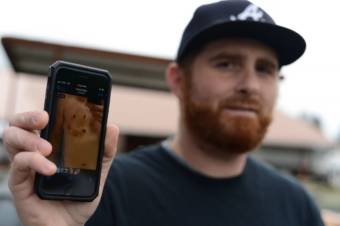
Brandon McVey of Juneau holds up his cellphone on Tuesday, Aug. 4, 2020 to show a picture of injuries he sustained during a Friday night bear attack. A black bear followed McVey and another man into a Juneau home. (James Brooks / ADN)

A man is healing after a black bear entered a home’s open door late Friday night and threw him to the ground in a panicked escape attempt. A Fish and Game wildlife biologist in the area called it an unusual event but said bear encounters have been more frequent than normal this year in the capital city, possibly because natural foods are limited.

Brandon McVey was at a friend’s house in Switzer Village Mobile Home Park when the bear followed them inside about 11 p.m., he said.

“Norm, he’s got like 10 kids, and they’re all in the living room,” McVey said, describing the scene. “(The bear) had walked past us, and he was walking toward the kids.”

One of the children, a two-year-old, reached out to touch the bear, before his mother, Angela Lott, realized what was happening, grabbed the baby and ran to a bedroom. The other kids scrambled under a table and a nearby couch.

McVey and his friend, Norm Lott, began yelling at the bear, which reared up and lunged.

Angela Lott and Norman Lott Sr. pose with their 10 children on Tuesday, Aug. 4, 2020 in the kitchen of their Juneau home. A black bear entered the kitchen on Friday night, confronting the family with an unexpected visitor. (James Brooks / ADN)

“He just jumped up and basically hit me, and then I kind of threw an elbow the same time he was hitting me, and he sat me right down,” McVey said, describing the way the bear threw him to the floor.

Lott was also thrown to the floor, and the bear fled through the home’s door into its arctic entry, where it was trapped by a closed door. The bear tore up a wall before ripping a window from its frame and escaping through the opening.

“It felt like a million years, seriously,” Angela Lott said of the time she spent trapped in her bedroom.

McVey suffered three puncture wounds on his chest and deep scratches across his chest and shoulders.

“It’s very unusual to have human contact, so that’s really rare,” said Alaska Department of Fish and game Area Biologist Roy Churchwell.

Bears infrequently break into homes in Switzer Village, he said, but all of the cases he’s aware of have involved empty houses.

Five-year-old Aaron Lott is seen on Tuesday, Aug. 4, 2020 next to a door broken by a black bear Friday night at his family home. (James Brooks / ADN)

Churchwell said the bear in this case was an adult male and remains at large. A younger bear, culprit of several recent garbage raids, was captured in a nearby trap on Saturday and euthanized, he said.

Churchwell said there seems to be an unusual number of black bears in Juneau this year.

“It seems like there is not much natural foods around right now — very few fish in the rivers and berry production is very low,” he said, which contributes to bears’ interest in human food.

“Definitely keep your doors closed this time of year,” McVey said. “They’re getting wild out there.”

A lack of summer tourism means fewer people in Juneau, which could reduce the disincentive for skittish bears to come into town.
“It’s a definite possibility and something we’re curious about,” Churchwell said. “There are a lot of bears within Juneau this year.”

This story was originally published by the Anchorage Daily News and is republished here with permission.

Native Village of Eklutna will decide what to do with Captain Cook statue in downtown Anchorage

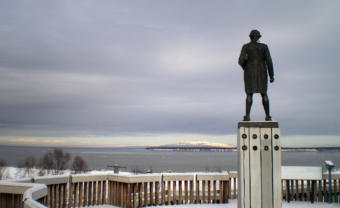
The statue of Captain James Cook at Resolution Park in Anchorage, Alaska. (Photo courtesy James Brooks/Flickr)

Following calls on social media for the statue of Captain James Cook to be removed from downtown Anchorage, Mayor Ethan Berkowitz has asked the Native Village of Eklutna to decide what to do with the statue.

In a joint letter Tuesday, Berkowitz and tribal president Aaron Leggett said “the statue is but one symbol among many that fail to fully and fairly recognize Anchorage’s First People.”

“Consequently, as part of the government-to-government relationship between the Municipality of Anchorage and the Native Village of Eklutna, we seek to establish a process that respects the crucial role and sovereign authority of local tribes as we more fully and fairly portray Alaska’s past,” the letter said.

The Native Village of Eklutna is the only tribal government within the boundaries of the Municipality of Anchorage. It became federally recognized in 1982.

Leggett said he would prefer to augment the monument at Resolution Park to include an accurate history of Cook’s time in Alaska and the history of the Dena’ina people. But he said it’s a decision for the village’s council to make later this summer.

“I don’t want to be the one saying it will never be taken down, but I think there needs to be a lot more discussion before we move forward,” Leggett said.

Leggett said this is the most significant recognition from an Anchorage official of the village being a sovereign government. That recognition, and the formation of government-to-government relations between the village and Alaska’s largest city, is something he’s been working on for 15 years.

Leggett called the recognition “huge.”

“This is a formal statement on behalf of the mayor that really does honor our sovereignty and looks at us as the true partner and governmental institution in our city,” he said.

Cook, a famed British explorer, was in the Anchorage area for short period in May and June of 1778; he and his crew were the first Europeans to reach Prince William Sound and Cook Inlet. His visit is remembered in the oral tradition of the Dena’ina people.

The statue in downtown Anchorage was given to the city by oil company British Petroleum in 1976. It is a replica of a statue in Whitby, England, which is a sister city of Anchorage.

Calls for the Cook statue’s removal in Anchorage come as statues of historical figures who were involved in colonization or the slave trade are being taken down and vandalized worldwide, viewed in a more critical light during the current global reckoning on racial equality.

Leggett said the Cook statue could be removed, or the outcome could be as simple as turning it around, so its back faces Cook Inlet. He said he’s humbled that so many have taken interest in the statue.

His personal goal is to use this as a way to educate people. Leggett, a special exhibits curator at the Anchorage Museum, said he sees Cook as a complex person whose maritime achievements are impressive. But Leggett said he also sees Cook as a colonialist.

That education could be changing the plaque on the statue to reflect the history of Indigenous people, as well as adding other educational materials at Resolution Park.

“It creates an opportunity for my people to tell a portion of our story because of Cook’s celebrity; the natural draw,” Leggett said. “Most people in the world know who Captain Cook is.”

This story was originally published by the Anchorage Daily News and is republished here with permission.

Site notifications
Update notification options
Subscribe to notifications