Anchorage Daily News is our partner in Anchorage. KTOO collaborates with partners across the state to cover important news and to share stories with our audiences.
People hold picket signs at the Alaska Marine Highway System ferry facilities in Juneau during the Inlandboatmen’s Union strike on July 25, 2019. (Photo by David Purdy/KTOO)
As a statewide strike cripples the Alaska Marine Highway System, coastal lawmakers say they’re worried that the walkout will have long-term effects on the state’s ferry system and encourage Gov. Mike Dunleavy to further slash the state agency’s budget.
“It’s ridiculous,” said Sen. Bert Stedman, R-Sitka. “I know the opponents of the marine highway would like nothing better than to shut it down.”
Rep. David Eastman, R-Wasilla, didn’t have much to say about the strike when asked for his thoughts, but he said the actions of the workers might speak for themselves: “If even the folks who work the ferries think it’s not life or death to not have ferry service, then maybe it’s not.”
In February, Gov. Mike Dunleavy proposed cutting $97 million from the ferry system’s $140 million budget. At that level of funding, the system would have had to stop sailing Oct. 1. The Legislature revised Dunleavy’s proposal but still accepted nearly $44 million in cuts, according to figures from the nonpartisan Legislative Finance Division.
Though less than half of what Dunleavy originally proposed, those cuts have been significant enough that draft schedules for the winter and spring show Cordova without service for more than six months and other coastal communities without service for shorter periods of time. For a small stretch, only one of the state’s 11 ferries will be operating. The rest will be laid up for overhaul or because there isn’t enough money to run them.
The governor has suggested that privatization could be in the cards, and the state has hired a consultant to determine the future of the system.
“I think it works right into his hand of eliminating the marine highway system,” Sen. Gary Stevens, R-Kodiak, said about Dunleavy and the strike. “It just could not be more unfortunate timing to happen at this point.”
Rep. Sara Hannan, D-Juneau, said the strike is particularly bad timing for northern Southeast Alaska.
“The Haines state fair begins today, so it’s one of those days when the ferry was fully sold out and lots of people moving in the district,” she said.
The Tazlina and Malaspina moored in Juneau during a strike by the Inlandboatmen’s Union of the Pacific on July 25, 2019. (Photo by David Purdy/KTOO)
John MacKinnon, commissioner of the Alaska Department of Transportation, said in a call with reporters Wednesday that the strike’s timing means significant lost revenue for the ferry system, which in turn will have budget consequences. Of the $56 million in the ferry system’s budget reserved for operations, $26 million is supposed to come from ticket sales, according to Legislative Finance Division figures.
“July and August are our big revenue months,” MacKinnon said. “Without the revenue from the rest of July and August, should this continue, it’s really going to impact our ability to operate next winter and spring.”
Meadow Bailey, special assistant to MacKinnon, wrote by email, “Historically, AMHS grosses $1.5 million per week during the summer months. This strike, which the state believes is illegal, will negatively impact the AMHS budget. Since yesterday, we’ve refunded $1,176,918 in passenger fares. With the current budget deficit, this is money that could be used to provide service to communities.”
On Wednesday, Hannan was one of many House lawmakers who voted in favor of a budget amendment from Rep. Louise Stutes, R-Kodiak, that would add $5 million to the ferry system’s budget. That increase, equivalent to slightly more than 5% of the system’s reduced budget, would have to be approved by the Senate and governor to become law.
“I just think it’s very ill-timed and ill-advised,” Stutes said of the strike.
Sen. Jesse Kiehl, D-Juneau, winced and knocked his head against an office doorjamb when asked his thoughts on the cuts.
“I think we need ferry service,” he said. “My phone calls today will be urging everyone to do what they have to do to get people back to work and vessels running.”
Rep. Sarah Vance, R-Homer, said she doesn’t know what will happen as a result of the strike, but she believes the law of supply and demand might have an answer.
“I think this would just encourage the private sector,” she said. “Regardless of what happens, the private sector can fill in the gaps. They can see an opportunity where the state falls short … and provide services for those communities.”
STEBBINS — When Nimeron Mike applied to be a city police officer here last New Year’s Eve, he didn’t really expect to get the job.
Mike was a registered sex offender and had served six years behind bars in Alaska jails and prisons. He’d been convicted of assault, domestic violence, vehicle theft, groping a woman, hindering prosecution, reckless driving, drunken driving and choking a woman unconscious in an attempted sexual assault. Among other crimes.
“My record, I thought I had no chance of being a cop,” Mike, 43, said on a recent weekday evening, standing at his doorway in this Bering Strait village of 646 people.
He was wrong.
On the same day Mike filled out the application, the city of Stebbins hired him, handing him a policeman’s cellphone to answer calls for help.
“Am I a cop now?” he remembers thinking. “It’s like, that easy?”
Nimeron Mike, 43, worked as a village police officer for his hometown of Stebbins from Dec. 31 to March 29. Mike was hired even though he is a registered sex offender and had served six years behind bars in state jails and prisons. (Bill Roth / ADN)Stebbins, Alaska (Graphic by Kevin Powell/Anchorage Daily News)
The short answer is yes. With low pay and few people wanting the jobs, it is that easy in some small Alaska communities for a convicted felon, even someone who has admitted to a sex crime or who was recently released from prison, to be hired with public money to work as a city police officer.It’s also a violation of state public safety regulations, yet it happens all the time.
In Stebbins alone, all seven of the police officers working as of July 1 have pleaded guilty to domestic violence charges within the past decade. Only one has received formal law enforcement training of any kind.

The current police chief pleaded guilty to throwing a teenage relative to the ground and threatening to kill her after drinking homebrew liquor in 2017. (Alcohol is illegal in the village.) He was hired a year later. He declined to answer questions in person and blocked a reporter on Facebook.
Two men who until recently were Stebbins police officers pleaded guilty to spitting in the faces of police officers; one was the subject of a 2017 sexual assault restraining order in which a mother said he exposed himself to her 12-year-old daughter. (The officer named in the restraining order said he was busy and hung up the phone when asked about his criminal history; the other officer admitted to the crime.)
The seven-man police force has served a combined six years in jails, prisons and halfway houses on dozens of criminal charges. That doesn’t include Mike, who was terminated on March 29, city records show. He says he wasn’t given a reason, but the city administrator said it was because he wasn’t responding to calls and didn’t get along with another officer.
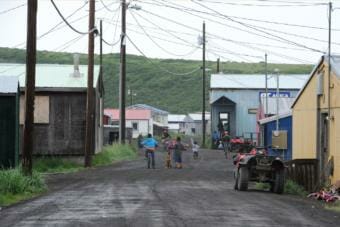
Children play on the main road of Stebbins, a Bering Strait village that is home to 646 people. It has no Alaska State Troopers post or state-funded village public safety officer. The city employed seven village police officers as of July 1. (Bill Roth / ADN)
ProPublica and the Anchorage Daily News reported in May that one in three Alaska communities has no local cops of any kind. In June, U.S. Attorney General William P. Barr declared a “law enforcement emergency” in rural Alaska, announcing $10.5 million in Justice Department spending to support village police.
In the villages where there are cops, a different problem has emerged. A first-of-its-kind investigation by the Daily News and ProPublica has found that at least 14 cities in Alaska have employed police officers whose criminal records should have prevented them from being hired under Department of Public Safety regulations. The news organizations identified more than 34 officers who should have been ineligible for these jobs. In all but three cases, the police hires were never reported by the city governments to the state regulatory board, as required.
In eight additional communities, local tribal governments have hired tribal police officers convicted of domestic violence or sex crimes.
All 42 of these tribal and city police officers have rap sheets that would prevent them from being hired by the Anchorage Police Department and its urban peers, as Alaska state troopers or even as private security guards most anywhere else in the United States. Many remain on the job today.
“It’s outrageous that we have a situation where we have a, such a lack of public safety that communities are resorting to hiring people who have the propensity for violence,” said Melanie Bahnke, a board member for the Alaska Federation of Natives, which represents 191 tribes. “And placing them in a position where they have control over people and possibly could victimize the victims further.”
“That’s like a frontier mentality,” said Bahnke, who is also chief executive for Kawerak Inc., a Nome-based tribal consortium that oversees state-paid police in the region.
Substitute Village Police Officer Robert Kirk, 25, walks past boarded windows in the Stebbins public safety building. Police said the jailhouse is a former library where evidence is stored and officers can hold people in three cells at a time. (Bill Roth / ADN)
A handmade sign in the Stebbins public safety building, where village police officers, hired by the city, hold inmates and prepare for village patrols. (Bill Roth / ADN)
A key part of the problem: There aren’t enough state troopers or other state-funded cops to go around. When it comes to boots-on-the-ground law enforcement, village police officers (VPOs) and tribal police officers (TPOs) working in Alaska villages are at least as common. Yet no one keeps track of who these officers are, where they are working, if they’ve passed a background check or if they’ve received any training.
The state agency that regulates Alaska police has suspended efforts to solve this mess.
Alaska Police Standards Council Director Bob Griffiths said his agency barely has the time to fulfill its regular duties of juggling complaints and appeals involving certified police officers. It doesn’t have enough money to also visit rural Alaska so it can research ways to fix police hiring practices. That effort will come in the fall, at the earliest.
Yet the stakes are high. The same Alaska towns that have no police, or criminals working as cops, are in areas with some of the highest rates of domestic violence and sexual assault in the country.
When a case relies on an arrest by an untrained cop who has a criminal record, prosecutors sometimes do not want to put that person in front of a jury and instead might drop or reduce felony charges, Griffiths warned. “I could see felony domestic violence assault cases that end up being pleaded down to harassment or coercion.”
Nome District Attorney John Earthman agreed that sometimes happens, and that cases involving untrained officers sometimes lack key evidence such as recordings of initial interviews. He said public defenders have raised concerns about some police because they have defended those same officers on recent criminal charges.
“I’ve been out here almost 20 years and some of these are realities that you just don’t see in the city,” Earthman said. Still, the hiring of Mike as a village police officer came as a surprise.
“If he’s the only one who took a statement from a suspect or a defendant, that may be an issue.”
Salmon dries on racks along the Norton Sound coast in Stebbins. (Bill Roth / ADN)
‘You are absolutely desperate’
The story of how Alaska communities came to quietly hire criminals as police officers, without consequence or oversight, is the story of how cash-poor local governments found themselves without law enforcement and few options.
There are several different forms of police in rural Alaska.
The best trained and best paid are state troopers. More than 300 work across Alaska, but just one-third are based off the road system.
Next is a class of cops unique to Alaska: village public safety officers (VPSOs), who are nearly as well-trained as troopers and are also paid by the state. But the number of VPSOs appears to be at an all-time low, with just 42 officers statewide this year, compared with more than 100 in 2013.
On the same day the federal government announced millions in emergency funds for Alaska rural police in June, Gov. Mike Dunleavy revealed he had vetoed millions from the VPSO program, saying the money was for vacant positions.
Dunleavy, a Republican, has declared a “war on criminals” and vowed to punish sexual predators. “If you hurt Alaskans, if you molest children, if you assault women, we’re really going to come after you,” Dunleavy said at a July 8 crime bill signing.
Asked moments later why the Alaska Police Standards Council has suspended efforts to revamp law enforcement hiring regulations, given that men convicted of sex crimes are working as police in some villages, Dunleavy offered no specifics but said he planned to hold meetings over the summer with “stakeholders.”
Bahnke, the head of the Nome-based nonprofit that employs VPSOs, said that only five of the 15 communities in her region have VPSOs and called on the state to spend unused salaries on equipment, housing and other amenities that would make it easier to recruit new officers.
Alaska Native leaders once sued to force the state to provide armed, trained police in villages, but their lawsuit failed in state court. That leaves VPOs and TPOs to pick up the slack. They tend to be younger, paid less and have less training than traditional police.
VPOs, such as those in Stebbins, are mainly expected to enforce city laws such as curfews and misdemeanors. In practice, however, they must sometimes handle life-and-death encounters such as standoffs and suicide threats. TPOs perform a similar role but are employed by federally recognized tribes and are not regulated by the state.
Of the emergency village law enforcement funding announced in June by the attorney general, $4.5 million will go to hire tribal officers who will not be required to undergo background checks.
But lack of funding for cops isn’t the only problem. Many villages have no housing for police, no secure jail cells or no public safety building. When Barr visited the state in May to see the problem for himself, he called the lack of services one of the most pressing public safety needs in the United States.
Our review also found that villages have routinely ignored — or said they were unaware of — laws that require training and bar people with certain criminal records from being hired.
Sen. Lisa Murkowski and U.S. Attorney General William P. Barr tour a jail holding cell in the Western Alaska village of Napaskiak on May 31. Barr later declared a federal emergency related to public safety in Alaska villages. (Marc Lester / ADN)
Last year, the Daily News reported on isolated cases of people with criminal records working as police in remote Alaska villages. That story focused on a case at the edge of the Arctic Circle, in the tundra village of Selawik, where the city employed an officer who had been convicted of bootlegging and faced a pending charge of giving alcohol to a minor when he sexually assaulted an underage girl. The 16-year-old died the night of the attack, and the city settled a subsequent wrongful death lawsuit for $300,000. (The officer pleaded guilty to rape and furnishing alcohol to a minor in that case but was not charged in her death. He has not responded to numerous interview requests.)
What happened in Selawik is far from an isolated example, our comprehensive examination shows. Between January and May, ProPublica and the Daily News identified 50 city and tribal governments that employ officers. Some would not provide names, but of the 159 officers identified, more than 42 have been convicted of or pleaded guilty to assault or another crime, most often domestic violence, that is typically a bar to working in law enforcement.
Leaders in some communities, including Stebbins, say they have little alternative but to hire anyone they can.
“It’s easy to look at in that light, ‘How could these people hire criminals to do this job?’” said Jason Wilson, public safety manager for several Southeast Alaska villages.
“When you live in a community and you’re desperate, you are absolutely desperate for some law enforcement and to have somebody step up that might have a blemished record, you are willing to say, ‘OK, I think person is still going to do OK for us.’”
Asked if the criminal backgrounds of some TPOs and VPOs hamper investigations or undermine prosecutors’ cases, Alaska’s Public Safety Commissioner Amanda Price said the local officers are vital to fighting crime in far-flung communities.
“Our troopers regularly say that, while tomorrow they might have to arrest a VPO or a TPO, today they are critical,” Price said.
‘He was our only applicant’
In village after village, troubling examples abound.
In Mountain Village, population 864, one recent VPO awaits trial on charges of stealing from a murder scene. Court records show five other recent VPOs in the same Yukon River community are awaiting hearings or have admitted to criminal charges including four counts of disorderly conduct, three counts of assault, two cases of neglect, two cases of drunken driving, two charges of harassment and three cases of domestic violence.
The Yukon River community of Mountain Village. (Loren Holmes / ADN)
Along the Norton Sound coast, the city of Shaktoolik in May hired a VPO who has pleaded guilty to five assault charges within the past 10 years. “He was our only applicant so we had no other choice,” a city employee said.
Among those hired as TPOs in the fishing villages of Kasigluk and Tuntutuliak, located among the vast web of river-fed lakes in western Alaska, are registered sex offenders who admitted to abuse of a minor or attempted sexual abuse of a minor. The Kasigluk tribal administrator said he was directed by the tribal council not to talk to a reporter about the issue. In Tuntutuliak, Administrator Deanna White said the village council was willing to hire an offender on a part-time basis because of constant turnover and a lack of applicants in the high-stress job.
“Every time we hired, they wouldn’t last,” she said.
In the Kuskokwim Bay village of Kwigillingok, a 33-year-old man worked as a tribal police officer while subject to a long-term domestic violence restraining order. He was indicted in February on charges of sexually abusing an 11-year-old and is awaiting trial in a Bethel jail. He has pleaded not guilty.
And in the nearby Kuskokwim River village of Napakiak, recent police hires include William Gibson Smith as a TPO.
Smith was picked to patrol the village despite a complaint filed two years earlier by a young mother whose 3-year-old daughter told her that her bottom hurt. The girl later confided that Smith had touched her there, according to an application for a sexual assault restraining order filed in Bethel court. Based on a “preponderance of the evidence,” a magistrate ordered that Smith, who was not present at the hearing, stay away from the family. (Such an order is not automatically disqualifying, but the regulations say candidates must be of “good moral character.”)
Despite the judge’s orders, a matter of public record and discoverable on a public court database, Smith was hired to perform police work in Napakiak. He had the power to place his neighbors in custody and to hold them against their will if he declared them to be drunk or disorderly. In October, the Alaska State Troopers arrested Smith on charges of having sex with a different underage girl, and he has been in custody since. Today he is awaiting trial in that case and in another, in which he was charged with sexually assaulting a woman in police custody. He has pleaded not guilty in both cases.
Jail cells inside the Stebbins public safety building on June 27. Officer John Aluska said one of the cells had been occupied the night before, following a drunken driving arrest. (Bill Roth / ADN)
In Stebbins, Louise Martin said she knows all too well the toll that officers with criminal records can take on a town. She recently filed a restraining order against a current city police officer, accusing the man of threatening her in person and through Facebook messages in which he said he would beat her up. Prior to his hire, the officer had been convicted of domestic violence and bootlegging.
“For him to be a cop, he shouldn’t be acting like this, especially if there’s kids + elders around,” Martin wrote in her application for the restraining order. An initial order was granted but a longer-term one was denied because Martin did not participate at a hearing.
Martin, grew up in Stebbins and isn’t unsympathetic to the needs of the village. “They need a trooper in town.” But she said the city cops “hide behind their badge and harass people and drink on the job.”
One of the worst jobs in town
Stebbins, an Inupiaq and Yup’ik village, survived a generation of monstrous sexual abuse by a Catholic priest and church volunteers. It is plagued by 12% unemployment, and its lone grocery store charges twice as much for food as it costs in Anchorage. As the lack of police data regarding missing and murdered indigenous women raises concerns nationwide, residents of Stebbins and neighboring St. Michael say the suspicious death of a local woman, 19-year-old Chynelle “Pretty” Lockwood, in 2017 remains unsolved.
The city offers no benefits to part-time officers who walk into life-and-death emergencies. They are untrained and unarmed, their only equipment a cellphone and a pair of handcuffs. The police department, like most homes, has no flush toilets or running water.
Stebbins Village Police Officer John Aluska provides a tour of the public safety building. Aluska has a criminal record but said it does not interfere with his police work. (Bill Roth / ADN)Leg irons hang on the wall of the public safety building in Stebbins. (Bill Roth / ADN)
Next to hauling waste, residents say being a cop is one of the worst jobs in town. In 2001, the mayor of Stebbins was shot in the face as part of a robbery scheme involving a 20-year-old man who had been working as a VPO despite jail sentences for assault and animal cruelty.
“I was not very fond of that (hire) in the first place,” then-Mayor Robert Ferris told the Daily News at the time, having survived the shooting. But, he reasoned, “In a place like this you take any help you can get.”
After serving time in prison for his role in the mayor’s shooting, the former VPO returned to Stebbins and was eventually hired back by the city as a police officer, current city officials said.
Little has changed in recent years.
“Other people don’t want to apply,” said the current Stebbins city administrator, Joan Nashoanak, when asked why her local government has hired so many VPOs with criminal backgrounds. “They are willing to work.”
In Alaska’s largest city, the Anchorage Police Department receives 18 applications for every cop it hires. Each recruit is subject to criminal background checks, drug tests and polygraphs.
“It’s incredibly important for our department to uphold those standards because they are key to upholding the public’s trust in law enforcement,” said APD Chief Justin Doll, who serves on the Alaska Police Standards Council board. “If the public looks at a law enforcement officer and sees a lengthy criminal background, it undermines that trust.”
In Stebbins, Nashoanak said it’s impossible to avoid candidates with a felony or a misdemeanor within the past five years, who should be prohibited from serving as cops by law, because of constant burnout and turnover. Officers are paid $14 an hour.
Factor in small-town politics and the pressure to look the other way when an influential person or family gets in trouble, and it’s easy to see why officers are constantly quitting.
“It’s a problem, but it’s never really been addressed,” Nashoanak said. “We can’t find anybody else without a criminal background.”
A former city administrator, Doreen Tom, says she has complained to the city about the officers’ conduct and rap sheets.
“These guys are criminals,” Tom said of the VPOs. “There’s qualifications to be a police. What you can’t be and what you can be. You can’t have a misdmeanor within five years and these policemen, there’s police who were charged with rape. People who were charged with assault.”
One recent Stebbins VPO is 24-year-old Harold Kitsick Jr., who has worked off and on over the past year despite a conviction for spitting in the face of a police officer in nearby Kotlik in 2013. The victim in that case said Kitsick had threatened to kill him, his 6-year-old child and his wife and vowed to burn down his house. The Kotlik officer said that he could smell gasoline around his home and that he waited out the night with a gun handy, afraid for his life.
Reached by phone, Kitsick denied that he threatened the police officer but admitted to attacking him. “I assaulted him, I hit him. I spit on him and kicked him. That was it.”
The Kotlik VPO quit being a police officer soon after the encounter with Kitsick. He asked not to be identified because his wife still works in the region. He, too, was a VPO with a criminal record, he said. The city of Kotlik recruited him despite an assault charge that should have prevented him from being hired under state law.
“There’s really no background checks to it,” he said.
Stebbins city records show Kitsick stopped working as a police officer on May 28 after two years on patrol. He sometimes tried looking for different work with better pay and more hours, he said, but jobs are scarce in the village.
“Then (the city) asked me to go back. I was, like, ‘Well, might as well,’” said Kitsick, who is currently awaiting trial on two new charges. Troopers accused him of punching a woman in the face and punching fellow Stebbins VPO John Aluska in two separate 2018 incidents. He has pleaded not guilty to both.
Tania Snowball cuts up salmon after a day working as the village health aide. As a first responder who relies on village police officers to handle emergencies at her side, Snowball said she couldn’t do her job without the local village police officers. (Bill Roth / ADN)
Aluska, who himself was convicted of domestic violence in 2010 and 2014, said he hasn’t been in trouble in years and is part of a roster of about seven officers who some Stebbins residents said work well together.
“The current ones we have are pretty good,” Stebbins health aide Tania Snowball said of the police force. While she spoke, Snowball cleaned a gleaming chum salmon, hauled moments earlier from the Bering Sea. “The ones in the past, they never answered their phones.”
As a health aide, Snowball said she partners with VPOs. If there were no police — or if the city couldn’t hire people with criminal records — Snowball said there would be no one to assist her in emergencies such as suicide attempts or shootings. She would quit the clinic.
“You have to have somebody help respond, because most of the people that call are intoxicated. There’s four-wheeler accidents or serious injuries,” she said. “VPOs gotta be available.”
‘I’m a pretty good cop’
A few hours after the health aide finished cutting fish along the foaming shoreline, Aluska began the midnight to 4 a.m. patrol. Rain beaded on his four-wheeler, a Honda shared by the entire police force.
Aluska circled the village in a wide loop. There are no stoplights and no paved roads in Stebbins. Most homes rest on stilts; red foxes and berry bushes hide in the knee-high grass. All groceries and vehicles arrive by plane or barge, and trailer-sized shipping containers in primary colors dot the yards. Aluska has lived here all his life.
Village Police Officer John Aluska tells children to go home at 12:45 a.m. on June 27. Village police officers mainly enforce city ordinances, such as curfew, and prevent drunken driving. They are also first responders to emergencies and domestic violence calls. (Bill Roth / ADN)
“Go home!” he hollered to a crowd of middle-school-age kids outside the gymnasium. More than 40% of the village population is younger than 19, and parents said it’s hard to keep them indoors this time of year, when the sun dips low and red but never really sets.
“Don’t make me tell you again,” Aluska warned. A boy in a hoodie shuffled his feet, walking with exaggerated slowness.
The Honda engine clicked and popped as he turned off the ignition. The real trouble usually starts later. Everyone knows when the VPOs go off duty.
If someone is driving drunk, getting in fights or becomes a danger to themselves, they are held in one of three cells in the city jail. The building used to be a library, but it was converted when someone broke the fuel line at the old jail house, soaking the building in heating oil.
Aluska likes the new jailhouse. No one has broken out yet.
“In my time it was easier,” Aluska said.
VPO John Aluska walks to the door of the Stebbins public safety building. The jailhouse is a converted library, residents said. (Bill Roth / ADN)
The 42-year-old said he got into his share of trouble when he was younger. Making homebrew. Escaping custody. “It’s been years ago now since I last went to jail.”
Asked if he had ever been convicted of domestic violence, Aluska said he had, in 1998, but the charge was dropped. State court records show he also pleaded guilty to domestic violence-related assault charges in 2010 and 2014.
Aluska doesn’t think his record makes him any less able to keep the village safe. Same for his colleagues.
“Not really,” he said. “I get a call and, if you’re drunk and doing bad things, I’ll come get you.”
The next afternoon the rain disappeared, replaced by a damp heat that sent kids splashing between gillnets.
At city hall, the Stebbins City Council gathered for a monthly meeting. Chairs ringed a cafeteria table beneath property maps of village landmarks: The Old Church. The Elder Center. The New School. Skin drums and a bingo scoreboard (proceeds help pay police salaries) adorned the adjacent community hall.
Mayor Morris Nashoanak Sr. leads a Stebbins City Council meeting, where each village police officer presented a monthly report and talked about ways to improve public safety in the village. (Bill Roth / ADN)
One by one, the police officers gave monthly reports and brainstormed public safety ideas. Officer Delbert Acoman suggested police begin wearing small body cameras purchased from Amazon; the police chief admitted he can’t bring himself to shoot dogs when an animal needs to be put down. One officer who is the subject of a current restraining order wondered about turning a vacant building into a teen center.
At 45, Acoman said he’s worked as a Stebbins police officer off and on for two decades. During that time, court records show, he has been convicted of a dozen crimes, including three counts of domestic violence. His last no-contest plea to assault came five years ago and Acoman said he’s turned a corner — trying to provide for his wife and kids. A steady job makes that possible.
Acoman headed home as his colleagues prepared for overnight patrols. Middle schoolers chased rebounds on an outdoor basketball court as two young men sat wrenching on a four-wheeler, fanning mosquitoes.
At the edge of town lives Nimeron Mike, the registered sex offender. While he was working as a police officer he could never shake the feeling that visiting state troopers might take him away to jail, instead of the people he arrested.
Stebbins police chief Sebastian Mike, left, and fellow officers leave City Hall. Two officers patrol the village each night until 4 a.m. (Bill Roth / ADN)
Mike said he is ready to go back on patrol any time the city needs him. He figures street smarts must count for something.
“I’ve done my time, now all I want to do is work and make money,” he said. “I’m a pretty good cop.”
For now, the state of Alaska hasn’t caught up with Mike’s change in job status. The official state sex offender registry database still lists his employer as “City of Stebbins.”
Residents from two Northwest Alaska villages say they found large numbers of dead mussels and krill washed up along shores in June, contributing to fears in the region that record warm waters may be causing a wide range of ecosystem changes, including unusual wildlife deaths.
The discoveries come amid profound changes in the ocean environment in Alaska linked to climate change, including a dramatic early ice melt, warmer water temperatures and record high air temperatures. There has been a string of unusual mortality events this season including deaths of seabirds and seals. Scientists are working to pinpoint what killed the animals and whether the deaths are related.
Mike Brubaker, director of the Center for Climate and Health at the Alaska Native Tribal Health Consortium, oversees a network of local environmental observers in Alaska and elsewhere. He wrote in late June that “an ecosystem scale event appears to be playing out” off Alaska’s coasts, related to unusual ocean conditions.
“We do not know if these events are connected or what the cause or causes are. There are a number of possibilities,” wrote Brubaker, an environmental health professional.
The northern Bering Sea in May and June has never been warmer than this year, according to Rick Thoman, a climatologist with the University of Alaska Fairbanks. Following years of low sea ice, those and other waters near the Seward Peninsula late last month were 6 to 12 degrees above normal.
Lucy Oquilluk, a tribal president in the village of Teller, said she was part of a group that came across what she estimated was 2 million dead mussels lining a channel near the ocean on the Seward Peninsula in late June.
“It’s something we never imagined,” she said.
The blue shellfish were “floating everywhere” in the water, clinking against the group’s metal skiff. In some places, thick clumps of mussels were piled up along beaches like plowed gravel. They found mussels for about four miles, the meat inside the shells rotting and causing a stink that filled the area, she said.
Mussels aren’t a subsistence food like salmon, but their deaths raise questions about the health of the ecosystem, she said.
“The salmon that we eat were running, but it’s still kind of concerning,” she said.
George Scanlan, recently retired shellfish specialist for the state, said he’s seen pictures of the rafts of mussels, taken by Oquilluk and others. In 15 years focused on shellfish in Alaska, he’s never seen mussels dying in such large numbers, or heard reports of it, he said.
“It certainly raises concerns,” he said. “These are resources where we need to know what’s going on.”
Residents in the village of Shishmaref, about 70 miles north of Teller, have found mounds of dead krill along beaches on the barrier island, they’ve reported on the site. They’ve also occasionally found small prey fish — eaten by seabirds and larger fish — washing ashore.
More than 30 dead seabirds — murres, auklets and puffins — have been found near the village in recent weeks, said Ken Stenek, a high school science teacher from the village. That comes atop the thousands of seabird deaths recorded in Western Alaska waters in recent years, many showing signs of starving.
In recent weeks, dozens of dead ice seals have been found off Western and Northwest Alaska coasts. That includes 39 seals in the Shishmaref area discovered around July 1 that likely died weeks or months earlier, said Barbara Mahoney, acting stranding coordinator in Alaska for the National Oceanic and Atmospheric Administration.
The deaths are reminiscent of an ice seal die-off in Alaska waters that ended three years ago and prompted NOAA to declare an “unusual mortality event” for the animals.
Scientists will collect samples of the various animal carcasses for testing, according to the LEO network.
In southern Alaska waters, scientists have confirmed 15 gray whale deaths, part of an unusual mortality event for gray whales from Mexico to Alaska, Mahoney said.
NOAA is working with other groups to investigate possible connections between the deaths of the seals, whales and other animals in Alaska, she said. Potential contributing factors include warm waters, a lack of prey, and harmful algal blooms that can allow toxins to enter the food web, she said.
“They are all possible factors to be examined,” Mahoney said.
Stenek said that in late June he found “millions” of dead krill stretching for several miles along beaches near Shishmaref. Stenek said he’s heard reports of miles-long stretches of dead krill also being found on nearby islands.
— NOAA Fisheries AK (@NOAAFisheriesAK) July 9, 2019
Julie Keister, an oceanographer at the University of Washington, said it’s not unusual for krill to wash ashore in large numbers. But the high water temperatures near Shishmaref late last month — 12 degrees above normal — would be enough to stress the animals.
Stenek said he’s been walking beaches in Shishmaref for years.
“I’ve never seen them piled up like this,” said Stenek, who reported his findings on the LEO network.
Many ocean animals eat the shrimp-like krill, including whales, seabirds and the valuable pollock fish harvested by commercial fishermen in Western Alaska waters.
“It’s a worry,” Stenek said. “Is there a toxin being produced by algae because the water is warm? There’s something wrong in the environment that all these things are dying and washing up on our beaches.”
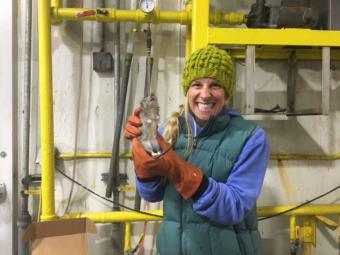
Lauren Divine of the Ecosystem Conservation Office of Aleut Community of St. Paul holds a dead rat found on St. Paul Island after an intensive 10-month search. (Photo courtesy Jessica Tran/Aleut Community of St. Paul Island Ecosystem Conservation Office)
An intensive 10-month search for a stowaway rat that invaded the rat-free seabird paradise of St. Paul Island has come to a happy end for everyone. Except the rat.

St. Paul Island, in the Bering Sea, is home to about 480 people and is an internationally known breeding habitat for millions of seabirds, including rare migratory species.
Being rat-free is essential for the ecosystem’s survival, biologists say.
So biologists and locals felt a moment of “terror” when a Norway rat was spotted in the island’s fish processing plant last fall, said Heather Renner, a supervisory wildlife biologist with the Alaska Maritime National Wildlife Refuge.
“(St. Paul and neighboring St. George Island) are two of the last communities where there’s actually a port and vibrant community and there are not rats,” she said. “They are home to a tremendous wildlife resource.”
Rats pose a potentially devastating threat to the island’s abundant bird populations, said Lauren Divine, director of the Ecosystem Conservation Office at Aleut Community of St. Paul Island.
“Rats have such a potential to invade and change the ecosystem in a way we’d never recover from,” she said.
Seabirds laying eggs on rocks and songbirds nesting on the tundra would offer rats a buffet. Double the trouble for a pregnant female rat, the “worst case scenario,” Divine said.
So for decades, the local tribal government and state and federal agencies have partnered to keep rats off the island while maintaining a local port and fish processing.
Rats have tried — and failed — to slip on to St. Paul before, said Renner.
At least eight rats have been caught by a “security detection program” involving traps at the harbor, she said.
The rat that somehow slipped into the fish processing plant probably arrived on a boat, officials believe.
Its presence was cause for major and immediate alarm, said Divine.
Local wildlife conservation agency and federal officials mounted an immediate and aggressive response, assembling a “strike team” that deployed baited rat traps and set up a system of wildlife cameras to track the rat’s movements.
By then, an elite team invested in killing St. Paul’s rat had become involved: There were weekly email conversations and calls, and consultations from federal scientists and an international group called Island Conservation that specializes in eradication of invasive species.
Then came a winter of frustrating near misses. Once, the rat was caught in a live trap but somehow escaped.
“It has been a wily rat,” said Renner. “Really frustrating.”
People on St. Paul spotted it at such close range they “felt like they could reach down and grab it,” Renner said.
Finally, the group decided rodenticide, which they’d hoped to avoid because of the risk to people, pets and wildlife, was needed. A person had to be specially trained to safely apply it, according to Renner.
Then on June 30, just as island kittiwake chicks were hatching and bird tourism was nearing its summer peak, a visiting birder made a discovery: The dead rat.
KUHB, the local public radio station, posted a Facebook photo of a jubilant-looking Divine holding the frozen, dead rat.
The end of the wily rat saga is cause for tempered celebration, said Renner.
“If you have one rat, you have to assume there are more,” she said.
There’s no evidence that other rats are on the island, but monitoring will continue.
“If after a few weeks or months we have no further detection we’ll feel more comfortable saying they are gone,” she said.
Keeping rats off St. Paul is “a forever war,” Renner said.
Divine, the ecosystem director, said people are happy about the news and ready to work to keep St. Paul devoid of any more rodent interlopers.
“It’s definitely a deep source of pride for tribal members and community members to say we are a rat free island,” she said.
In a pointed letter to the head of the state’s largest Alaska Native organization, Gov. Mike Dunleavy took issue with the assertion that his proposed budget cuts were divisive and said the group hasn’t offered a valid solution to the state’s fiscal crisis.
Turning the tables on the Alaska Federation of Natives, Dunleavy asked AFN president Julie Kitka how the group will address problems plaguing Alaska, including domestic violence and sexual assault among Alaska Natives.
“Your characterization that my administration is responsible for ‘divisive rhetoric’ is in and of itself divisive and wholly unfounded,” Dunleavy wrote in the May 24 correspondence, obtained by the Daily News through a public-records request.
Alaska Gov. Mike Dunleavy speaks at a press conference in Wasilla earlier this month. (Photo by Wesley Early/Alaska Public Media)
Speaking with a reporter on Wednesday, Kitka said the governor’s letter contains “misinformation and misunderstandings” of AFN’s position.
“But we do welcome the governor’s intent behind the letter, which we believe is that he wants to open up a dialogue,” she said.
The dispute appears to date back to February, when AFN publicly called Dunleavy’s massive proposed budget cuts “contentious and ill-advised.” AFN said they appeared “divisive by design.”
Dunleavy’s two-page letter is part of an ongoing dialogue between the governor, his staff, and AFN leadership, said Matt Shuckerow, a spokesman for the governor. The governor’s office has met with AFN leaders at least seven times, he said.
The letter references an April 16 letter from Kitka to the governor. In it, Kitka said Dunleavy and his administration have not “satisfactorily” described his positions. His top officials haven’t properly supported claims that the Legislature recklessly wasted money starting in 2008 during an era of high state revenues, her letter argued. She suggested the governor’s approach is “misguided” and asked him to “put aside the divisive rhetoric.”
The Legislature recently passed an operating budget with much smaller cuts than the governor proposed. The governor has the option to accept or reject it, or veto portions of it.
AFN represents about 140,000 Alaska Natives, about 20 percent of the state’s population.
Dunleavy wrote in the letter that he and his staff have met “with open minds” with AFN leaders. But Kitka’s solutions to closing the state’s $1.6 billion deficit have been “absent.”
He wrote that Kitka suggested in her April 16 letter that the state use the “entire (Alaska) Permanent Fund account” to pay for government. Dunleavy said such an idea is “unconstitutional” and he and most Alaskans aren’t interested in it.
Kitka said Wednesday AFN has never supported that approach. Her two-page letter mentioned the $65 billion Permanent Fund once. She wrote that Alaska is not poor and cannot “cut its way to prosperity.” The letter does not propose using the fund to pay for state government.
Kitka on Wednesday declined to describe what she said were other errors in the governor’s letter. AFN doesn’t want to publicly “engage in a back and forth” over the letter’s details, she said.
“We look forward to sitting down in person with him,” she said.
In the letter, Dunleavy listed his proposed constitutional amendments to limit government spending, enshrine the traditional payout formula for the Permanent Fund dividend, and require voters to approve new or increased taxes.
Dunleavy suggested Kitka doesn’t support those plans.
“We believe that opposition to allowing Alaskans to be involved in their long-term fiscal plan cannot be explained unless it is that you do not trust the people of Alaska, which, if true, is disappointing,” Dunleavy wrote.
Kitka said on Wednesday that AFN has not taken a position on the constitutional amendments.
“We’re studying them very closely and putting together pros and cons on them,” she said.
Summing up, the governor wrote that he’s interested in “finding solutions to the issues that plague Alaska.” He asked Kitka how AFN will combat problems including low student achievement in rural Alaska, domestic violence and sexual assault among Natives, and the state’s fiscal challenges.
“You have called my approach ‘misguided’ — I think it only just to expect you to productively outline your approach,” he wrote.
Kitka said the 38-member AFN board has discussed the governor’s letter and will respond to it.
“We know there’s not the resources for the state to do everything we’ve done in the past, and that priorities have to be set,” she said. “(But) we have to be very careful setting those priorities so that we don’t have unintended consequences.”
Shuckerow, Dunleavy’s spokesman, said Wednesday the letter speaks for itself. He said the administration and AFN will keep meeting. That includes regular conversations between the governor’s policy adviser, John Moller, and AFN board members, he said.
“This is only one small portion of a dialogue that continues. We have folks on staff that work closely with that organization,” he said.
Kitka said AFN’s annual statewide convention in October, attended by thousands of Alaska Natives, will focus on “what makes a good government that is responsive to its people.” It will highlight the need for Alaskans to engage in the political process to help determine state priorities.
The convention will be called “Good Government, Alaskan Driven.”
Marko Cheseto competes in the Skinny Raven Half Marathon at the Anchorage RunFest in August 2018. (Photo by Bill Roth/Anchorage Daily News)
Marko Cheseto sends his love. As a marathoner, and as an American.
Cheseto, the former University of Alaska Anchorage runner from Kenya who lost both of his feet to frostbite in 2011, enjoyed two milestone moments in the past week.
Racing on carbon-fiber running blades, Cheseto ran his first marathon last Sunday in New York City. He finished in 2 hours, 52 minutes, 33 seconds — about 10 minutes off the world-best for a double-leg amputee.
Two days later, he became an American citizen.
“This is an emotional moment for me,” Cheseto said by email from Orlando, Florida, his home since early this summer. “I have been longing for this. During the ceremony, I was extremely excited. America has offered me great opportunities to excel.”
As has Alaska.
Cheseto, 35, came to Anchorage in 2008 on a UAA athletic scholarship. He quickly established himself as one of the program’s all-time bests, earning NCAA Division II All-America honors six times in track and cross country.
In November 2011 of his senior year, despondent over the suicide of another UAA runner from Kenya, Cheseto overdosed on prescription pills and disappeared into the woods around the UAA campus.
Early this summer, the Cheseto family moved to Orlando so Cheseto could work and train at Prosthetic & Orthotic Associates. He came back briefly in August to run the Anchorage RunFest half marathon, placing 10th in 1:26:55 (he still owns the Mayor’s Half-Marathon record, a 1:07:47 set in 2010).
In his 26.2-mile debut at the New York City Marathon last week, Cheseto placed 613th overall in a field of nearly 53,000. He is believed to be the second person with two prosthetic feet to break the 3-hour mark in the marathon. The other, Richard Whitehead of Great Britain, owns the world’s top marathon time for a double amputee — he ran 2:42:52 at the 2010 Chicago Marathon.
“I was happy with my time,” Cheseto said. “My biggest challenge was going over the bridges, and sharp inclines. (It) is not an easy course running with blades, the last 0.2 was the hardest, after crossing Mile 26 mark, I was so ready to be done and I couldn’t see the finish line.”
He said one of his goals “is to run with elites in one of the major marathons.” The time he’s chasing? A sub-2:10.
Stan Patterson, the owner and head prosthetist at POA in Orlando, thinks that’s an achievable goal.
“As you know, Marko is a natural runner,” Patterson said by email. “The terrain of the NY Marathon course is hilly, which is more difficult for an amputee, and thus slows down the completion time. Our immediate plan for Marko is to enter him in marathons with flatter terrain and believe just that difference should get his time down to 2:38 or so — easily beating Whitehead’s record.
“The ultimate goal is to break the overall world record and finish a marathon in less than 2 hours. We believe that Marko is the man to do it!”
Cheseto is hopeful that the marathon for lower-limb amputees will be added to the Paralympics, which currently offers a wheelchair marathon, but none for runners with prosthetics.
If the event is added while Cheseto is still competing, he’d get to race as part of Team USA, thanks to his recent change of citizenship.
Cheseto said he became a permanent U.S. resident in 2014. “I applied for citizenship while I was in Alaska, I in fact took my citizenship test in (the) Anchorage office back in May before moving to Florida,” he said.
While Florida’s weather is more conducive for year-round training, a big piece of Cheseto’s heart is still up north.
“I love Alaska dearly,” he said.
Close
Update notification options
Subscribe to notifications
Subscribe
Get notifications about news related to the topics you care about. You can unsubscribe anytime.