Associated Press

Democrat Begich turns to Alaska voters one more time in governor’s race

U.S. Sen Mark Begich talks to reporters after speaking to a joint session of the 28th Alaska Legislature, March, 3, 2014. (Photo by Skip Gray/Gavel Alaska)

For months, Mark Begich faced pressure from fellow Democrats to drop out of the Alaska governor’s race. Now, he’s their best shot at winning the seat.

The race was upended last week when independent Gov. Bill Walker dropped his re-election bid. He said he concluded that he had no chance of winning against Begich and Republican Mike Dunleavy and thought Begich would be better for Alaska than Dunleavy. Walker’s announcement came days after his lieutenant governor, Democrat Byron Mallott, resigned over what Walked described as an inappropriate overture to a woman.

Walker, a former Republican who was elected with Democratic support in 2014, said he and Begich don’t agree on a lot of things. But Walker said he fears Dunleavy will unravel some of his major policies and “hurt” Alaska. Dunleavy’s campaign manager criticized Walker for a “bitter, partisan” attack on Dunleavy.

Begich, the former Anchorage mayor and one-term U.S. senator, entered the race late, worried about the direction the state was headed. Alaska fell into a recession in 2015 amid slumping oil prices. Crime rates are up. Student test scores are lagging. But his decision to run riled some Democrats and independents who believed Walker deserved a second term. They worried Begich and Walker would split the vote and hand the race to Republicans.

Begich said his campaign was “inundated” with calls after Walker’s announcement Friday, “a sign that people have been waiting for the governor’s race to firm up in one way or another, and now they see it.” He called Walker’s action courageous.

“I think this is the moment,” he said, adding: “I believe we can move the dial and win this election.”

State Rep. David Guttenberg was among the Democrats who backed Walker and wanted Begich to quit. Now, he said, “you just take one pin off and put on the other.”

“I would have hoped that it would have reconciled itself earlier,” he said of race dynamics. “But it is what it is.”

Begich, he said, is now the clear choice for him.

Libertarian Billy Toien also is running.

It was amid intense pressure this summer that Begich said the focus of his campaign became clear.

Then, speaking to a women’s group in Anchorage, his voice hoarse from laryngitis, he embraced his Democratic roots. He talked about wage inequality, fighting for working families who struggle with costs like day care and the need to speak out when President Donald Trump, who easily won the state in 2016, is wrong. “You cannot be silent,” he told them. “You cannot sit there and hope it’s all going to work out.”

The women applauded. But he said the positive response after video of the speech was posted online, from people previously on the fence, was like “the Big Bang.”

“It crystallized in my mind … all these people I’ve talked to on the campaign trail, ‘This is why I’m in.’ I don’t need the office,” he said, adding: “But I do believe there’s a lot of people who have been just excluded from the process.”

Begich knows he has to earn every vote and has been traveling the state, sometimes meeting people when they can make time for him.

Wife Deborah Bonito said Begich prefers working to recreating but might allow himself an hour of Netflix with her or playing cards with their son, Jacob, after dinner. Begich, who plays poker, said that game and other experiences he’s had — as a bartender, in business — taught him useful skills for being in office: patience, listening to people, taking calculated risks.

Growing up, public service was instilled in the Begich kids. That pull that Begich feels isn’t about ego — it’s engrained, said state Sen. Tom Begich, one of Begich’s brothers.

“Maybe that’s a consequence of a parent dying young who’s been involved in public service and has only been involved in it in a way that’s pretty idealistic. You end up feeling it’s an unfinished thing that needs to be finished, and so you’re driven by that for the rest of your life,” Tom Begich said. “You’re always engaging, you’re always involved, you’re always reaching out.”

For a long time, Begich blamed politics for taking his father. In 1972, a plane carrying U.S. Rep. Nick Begich and House Majority Leader Hale Boggs went missing during a campaign trip in Alaska. They were never found.

Nick Begich left behind six children; Mark was 10 years old.

Begich told supporters he came to understand his father’s commitment.

“He understood that you can’t wait for someone else to speak up or speak out or do the right thing,” Begich said. “If there is work to be done, you must get in there and do it.”

Tom Begich said some told his brother that if he waited four years he could “walk” into the governor’s office.

“If that’s what it’s about, if it’s about waiting for your time, then what’s the point of public service anyway? And he’s said those very words to me before,” Tom Begich said of his brother.

Mark Begich has emphasized his support of abortion rights. He has proposed constitutionally protecting the annual check Alaskans receive from the state’s oil-wealth fund and suggested Alaska’s Medicaid rolls are so high in part because some big companies aren’t paying their workers a livable wage. His running mate is Debra Call.

Dunleavy’s campaign has sought to portray Begich as a career politician who wants to grow the size of government. Begich has said he wants to stabilize the budget and is open to new revenues.

Begich has had tough races before. He eked out a win over longtime Republican U.S. Sen Ted Stevens in 2008 but lost re-election in 2014 to Republican Dan Sullivan in the most expensive race in state history.

Bonito said Begich wasted no time thinking about returning to work. He became CEO of a consulting firm.

“That’s kind of what he brings to the table, like, there’s setbacks but there’s also, ‘Hey, folks, here’s how we’re going to move forward,'” she said. “… There’s no moping.”

Former U.S. Sen. Mark Pryor, an Arkansas Democrat who worked with Begich, called Begich independent minded and “relentlessly bipartisan.”

He is nice but not a doormat and stands up for what he believes, Pryor said.

“He is what is right about politics,” Pryor said.

Grand jury indicts Alaska ivory dealer on smuggling charges

A federal grand jury has indicted an Alaska man on charges of smuggling ivory.

James Terrance Williams, who does business in Skagway as Inside Passage Arts, faces 10 counts of smuggling goods into and out of the country, violating the Lacey Act that bans trafficking in a variety of illegal items, and falsely labeling goods.

Williams, 67, could not be reached Friday at the number listed for his business. Online court documents do not list his attorney.

He is scheduled for arraignment Nov. 1 in Anchorage, said Chloe Martin, spokeswoman for the U.S. Attorney’s Office in Alaska.

Williams in October 2014 and March 2016 exported raw, unworked, walrus ivory tusks from Alaska to Indonesia for carving, violating federal law, prosecutors said in an announcement

He later smuggled carved ivory back to the United States, disguised the transactions by falsifying records and sold illegally imported carved ivory pieces, according to the indictment.

The maximum sentence on the charges is 10 years in prison and fines of $250,000.

Gov. Walker says he quit race to boost Democratic rival Begich

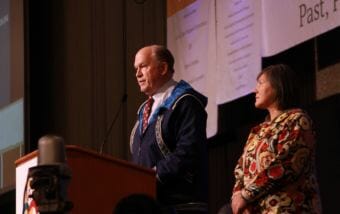
Alaska Gov. Bill Walker announces Friday, Oct. 19., 2018, that he is suspending his re-election campaign at the Alaska Federation of Natives convention in Anchorage. With Lt. Gov. Valerie Davidson next to him, Walker endorsed Mark Begich.
Alaska Gov. Bill Walker announces Friday, Oct. 19, 2018, that he is suspending his re-election campaign at the Alaska Federation of Natives convention in Anchorage. With Lt. Gov. Valerie Davidson next to him, Walker endorsed Mark Begich. (Photo by Tripp J Crouse/KNBA)

Alaska Gov. Bill Walker’s surprising announcement that he was quitting his bid for re-election with less than 21 days to go was an effort to boost Democratic rival Mark Begich’s chances of beating Republican Mike Dunleavy.

Walker, the only independent governor in the country, said Friday he could not win a three-way race and that Alaskans deserve a choice other than Dunleavy. There are a lot of things he and Begich don’t agree on, but Walker said Begich would be better for Alaska.

Whether Begich can overtake the presumed front-runner remains to be seen with two-and-a-half weeks before the election. Begich, who said his campaign was “inundated” with calls after Walker’s announcement, thinks he can win.

Some Democrats and independents had long worried Walker and Begich would split the vote, handing the race to Dunleavy. Walker, a former Republican, was elected in 2014 with Democratic support. The clincher for Walker’s decision to leave the race, it appears, was his lieutenant governor’s abrupt resignation days earlier over an inappropriate overture to a woman.

After his announcement Friday, Dunleavy campaign manager Brett Huber blasted Walker’s “bitter, partisan attack” on Dunleavy. In a statement, Huber said Walker’s decision to drop his re-election bid will provide voters “a clear choice.”

Key issues in the race are crime, the economy and the future of the annual check Alaskans receive from the state’s oil-wealth fund, the Alaska Permanent Fund.

Walker worries Dunleavy could undo actions he’s taken as governor, such as expanding Medicaid. Dunleavy has expressed concerns with the program.

Dunleavy, a former state senator, wants to reduce state spending and supports a full payout of Permanent Fund dividend checks. Alaskans should get a say on any proposed change to how the dividend is calculated via an advisory vote, he said.

The size of the checks has been capped since 2016, first by Walker, then by legislators, amid budget deficits. Lawmakers this year began using Permanent Fund earnings to fill much of the deficit after going through billions of dollars in savings amid gridlock and rejecting Walker tax proposals. Fund earnings also are used for dividend checks, setting the stage for a political fight.

Begich, a former U.S. senator, has supported constitutionally protecting the dividend and using bonds for infrastructure projects. He also has noted his support of abortion rights, which distinguish him from Dunleavy and Walker.

Walker’s announcement came three days after his lieutenant governor and close friend, Democrat Byron Mallott, resigned. Walker told reporters there wasn’t any one thing that caused him to abandon his campaign now, though he said it was a tough week. He said conversations he’d had with Begich about Begich’s positions and the dynamics of the race also were considerations.

“There was no, quote, deal as such on anything like that,” he said.

Begich said there were talks with Walker about Alaska’s future, born of shared concerns about Dunleavy.

“So we’d continue to have conversations to try to figure out, Is there a path forward to move Alaska and unify in a way that makes sense? And we are where we are,” he said.

Jay Parmley, executive director of the state Democratic party, said he expects additional help from the Democratic National Committee. The Republican Governors Association already has been a major contributor to a third-party group backing Dunleavy.

Pollster Ivan Moore said people are starting to pay closer attention to the race. But he said the impact of Walker’s decision remains to be seen. He said Dunleavy also could pick up some Walker votes.

Stephen Gasche, a Juneau independent, leaned toward Walker before Mallott’s resignation and toward Begich after. On Friday, he said he would vote for Begich. “I am so glad I don’t vote early!” he said via Facebook messenger.

Lindy Jones, a Walker supporter from Juneau, blamed Begich for creating a three-way race but said he’d “reluctantly” vote for him.

Alaska Democrats opened their primaries to independents, and Walker, who wanted to run with Mallott, flirted with entering the primary. He backed out when it appeared Begich would run and instead gathered signatures to appear on the ballot, a move that ensured he and Mallott could be running mates.

Jones said Walker’s decision to abandon his campaign was another example of tough decisions he’s made.

“I think that he realizes that there’s going to be a spoiler if it’s a three-way race, and this is the only hope,” Jones said. “And frankly I don’t know if it’s going to be enough.”

Libertarian Billy Toien also is running.

Investigators release report on Alaska helicopter crash that killed 3

NTSB photo
(Creative Commons photo by Matt’ Johnson)

The surviving passenger of a deadly Alaska helicopter crash told federal investigators that the aircraft entered a freefall from about 500 feet in the air before smashing onto a beach in Glacier Bay National Park last month.

The National Transportation Safety Board released a preliminary report last week on the Sept. 28 crash the killed both pilots and an 11-year-old boy, the Juneau Empire reported Sunday.

The 14-year-old survivor told an NTSB investigator that the pilot “reached down and rolled the throttle off” before the helicopter entered the freefall. The pilot increased throttle, but the helicopter hit shallow water near Lituya Bay, about 60 miles (97 kilometers) northwest of Gustavus. The passenger went unconscious after the impact, according to the report.

The passenger did not understand the pilot’s actions, and “at this point, neither do we,” investigator Joshua Lindberg said.

The helicopter had taken off from the Juneau airport and was traveling to Yakutat. The aircraft was being delivered to Anchorage from the Airbus Helicopters factory in Grand Prairie, Texas, according to the report.

The crash killed 53-year-old David King of Palmer, 42-year-old Joshua Pepperd and Andrew Pepperd, both of Anchorage. Aiden Pepperd was injured, but was rescued by the U.S. Coast Guard.

Investigators visited the wreckage site two days after the wreck. The helicopter’s tailboom, tail rotor assembly and most of the instrument panel were not found. The NTSB recovered the engine data recorder, engine control unit and a camera that monitored the instruments and the pilot’s actions.

Lindberg said determining the cause of the crash will take time, possibly more than a year.

“The reason that those take so long is that there’s a lot of information to process,” Lindberg said. “There’s a lot that goes into an accident like this.”

___

Information from: Juneau (Alaska) Empire, http://www.juneauempire.com

Alaska plans changes to how it taxes marijuana

The state of Alaska is changing how it taxes marijuana in response to industry concerns.

The current tax is $50 an ounce for any part of the bud and flower and $15 an ounce for the remainder of the plant.

New rules, set to take effect Jan. 1, make distinctions between different types of bud.
So-called mature bud would be taxed at $50 an ounce, while immature or abnormal buds would be taxed at $25 an ounce. The tax rate for the rest of the plant would be unchanged.

Cultivators would continue paying the tax, imposed when marijuana is sold or transferred from a grow facility to a retail store or product manufacturing facility.

Some in the industry have sought a more extensive tax overhaul. That would require legislative action.

marijuana in hand
Marijuana. (Creative Commons photo by Katheirne Hitt)

Kodiak cooperative sells first offering of local salmon

A Kodiak cooperative has received its first delivery of locally harvested canned salmon — a step toward reaching its goal of opening a grocery store selling Alaska-sourced products.

The Kodiak Harvest Food Co-op received a delivery this week of 1,000 cans of sockeye salmon from Larsen Bay to sell, the Kodiak Daily Mirror reported Wednesday.

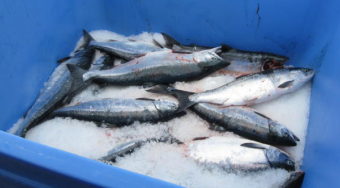
File photo of sockeye on ice. (Photo by Mike Mason/KDLG)

The salmon caught and processed locally will be sold first to co-op members and then to other residents, said Tyler Kornelis, the co-op’s board chair.

“Our first offering for sales will be to our membership base, as a benefit of being part of the co-op already,” Kornelis said. “But we anticipate having some left over for the holiday season, and there seems to be a bazaar just about every weekend in November and December.”

The co-op is working toward opening a full-service grocery store in Kodiak, giving residents access to local produce and seafood.

“We are trying, in essence, to help the localization of our economy,” Kornelis said.

The co-op is wants to boost its membership to 500 before setting up a store. It now has 370 members.

The co-op has been selling Alaska-grown produce at a Kodiak market through the summer. The produce sales have served as a way to determine pricing and the products’ popularity, Kornelis said.

“The objective in selling that produce was to establish the product types and volumes that we could ideally get Kodiak growers to sell to us next year,” Kornelis said.

___

Information from: Kodiak (Alaska) Daily Mirror, http://www.kodiakdailymirror.com

Site notifications
Update notification options
Subscribe to notifications