I keep tabs on what’s happening in Juneau’s classrooms for the families they serve and the people who work in them. My goal is to shine a light on both stories of success and the cracks that need to be filled, because I believe a good education is the basis of a strong community.
Harris Monsef, who attends high school in Juneau, started working for Alaska Probiotics this summer. The company is hosting a fundraiser to help Monsef’s family in Afghanistan. (Photo courtesy of Kaila Buerger)
While the unrest in Afghanistan seems far away to some Americans, for one of Juneau’s families, the crisis hits close to home. Sima Shoja has lived in Juneau since 2008, but her loved ones are living in fear in Afghanistan.
“Nobody can get out [of Afghanistan],” Shoja said. “Basically, they’re prisoners in their homes.”
Shoja’s husband died of cancer in January of 2021, just months before the Taliban took over Afghanistan, and his side of the family still lives there.
“If [my husband] was here, he would absolutely help his family,” Shoja said. “My son tells me ‘if my dad was here, he probably would’ve done a lot more, mom.’ But we try as much as we can.”
Sima Shoja (second from left) is a Juneau resident who has family in Afghanistan. She’s partnering with the team at Alaska Probiotics to raise money for her loved ones overseas. (Photo courtesy of Kaila Buerger)
Some of Shoja’s family members can’t go to school, others are unable to work and the boys can’t leave the house for fear of being recruited by the Taliban. Shoja is able to talk to her family, but they speak in code, just in case their conversations are being monitored.
“We can’t name the Taliban or some other groups so we made our own words for them,” Shoja said. “You can hear from their voice what they want to tell you. Every time I talk to them, I cry when I hang up.”
Shoja’s son, Harris Monsef attends high school in Juneau. He started working for Alaska Probiotics this summer, where he met owner Kaila Buerger. When Buerger heard about Monsef’s ties to Afghanistan, she knew she wanted to help.
Shoja is selling some of her Afghan cuisine to raise money for her family overseas. (Photo courtesy of Kaila Buerger)
“I think oftentimes we hear about these crises overseas and there’s a disconnect because we’re not witnessing it right in front of us,” Buerger said. “Having community members with these connections just makes it a little more real.”
Alaska Probiotics will host a fundraiser on Saturday at its storefront on Franklin Street. Shoja will be selling Afghan cuisine for $15 a plate from 4 to 7:30 p.m.
“[Shoja] is a fabulous cook,” Buerger said. “She made us some recipes to taste that she’ll be making for the event and they’re delicious.”
Local artists have donated some pieces to be sold at the event and additional donations will be accepted through cash, check or Venmo (@Sima-Shoja).
“This is not only my voice,” Shoja said. “It’s my family’s and my country’s voice. These are innocent people. Some people think all Afghans are terrorists, but we’re not. We’re just normal, regular people.”
The Juneau Board of Education decided to pay a newly retired coach and teacher for his unused leave.
The City and Borough of Juneau is asking its assembly to adopt updated hazard maps. A new scientific report puts about half of the structures downtown at moderate to severe risk of landslide or avalanche. But some residents say they aren’t ready for the “upgrade.”
Starting next month, all Juneau School District staff members will be required to get weekly COVID-19 tests.
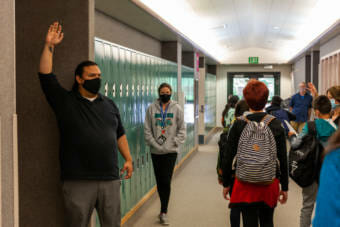
Frank Henry Kaash Katasse guides students to his classroom for a Tlingit class at Dzantik’i Heeni middle school on the first day of school on Monday, August 16, 2021, in Juneau, Alaska. (Photo by Rashah McChesney/KTOO)
Starting next month, all Juneau School District staff members will be required to get weekly COVID-19 tests. The school board voted unanimously to move forward with the mandate on Tuesday.
At the moment, school staff members have access to testing, but it’s optional. About 150-200 of them have been testing each week, voluntarily. District Superintendent Bridget Weiss said the new requirement will go into effect no later than Oct. 4.
“Staff [members] register [online],” Weiss said. “They can pick which day and which site they test at. So we will be expanding that to accommodate the required testing.”
Bridget Weiss is the superintendent of the Juneau School District. (Photo courtesy of Bridget Weiss)
Staff members who’ve been fully vaccinated or who’ve had COVID-19 in the last 90 days will be able to opt-out of testing. To make that possible, the district first has to verify everyone’s vaccination status. They’re hoping to use software that was put in place over the summer to collect that information.
Ideally, people would just log in and upload a photo of their vaccine card or doctor’s note. Weiss said there are steps in place for staff members who don’t comply with the testing requirement.
“We already have established progressive discipline for adults, kind of like we do for kids,” she said.
That can be everything from the supervisor talking with the person who missed the test all the way up to termination.
“That’s extreme,” Weiss said. “I don’t see that happening, but that’s kind of the end of the process.”
Like testing at any other place in town, staff members provide their health insurance information before getting the swab. While there’s no out-of-pocket cost to the employee, some union reps are concerned about insurance rates increasing in the future. But Weiss said if the district didn’t use the insurance system, it wouldn’t have the funding to support the program.
“And the cost for testing is minuscule in comparison to the cost to an insurance company when people contract COVID, get hospitalized from COVID, or those unknown, long-term effects of COVID,” Weiss said.
By adding another layer of mitigation and making testing convenient, the district hopes to keep schools and families healthier. So far, Weiss has received positive responses and very little pushback from staff.
“We’re so blessed in Juneau that people understand that we have a priority around keeping kids in school,” she said. “There are so many different things that we can do that contribute to that and this just happens to be one of them.”
The district is also working on a plan to increase testing among students. Weiss will present that plan during the school board meeting on Oct. 19.
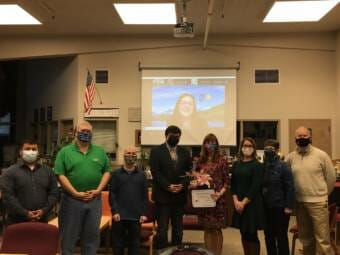
Juneau School District Superintendent Bridget Weiss poses with school board members during a meeting on Tuesday, Sept. 14. Lisa Parady with the Alaska Superintendents Association showed up via Zoom to present Weiss with an award. (Photo courtesy of Kristin Bartlett)
Juneau School District’s Bridget Weiss has been named Alaska’s 2022 Superintendent of the Year. The Alaska Superintendents Association presented the award Tuesday night.
At the start of what appeared to be any other school board meeting, the agenda was changed to add a last-minute spotlight. One of the board members asked Superintendent Bridget Weiss to look under her chair, where she found a piece of paper and was asked to read it out loud.
“What! I cannot read that out loud,” Weiss said.
Moments later, ASA Executive Director Lisa Parady appeared on the room’s projector screen.
“This is one of my very favorite things that I have the privilege of doing each year,” Parady said. “I’m just so delighted to be here in my hometown to present a very special award.”
Some of the criteria for Alaska’s Superintendent of the Year award are state-level involvement in promoting public education, demonstrated leadership skills and evidence of district-level improvements. Parady went on to read statements about the reasons Weiss was selected.
“Dr. Weiss is an excellent leader who is passionate about bringing quality education to Alaska’s students,” Parady said. “She has done admirable work during the pandemic to ensure her students and staff can continue to succeed while keeping their health a priority. She is an example of a servant leader for her colleagues statewide.”
The surprise presentation left Weiss at a loss for words.
“I do not know how that was pulled off,” Weiss said. “I want to know who in this room knew that that was happening tonight. Thank you. I really am completely speechless. I just had absolutely no idea.”
Weiss has served as Juneau’s superintendent for four years but has worked in the district for eight. She was recently included in a Time magazine article featuring educators who went above and beyond during the pandemic.
“I will continue to say this: It takes a team,” Weiss said. “I have a great team all the way around and you’re all in this room, so thank you.”
Later this month, Weiss will be honored at the upcoming Alaska Superintendents Association Fall Conference. She will also be a candidate representing Alaska for the 2022 National Superintendent of the Year.
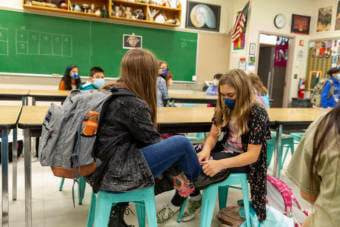
Maddie Bass watches as Zara Ritter ties her shoe during an art class on the first day of school at Dzantik’i Heeni middle school on Monday, August 16, 2021, in Juneau, Alaska. (Photo by Rashah McChesney/KTOO)
It’s been just over three weeks since students returned to Juneau’s classrooms and so far, school case numbers seem to be reflecting the rates of the city as a whole.
“Our most frequent cases are at elementary where kids can’t be vaccinated yet,” said Juneau School District superintendent Bridget Weiss. “Our response is most of the time to quarantine a classroom.”
Bridget Weiss is the superintendent of the Juneau School District. (Photo courtesy of Bridget Weiss)
When someone tests positive for COVID-19, staff at Juneau’s Public Health division determines when that person can return to school based on factors like their symptoms and when they took the test.
When someone has been in close contact with an infected person, they get tested five days after exposure and if the result is negative, they can return to school on day eight.
Weiss said so far, that response has proven effective, but it isn’t always easy because reports of positive cases or possible exposures come in at all hours.
“A couple of times, I’ve been notified of an elementary case at about 7:00 in the morning, 7:15, 7:20,” Weiss said. “So we are sometimes calling parents right before school starts to say ‘please don’t send your kid’ or ‘come pick up your kid’ and that’s unfortunate but it is what we have to do sometimes.”
Until recently, school officials were under the impression that they couldn’t ask staff members if they’d been vaccinated, but that’s no longer the case.
“We’ve gotten some clarity this week and I’m super excited that we can request verification of vaccination status, that it is not protected by [health information privacy laws],” Weiss said. “So that is going to be a huge tool for us and many many of our staff tell us that they’re vaccinated or not. It’s just very few that don’t want to do that.”
If for any reason a staff member doesn’t answer, the district just assumes they are unvaccinated for any protocols built around vaccine status.
“It is simply operational information,” Weiss said. “What we want is a safe environment. So whether somebody is vaccinated or not, we don’t hold any judgment on that. We just need to know so that we can respond accordingly.”
She estimates about 70 to 80 percent of all school staff members are currently vaccinated against COVID-19. Optional weekly tests are also available to staff members.
As for athletics and activities, participating high school students have been tested frequently for COVID-19. Starting this week, the district is also implementing that policy for middle schoolers.
Every opportunity for teams to travel is looked at individually and the trips are being kept as short as possible.
“We used to play football at seven or eight at night,” Weiss said. “Now, we’ve been playing them at three in the afternoon because teams can come in in the morning, play and then go home that night and not have any overnight. So again, [it’s] limiting that exposure.”
Those teams are no longer eating out at restaurants. They bring food with them instead. Student athletes who’ve been vaccinated are allowed to opt out of testing. However, all policies are subject to change based on the most up to date information.
“If we started seeing cases pop up in our activities, then we might tighten it and just say: ‘There’s no opt-out. Everybody’s testing,'” Weiss said.
Back in school buildings, masks are still required for everyone, proper hand washing has been taught and re-taught to younger kids, and air purifiers have been installed.
“Most of our kids, most of our staff, when they’re at school, it’s the most mitigated environment that they participate in,” Weiss said. “So far that’s paying off.”
At this point, Weiss doesn’t see a scenario where the whole district would have to return to remote learning again.
“I just think we’re far enough down the road,” she said. “I could be wrong. Stranger things have happened in the last 15 months that we never would have predicted. But with everything that we know up to this point, I would be incredibly surprised if we ever had to take that step.”
In some cases, the district has moved one grade level or one school to distance learning when cases emerged. School officials plan to take that approach for the foreseeable future.
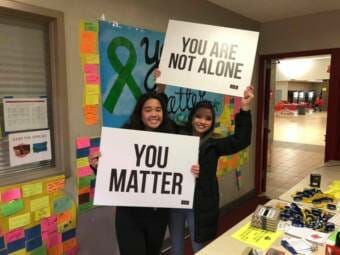
Two Juneau high school students pose with signs displaying positive messages during a ‘Take a Time Out to Talk’ event in 2020. (Photo courtesy of Melissa McCormick)
The social isolation caused by COVID-19 has many people feeling Zoom fatigue and yearning for real-life interactions. But for those who struggle with mental health disorders, the isolation can feel amplified.
September is also Suicide Prevention Awareness Month, so one Juneau resident is focused on spreading positive messages throughout the community.
Melissa McCormick spends a lot of her time trying to lift people up, in part because she knows what it’s like to experience loss.
Speier McCormick (Photo courtesy of the McCormick family)
Her son, Speier, struggled with bipolar disorder for years before taking his own life in October of 2017.
“We always said that Speier had a fire inside of him,” she said. “He had a lot of passion about a lot of things that he was working on.”
With that sentiment as her inspiration, McCormick founded a nonprofit in 2018 called Find Your Fire. The organization aims to help young adults find their passions, learn life skills and develop strong mental health foundations.
“We tell them to be you and not anybody else,” McCormick said. “You’re basically already enough.”
Timi Tullis and Melissa McCormick pose with ‘don’t give up’ signs during an event at the University of Alaska Southeast. (Photo courtesy of Melissa McCormick)
Now McCormick is distributing yard signs with similar sentiments to homes all over Juneau, in hopes of reminding others that they’re not alone.
“The more popular ones are ‘we’re all in this together,’ ‘you matter,’ ‘don’t give up,’ ‘you are enough,’ ‘you are worthy of love,'” McCormick said.
Although she’s had the signs since 2018, they grew in popularity during the COVID-19 pandemic. So far this year, McCormick has distributed more than 400 signs to people who requested them.
“One gentleman, in particular, came up to me and asked me if I was the one who helped put the signs up in Juneau and I said ‘yes’ and he said ‘well your sign just saved my life,’” McCormick said.
The man had been struggling with his mental health and after seeing the sign, sought help from JAMHI.
“So it was one of those moments where you just get those chills and think, ‘Wow, I may have made a difference in one person’s life with just a simple message,'” McCormick said.
Jaeleen Kookesh poses with a ‘you are worthy of love sign’ provided by the Find Your Fire organization. (Photo courtesy of Melissa McCormick)
Last month, McCormick took to Facebook to promote the signs for Suicide Prevention Awareness Month. The response was overwhelming and she’s had to beef up her sign orders.
“We do give [the signs] away,” she said. “There’s not a charge. Occasionally people will make a donation but it’s not required. We are a little bit low on our funding, but it’s always nice to see them in the community.”
For the most part, McCormick has used the money she’d set aside for Speier’s college fund to pay for the signs.
Juneau resident Casey DenAdel asked McCormick for a ‘you matter’ sign to put in her window.
Juneau resident Casey DenAdel poses with a ‘you matter’ sign she displays in her window. (Photo courtesy of Casey DenAdel)
“I am somebody who lived through a suicide attempt and I have two really close family members who also lived through attempts,” DenAdel said. “So it’s a subject that’s really near and dear to my heart.”
The other side of her sign says ‘don’t give up,’ so DenAdel flips it over from time to time, alternating messages.
“By putting signs up, it gets it out there that it’s okay to talk about mental health issues and that people aren’t alone in this,” she said. “There are so many of us who think that there’s something wrong with us when there are just so many more of us than you think there are – we’re normal people.”
DenAdel plans to keep the sign in her window, not just for September, but for the foreseeable future.
If you or someone you know is dealing with thoughts of suicide, you can call the National Suicide Prevention Lifeline at 800-273-8255 or the Alaska Careline any time of day or night at 877-266-HELP.
Close
Update notification options
Subscribe to notifications
Subscribe
Get notifications about news related to the topics you care about. You can unsubscribe anytime.