
Bridget Dowd

Local News Reporter

I keep tabs on what’s happening in Juneau’s classrooms for the families they serve and the people who work in them. My goal is to shine a light on both stories of success and the cracks that need to be filled, because I believe a good education is the basis of a strong community.
New program funds veterans-choice caretakers in Alaska ‘they can hire and fire and train whoever they’d like’

Veteran Joe Hotch at Picture Point in Haines. Hotch has been using a new program that lets veterans choose their own caretakers which allows him to continue living at home, instead of an assisted living facility. (Photo courtesy Mel G Photography)

Veterans Day reminds Americans to honor those who’ve served the country, but many senior veterans need help on a daily basis.

To help facilitate that, Southeast Alaska Independent Living (SAIL) is offering a program in which veterans can choose their own caretakers. It also allows those seniors to continue living at home, instead of an assisted living facility.

There are about 77,000 veterans in Alaska, but according to AARP, only about 29 percent of them access Veterans Affairs benefits. That’s why Janine Allen, who works in SAIL’s Haines office, wants to spread the word about their services.    

“I feel like anything we can do to promote veterans being able to obtain the care they need and be able to live happy lives at home is really what SAIL is all about,” she said.

SAIL’s newest program is called VOICE, which stands for Veteran Options for Independence, Choice and Empowerment. 

“It’s a veteran-directed program. So it’s designed for veterans that need assistance with their daily living, but they want to remain at home,” said SAIL Assistant Director Sierra Jimenez. 

Interested veterans need to enroll in VA Health Care and meet the criteria for nursing-home level care. Then the VA will give them a monthly budget. 

“Then they can hire and fire and train whoever they’d like,” Jimenez said. “It can be a family member, a spouse, it can be the neighbor. Our job is to help coordinate it and kind of be the in-between [person] with the VA and just make sure that the program is on track, answer any questions and help with paperwork.”

At that point, all the veteran has to do is submit time sheets for their chosen employees. Jimenez said the program is especially helpful for those who live in more rural parts of Alaska where there’s a shortage of care workers.

“So even though they qualify for services, they can’t get employees to provide them,” Jimenez said. “[VOICE] also allows people to hire a family member who is already doing the work. It can relieve some of the stress if they had to quit their job to take care of their spouse. Now they can get paid to do that.”

91-year-old veteran and Haines resident, Joe Hotch has been using the VOICE program for a year and a half. His wife Georgiana Hotch said Joe was able to hire two caretakers, set their wages and use any leftover funds to meet other needs, like purchasing a bed rail.

“That helps him to get out of bed in the morning or in the middle of the night,” she said. “It really helped him to regain independence at his age.”

Georgiana is not retired yet. She said VOICE allows her to continue to work without worrying about her husband.

“It has helped Joe and I immensely,” she said. “We’re very thankful.” 

SAIL offers VOICE throughout Southeast Alaska; partner organizations offer it in the Mat-Su and on the Kenai Peninsula. For more information about the program, you can contact your local SAIL office or visit its website.

Correction: This story has been updated to show that SAIL only offers VOICE throughout Southeast Alaska, partner organizations offer those services in the Mat-Su and on the Kenai Peninsula.

New online tool helps Juneau taxpayers see where their money goes

A new online tool allows Juneau residents to get an estimate how how their tax dollars are spent.
A new online tool allows Juneau residents to get an estimate of how their tax dollars are spent. (Bridget Dowd/KTOO)

Juneau city officials rolled out a new online tool that allows residents to see how the city spends their tax dollars.

Users will see an estimated breakdown of the programs and services supported by their sales and property tax dollars.

The tool runs through a site called Balancing Act. It asks residents to enter their annual income, age and the assessed value of their home — if they own one.

With that information, the site generates an unofficial “tax receipt” which shows the estimated amount paid to the school district, police and other services. 

For example, a woman in her late 30s who has an income of  $57,000 and who doesn’t own a home in Juneau, would be paying just over $800 in taxes and the bulk of it would be going to the Juneau School District. 

This screenshot shows an example of what it looks like when a resident enters their information into the Balancing Act tax tool.
A screenshot showing an example of what it looks like when a resident enters their information into the Balancing Act tax tool. (Bridget Dowd/ KTOO)

Juneau’s budget analyst Adrien Speegle said the idea came up when the City of Tacoma posted a video using the same software. 

“We became aware of that maybe last January (January 2021) and have since been sort of working with the assembly on whether they were interested in pursuing this tool and this education mechanism for the public,” she said. “They definitely were [interested].”

The receipt doesn’t include taxes levied on tobacco, liquor or marijuana sales. It also doesn’t include property taxes paid through rental costs. 

Speegle said by offering this tool, the city hopes to increase transparency and improve people’s understanding of where their money goes.

“I believe a lot of members of the community care where those tax dollars are being spent and perhaps haven’t historically had an easy way of obtaining this information,” she said.

Speegle said the city hopes having more information will encourage residents to participate in the budget process.

“If, you know, they feel like the priorities that are funded by their taxes maybe aren’t the right priorities, they may feel empowered to engage in the in the public process more,” Speegle said. “Or if they are really excited about what their tax dollars are going towards, that also, I’m hoping will encourage people to communicate that.” 


What do you think of the city’s tax tool? Let us know.

Juneau Board of Education adopts land acknowledgment

JSD Office
The Juneau Board of Education adopted a land acknowledgment during its meeting Tuesday night.(Photo by Bridget Dowd/ KTOO)

The Juneau Board of Education adopted a land acknowledgment during its meeting Tuesday night. It will be used during all future meetings of that board. 

The acknowledgment is intended to express appreciation and celebrate the context of the indigenous presence and history in the community. The board had tried to settle on the language during its Sept. 14 meeting.

A member of the public, Ayyu Qassataq, raised some concerns during that meeting. Qassataq serves as vice president and Indigenous operations director at First Alaskans Institute. She referenced a portion of the initial language that said “we are grateful to have been welcomed to be in this place.” She said it struck her because it seemed to center on a settler’s perspective instead of an Indigenous perspective. 

“Though unintentional, I feel like it could potentially contribute to erasure of the history of how the education system came to be in the community,” she said. “It was not necessarily a welcoming, but an imposition.”

So the language was sent back to the policy committee in September and a final reading was presented Tuesday. That portion was swapped out to say: “We are grateful to be a part of this community.”

At the end of the meeting, newly sworn in board member Amber Frommherz said she appreciated the land acknowledgment.

“I think that it is timely,” Frommherz said, “better late than never and that means a lot that we were able to move that.” 

The full acknowledgment reads:

“The Juneau School District is situated upon the traditional lands of the Tlingit people. The Board of Education acknowledges that, since time immemorial, Alaska Native people have been and continue to be stewards of this land and integral to the well-being of the community. We are grateful to be a part of this community. We support the education of all children, including future Elders. We honor the culture, traditions, language, and resilience of the Tlingit people. Gunalchéesh!”

The board’s action comes several months after the Juneau Assembly formalized its own land acknowledgment.

What’s the status of Juneau School District’s weekly employee testing requirement?

JSD Office
The Juneau School District has formally surveyed its employees on their vaccination status. Of the 600 or so who’ve responded, 92% are vaccinated. However, about 100 other staff members have yet to provide their information. (Photo by Bridget Dowd/ KTOO)
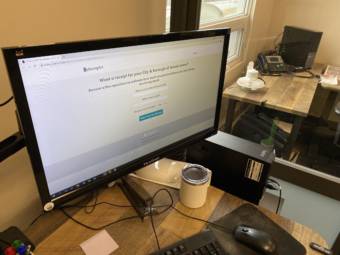
It’s been almost a month since Juneau’s school board voted to require Juneau School District employees to get weekly COVID-19 tests. The mandate was supposed to go into effect no later than Oct. 4. 

KTOO’s Bridget Dowd sat down with JSD Superintendent Bridget Weiss to get an update.

Read a transcript of the conversation with minor edits for clarity.

Bridget Dowd: Alright, so last time we talked, the district was gathering vaccine and exemption information to figure out how many employees would be required to test because only unvaccinated employees or those who hadn’t contracted COVID in the last 90 days are required to do it.

You were also working on expanding the number of testing sites you had available because in the past, the district had offered voluntary testing for staff members.

I know you had intended to start the required weekly testing by last week, so has it been officially implemented yet and if so, how is it going?

Bridget Weiss is the superintendent of the Juneau School District.
Bridget Weiss is the superintendent of the Juneau School District. (Photo courtesy of Bridget Weiss)

Bridget Weiss: So we started out at a couple of sites and then three sites and now we have testing five days a week. We have a morning session [and] an afternoon session and it’s spread out at 10 different sites. So we’ve increased the access to testing to make it as user-friendly as possible for our staff. 

The other thing that we have done is we had to survey our staff to determine vaccine status and we had not done that formally before. We still have some staff that haven’t done that yet. So this week, we’re hitting that real hard. 

We do have just shy of 600 employees who have completed the process to let us know their vaccination status. Of those people who have done that, 92% are vaccinated. We still have about 100 who haven’t completed the survey yet. 

Then the other way to opt-out of required weekly testing is if they’ve had COVID in the last 90 days. So we have some staff that have had COVID recently. So with all that said, up to this point, with 600 or so reporting, we have about 40 staff members who are going to be required to test and are required to test at this point.

Bridget Dowd: So for those 40, the requirement is already in place and they already have to do their weekly testing. But for those 100 or so employees who haven’t filled it out yet, are they being required to test until they provide their information or how does that work?

Bridget Weiss: Correct. That’s kind of what we’re getting at this week. We have to make sure that we’ve given everybody enough support in doing it. Then we’re going to reach out to their supervisors and have them check with them and really they have that choice: They can complete the survey, or test, or both, depending on their status, of course. But yes, if they haven’t completed the process, then we will be expecting them to test. 

How many of those 100 maybe don’t want to do it, or just didn’t get a chance to do it, didn’t have time, or didn’t know how to do it, I don’t know yet. Next week, I’ll know how much trouble we’re [having] getting the last little bit of that survey done.

Bridget Dowd:  Have you had anyone thus far, maybe of those 40 people, who have just decided they don’t want to share their vaccine status?

Bridget Weiss: I have had a couple people share that with me, you know, we’re a subset of our community. So every perspective that exists in our community is going to exist somewhere in our 700-person staff and we’re doing this as respectfully as possible. There is no judgment involved. There are many different reasons somebody might not be vaccinated. 

We are, right now, keeping our testing sites open for people who voluntarily want to test, who are vaccinated but still want to test. We’re going to keep that going as much as we can, depending on capacity once we get to the end of this whole survey piece. 

So when people go to our sites to test, nobody knows whether they’re vaccinated or not. We think that’s pretty supportive to people in not feeling pointed out or judged. 

Bridget Dowd:  Shifting gears a little bit, obviously, there’s been some talk recently about moving forward with COVID-19 vaccines for children five and up. Does the district have a plan in place for when COVID-19 shots are available to that age group, as far as setting up vaccine clinics for them?

Bridget Weiss: Yeah, we’re so excited by that news and we are working closely with CBJ and Juneau Public Health. We’ve done this all along, at every stage of the vaccine, we have planned in advance and been ready and prepared. As soon as the vaccine was available and the approval was there, we were ready to launch opportunities. So we’re doing that again. 

Because these are littler ones, we want to be very conscientious about parent involvement and opportunity. So we’re looking at how we can do these a little bit differently than we’ve done before. So that we are most supportive of families being with their kids and where we might do that. We’re still in the planning stages. It looks like this vaccine is a little bit different [of a] dose than the adult dose. So I don’t know if that’s going to slow things up at all once they get approval, if we’ll have to wait for certain doses to show up, but we’ve got it down so that we really know what works well and what doesn’t. So we’re going to be ready to make that opportunity available at the very first chance we can.

Bridget Dowd:  The last time we spoke you also mentioned that you were working on a plan to increase testing among students. Do you have any more information on that yet?

Bridget Weiss: We are still designing and looking. We want to focus on our elementary students because that is where we are seeing the most COVID, for good reason. They’re our unvaccinated population and because they’re unvaccinated, we’re having to quarantine a lot of students. 

So we’re just looking at those combinations of things and how we can be most strategic at elementary, again, with parent permission. Any way we can use that as well as some other strategies, increased screening as an example, to start reducing those quarantine numbers. So that’s kind of where our heads are at right now in the planning, but I’m hoping by next Tuesday, I’ll have a more distinct plan to share.

Sealaska Heritage, Tlingit and Haida host training for Native Youth Olympics coaches

Kyle Worl demonstrates the One Foot High Kick, and event in the Native Youth Olympics. (Photo by Adelyn Baxter/KTOO)
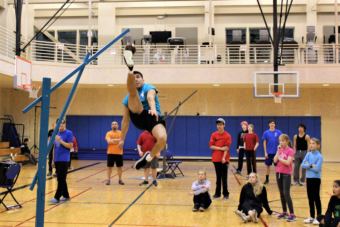
Kyle Worl demonstrates the One-Foot High Kick, an event in the Native Youth Olympics, in 2017. (Photo by Adelyn Baxter/KTOO)

Sealaska Heritage and Central Council of the Tlingit and Haida Indian Tribes of Alaska will offer free classes for anyone who is interested in becoming a Native Youth Olympics coach. The organizations are based in Juneau, but anyone with internet access can sign up because, for the second year in a row, the training is virtual.

Juneau resident Kyle Worl has been coaching NYO for four years. He said the games are based on hunting and survival skills that allowed the Inupiaq people to live in Arctic conditions, like the One-Foot High Kick.

“[That] is a high jump where you kick a suspended seal skin ball target,” Worl said. “It was used long ago, not only as a game but also as a form of communication across the Tundra. So a high kick could signal a successful or unsuccessful hunt.”

An athlete participates in the One-Foot High Kick during the 2021 Traditional Games in Juneau.
An athlete participates in the One-Foot High Kick during the 2021 Traditional Games in Juneau. (Photo courtesy of Kyle Worl)

There’s also a Seal Hop which is based on a technique used to sneak up on seals laying out on the ice. Alaska isn’t the only place where the games are played either. Worl said they reach as far as Canada, Greenland and Russia.

“But in other places they’ll refer to it as Inuit Games or Arctic Sports,” he said. “So they’re games that draw origins really from across the Arctic.”

More than 100 different Alaskan communities participate in the games. Worl said by offering virtual coach training, he hopes to bring it to more places. So far, people have registered for it from six different time zones across North America.

The training is available in two parts on Monday and Tuesday or as a single session on Saturday, Oct. 16. Worl said he’s found coaching to be very rewarding.

“You’re providing support for youth and a healthy outlet for them,” Worl said. “It also keeps me involved with my community, keeps me healthy. We encourage anyone who may be interested to join us.”

Registration will remain open until the day before for each training session. The link to sign up is available on the Sealaska Heritage Facebook page

The next event scheduled for Juneau is the 2022 Traditional Games. Those will take place April 2-3, 2022 at Thunder Mountain High School.

Juneau brings back penalty for violating COVID safety rules

A blue sign with off white lettering that says: "Masks & physical distancing required" in all capital letters.
A sign in Juneau reminding people about mask and physical distancing requirements. (Bridget Dowd/KTOO)

A lot of people turned out at Juneau’s special Assembly meeting last week to comment on the proposal to extend the city’s  COVID-19 mitigation strategies. Most of those opposed were upset over an added penalty for those who don’t comply with mask mandates or other policies.

When the Assembly voted to extend the safety measures, they also approved the use of a $25 fine for violators. While that was alarming to some, Juneau Emergency Manager Robert Barr said the city’s had it in place before. 

“The penalty section has been there in every iteration of the strategies so far, except for the last one,” he said.

By the last one, he means the set of strategies that expire at the end of October. But, even though the penalty has been an option in the past, no fines were ever issued. Barr said 90% of the time, just educating people about the policy and reminding them to follow it, is all that’s necessary.

“But those conversations with people about complying with the mitigation strategies were a little bit more challenging to have when we didn’t have that enforcement option,” Barr said.

That’s why city officials asked the Assembly to put the penalty section back in, which led to a debate amongst Assembly members, like Michelle Hale, during last week’s meeting. 

“I’m really torn by this,” Hale said. “I understand what staff is saying about the advantage of having the penalty. I’ve also spoken with a lot of people today and gotten a lot of information from people who really feel that the penalty goes too far.”

Hale went on to say that most of the city’s transmission had been in private gatherings and among families, where a compliance officer wouldn’t be going anyway.

The city also has civil enforcement options for businesses that don’t comply, but those steps have never been used either. The city says if anyone would like to report non-compliance, they can email covidquestions@juneau.org.

Site notifications
Update notification options
Subscribe to notifications