I keep tabs on what’s happening in Juneau’s classrooms for the families they serve and the people who work in them. My goal is to shine a light on both stories of success and the cracks that need to be filled, because I believe a good education is the basis of a strong community.
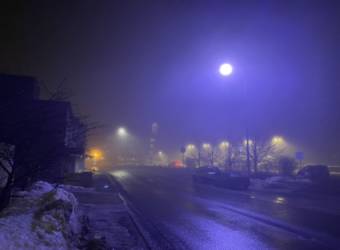
A street light near the Juneau Public Library glows purple on Sunday, Jan. 23, 2022. (Photo by Bridget Dowd/KTOO)
On a foggy Sunday night in Juneau, the corner of Ferry Way and Marine Way is made eerie by a violet glow coming from a nearby street light. It’s just one of several lights around town that have changed colors.
A Curious Juneau listener saw these lights around the city and asked KTOO why the lights have a dark purple hue. As it turns out, the color is a mistake and the state is working to fix it.
Juneau resident Max Stanley said he and his girlfriend noticed the lights in October when they were driving toward Thane.
“At first we wondered if it’s something for Halloween,” Stanley said. “As we continued to drive, we realized it’s just — all the street lights have this hue.”
Stanley said over the next few weeks, they noticed the same purple hue coming from several other street lights all over town.
“It’s pretty noticeable sometimes when there’s one of the purple ones and then right after an older white one,” Stanley said. “So we just were wondering why there are these new purple-hued lights around town.”
The Alaska Department of Transportation and Public Facilities maintains a lot of Juneau’s street lights. Spokesperson Sam Dapcevich said the lights actually aren’t new at all and the purple hue isn’t intentional.
“The purple hue in the LED lights is caused by a computer chip issue, possibly a defect,” Dapcevich said.
“It was occurring in quite a few places around the country,” Dapcevich said. “It appears that most of the LED street lights have three colors. They have yellow, red and blue and the yellow color is failing.”
Of course, when red and blue mix, the resulting color is purple. Dapcevich said most of the lights are less than 5 years old. They’re still under warranty, so the manufacturer should cover the cost of fixing them as well – though he didn’t have an answer as to when that would happen.
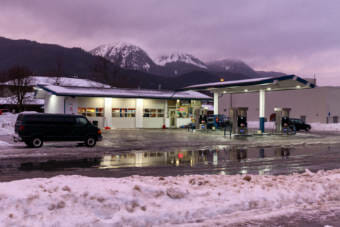
The full service Capital Service gas station in downtown on Tuesday, Jan. 11, 2022, in Juneau, Alaska. (Photo by Rashah McChesney/KTOO)
An atmospheric river is currently passing over Southeast Alaska and the rain doesn’t show any signs of letting up for Juneau residents this weekend. Showers will be especially heavy from Saturday night through Sunday morning with three to five inches falling in that time.
Kimberly Vaughan with the National Weather Service in Juneau said there’s a flood watch in effect for the area through Saturday night due to the heavy rain and increased snowmelt.
“We’re already seeing a lot of standing water on roadways and other surfaces due to poor drainages or blocked drainages from the cold weather and ice and snow that we’ve had so far this winter,” Vaughan said.
Excessive runoff could lead to high water levels in creeks and streams. Vaughan said more snowmelt is expected because freezing levels are rising up to 2,000 – 4,000 feet.
The heavy rain on top of new snow in higher elevations is also raising concerns about potential avalanches. Avalanche danger was high Friday and likely to increase, according to an advisory that’s updated daily by Juneau Emergency Programs Manager Tom Mattice.
Mattice said people should avoid the Flume Trail over the weekend and stay out of the gated areas above the Behrends neighborhood. Natural avalanches are likely this weekend and human-caused slides are more than likely.
A little before 3 p.m. on Friday, Mattice reported on social media that there were slides over Behrend’s Avenue and Thane Road. He described both as good news, limiting the potential for bigger slides later. Thane Road remains open.
Daytime temperatures will be in the lower 40s and nighttime temperatures won’t fall much, staying in the upper 30s.
This story has been updated to add information about small avalanches that occurred Friday afternoon.
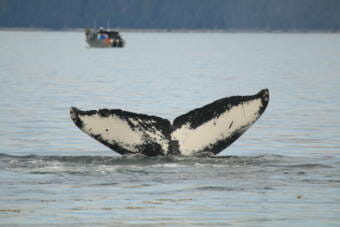
Flame, whose tail is pictured above, is one of Juneau’s most frequently spotted humpback whales in recent years. (Photo courtesy of Brianna Pettie)
There’s about to be a new resource to educate locals, tour guides and visitors about the humpback whales of Southeast Alaska.
A larger list of all the individual humpback whales that have been spotted swimming around Juneau already exists, and just about every local whale watching outfit has a copy on board. But a group of marine mammal enthusiasts is working on a simplified version.
Shannon Easterly is a local whale watching guide in the summer, and she’s been working with marine mammals all over the country for about 10 years. For the past few months, she and three others (Gabrille Lopez, Brianna Pettie and Jayleen Bydlon) have been working on making a new, condensed catalog of humpbacks.
“The goal of the project is basically to make a mini catalog,” Easterly said. “[We want] to take that well over 100 whales and shrink it down to about the 20 most commonly sighted whales in Juneau.”
The new catalog will have fewer individuals in it, but will have a lot more information about each whale. Easterly said they hope to provide tour guides with more detailed profiles of Juneau’s most frequently spotted flukes — also known as whale tails.
“So a great example would be one of our whales, Flame,” Easterly said. “She is probably the most commonly sighted whale in Juneau waters in recent years. The photo of her in the catalog is great. There’s a little bit of information about her. [It] says that she’s a known female, things like that. But what we really want to do is build something that doesn’t just include that, but also includes information like ‘Is that whale a whale the breeds in Hawaii or in Mexico?’”
Gabrille Lopez photographs a humpback whale in Auke Bay. Lopez is one of four people working on creating a new catalog of Juneau’s most-sighted humpback whales. (Photo courtesy of Shannon Easterly)
For instance, Flame is a whale that breeds in Hawaii, and she’s been sighted in Maui.
“And we also know that she has had calves in at least 2013, 2016, 2019, 2020 and 2021,” Easterly said. “[Flame] is a prolific lady.”
The new catalog will also include facts like where the whale was first recorded, where it’s most commonly seen feeding and which other animals it hangs around with.
“Are they typically seen alone? Like, Flame prefers to be alone,” Easterly said. “It’s also fun to talk about the fact that she doesn’t really like killer whales and will actively avoid them or be aggressive toward them. Those little personality quirks that set one whale apart from another are some of the things that we want to include.”
All of the photos in the catalog were taken by one of the four guides and researchers working on the project. A lot of the data comes from a citizen science website, managed by Duke University, where anyone in the world can contribute information about their own whale sightings.
Easterly said she hopes knowing more about Juneau’s whales will help both tour guides and tourists make more meaningful, personal connections with the animals.
“It’s on everybody’s bucket list to see a whale, and we want you to take that home — not just with a pretty picture, but with a story about that animal and to know who they are, so that it’s an important part of your trip and [so it will] maybe inform your decisions conservation-wise moving forward,” Easterly said.
So far, the mini catalog is 42 pages long, with each animal having two pages dedicated to it. When it’s finished, the catalog will likely be distributed in Facebook groups for local whale watch guides and other social media sites.
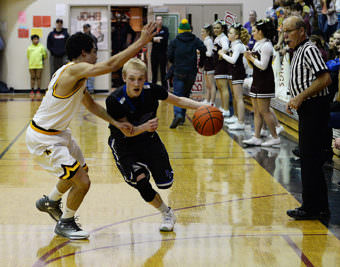
Juneau’s high school basketball and hockey players no longer have to wear masks while playing the game. (Photo courtesy Klas Stolpe)
Juneau’s high school basketball and hockey players no longer have to wear masks while playing the game.
Juneau School District Superintendent Bridget Weiss granted the exception earlier this week, saying those athletes can instead participate in increased testing. She said the alternative will be available as long as the district also has enough supplies to maintain its test-to-stay policy.
“[That’s] because our very first priority is keeping kids in school, and our test-to-stay protocol allows that to happen now where it didn’t before,” Weiss said. “We don’t have to quarantine students when they become a close contact because we have access to testing.”
Bridget Weiss is the superintendent of the Juneau School District. (Photo courtesy of Bridget Weiss)
The change only applies to players who are actively participating in one of the two sports. That means coaches and athletes seated on the bench still have to wear face coverings.
“Conditions change,” Weiss said, “but for now, even with the increased pace of omicron working its way through our community, we feel like the testing protocol is actually a better mitigation strategy than the masks because if somebody is positive, we will catch them earlier.”
To play in home games unmasked, athletes will take a rapid test the day of the event. For away games, traveling players will need to test negative within 48 hours of the trip using the more accurate PCR test. Players will be testing two to three times a week with those requirements, so they will not have to test for each day of practice.
These rules apply to both vaccinated and unvaccinated student athletes. The only exception to the testing rule is if a player has had COVID-19 within the last 90 days.
During Tuesday’s school board meeting, Thunder Mountain High School’s boys’ basketball coach John Blasco said he supports the change because the athletes can’t perform at their best while wearing masks.
“I’ve had players have masks get knocked off and they have to pick ‘em up and catch up to the game,” Blasco said. “We preach communication, and when you’re playing the game of basketball, it’s not a simple conversation, it’s loud yelling and every time you yell loudly your mask falls off.”
Blasco said his team did experience a COVID-19 outbreak over winter break, but the spread didn’t happen on the court.
“It came [from] elsewhere, and we are working to improve mitigation measures off the court,” Blasco said. “[It was] very unfortunate but we caught it and we shut down and protected the kids within the program.”
During the same school board meeting, member Emil Mackey said he was worried about students putting themselves at risk in other ways during team trips.
Emil Mackey poses for a portrait at KTOO on Sept. 7, 2018 (Photo by David Purdy/KTOO)
“Numerous social media posts have been screen grabbed and sent to me (and probably others too) of players off the court taking selfies unmasked in Las Vegas or wherever they’re at,” Mackey said. “That’s a concern because that’s a violation of our strategy.”
Superintendent Weiss said the district was looking into travel practices and would bring back some rules that were in place earlier in the pandemic, like having fewer students per hotel room. But she also admitted that coaches only have so much control over off-the-court student behavior.
In addition to the increased testing for all students who want to play unmasked, weekly PCR testing is still required for all unvaccinated athletes and coaches.
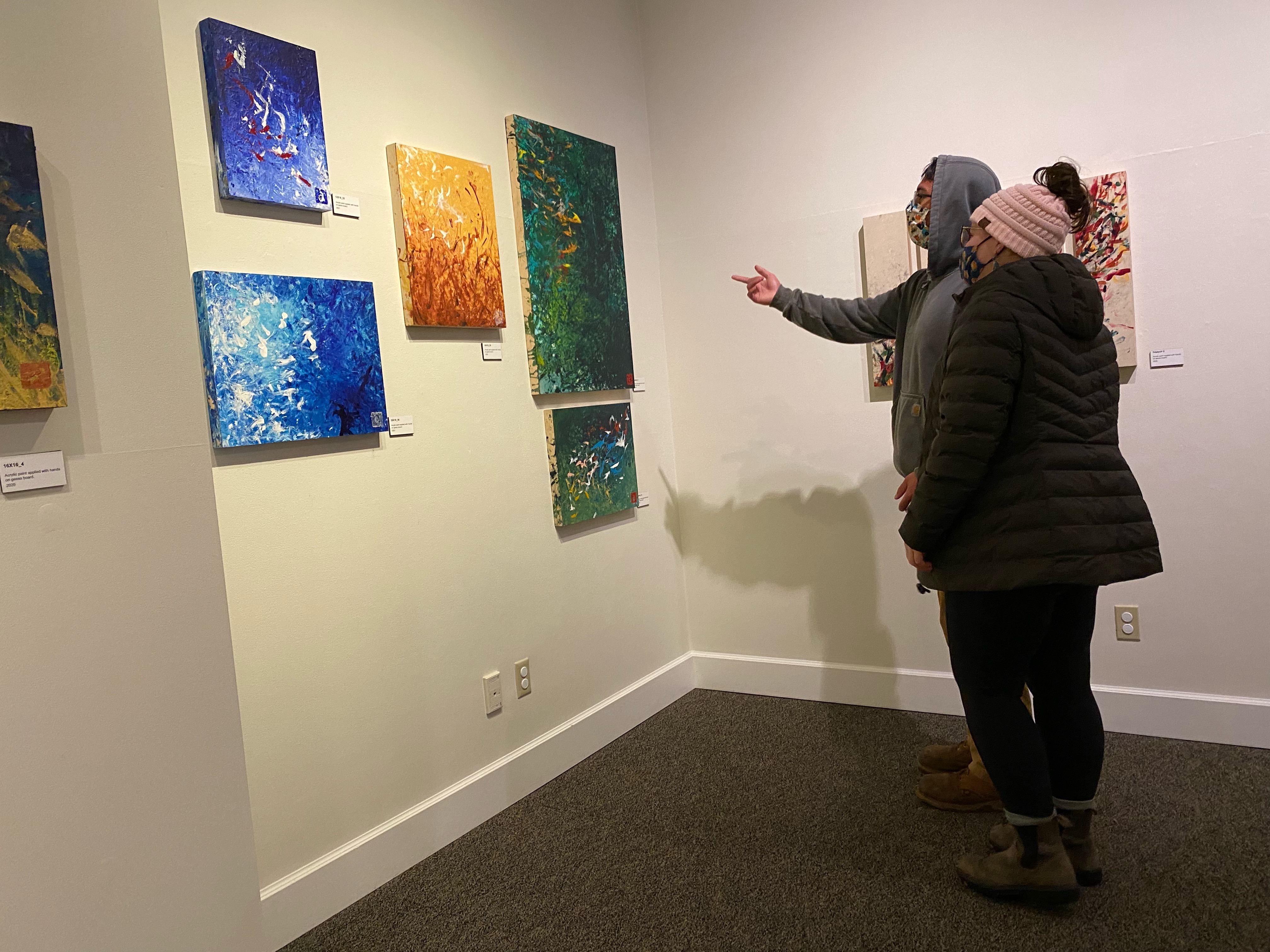
Museum-goers examine the artwork of Avery Skaggs at the Juneau-Douglas City Museum on Friday, Jan. 7, 2022. (Photo by Bridget Dowd/KTOO)
The walls of the Juneau-Douglas City Museum were covered in canvases splattered with brightly colored paint on Friday night. It was a stark contrast from the dark, gray city outside.
Avery, who did not attend his opening reception due to COVID-19 concerns, is in a wheelchair and he’s nonverbal. But he communicates in other ways, like through facial expressions, noises and his art.
Avery Skaggs is a Juneau artist who is nonverbal and uses a wheelchair. His hand movement is limited, but he paints with his fingers. (Photo courtesy of Josh Smith)
“He is very expressive when he paints,” Lea said. “It’s like you can tell that he’s enjoying the process and I think a lot of the paintings just kind of show that expression because you can see that there’s a lot of movement involved in creating these things.”
Josh Smith is Avery’s case manager at TIDES LLC, which provides home and community-based services to people with intellectual and developmental disabilities.
“His hand movements are limited in terms of fine motor capacity,” Smith said. “For example, he doesn’t have the ability to pick up an object and maintain a grasp of it. He can pick up an object briefly and move it away from him.”
Avery gets some help with setting up his workspace, but the pieces he creates are 100% his own work.
“When it comes down to the strokes that you see on any given piece, that’s all Avery,” Smith said. “It’s a sensory experience for him. He enjoys the feeling of the paint on his fingers. He enjoys the sensations of manipulating the paint across a surface or a canvas.”
All of the paintings displayed in the exhibit were created during the pandemic when, much like the rest of the world, Avery’s routine was interrupted.
“[Avery’s] way of producing his artwork drastically changed,” Smith said.
For at least a decade, Avery spent four days a week at a community art space downtown, but when businesses across the world closed their doors, so did the art studio.
“Staff at TIDES had to problem solve how Avery was going to be able to engage in his passion,” Smith said.
A new exhibit at the Juneau-Douglas City Museum features paintings created by local artist Avery Skaggs. Skaggs is in a wheelchair and is non-verbal, but expresses himself through art. (Photo by Bridget Dowd/KTOO)
There were a few hiccups for Avery’s caretakers as they took on an aspect of his care that they weren’t used to, but eventually, they found their groove.
“[Avery has] created an absolutely beautiful body of work during this time, which is, specifically in my mind, characteristic of his adaptability,” Smith said. “I think the pieces speak to the dramatic changes that have occurred.”
Avery’s paintings will be displayed at the Juneau-Douglas City Museum through Jan. 28 and all of them are for sale.
Maddie Bass watches as Zara Ritter ties her shoe during an art class on the first day of school at Dzantik’i Heeni middle school on Monday, August 16, 2021, in Juneau, Alaska.
In the last week, the U.S. recorded 1 million new COVID-19 cases. Across the country, districts are reporting staff shortages, a lack of tests and safety equipment like masks and air purifiers. Some districts don’t have enough bus drivers to transport the students to and from school.
KTOO’s Bridget Dowd spoke with Juneau School District Superintendent Bridget Weiss on Friday about what it takes to keep schools open during a surge of new COVID-19 cases.
Read a transcript of the conversation with minor edits for clarity.
Bridget Dowd: Let’s jump right in. How are you getting ready for schools to open their doors on Monday?
Bridget Weiss: Well, we are ready. We have staff, obviously, in in-service yesterday and today. As we look at Monday, we’re prepared. We have all of our protocols in place. We’re ready to start a new semester at our secondary schools. At our elementary, of course, it’s just a continuation. So we’re excited to get kids back!
Bridget Dowd: Do you have any teachers or staff members who are out due to contracting COVID-19 or being exposed to it?
Bridget Weiss: We certainly have had positives reported to us in the last week, both students and staff, I don’t have specific numbers. I’ve not had a large number of teachers, particularly, certainly some staff that have been positive in the last week. But there’s really no way of knowing, until we get to Monday, for sure if staffing is going to be an issue or not. We’ll be all hands on deck.
The Juneau School District is offering antigen tests as an alternative to quarantines for students who’ve been exposed to someone who tests positive for COVID-19. (Photo courtesy Bridget Weiss)
Bridget Dowd: And as you might know, in Kodiak, the high school district had to close for three days because of employee absences. Given the sharp rise in positive cases in Juneau – are you prepared to handle teacher and staff shortages?
Bridget Weiss: We are, as best as anybody is. We don’t have a lot of substitutes, but we have worked all fall to create a bigger pool of substitutes. We’ve designed a system where we have some district-wide staff that are armed and ready, prepared to sub in buildings. We also offer pay to teachers, for them to sub during their prep periods at secondary — it’s by choice, but we also have that program created so we’ve really done everything that we can to prepare and to have as much human resource ready in case.
We also have other major systems that operated all last week. Anchorage has sustained themselves, Kenai, Fairbanks. So we also are seeing lots of districts be able to sustain their operations.
Bridget Dowd: What factored into your decision to return in-person instead of remote learning? Was there any pushback?
Bridget Weiss: No, everybody understands the importance of in-person learning. We are at a point in this pandemic that we need to continue to do every single thing possible to keep learning in person. We absolutely did our best from the beginning of this to serve students when they are not in our buildings, but the students’ experience is not the same. The hardship on our families when students are not in school is extraordinary.
We know a lot more about omicron right now, quickly, than we knew about either the original COVID or the delta variant early on. So we just have so many tools right now that we didn’t have a year and a half ago, even a year ago.
It’s important to remember that our community is highly vaccinated. Our staff is over 90% vaccinated and while we know that’s not a full barrier, it does make a big difference, in terms of illness and severity of illness, and with the new five-day quarantine guidance from CDC that will help us. We’re masking. Other communities are not masking the same as we are. We’re just relying on all of those tools to help us — pun intended — weather this most recent storm of the pandemic.
Bridget Dowd: Obviously, it’s difficult, especially during these times to predict the future, but do you foresee any situation in which you would return to remote learning?
Bridget Weiss: Well, yeah you’re right. I wish I had a crystal ball. I just don’t know. We know that we may be limited with staffing at some point in time. What I do believe is that if we get to that point in a building, we may have to make a building decision.
I do not foresee a reason that we would have to shift the whole district to remote learning. We may have to do something at a school for a short period of time. I just don’t know that yet. You know, we are literally going to take this as we have so many times — day by day, week by week, school by school, and you know, communicate with parents.
Bridget Dowd: Other school systems are running into problems with outbreaks among transportation staff? Do you know if buses will be running normally? Obviously, the weather will factor into that as well
Bridget Weiss: Weather is gonna factor into transportation, but we’ve been very fortunate, and again, it’s because we’ve made these really good decisions along the way. We’ve been able to have lower levels of COVID in our sites, because we have for, now, a couple of months instituted a testing requirement. So we tend to catch cases earlier than we would otherwise. So the amount of exposure is limited and that has helped. We are testing our First Student drivers — anyone that’s unvaccinated. So I don’t anticipate huge issues there.
We certainly are minimally staffed. We don’t have a lot of cushion just like everyone in the country, there just doesn’t seem to be enough human resource to fill positions and that makes us vulnerable like everybody else. But for now, I don’t have any reason to be panicking or foreshadowing, closures based on personnel.
Bridget Dowd: Andin Chicago this week, teachers refused to teach in person due to safety concerns. What are you hearing from teachers?
Bridget Weiss: Everyone is watchful, but I have gotten a strong sense from staff that they’re ready, they’re prepared, they’re excited to get started again, we have not gotten major pushback, we certainly made some adjustments to in-service today, to allow for people in some settings to virtually attend their training and so forth. We used large spaces. So I think by and large staff feels very supported through the decisions that we’ve made and the mitigation that we have in place.
Bridget Dowd: Just before the winter break, the Juneau School District moved from isolation and quarantine to a test-to-stay policy. Does the district still have a supply of rapid tests and how are you using them?
Bridget Weiss: We feel pretty good about our supply and there’s a pretty good state supply we’ve been told and we’re using them the same way. So we adjusted our “test to stay” program based on the new guidance. So we’ll provide that testing for families or staff, any close contact for that five-day window for close contacts versus the seven, eight days that it was before.
Bridget Dowd: You mentioned earlier that the district’s staff vaccination rate is more than 90%. Public health officials have consistently said that vaccinating students (to the extent that they can be vaccinated) is the best way to prevent severe COVID-19 infections. Do you know the vaccination rate among students?
Bridget Weiss: It hasn’t been provided for the younger students, but for our 12 to 18-year-olds, the number was very high in Juneau, in the 90 percentile.
Bridget Dowd: We talk a lot about students and teachers, but what about you? How are you keeping safe? Do you ever worry about getting sick?
Bridget Weiss: I use all the same protocols that we provide for staff. So I take advantage of our testing program, I adjust as we get more information. So with this omicron as an example, I ordered my own personal set of KN95 masks from Amazon so that I could upgrade my mask from what I had been wearing. I ordered, by the way, a bunch of KN95 masks that should be in next week, so that I could provide them to buildings for staff to use.
I try to distance myself, as much as I can, when I’m out and about in schools. I use hand sanitizer when I come in and out of schools, like I hope everybody is, so because I’ve taken advantage of every mitigation possible, I feel, you know, pretty safe. And I wouldn’t want anything less for any of our staff.
Bridget Dowd: Alright that’s Juneau School District Superintendent Bridget Weiss. Bridget, thanks for taking the time today.
Bridget Weiss: Absolutely. No problem. You have a great day.
Bridget Dowd: You too.
Close
Update notification options
Subscribe to notifications
Subscribe
Get notifications about news related to the topics you care about. You can unsubscribe anytime.