Bridget Dowd

Local News Reporter

I keep tabs on what’s happening in Juneau’s classrooms for the families they serve and the people who work in them. My goal is to shine a light on both stories of success and the cracks that need to be filled, because I believe a good education is the basis of a strong community.

The season’s most significant snowfall could hit Juneau over New Year’s weekend

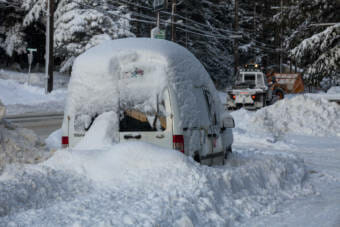
A van buried in snow along the Douglas Highway on Dec. 22, 2021, in Juneau, Alaska. (Photo by Rashah McChesney/KTOO)

Juneau could see its most significant snowfall so far this season between New Year’s Eve and New Year’s Day. A winter storm watch will be in effect for the entire Alaska Panhandle. The National Weather Service says 6-16 inches of snow is expected in the capital city. 

Flakes will begin falling Friday morning and should taper off early Saturday as the system moves south.

Kayla Tinker with the National Weather Service in Juneau said the heaviest snow will hit the city overnight as people ring in 2022. 

“Be careful when moving heavy snow,” Tinker said. “This snow is probably going to be wetter than what we’ve been seeing and be careful on the roads just because we do have the heavy [snowfall] rates overnight on New Year’s Eve.” 

Near-freezing temperatures are expected on both days. Juneau city officials are also reminding drivers not to park their cars on certain streets to avoid being towed during snow removal operations. Towing will begin at 8 p.m. each night and snow blowing will start after vehicles are moved.

There will be yellow “no parking” signs in those areas to warn drivers. Vehicles that do get towed will be taken to the Whittier Street parking lot near Centennial Hall.

Kids help take care of chickens spending their first winter at Juneau’s youth center

10-year-old Warren Ploof holds one of the Zach Gordon Youth Center hens.
10-year-old Warren Ploof holds one of the Zach Gordon Youth Center hens. (Bridget Dowd/KTOO)

Half a dozen chickens are enjoying their first winter at a community space in Juneau that’s become their new home.

On a dark, 20-degree afternoon in Juneau, the Zach Gordon Youth Center is bustling. Just a few steps from the front door sits the center’s recreation coordinator Amanda Lovejoy.

“It’s a great place,” she said. “Kids get to come in [and] they can do their homework, they can hang out with their friends. We have a lot of resources we can connect youth with.” 

Lovejoy is usually in charge of sports programs and scholarships, but lately, she’s earned an additional job title — the “chicken expert.” 

“I used to have chickens,” Lovejoy said. “I had three chickens for several years. So it was just natural for me to slide into it here.”

Inside a small gated area behind the youth center, she’s greeted by six hens strutting over frosted hay. Because this is Alaska, they have a heated water bowl and a cozy henhouse, illuminated with red lights.

The Zach Gordon hens have access to a heated water bowl and a cozy henhouse, so they can stay comfortable during the winter.
The Zach Gordon hens have access to a heated water bowl and a cozy henhouse, so they can stay comfortable during the winter. (Lyndsey Brollini/KTOO)

“The fun thing is watching them run,” Lovejoy said. “They really do look like little dinosaurs when they’re running.”

The youth center took them in as chicks earlier this year and the now fully grown hens are not just for show. They’re here to serve a purpose. 

“The purpose is to have the eggs, really,” Lovejoy said. “The kids are involved in taking care of them and coming in and spending time with them and helping raise them. It’s been fun for everybody.”

The kids who come to Zach Gordon after school bring the hens treats and scour the chicken coop for eggs, but Lovejoy still does the dirty work, like cleaning up poop. 

Back inside, some of the youth center’s biggest chicken enthusiasts are climbing the youth center’s indoor rock wall. One of them, 10-year-old Warren Ploof, is eager to chat about the center’s resident farm animals.  

“I like going out there and petting them and picking them up,” he said. “I like the white one. Its name is like Mocha or something.”

Warren also loves going outside to look for eggs.

10-year-old Warren Ploof pets one of the hens living at the Zach Gordon Youth Center in Juneau.
10-year-old Warren Ploof pets one of the hens living at the Zach Gordon Youth Center in Juneau. (Bridget Dowd/KTOO)

“We once found like 21 [eggs] or something at the same time because they hadn’t checked it in a while,” he said. “They have a little nest and [the hens] just lay the eggs in there.”

Warren is no stranger to being around chickens either. His family used to have some of their own. Now, he gets a kick out of hanging out with the Zach Gordon hens after school.

“Sometimes if you’re eating raisins, they crowd you or if you’re eating any food, they just crowd you,” Warren said. “It’s just fun because they jump on top of you and try to peck you.”

In the kitchen, volunteer Annie Bonino-Britsch pulls out a tray of eggs, all labeled with the date they were found. The youth center uses the fresh eggs to make meals for the kids and bake cookies with them. Bonino-Britsch said they’ve been trying different methods to get the hens to lay more eggs, like feeding them cayenne and red pepper flakes.

Staff members at the Zach Gordon Youth Center use fresh eggs from the center's chickens to make meals for the kids who spend time there after school.
Staff members at the Zach Gordon Youth Center use fresh eggs from the center’s chickens to make meals for the kids who spend time there after school. (Lyndsey Brollini/KTOO)

“Chickens don’t have the taste buds to taste spiciness,” Bonino-Britsch said. “So they can’t tell that it’s spicy, but it’s supposed to help them increase the number of eggs that they lay and improve the color and quality of the yolk.”

Warren said he doesn’t come to the youth center as often as he used to because he’s gotten busy with other after-school activities, but he still likes to visit the Zach Gordon chickens as often as he can.

Juneau city officials figuring out how to spend less-than-usual cruise ship tax money

Royal Caribbean’s Serenade of the Seas docks in Juneau on July 23, 2021.
Royal Caribbean’s Serenade of the Seas docks in Juneau on July 23, 2021. (Photo by Bridget Dowd / KTOO)

The number of large cruise ship passengers arriving in Juneau this summer was down about 90% from 2019, the last time the city saw a normal, non-pandemic cruise season. But the city took in per-person tax dollars for the 125,000 passengers who sailed into Juneau this year on a cruise ship, and now city officials are in the process of trying to determine how to spend those dollars. 

Juneau gets money from cruise passengers through three different fees: $5 per passenger from the state’s commercial passenger vessel fee, $3 from a port development fee and $5 from the city’s marine passenger fee.

City Manager Rorie Watt said they charge those fees because cruise ships are different from any other business in town.

“If you took that cruise ship and you said instead of a multi-thousand passenger ship, it was actually a hotel [and] the hotel was full every day of the summer and people came in and out, we would charge the hotel property tax,” Watt said. “We don’t charge the ships property tax. So we have this different process.” 

Over the course of a normal summer, Juneau sees about 1.2 million cruise ship passengers from large ships. This year, with tourism and the cruise industry still reeling from the pandemic, only about 125,000 of those passengers made it to the city.

That means revenue from passenger fees, too,  is down almost 90% from an average summer. 

Due to a court settlement with the cruise industry a few years ago, there are some limits on how that money can be spent, but Watt said it’s usually used for a mix of services and infrastructure projects.

“We open up seasonal restrooms, we hire crossing guards and we pay for visitor information services that coordinate a bunch of  volunteers,” he said. “We [also] produce maps and signage so people can find where they’re going.”

The city is asking for input from city departments and the public on how it should spend money from the marine passenger fees. That’s something they do every year.

Once people submit their ideas, Watt will draft a recommended list of projects. Then there will be a 30-day public comment period before it moves on to Juneau’s assembly for final approval. The deadline for submissions is Jan. 3. They can be sent to susan.phillips@juneau.org or the City Manager’s Office, attention Susan Phillips, 155 S. Seward Street, Juneau, Alaska 99801.

Icy roads, speed factored into weekend car wrecks in Juneau

South Franklin Street in Juneau after a series of snowstorms over Thanksgiving weekend on Nov. 28, 2021. (Photo by Jennifer Pemberton/KTOO)

The winter weather made for slippery conditions on Juneau’s roads over the weekend.

The Juneau Police Department responded to 10 car crashes between Saturday and Sunday. JPD Public Safety Manager Erann Kalwara said nine of those accidents involved a single car. 
“Five of them were vehicles that went in ditches or got high-centered on a snow berm, something like that,” Kalwara said.

Kalwara said most of the accidents were weather-related or because someone was driving too fast for conditions. One person died in an early Saturday roll-over crash, but it’s not clear what caused that accident. 

Kalwara said the number of incidents over the weekend is typical for one with alternating snow and rain. 

Most of the accidents that were reported to us in the [Mendenhall] Valley, a couple were out the road, several were in the area of the McNugget intersection and quite a few on Egan Drive,” she said. 

Most importantly, she said people need to slow down and put space between themselves and other vehicles. Sam Dapcevich with the Alaska Department of Transportation agrees.

DOT maintains most of Juneau’s roads and Dapcevich said they’re facing some uphill battles this year.

“Over the last five or six years, our budget for highways and aviation has been reduced and so we have fewer staff and less equipment available to respond than we did in years passed,” he said. 

Snowplows are on the roads at four in the morning when the winter weather hits. Dapcevich said they’re taking steps to try and be more efficient as well, like using a tow plow. 

“The tow plows can operate quite a bit more efficiently because they take care of multiple lanes in one pass. It has a 26-foot plow basically that reaches across the highway and saves time, allows us to free up resources for other routes,” he said.

He said drivers should give themselves plenty of time to get where they’re going and give snowplows plenty of space on the road. 

Juneau schools offer antigen tests as alternative to quarantines for students who’ve been exposed to COVID

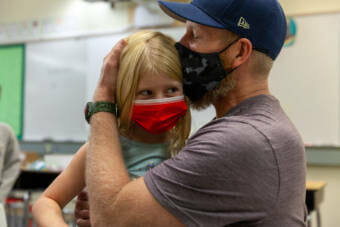
Sophie Griffith, 5, gets a kiss from her dad, Scott Griffith, after getting her COVID-19 vaccine during a pediatric clinic at Riverbend Elementary School in Juneau, Alaska. (Photo by Rashah McChesney/KTOO)

The Juneau School District is no longer requiring students to quarantine at home after being exposed to someone who tests positive for COVID-19.

Instead, families now have the option to use antigen tests before sending their kids out the door.

The school district has received 850 antigen tests from the state. Those tests are distributed to families on a case-by-case basis when students are exposed to someone who’s COVID-positive.

Juneau School District Superintendent Bridget Weiss said so far this month, that’s happened about six times.

“In each of those cases we were able to eliminate the need for students to quarantine,” Weiss said. “And so far, none of those tests have come back positive.”

In the past, when unvaccinated students were exposed, they had to stay home from school for seven days. They would get a PCR test for COVID-19 on the fifth day (to make sure they were clear) and could return to school on the eighth day.

Until recently, all elementary school students were unvaccinated, which meant frequent quarantines for classes in those grade levels.

Now, when unvaccinated students are exposed, the family can decide whether they’d like to quarantine or pick up antigen tests to use for the week.

Bridget Weiss Antigen Test Box
The Juneau School District is now offering antigen tests as alternative to quarantines for students who’ve been exposed to someone who tests positive for COVID-19. (Photo courtesy Bridget Weiss)

“We give [the tests] to the parents when we notify them that their child was a close contact, and they test their child before school,” Weiss said. “With a negative on that antigen test, then they can send their kid to school.”

Juneau Public Health still suggests those kids stay away from community activities during that time. If the student develops symptoms at any point during that period, they have to get a PCR test and they’re still required to get a PCR test on the fifth day, even if they don’t develop symptoms.

So what’s the difference between an at-home antigen test and a PCR lab test? Juneau Emergency Manager Robert Barr said a PCR test is much more sensitive.

“By sensitive, I mean it requires a lot less of the virus in the sample to return a positive result, whereas an antigen test is not as sensitive,” Barr said. “So you need more of that virus on the specimen in order for it to return a positive result.” 

A PCR test will detect COVID-19 sooner than an antigen test, but Barr said that doesn’t mean antigen tests aren’t as good. 

“It’s generally thought that the amount of viral load that you need to be infectious, correlates pretty well with the sensitivity of antigen tests,” Barr said. “So while a PCR test might detect you a little bit sooner, even before you’re infectious, antigen tests are pretty good at detecting you once you are infectious.”

Both tests require a nasal swab. The hope is that as more students get vaccinated, and as long as they don’t show any symptoms, fewer families will have to worry about testing at all.

During the first round of city-run vaccine clinics for children five and up, 648 kids received a shot. Second-dose clinics for those children will begin Nov. 29.

Ketchikan’s school district announced Wednesday night that it would also start a test-to-stay program.

With reading and writing close behind, Juneau’s school board approves spoken Lingít teaching standards

Yeeskanaalx Tláa, cultural specialist at Sayeik Gastineau Community School puts the finishing touches on an eagle formline background she made for students who are attending in-person classes on Thursday, Jan. 14, 2020, in Juneau, Alaska. (Photo by Rashah McChesney/KTOO)
Yeeskanaalx Tláa, cultural specialist at Sayeik Gastineau Community School puts the finishing touches on an eagle formline background she made for students who are attending in-person classes on Thursday, Jan. 14, 2021, in Juneau, Alaska. (Photo by Rashah McChesney/KTOO)

Juneau’s board of education has approved new oral narrative standards for its Tlingit Culture, Language, and Literacy program. 

These are the first oral narrative standards to be developed for Lingít language to be taught to school children.

The literacy program is available to kindergartners through fifth graders in the Juneau School District. It requires an application and acceptance through a lottery process.

The school district has been working with community partners like Sealaska Heritage Institute, the Douglas Indian Association, and Goldbelt Heritage Foundation to foster the revitalization of Lingít language.

Before the school board’s vote last week, Director of Teaching and Learning Support Ted Wilson said the new standards were an important step in a long journey.

“We also have representatives from preschools and from UAS so that we can talk about what the curriculum looks like all the way through from when you’re tiny until you are in college,” Wilson said.

He said they’d like to see the program expand to other grade levels, but aren’t sure when that would be possible, considering they’d need to develop a number of fluent speakers who can teach it in order to do that.

The final reading of the standards during the school board meeting prompted several emotional responses from the public and board members, including new member Amber Frommherz. “I’m Diné from Arizona and this is a gift that you are presenting to probably many families who are not able to share it as much as we want to,” Frommherz said. “I would love to teach my children our language, but I was not taught my language.”

Paul Marks also spoke at the meeting, thanking the board, first in Lingít.

“I just want to say thank you to all those that are working toward a standard of our people to be taught to our children,” Marks said. “Our elders are the ones who taught us and they taught us so that we would teach our children.”

The district and its partners are working on developing a reading and writing curriculum for the program.

Site notifications
Update notification options
Subscribe to notifications