Bridget Dowd

Local News Reporter

I keep tabs on what’s happening in Juneau’s classrooms for the families they serve and the people who work in them. My goal is to shine a light on both stories of success and the cracks that need to be filled, because I believe a good education is the basis of a strong community.
Sculpins with eggs on their heads: A sea creature mystery is afoot on Juneau’s sandy beaches

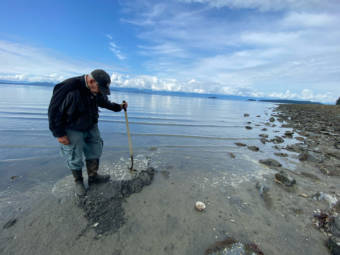
Bob Armstrong is a retired fisheries biologist who still spends a lot of time observing Juneau’s marine life.
Bob Armstrong is a retired fisheries biologist who still spends a lot of time observing Juneau’s marine life. (Photo by Bridget Dowd/KTOO)

Strolling along one of Juneau’s sandy beaches, you might see footprints, remnants of bonfires, or a variety of birds. But what about what’s underneath the sand?

To answer that question, retired fisheries biologist Bob Armstrong frequently makes the trek down a rocky hillside toward Eagle Beach. He left the Alaska Department of Fish and Game in 1984, but at 80 years old, Armstrong still spends a lot of mornings observing local marine life.

“One of my favorite things to do is just sit down here with a chair and a cup of coffee,” he said.

Stepping over layers of blue mussels, Armstrong makes his way toward the shore at low tide. He has a tripod over one shoulder, a shovel in the opposite hand, and a camera bag slung across his chest.

Two years ago, on a day much like this one, Armstrong saw something that surprised him.

Retired fisheries biologist Bob Armstrong wades through water at Eagle Beach, observing critters in the sand.
Retired fisheries biologist Bob Armstrong wades through water at Eagle Beach, observing critters in the sand. (Photo by Bridget Dowd/ KTOO)

“A raven would dig up quite a large [Pacific] Staghorn Sculpin, maybe up to a foot and a half long,” he said.

Often found in shallow seawater, sculpins are scaleless, bottom-dwelling fish with heads much larger than their tapered tails. Pacific Staghorn Sculpins live all along the Pacific Coast from Alaska to Mexico.

Armstrong said this one was buried in about a foot of sand when the raven got to it.

“The sculpin would flip about on top of the sand,” he said. “It was very much alive, which also surprised me because they were living out of water.”

But, the fish, now plucked from its shrouded bed of wet sand, wasn’t what the raven was after. Instead, the bird picked up a nearby clamshell, which was concealing two clusters of sculpin eggs.

“[The raven] would grab the eggs and then fly off probably to its nest to feed its young the sculpin eggs,” Armstrong said. “This happened on three different occasions and I didn’t realize exactly what was going on until I looked at the videos.”

That prompted him to do some research, looking through scientific literature on sculpins, only to find that what he’d seen wasn’t well known or documented.

“With sculpins, it’s usually the male that guards the eggs until they hatch,” he said. “What I suspected happening, was that the female would lay her eggs near or on the head of the male sculpin and then put a horse clamshell on top of it to protect it and this seems extremely bizarre. It just really excited me.”

As Armstrong continued to observe the critters, he ran into his former coworker and fellow retired biologist, John Palmes.

John Palmes is a retired Juneau biologist.
John Palmes is a retired Juneau biologist. (Photo courtesy of John Palmes)

“We’re both naturalists,” Palmes said. “We just really love nature. That’s our joy to go out there and look at that stuff and to understand it and try to figure it out.”

During their conversation, Palmes realized they’d both observed the same spectacle at different times on Eagle Beach: a disturbed area in the sand with a large horse clam shell sitting on top.

“Underneath the edge of the clamshell, I could see eyes,” Palmes said.

Retired biologist John Palmes used a photo of a sculpin in the sand to recreate what he saw when he found a horse clam shell on top of a sculpin's head.
Retired biologist John Palmes used a photo of a sculpin in the sand to recreate what he saw when he found a horse clamshell on top of a sculpin’s head. (Photo by John Palmes)

“So I just flipped the shell over and underneath there was a sculpin with a big mass of eggs on its head,” Palmes said. “They were molded to the shape of the shell.”

Palmes knows a lot about fish, but he’s never seen anything like this.

“This sculpin thing is so cool because it is so weird,” he said.

Retired biologist John Palmes turned a horse clam shell over (A) to reveal a sculpin (B) that was hiding its eggs inside the shell.
Retired biologist John Palmes turned a horse clamshell over (A) to reveal a sculpin (B) that was hiding its eggs inside the shell. (Photo by John Palmes)

After seeing it again at another beach, Palmes started to wonder if the event had something to do with the tides.

Birds fly over the shoreline at low tide on Juneau’s Eagle Beach in July 2021.
Gulls fly over the shoreline at low tide on Juneau’s Eagle Beach in July 2021. (Photo by Bridget Dowd/KTOO)

“I think they lay their eggs and they dig themselves in, so that they’re pretty much free of predation for the time when the beach is nearly exposed,” he said. “The other thing that happens is they’re in warmer water. The sun provides higher temperatures and warmth to incubate the eggs. So I think that’s all part of the plan.”

Palmes said he can’t know for sure yet, but it would make a lot of sense. By sharing his observations, he hopes other beach-goers will keep an eye out for the phenomenon.

“It’s just a wonderful thing to do and it feeds you,” Palmes said. “The Lingít people say ‘when the tide is out, the table is set’ and it’s true.”

Armstrong and Palmes don’t have any plans to formally research this sculpin behavior, but with the help of some citizen science, Palmes said they might be able to solve this sea creature mystery just for fun.


Back in session: How the UAS campus looks different this year

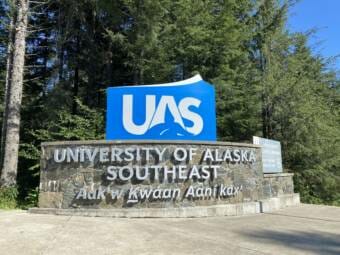
Photo of the UAS sign in Juneau
The University of Alaska Southeast campus is located near Auke Bay in Juneau. (Photo by Bridget Dowd /KTOO).

Monday was the first day of the fall semester at the University of Alaska Southeast and operations look a little closer to normal this year.

The University of Alaska Southeast campus in Juneau welcomed about 140 students at its new student orientation last week. The event was held in person this time instead of over Zoom, like last fall — where just dozens of students participated.

Lori Klein is Vice Chancellor for Enrollment Management & Student Affairs at the school. She said they’re offering a mix of online and in-person courses, whereas most classes were online last year.

Headshot of Lori Klein
Lori Klein is Vice Chancellor for Enrollment Management & Student Affairs at the University of Alaska Southeast. (Photo courtesy of Lori Klein)

“There’s a lot of great energy on campus today,” Klein said. “It feels really good. The students are really engaged with each other and with the staff. So here we are – we’re off and getting ready to go and very excited.”

Masks are still required at school-sponsored events and on campus — except inside students’ private residences — and social distancing is encouraged when possible. All 200 or so students living on campus were required to get a COVID-19 vaccine unless they’ve been approved for an exemption.
“This is a process we have available for all of our vaccines,” Klein said. “If you live on campus, there’s a wide number of vaccines that we require you to have, not just COVID. But we follow the State of Alaska religious and medical exemption process. So students fill out a form and have it notarized and provide that.”

More students are able to live on campus this year, but some rooms are still reserved for “quarantine housing.”

“We’ve carved out housing available to relocate students who have been exposed to someone who is COVID positive or who get sick themselves,” Klein said. “[It’s] a space on campus where we can still provide them all of our services, but it allows them to either wait out test results or isolate, should they test positive.”

Nearly 1,200 students are enrolled this year, down about 5% from last fall. Klein said there was a bit of an artificial bump in enrollment at that time, due to COVID.

“We think the difference is that so many people waited until the middle of August last year to make decisions,” Klein said. “When schools in other places decided to go online, a lot of students ended up staying in Juneau and so we had a huge influx of students who eventually went to other places and we don’t have that this year.” 

She said students were very compliant with COVID-19 mitigation measures last year and the school experienced very few outbreaks. Klein hopes that trend will continue this semester.

Juneau health officials ask community to help limit the spread of COVID-19: ‘Being tired of something doesn’t make it go away’

Updated — Friday, Aug. 20, 2:37 p.m.

The highly transmissible delta variant is taking a toll and Juneau’s incident commander Mila Cosgrove said they want to get ahead of it. 

“We do not want to get into a situation where our hospitals are completely overwhelmed or we’re unable to keep up,” she said.  

Starting at 5 p.m. Friday, stricter mitigation measures will be in place. Indoor gatherings will be limited to 20 people —  masks are required and social distancing is recommended outside, but Cosgrove said some exceptions are possible. 

“We want to work with the community,” Cosgrove said. “We don’t want to stop life altogether, but right now, mixed groups of vaccinated and unvaccinated folks with masks off is not a very good idea.”

Vaccinated people are still testing positive at a lower rate than those who haven’t had the shot. They’re also less likely to be hospitalized or die from the virus. 

“We are tired of COVID too, but being tired of something doesn’t make it go away. We can’t wish it away. We are still very much in a pandemic and it’s not the time to let our guard down,” she said. 

Beginning Monday, there will be some changes to city services. Libraries will have reduced hours and there may be other changes, as the city reassigns staff members to emergency operations. 

At Bartlett Regional Hospital, beds are limited and they’re struggling to get seriously ill patients flown out of town. The hospital is looking to protect inpatient beds by suspending elective surgeries. 

Right now, Juneau’s test positivity rate — the number of positive cases compared to the total number of people tested — was 6%. That means there could be undetected COVID-19 cases in the community.

More than 82% of eligible Juneau residents have had their first COVID-19 shot, but regardless of vaccination status, Cosgrove says people should still get tested.

“If you test at our local testing center, you will have your results in under 24 hours. You can also test at private providers in town,” Cosgrove said. “If you are symptomatic, do not go to the airport to test. We do not want symptomatic people in the airport.”

Unvaccinated people who work around other unvaccinated populations are eligible for weekly screenings — even if they don’t have symptoms — at the Hagevig Regional Fire Training Center. 

People are encouraged to decrease time spent with people outside of their household and get tested five days after being exposed to someone who is positive for the virus.

The city is also in regular communication with the cruise lines, but most of the recent cases have been among Juneau residents. 

Bars and restaurants will be at 50% capacity indoors and close at 11 p.m. Cosgrove says she believes that’s enough and doesn’t expect to completely close any public spaces.

“I think we would have to see a variant that made fully vaccinated people very ill before we would get to a full hunker down order, which would essentially place us back to the beginning of the pandemic,” Cosgrove said. 

Planning is underway for public health clinics to offer COVID-19 booster shots. Beginning in September, those who are eight months out from their second dose will be eligible for those. If you’re immunocompromised, you can get a third shot now. 

Children ages 5 to 11 could be approved for the shot by November. 

“We got used to behaving as if we weren’t in the middle of a pandemic and I think that caught up with us,” she said. 

Ultimately, Cosgrove says she hopes the new restrictions are short-lived.

Original story

Juneau emergency officials have raised the community risk to Level 3: High with all mitigation efforts in place. 

This comes as the delta variant of the coronavirus spreads rapidly, locally and statewide. City officials say Juneau is averaging between 16 and 17 new cases per day this month, which is the highest rate the area has experienced since the beginning of the pandemic. Last month’s average was around seven new cases per day.

Prior to Wednesday night’s announcement, Juneau was at a modified high risk level with only masks required for mitigation.

New, stricter measures go into effect at 5 p.m. on Friday, Aug. 20. That means:
  • Masks are required in all public indoor areas and in public outdoor areas where 6 feet of distancing cannot be maintained. 
  • Indoor gatherings should be limited to 20 people with masks required, but there is no size limit if all individuals are fully vaccinated.  Six feet of distancing is recommended for outdoor gatherings.
  • Bars and restaurants cannot exceed 50% capacity indoors, they must maintain 6 feet of distance between patrons, maintain a list of customers, and close at 11 p.m.
  • Personal services must be by appointment only with no waiting areas.
  • Gyms cannot exceed 50% capacity and indoor classes should be limited to fully vaccinated individuals.

Over the past two weeks, more than 260 people tested positive for COVID-19 in Juneau. There were also three deaths — all were being treated for COVID-19 at Bartlett Regional Hospital. 

While there have been up to seven people with COVID-19 at Juneau’s hospital at a time, it’s not over patient capacity. But city officials say staffing shortages and supply chain issues will make treating COVID patients more difficult at Bartlett as hospitalizations increase. Also, as hospitals in Anchorage and Seattle fill up, critically ill patients won’t be able to be medevaced from Juneau.

While Juneau’s vaccination rate is high – and individuals who are fully vaccinated are less likely to develop severe illness requiring hospitalization –  city officials say there is still a high case positivity in the unvaccinated populations, including children who are unable to be vaccinated.

The city will answer questions about the community’s COVID-19 risk level on Friday at 9 a.m. during a press conference.  Representatives from the city, the hospital and Juneau’s public health department will be available. You can watch on this post or join on Zoom or call 1-253-215-8782 and use the webinar ID: 955 7921 9941.

This story was updated after a third death at Bartlett Regional Hospital was announced on Thursday. A previous version of this story said that the alert level is the highest level, but there is a Very High level, too. The story has been corrected.

Masks will be required inside Juneau schools when classes begin next week

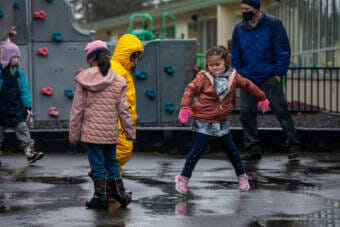
Avery Barnaby dances on the playground during her first day back to school as a first-grader at Sayéik Gastineau Community School on Thursday, Jan. 14, 2021, in Juneau, Alaska. (Photo by Rashah McChesney/KTOO)
Avery Barnaby dances on the playground during her first day back to school as a first-grader at Sayéik Gastineau Community School on Jan. 14, 2021, in Juneau.  Juneau’s Board of Education has decided that when school starts in August, everyone inside of school district buildings will be required to wear masks. (Photo by Rashah McChesney/KTOO)

With less than a week before the first day of school — the Juneau Board of Education is mandating masks for everyone inside school district buildings. 

The board voted unanimously on Tuesday, but not before more than a dozen parents, teachers and community members voiced their opinions over Zoom.

Board President Elizabeth Siddon said they also received more than 230 emails on the topic.
“I also want to note that the decision tonight is not written in stone,” Siddon said. “We are not making this decision to be a decision that will last all year without reconsideration. We are going to keep our eyes on what is happening.”

During the meeting, some parents said their children were suffering from not being able to see non-verbal cues. Others said their children’s mental health is declining. 

Parent Robert Shoemake said his son is having trouble learning to read.

“He wears a mask,” Shoemake said, “and he seems to be disconnected from the kids around him and I’m thinking that a lot of the other kids are feeling that way.”

Another parent said the opposite, that her daughter was afraid to go to school without masks. Multiple parents told the board their kids don’t mind wearing face coverings and are excited just to be able to attend school in person.

“We’ve had a tough year and a half like a lot of families out there,” said Iris Matthews, who has two children enrolled in school. “They’re fine in the masks. They’ve gotten used to it. They don’t even think about it anymore. The best chance we have at giving them what they really need, which is being able to go to school every day and establish those routines that are so important to their learning, is to keep masking.”

Others, like community member Thom Buzard said the decision should be left up to parents, not the school district.

“You’ve been elected by the people to run the school, but not to overrun the rights of the parents.” Buzard said. “We already provide sanitation in the schools, hand washing, we do ask the children if they have symptoms to stay home. These are all reasonable and prudent things to do, but I think that this [requiring masks] is a huge power grab and I’m against it.”

Under the new policy, the Superintendent still has the authority to grant minor adjustments that are consistent with CDC guidelines for in-building operations and at district-sponsored events. That means for teams traveling for games or events, safety protocols can be modified based on the risk level in their destination as well as other factors. 

Masks will not be required outdoors anymore. In the past, they were required at all times on school grounds, even outside.

“We’re all making the best decisions we can with the number one priority that we maintain our operations full time, five days a week for in person learning,” Superintendent Bridget Weiss said. “Every decision we make fuels that goal because we know that there is a hardship on our children and on our families when we can’t do that.”

Juneau Assembly to introduce $700,000 plan for local vote by mail facility

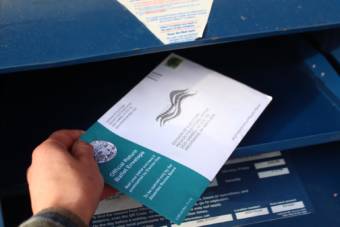
A voter mails an absentee ballot in October 2020.
A voter mails an absentee ballot in October 2020. (Lex Treinen/Alaska Public Media)

Juneau residents will soon be able to weigh in on the future of voting by mail in the city. The Juneau Assembly is considering turning a city-owned warehouse into a more permanent ballot counting facility.
On Monday night, the assembly learned that it needs about $700,000 to remodel its Thane warehouse, located at 1325 Eastaugh Way, and purchase ballot-counting equipment.

Assembly member Michelle Bonnet Hale said once the request for those funds is drafted, voters will have a chance to make their voices heard.

“We’re going to try to have at least two public comment periods,” she said, “so that people have an opportunity to weigh in and tell the assembly what they feel about the proposal to go permanently to vote by mail because that’s what building that voting center would do.”

Juneau implemented a temporary vote by mail system for the 2020 election due to concerns over COVID-19. Currently, that requires city officials to use an Anchorage facility for ballot-counting. That’s what will happen again in 2021, but if this new proposal doesn’t hit any snags, Juneau would have its own facility next fall.

“Timing was kind of tight,” Hale said. “We have to give the people that manufacture those machines lots of lead time so that’s why we have to be working on it like right now in order to have it in place by October of 2022.”

Hale said by having a facility here in town, she thinks Juneau’s elections would gain an added level of certainty and security.

“You know we’re the capital city and if we can do it ourselves, the cost is a little high, but I feel that it’s worth the cost,” Hale said. “I also feel that study after study has shown that vote by mail increases voter turnout and makes voting easier for voters.”

The proposal will be introduced at the Aug. 23 assembly meeting. They’ll take public comment at that meeting and at the one on Sept. 13.

Was there really a gun range in the basement of Harborview Elementary School?

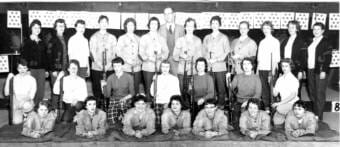
The 1958-'59 high school rifle club poses for a yearbook photo.
The 1958-1959 girls’ high school rifle club poses for a yearbook photo in the basement of Harborview. (Courtesy of Karleen Grummett)

As part of KTOO’s Curious Juneau project, a listener asked: “Was there really a gun range in the basement of Harborview Elementary School?”

The short answer is yes. It was there for decades, and there are plenty of people still around in Juneau who remember it.

Flipping through decades of Juneau’s high school yearbooks, you’ll find some dated extracurriculars, like candy stripers and the Future Homemakers of America.

You’ll also find the rifle club, which was founded in 1934. Karleen Grummett is a former member. 

“Rifle club was one of the more common groups to join in high school, and it sounded like fun to me,” she said. “They had both boys’ and girls’ rifle clubs, and they were both very well attended.”

Grummett participated in the club from 1958 until 1960, when she graduated from what was then Juneau High School (not yet Juneau-Douglas High School).

“It was just assumed that that’s where you went to learn how to shoot a rifle,” she said. “It was in the basement of the Harborview school.”

She joined the group hoping that if she could properly handle a gun, her father would take her hunting. 

The 1974-'75 high school rifle club as pictured in the yearbook.
The 1974-1975 high school rifle club as pictured in the yearbook. (Bridget Dowd/ KTOO)

“That didn’t happen, but we still had a lot of fun,” Grummett said. “It was really noisy down there in that basement, with all the guns going off. I have nothing but fond memories of it.”

The girls would start in the prone position and work up to sitting, kneeling and standing.

“There were certain goals for each of those positions,” she said. “At the end of the year, you were awarded some brass bars that you put on a pin on your high school sweater.”

Club members could work their way up to “expert” or “distinguished” levels, and Grummett was proud to achieve the expert title.

Karleen Grummett (then Karleen Alstead) saved this certificate from her time in the Juneau High School rifle club in the late 1950s.
Karleen Grummett (then Karleen Alstead) saved this certificate from her time in the Juneau High School rifle club in the late 1950s. (Courtesy of Karleen Grummett)

“But I was a little disappointed when I found out later that the way to get your ‘distinguished’ was to get special time at the gun range, and that wasn’t readily available to women at that time,” she said.

But the high school rifle club wasn’t the only organization to use the Harborview gun range. James Cartmill wasn’t yet 10 years old when he started taking gun safety classes through Territorial Sportsmen in the early 1970s.

“There was an open area down there [in the Harborview basement] right next to the rifle range that we would go in and play around until our names were called,” he said.

Courses were held for several weeks each year, and Cartmill’s family was heavily involved. 

“My mom would be the one that would take down the names at the front door,” he said. “You would check in with her, and then they would have movies on shooting safety and hunting. My dad would run the movie projectors in the library area.”

At one point, Cartmill remembers there being about 50 kids involved in the program.

“There was, I believe, five different stations, and each one of the stations had a coach or an adult there to tell you how to use the gun, your breathing, your sight alignment, your trigger squeeze,” he said.

At the end of each day, the kids took their targets home to show off and later received certificates of completion. A few years later, in 1986, Ryan Scott took a hunter education class in the Harborview basement. Now he teaches the course through Alaska’s Department of Fish & Game, but a lot has changed since he first learned to shoot.

“Many of us, when we were older, especially in high school when we were able to drive, would hunt in the mornings before school started or in the afternoons as soon as it got done,” Scott said. “Certainly, I had shotguns in my vehicle because that’s what I was doing after school.”

The 1946-'47 high school rifle club as pictured in the yearbook.
The 1946-’47 high school rifle club as pictured in the yearbook. (Photo by Bridget Dowd/ KTOO)

Nowadays, taking a gun to school would land you in a lot of trouble. Debates over American gun laws heated up over the years as mass shootings became more frequent. 

Scott said his courses aren’t just for hunters, and being familiar with a gun could help dispel some of the fear people associate with them.

“That does give an individual more comfort, just understanding what the firearm really is and what it will do,” Scott said. “And then also knowing, well, this is the type of ammunition. You know, it’s not a shotgun shell, it’s a cartridge, and this is a revolver, this is a semi-automatic pistol, things like that.”

Scott said that education could come in handy even if you don’t have a gun in your home because it’s not uncommon to come across one in someone else’s, especially in Alaska. 

Continuing through those high school yearbooks, the number of rifle club members gets much smaller in the late ’70s, then the club disappears completely.

The 1976-'77 high school rifle club as pictured in the yearbook.
The 1976-1977 high school rifle club as pictured in the yearbook. The club practiced in the basement of Harborview. (Photo by Bridget Dowd/ KTOO)

As for the rifle range at Harborview, it’s long gone. The school was renovated in the early 2000s and didn’t include a range. Around that time, a new gun range was built in Montana Creek.

But for James Cartmill, when it comes to gun safety, some things haven’t changed. He and his two grown children still go hunting, employing the lessons he learned in Harborview’s basement more than 40 years ago.

“You know, it’s not a toy, it’s a weapon,” he said. “That’s something that I’ve instilled in my kids.”


Are you curious about Juneau, its history, places and people? Or if you just like to ask questions, then ask away!

Site notifications
Update notification options
Subscribe to notifications