Casey Kelly

Kids learn the lost art of tinkering

A weekly program of the Juneau Economic Development Council called “The Saturday Thing” aims to help kids rediscover the lost art of tinkering. Casey Kelly has more.

Ethan Madsen is seven years old – almost eight – and a regular at “the Saturday Thing.”

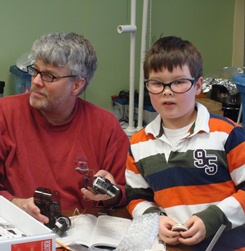
Ethan Madsen (right) and father Andy tinker with stuff at JEDC's Saturday Thing. Click to enlarge. (Photo by Casey Kelly/KTOO)

“I built a rocket. I kind of mess around with recycling and put it together and see what I can build,” he says.

On a recent weekend Madsen is busy building a robotic arm that will be powered by four separate motors.

“The one is for the fingers to open and close, the other is for the wrist, the next is for the elbow joint, and the last is the base motor that will allow it to move,” Madsen explains.

Since September JEDC has offered “the Saturday Thing” every weekend at its STEM Education office. STEM stands for Science Technology Engineering and Math. JEDC

JEDC's Bob Vieth. Click to enlarge. (Photo by Casey Kelly/KTOO)

Education Specialist Bob Vieth says the kids who attend the program are exposed to a little bit of everything.

“We do chemistry we do force and motion, physics, magnetism, electricity, optics, engineering – how things go together – gear ratios, it’s just across the board,” Vieth says.

Every week Vieth comes up with a different scientific concept to explore, but mostly “the Saturday Thing” is opportunity for kids to tinker with things.

“It’s kind of a lost art. And you can learn so much through tinkering. You can learn about how things work, why things work, explore scientific questions, phenomena,” he says.

What is tinkering, exactly? Vieth says it involves building things and taking things apart.

“We’ve got vacuum cleaners for kids to take apart and look at how they work. Kids can take apart computers and look at how they work. Just taking apart stuff is a learning experience in and of itself,” says Vieth.

So what’s the plan for Ethan Madsen’s robotic arm when he’s done building it?

“Mr. Bob he wants to put it in the window and just have it move around, maybe pick up a few things and move them around,” says Madsen.

Ethan’s dad, Andy – an electrical engineer – says “the Saturday Thing” has been a great opportunity for the whole family to experiment, learn and of course tinker.

“He’s learned how to solder down here, and they build rockets, and Bob has a launcher, so we’ve gone next door and launched the rockets,” says Andy Madsen. “My two year old daughter even comes down with us and she sits and works on Legos and so everybody is invited. Nobody is turned away.”

“The Saturday Thing” is free. Because Vieth is the only staff member there, it’s limited to 10 kids per week. Vieth says donations of items for kids to tinker with are always appreciated.

Thomas calls for more cooperation between tribes and ANCs

Ed Thomas. Click to enlarge. (Photo by Casey Kelly/KTOO)

Rural Alaska’s economic and social problems require greater cooperation between Native Corporations and federally recognized tribes, says Tlingit and Haida Central Council President Ed Thomas.

“We have very weak rural economies, we have high cost of energy that leads to high cost of living, higher cost of survival in our communities,” he says.

Thomas says past conflicts between Native tribes and corporations have largely risen from the belief by some that the Alaska Native Claims Settlement Act was a termination policy. That is, an act designed to make Native people assimilate into American society.

“Some of those folks that were anti-ANCSA felt that, well if we get rid of ANCSA then the land probably would go to the tribes,” says Thomas. “That really is very far-fetched, if not impossible.”

For one thing, Thomas says there’s no political will to take land from ANCSA corporations and give them to tribes. For another, corporate land is very different from tribal land, which is usually locked up in some sort of trust.

Subsistence is another issue that has divided tribes and corporations. ANCSA basically extinguished Alaska Native hunting and fishing rights, which Congress tried to address with the Alaska National Interest Lands Conservation Act. But Thomas says there are still those who think doing away with ANCSA is the way to restore full subsistence rights.

“While I generally agree that we can probably get rid of that one provision and it would improve things. I don’t agree that you have to throw everything out in order to accomplish that issue with subsistence,” he says.

Rather than debate the merits of the 30- and 40-year-old laws, Thomas says tribes and corporations should work together to accomplish what’s best for Native communities. It won’t always be easy, he says, but it’s essential for those communities to survive.

“We are a broad state, we have a lot of differences geographically and culturally, and lifestyle. So, it’s in our best interest to try to find areas of commonality and agree upon it. And where we disagree, agree to disagree and move on,” he says.

Thomas spoke yesterday (Thursday) at Sealaska Heritage Institute’s annual Native American Heritage Month lecture series.

The Tlingit and Haida Central Council is the sovereign tribal government for more than 27-thousand Southeast Alaska Natives worldwide.

CBJ Assembly makes appointments

The CBJ Assembly made appointments to the Planning Commission and Bartlett Regional Hospital Board of Directors at a special meeting last night (Wednesday).

Dr. Nathan Peimann was reappointed to a physician seat on the hospital board, while Bob Storer was reappointed to one public seat, and Nancy Davis was appointed another public seat. All three will serve three-year terms starting in January.

Jerry Medina was appointed to a vacant seat on the Planning Commission starting immediately and ending December 31, 2013. Incumbents Nicole Grewe and Marsha Bennett, and newcomer Karen Lawfer were appointed to three more seats. They’ll serve three-year terms beginning in January.

Native corporations and cultural sustainability

Anthropologist Tom Thornton. Click to enlarge. (Photo by Casey Kelly/KTOO)

Alaska Native Corporations display a strong ethos of corporate responsibility, according to an anthropologist who studies the organizations.

Tom Thornton is a senior research fellow for Environmental Change and Management at Oxford University. He presented some of his current research yesterday (Tuesday) at Sealaska Heritage Institute’s annual Native American History Month lecture series.

Thornton says Native Corporations make especially interesting subjects for social scientists.

“The big reason is that they are very unique hybrid institutions,” he says. “They’re not like regular corporations, and obviously they are major cultural institutions as well.”

Thornton says the corporate responsibility ethos is evidenced by many of the corporations’ mission statements, which refer to “sustainability.”

“Probably like all corporations, not every Alaska Native Corporation lives up to its ideals and its mission statement. But the fact that they’re articulated with a certain set of values is quite interesting,” Thornton says. “Because we’re all looking for the right model of sustainable development, if that’s not an oxymoron or a non-sequitur. If there is sustainable development, it obviously has to incorporate some key cultural values into it. It can’t just be an economic model.”

Thornton’s current project is looking at how ANCs have transformed institutional relations between Native people, state governments, ecosystems, and economies.

Since the corporations were created by the Alaska Native Claims Settlement Act, they have adapted to changing cultural, economic and political circumstances. He points to Southeast Alaska, where Native people traditionally lived and survived by the ocean. But under ANCSA – where the settlement included land – virtually all Southeast Native Corporations have been or are involved in timber.

“You move from people who were fishermen to forests. There wasn’t a lot of experience at the beginning. This lack of experience led to mistakes, or people taking advantage, and this set a lot of particularly small corporations off to a bad start,” Thornton says. “They either harvested their timber too quickly, they didn’t get a good price for it, or they didn’t really consider their own values in terms of what they really wanted to do with their natural capital to support their cultural capital.”

In some cases Thornton says Native corporations have done well by moving away from natural resource industries, and into businesses like tourism. One example is Huna Totem Corporation’s Icy Strait Point tourist attraction in Hoonah.

“You have 130 people employed by Huna Totem Corporation in tourism. That would seem to be sustainable if you can get one ship per day in there throughout the summer,” he says.

But there’s still a strong desire on the part of ANC leaders to combine traditional ways of living with newer models. Thornton says one Hoonah fisherman suggested to him that they develop niche economies.

“In the summer, you have tourism, major industrial tourism, that is your form of sustainable development. But in the winter and spring, maybe people could still fish there,” he says.

Thornton’s research is still in the preliminary stages. He says it will eventually compare the development of Southeast Native corporations with those in the Bering Straits region.

Sealaska Heritage Institute’s Native American History Month events continue today (Wednesday) with a luncheon to recognize ANCSA at the Alaska Native Brotherhood Hall.

The lecture series resumes tomorrow (Thursday) with a talk by Tlingit and Haida Central Council President Edward Thomas on the relationships between tribes and corporations.

CBJ Assembly approves grants to public safety projects

There was a distinct public safety theme to a handful of items approved by the Juneau Assembly last night (Monday).

Members appropriated more than 131-thousand dollars in grant funds related police or fire services.

The largest chunk was a $94,575 dollar expenditure that will allow the city to hire two new police officers. City Manager Rod Swope explained that the amount covers the first six months of a three-year grant from the US Justice Department.

“This grant will fund two police officers for three years free of charge, and then we will be obligated to fund those positions the fourth year and thereafter if we want to keep them on the force,” said Swope. “So, in total this grant’s worth $567,452.”

Swope said the officers would be assigned to JPD’s downtown patrol.

“Which, I think given all the issues we’re having to deal with recently, will really be a good thing,” he said.

The assembly also approved $6,615 for a software program that will give police the ability to do three-dimensional reconstructions of car crashes. Funding for that item came from an Alaska Department of Transportation and Public Facilities grant.

Another expenditure of $30,583 dollars will allow two members of Capital City Fire and Rescue’s Hazmat Team to go to a training seminar in Fairbanks. That item was courtesy of a grant from the Alaska Division of Homeland Security and Emergency Management.

The assembly last night also approved a $6.6-million dollar appropriation for continued funding of the Juneau Airport’s runway safety area project, with $6.3-million that was provided by a Federal Aviation Administration grant. The rest is coming from the Alaska Department of Transportation and Juneau Airport operating funds.

Assembly members also approved a climate action plan for the city and borough, which sets a goal of reducing Juneau’s greenhouse gas emissions by 25 percent by the year 2032.

CBJ Assembly honors Anna Graceman

Pint-sized Juneau songstress Anna Graceman was honored by the CBJ Assembly last night (Monday).

The 11-year-old singer-songwriter caught the nation’s attention earlier this year, when she made it to the semi-final round of NBC’s America’s Got Talent.

Mayor Bruce Botelho read from a proclamation recognizing Graceman’s many achievements.

“Anna found her musical gift at an early age, singing complete songs at 18 months, performing for audiences at the age of two, and playing the piano by the age of four,” it read. “At the advanced age of six she wrote her first song, entitled “So I Cried” – a song based on the experience of her brother being very sick when he was little.”

Graceman is performing in Denver this week, and was represented at the assembly meeting by her great-grandparents, Roy and Pat Varni. Roy Varni talked about how much Juneau has meant to Anna’s success.

“Juneau with its unparalleled beauty has provided much of the inspiration for Anna’s prolific songwriting,” he said.

Varni praised Anna’s teachers at the Juneau Montessori School for being particularly instrumental in her creative development.

Anna Graceman – “Superstar”:

Site notifications
Update notification options
Subscribe to notifications