Casey Kelly

Young foodies spice up downtown Juneau

The B's Bakery and Bistro Crew outside their food trailer in downtown Juneau. (Photo by Amanda Compton/KTOO)

Downtown Juneau is hopping with renovations and grand openings. Several young and creative entrepreneurs have expanded the local food scene. The Rookery, which opened last fall, was recently closed for renovations and has now reopened. The Wild Oven Bakehouse opened in October, and B’s Bakery and Bistro opened just last week. KTOO’s Amanda Compton starts her tour at the newly remodeled Rookery.

Smaller timber sales might help small communities


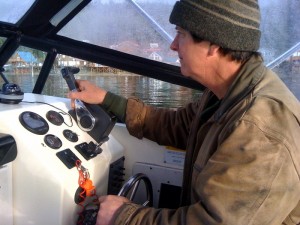
Gordon Chew pilots his boat, the Cool Cat, to the Tenakee Springs fuel dock on Monday, Oct. 24. Chew runs Tenakee Logging Company. (Photo by Ed Ronco/KCAW)

The era of large-scale logging might be gone from northern Southeast Alaska, but across the region, people are turning to smaller timber sales to earn a living. Officials hope the model can support local economies in the region. And for one family in Tenakee Springs, the effort has paid off. KCAW’s Ed Ronco has this profile.

Gordon Chew runs a small logging operation in Corner Bay, just across the inlet from Tenakee Springs. And it keeps him busy. So busy, in fact that he says he doesn’t have time to stop for an interview, but that I can borrow his adult son’s bike and talk to him as we ride down to the harbor. In the interest of my own safety, I wait until we get to his boat before I reach for a microphone.

“We have to do a little bit of everything, between all the boating and barging and lumber milling and logging and construction and restoration around town,” he says.

Chew runs the Tenakee Logging Company, and he’s part of the changing face of the lumber industry. In this part of Southeast Alaska, large-scale logging doesn’t exist anymore. But smaller, selective cuts – like the 100,000 or so board feet each year that Chew takes from the Tongass – are becoming more popular.

Chew’s company logs, but it also builds. He uses the timber taken from Corner Bay on projects in Tenakee Springs. As we leave the harbor, he opens up the throttle and we head to the fuel dock. There’s a 55 gallon drum in the back of the boat.

The fuel will go over to Corner Bay to feed the company’s truck. But not far from where we’re tied up is the Snyder Mercantile – a general store dating back to 1899. Chew and his team are working to restore the old building, along with its adjacent property, using wood they’ve harvested and milled. Chew says that part of the business is essential.

“The foundation under that warehouse are all hemlock pilings,” he says. “We drag a lot of them over here as pilings. Also, the underpart of the store is all repaired with cedar pilings. I’m not sure if we could manage it on our timber sales alone. The fact we get to work with the timber as builders is what makes it lucrative for us. It’s not selling the timber.”

Zia Brucaya, of the Sitka Conservation Society, says Chew’s operation “is definitely unique in our ranger district,” but not to the region.

“Throughout Southeast Alaska there are lots of small mills that are operating to different degrees,” she said. “Some of them are doing construction as well as milling, like Gordon is. Some of them are just doing milling, putting together cabin kits and things. They’re all working at that smaller scale of a few hundred thousand board feet per year.”

SCS and other environmental groups in Southeast have taken an interest in operations like Chew’s because they say they’re smart, sustainable ways to use the Tongass. It was never logging outright that was the problem, she says. It was the scale of what happened in years past.

“We’re now working at a scale that is appropriate for the community, and it’s needed in the community,” she said.

Brucaya says it’s also an opportunity to build up the local economy for the benefit of local residents – a way to keep people living in Southeast, especially in small, remote communities, where the loss of even a family or two can be felt throughout town.

And few are more aware of that than Chris Budke, a forestry technician in the U.S. Forest Service’s Hoonah office.

“It seems like every time I turn around I read something in the paper or I see a reason or I look at people and I see lots of reasons for people to be leaving Southeast Alaska,” he said.

He lists off reasons: it’s a harsh environment, goods and services are expensive, and more. But he says offering opportunities to run small businesses using Tongass resources might help keep people around.

“If we can work with local people that are using local products and meet the objective of everybody – which is really difficult, by the way – and provide a product for those people they can turn around and make a living off of, that, to me, gives you reasons to be here,” Budke said.

And giving people reasons to be here can have big implications for Southeast, which is hemorrhaging population.

“This is incredibly important for people to be working. It’s incredibly important for us to be using our natural resources. It’s incredibly important for people to understand that we can use it responsibly. So we can meet the objectives of a lot of things here and give people a reason to stay in Southeast.”

Gordon Chew and his family are examples of that. They saw Alaska during a trip in 1995, and loved it so much that they went back south and made plans to move up. They returned in 1999 and have been here since. Back in Tenakee Springs, Chew’s 55 gallon drum is nearly full of No. 2 diesel.

As the nozzle is hoisted back onto the fuel dock, Chew says there’s a future in the kind of small-scale logging he does, not only for places like Tenakee Springs, but for the entire region.

No foul play suspected in Kowee Creek death

Juneau Police say the man and woman involved in Sunday’s fatal fall into Kowee Creek on Douglas were running from officers responding to a disturbance call.

No foul play is suspected in the incident, which left 22-year-old Evan Marshall Smith dead and his 18-year-old female companion injured.

JPD Spokeswoman Cindee Brown-Mills says police responded to a disturbance at an apartment on Foster Avenue at approximately 2 a.m. Sunday.

“Apparently there was a disturbance out in the parking lot, and that’s what they were called to,” says Brown-Mills. “But when they got there, the people who were involved in the disturbance had gone into the house.”

Brown-Mill says when police tried to contact the people involved in the disturbance – believed to be Smith and the girl – the pair jumped out a second story window in order to avoid talking to the officers. She says they apparently ran into a wooded area, where they fell off an 80-foot cliff into Kowee Creek.

Brown-Mills says alcohol was likely a factor.

“Apparently there were some possible minor consuming issues,” she says.

The incident remains under investigation as an accident. Brown-Mills says the name of the girl is not being released, because she has not yet been charged with a crime.

Summer salmon harvest among most valuable in history

The 2011 statewide salmon harvest is currently the third most valuable since 1975, according to a report Monday from the Alaska Department of Fish and Game.

The estimated value of this summer’s catch of 603-million dollars is third behind 1988 and 2010. But Commercial Fisheries Division Assistant Director Geron Bruce says it won’t stay that way for long.

“We expect that once we get the final price information in from processors and buyers – and we’ll get that next spring – that it’ll actually become the second highest,” says Bruce.

While harvest volume varied from area to area and species to species, prices were strong throughout the state, particularly for pink and chum salmon. In Southeast, for instance, pinks averaged 42 cents a pound and chum averaged 81 cents. Bruce looks at this year’s good prices as the continuation of an upward trend over the past decade.

“The recognition in the marketplace that Alaska’s commercial salmon fisheries are sustainable; that it’s a wild, natural food, I think those have been important programs. And also the collapse of the Chilean salmon farming industry due to a virus a few years ago – they’re still recovering from that – played a part as well,” Bruce says.

Southeast Alaska’s combination of big harvests and high prices produced the most valuable salmon harvest for any region in 2011 – estimated at 203 million dollars. Nearly half of that came from a big pink harvest of 59 million fish. Bristol Bay is usually the most valuable fishery in the state, but catches there fell short of projections this summer. Bristol Bay had the second-highest value at 137 million dollars. Prince William Sound had the third most valuable catch at an estimated 101 million dollars.

In total, Alaska commercial fishermen landed 176 million salmon in 2011. That was the 9th largest catch since 1960, but well below the preseason forecast of 203 million fish.

Mallott says ANCSA is “unfinished business”

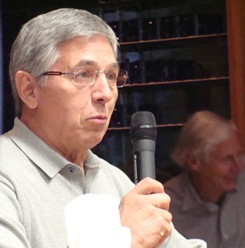
Byron Mallott. (Photo by Casey Kelly/KTOO)

Sealaska director and former CEO Byron Mallott says the Alaska Native Claims Settlement Act is a work in progress.

Mallott kicked off Sealaska Heritage Institute’s annual Native American History Month lecture series last week (Friday), by calling the landmark piece of federal legislation “unfinished business.”

“It’s unfinished in the sense that it has been amended many, many times in order to be responsive to changing public policy, the changing aspirations of Native peoples themselves,” says Mallott. “But it has also big chunks of it need to be rationalized and dealt with.”

Sealaska is one of twelve regional Native corporations created by ANCSA in 1971. Each received land to settle the various aboriginal claims of Alaska Native people. The settlement also included compensation of nearly a billion dollars that was split between the companies. A thirteenth corporation was later formed for so-called “landless Natives.”

Mallott hopes ANCSA will be amended in the future to allow land swaps between Native corporations, tribes, and the federal government.

“There are Native lands in Native ownership that probably should best be in public ownership. There are public lands that if you really look at them, have more the attributes of Native places,” he says. “And the biggest one of all to me, is how do we keep those lands which are now essentially corporate assets? Even though they are protected in modest ways, they are not tribal lands in the legal sense, even though we believe they are tribal lands in the Native sense.”

Mallott did not touch on it in his speech, but legislation sponsored by Alaska’s Congressional delegation would allow Sealaska to complete its ANCSA entitlement by choosing land outside the act’s original boundaries.

The Sealaska Heritage Institute lecture series continues next Monday. Tlingit and Haida Central Council President Edward Thomas will describe the interrelationships between Alaska Native Corporations and tribes.

Small pleasure craft rescued near Hoonah

Coast Guard crews from Juneau and Sitka responded to a pleasure craft adrift near Hoonah last night (Wednesday) – the second such incident in Southeast waters this week.

About 8:20 p.m. two men aboard the 24-foot Tlingit Boy II reported on VHF radio that they were disabled near Whitestone Harbor in 40 mile per hour winds and eight-foot seas.

An MH-60 Jayhawk helicopter crew from Air Station Sitka and a 45-foot medium response boat from Juneau launched to assist the vessel. Before the response boat could get on scene, the Good Samaritan vessel Vagabond Queen arrived and began towing the Tlingit Boy II back to Hoonah. The Coast Guard helicopter crew remained in the area to assist.

Lieutenant Junior Grade James Dooley says Wednesday’s incident followed the rescue Monday of a man aboard a 22-foot pleasure boat disabled near Kake.

“Just really want to urge all mariners to pay attention to the weather, use really sound judgment before venturing out into this kind of stuff,” Dooley says. “Because, when something goes wrong it can start to go wrong in a hurry.”

Dooley says neither of the men aboard the Tlingit Boy II were injured. The vessel was safely towed by the Vagabond Queen back to Hoonah, about 15 miles north of where it became disabled.

Site notifications
Update notification options
Subscribe to notifications