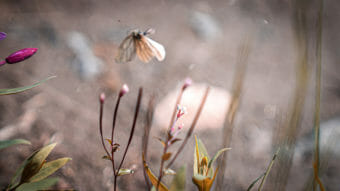
Margined white butterfly at Mendenhall Glacier on June 17, 2022 in Juneau. (Photo by Paige Sparks/KTOO)
Could you identify a margined white butterfly? Bears, porcupines and eagles get a lot of attention in the summer months, especially from tourists, but rangers at the Mendenhall Glacier Visitor Center say there are some small wonders, too.
“You’ve probably seen them without even knowing what they are. They’re small, little white butterflies that kind of fly around,” said Julia Schostak, an assistant director at the visitor center.
She says the margined white is one of four main kinds of butterflies we’re likely to see around Juneau.
“Sometimes it’s nice to think about the smaller things,” she said. “Our birds and our insects can really kind of open the world past those larger megafauna.”
Margined white butterflies can be found sucking nectar on early summer blooms — or doing a thing called “mudding” or “puddling.”
Schostak says it’s common for butterflies to cool off and drink in moist areas like mud puddles. They take in nutrients from the ground that they can’t get from plants. They know where to land and drink because chemoreceptors in their feet help them sense the composition of the soil.
Margined white butterfly at Mendenhall Glacier on June 17, 2022 in Juneau. (Photo by Paige Sparks/KTOO)
Schostak says a great place to see this in action is near Nugget Falls, by the Mendenhall Glacier. She says the water there has a perfect chemical composition for the butterflies because of glacier silt in the water.
But don’t step on them!
“Sometimes they just look like little rocks moving,” Schostak said
If you can’t get out to the glacier, don’t worry. Schostak says they’re all over the place this time of year. Look for a white butterfly with some ashy markings on the wings. It’s likely to be a margined white.
Correction: An earlier version of this story misspelled Julia Schostak’s last name.
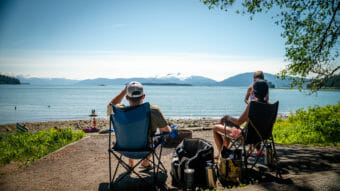
Families hanging out in the sunshine at Auke Rec in Juneau on June 1, 2022. (Photo by Paige Sparks/KTOO)
It’s going to get unusually hot in Juneau this weekend and next week.
National Weather Service meteorologist Rick Fritsch says the rain has dried out, and Southeast Alaska is looking at increasing daytime temperatures from Thursday through at least the beginning of next week.
Juneau’s record high of 90 degrees came on July 7, 1975. Temperatures could get close to that — or even top it — in the coming days. Fritsch said temperatures could get up to the mid-70s on Friday and push into the 80s early next week.
Juneau temperatures last hit 85 degrees on June 28, 2019.
Because most Juneauites don’t have air conditioning, Fritsch recommends drawing the shades to keep indoor spaces cool. NWS also recommends that people wear sunscreen and stay hydrated while recreating outdoors.
“Also, it’s important to remember that members of our population — or other valuable family members like pets — could suffer tremendously if left in vehicles with the windows raised, parked in a sunny location,” Fritsch said.
He said air quality should stay high, so residents can look forward to blue skies.
There’s no red flag fire warning, but Fritsch said it’s always a good idea to be cautious when it’s hot and dry.
Correction: Based on information from the National Weather Service, an earlier version of this story said Juneau’s record high was 87 degrees, in 1917. The text and headline have been updated to reflect that the record high was 90 degrees, in 1975.
University of Alaska Southeast will offer a free option for Alaska Native language courses this fall;
Southeast Alaska’s ferry link to northern British Columbia resumed on Monday after nearly three years out of service;
One of the first Alaska grants from the historic $1.2 trillion dollar federal infrastructure bill is going to replace a 100-year old railroad bridge on the route from Anchorage to Fairbanks;
Team “Pure and Wild,” a 3-man crew from Seattle aboard a 44-foot Riptide monohull, won the 2022 Race to Alaska.
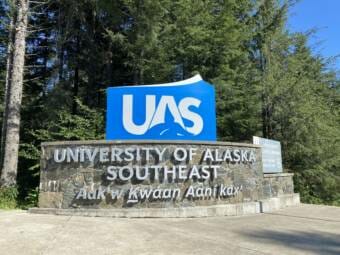
The main University of Alaska Southeast campus is located near Auke Bay in Juneau. (Photo by Bridget Dowd/KTOO)
University of Alaska Southeast will offer some Alaska Native language classes for free, starting in the fall.
Alaska Native Languages professor X’unei Lance Twitchell says this is part of revitalizing the Lingít, Haida and Tsimshian languages.
“We kept saying, Indigenous peoples did not choose to be in this situation. Our language was banished, it was prohibited, it was made illegal,” he said. “We were tortured and abused and all kinds of things to get us to stop speaking. So why should we have to pay to learn our own language?”
There has been a decline in the use of Alaska Native languages over the last hundred years due to genocide and assimilation. And many elders who were birth speakers died during the COVID-19 pandemic.
For the Lingít language, fewer than 50 people who have been speaking the language since birth are still alive.
But Twitchell says there has been a shift toward language revitalization over the last decade. When Outer Coast in Sitka offered a year of free Lingít courses during the pandemic, 600 people signed up.
“Education was a vehicle of oppression and genocide and assimilation. So our goal is to transform it into a vehicle of opportunity and equity and healing,” he said. “I think it’s going to be medicinal. I think it’s going to alter the course of the way things are going. And it’s really exciting.”
Arts and Sciences Dean Carin Silkaitis says one of their main jobs is to support faculty and find ways to say yes.
“You have to open doors, you have to bring seats to tables,” they said. “And I think creating free curriculum is a way to create more access for people.”
Silkaitis says the free classes are made possible with help from Sealaska Heritage Foundation and a Language Pathways grant. Students who select the free option won’t earn credits or receive a grade.
Twitchell also serves on the Alaska Native Language Preservation and Advisory Council for the state. The council has advised the governor and the legislature to make Native languages a statewide priority, to normalize their use and to reform state education to include Native languages.
Twitchell says free language instruction is one step toward achieving some of those goals.
“I think it’s going to reach a point where we’ll look back and we’ll say, ‘You remember how rare it was, when we didn’t speak it, to hear Lingít? You remember when hardly anybody knew Lingít?'” he said. “And then I think my hope is we look back at that and say, ‘What a strange time that was.'”
Disclosure: KTOO staff and reporters take Lingít language lessons from Twitchell.
Correction: Outer Coast in Sitka is the institution that offered a year of free language courses during the pandemic.
Young kids in Juneau could get their first dose of the COVID-19 vaccine this week;
The Zach Gordon Youth Center hosted its third Youth Pride Party to celebrate queer kids;
The North Pacific Fishery Management Council recommended further study after hours of testimony urging action to curb chinook and chum salmon bycatch in the Bering Sea trawl fisheries;
Governor Mike Dunleavy says he plans to decide soon whether to sign a bill that would give state recognition to Alaska’s 229 federally recognized tribes.
Close
Update notification options
Subscribe to notifications
Subscribe
Get notifications about news related to the topics you care about. You can unsubscribe anytime.