Claire Stremple

"I support KTOO reporters and guide coverage that informs our community and reflects its diverse perspectives."

When she's not editing stories or coaching reporters, you can find Claire outside with her dog Maya.

Alaska health commissioner announces COVID emergency order will end in July

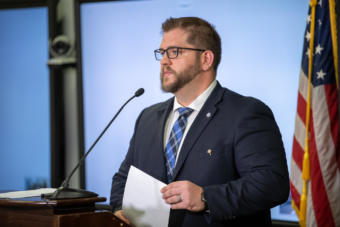
Alaska Health and Social Services Commissioner Adam Crum speaks at a news conference on COVID-19, Wednesday, April 1, 2020. (Creative Commons photo by Office of Gov. Mike Dunleavy)

State health commissioner Adam Crum will rescind Alaska’s public health emergency order for COVID-19 on July 1.

During a press conference Monday, Crum said the department has been working to make sure any COVID-specific tools and systems Alaskans still need are now permanent or sustainable.

“What’s changing for the average Alaskan is nothing. Most folks actually probably don’t even understand that we still have this in place,” he said.

The state Legislature granted the public health commissioner the authority to declare an emergency order in 2021. Crum’s emergency order would have expired with any federal emergency order unless he rescinded it earlier. The federal public health emergency runs through July 15 but is anticipated to be extended through this fall.

July 1 is also the date federal reimbursement will change. FEMA previously reimbursed COVID spending at 100%; after July 1 it will fund 90% with a 10% state match.

The end of the order also means the end of extra SNAP benefits for the more than 56,000 households in the state that receive them. That extra benefit could be anywhere from $95 to more than a thousand depending on the size of the family. Those benefits will continue through August of this year.

Public health director Heidi Hedberg said public health will continue to offer COVID-19 services.

“We are going to continue to pick up the phone, we are going to continue to be there to answer questions, we’re going to continue to make sure that there is access to testing materials and vaccine and therapeutics,” Hedberg said.

The state’s health department will also monitor and track COVID-19 cases and report them on a weekly basis.

COVID-19 public health resources

This story has been updated.

Newscast — Friday, June 3, 2022

In this newscast:

  • Juneau’s three incumbent Democratic state legislators are all running for reelection, and only one has an opponent;
  • Gas prices have been increasing for months and some Alaskans are rethinking their driving plans this summer;
  • Anchorage Assembly members voted to postpone a decision on whether to allow for the removal of the mayor for reaching the public trust.

Newscast — Thursday, June 2, 2022

In this news update:

  • The recent swell in COVID-19 numbers is unlike other surges, say state epidemiologists;
  • Alaska has crowded state election this year, so the primary will trim the list of candidates;
  • A new whale identification program uses artificial intelligence to identify Alaska whales by their flukes;
  • The Matanuska-Susitna Borough school board considers amending its athletic policy to exclude transgender girls from girls’ sports teams;
  • An Alaska oil and gas company acquired two offshore leases in Cook Inlet during a state sale this week.

COVID cases have been ticking steadily up in Alaska, but is it a surge?

A box of rapid covid tests on a table
At-home test kits available to the public at City Hall in Juneau. February 24, 2022. (Photo by Claire Stremple/KTOO)

COVID cases have ticked up steadily over the last few weeks in Alaska. But this swell in numbers is not like other COVID surges, which have looked much bigger.

Over the last week, numbers appear to have dropped slightly. There were 2,248 cases reported statewide on Wednesday, and that doesn’t include any positive results from at-home tests.

State epidemiologist Louisa Castrodale said it’s clear there’s a lot of COVID activity in the state, but compared to last year, the state isn’t capturing as many cases in its data.

“We know there’s a lot more over-the-counter testing that people are doing to make decisions, personal health decisions about whether they are gathering with people or traveling or what have you,” she said. “And those are numbers that are not reflected in the overall case counts.”

Castrodale says that taking a look at weekly case counts and trends over time is still useful. For example, Juneau’s test positivity rate spiked to nearly 40% for a couple weeks in May. That means that of all the test results that were reported to the state, close to half of them were positive. That’s usually an indication that not enough testing is happening to capture a true picture of how much of the virus is in the community.

While that percentage may not be the most useful metric for understanding how much COVID is in the community, Castrodale said the rapid increase is certainly an indicator that the virus is circulating.

“We’re kind of evolving in this data presentation of thinking about broader strokes and more global regional trends, and how to look at those numbers and make sense of them,” she said.

That “broad stokes” perspective has been the case for a while, and it’s because the COVID virus and our defenses against it have changed. So while it’s tempting to compare numbers now to numbers from 2020 or 2021, Castrodale said that’s ignoring context.

“We have vaccination in different age groups, we have a different variant that’s spreading, we have different levels of hospitalization relative to what we saw for cases,” she said.

If that all sounds kind of confusing, you’re in good company. Castrodale says even epidemiologists are struggling to find the best way to present COVID data over time.

She said the bottom line is that if case counts or hospitalizations make a big jump — even if it seems small compared to the pre-vaccine and pre-home test days — it’s an indicator that there’s more virus around, and you may want to consider taking precautions.

CEO search delayed at Juneau’s regional hospital as most candidates withdraw

Bartlett Regional Hospital. (Photo by Jennifer Canfield/KTOO)
Bartlett Regional Hospital in 2015. (Photo by Jennifer Canfield/KTOO)

Bartlett Regional Hospital announced a setback to its CEO search on Wednesday — two of three candidates withdrew from the final round of the hiring process. The hospital canceled all candidate visits previously scheduled for next week.

“While I am disappointed by this delay, ultimately, it is important that we take our time in order to find the best fit for our hospital,” said Kenny Solomon-Gross, president of the hospital’s board, in a press release.

Hospital leadership has not yet announced its next steps.

Juneau’s hospital has been without a permanent CEO since last fall.

Site notifications
Update notification options
Subscribe to notifications