Claire Stremple

"I support KTOO reporters and guide coverage that informs our community and reflects its diverse perspectives."

When she's not editing stories or coaching reporters, you can find Claire outside with her dog Maya.

Bartlett Regional Hospital candidates for CEO will visit Juneau

Bartlett Regional Hospital 2018 12 01
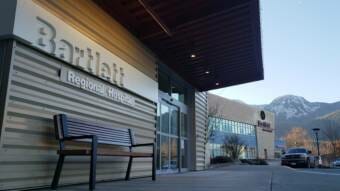
Bartlett Regional Hospital, located at 3260 Hospital Drive in Juneau. (Photo by Jeremy Hsieh/KTOO)

Bartlett Regional Hospital’s board of directors has selected three possible candidates to run Juneau’s hospital.

The hospital’s nationwide CEO search began this Spring to find a permanent replacement for Rose Lawhorne who resigned and was subsequently fired by the board last fall. Jerel Humphrey has been the interim CEO since then. He will remain with the hospital until a permanent CEO is selected.

The board appointed city officials and consultants to interview six candidates after they were recruited and vetted by an interim leadership company.

The three finalists for the role will visit Juneau to meet with the hospital’s board and staff in the first week of June.

The board will select between Emily Dilley, a hospital CEO in Larkin, Kansas; Matthew Heyn, a hospital president and CEO in Delta, Colorado; or Jeffery Hudson-Covolo, a vice president for patient care services and chief nurse executive of a medical center in Porterville, California.

There will be opportunities for public participation while the candidates are in Juneau, according to a hospital press release. The details are not yet available.


Juneau affordable housing project gets second chance at permit after appeal

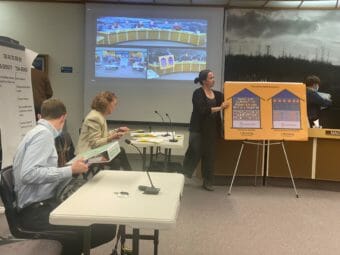
The Glory Hall demonstrated its understanding for density for Juneau’s planning commission at its appeal hearing. May 24, 2022. (Stremple/KTOO)

The Glory Hall’s affordable housing project in Juneau got a boost Tuesday night when it successfully appealed a city permit denial.

In a unanimous vote, the Juneau Planning Commission sent the permit back to the city’s Community Development Department and gave it 30 days to reconsider its decision.

The Glory Hall plans to convert its former homeless shelter building into seven housing units downtown. The city denied construction permits for the job back in December because it said the renovation would increase density in an avalanche hazard zone.

“Their position is we could have 50 homeless people living on this parcel, but we can’t have 14 renters,” argued Mary Alice McKeen, the Glory Hall’s attorney.

The city’s development department interpreted density to mean number of units, while the Glory Hall argued that the number of occupants should be used when determining density.

Ken Alper sits on the Planning Commission. He said that since density is not specifically defined in the relevant piece of code, the commission would now define it as the total number of people. This has implications for future projects.

The Planning Commission also directed the development department to accept an engineering study provided by the Glory Hall that it had previously not used in its permit decision. That study found that the building is not in a severe hazard zone.

The development department and the Glory Hall have 20 days to contest the decision to the Assembly if they wish to do so.

Juneau affordable housing project challenges city’s permit denial

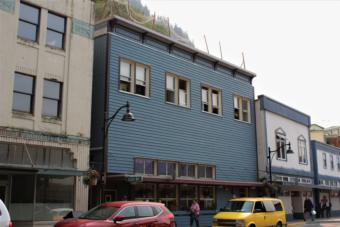
The Glory Hall homeless shelter in downtown Juneau. (Photo by Adelyn Baxter/KTOO)

An affordable housing project in Juneau has been stalled by decades-old hazard maps and city permit woes.

The Glory Hall runs Juneau’s homeless shelter and plans to convert its former building into seven housing units downtown. The city denied construction permits for the job because it says the renovation would increase density in an avalanche hazard zone.

Mary Alice McKeen is an attorney representing the non-profit group in its appeal. She says the city’s density argument hinges on the number of units rather than the number of people.

“This is an irrational, arbitrary and unreasonable basis to deny a building permit for this project. It doesn’t show it increases density because the prior use was one large dwelling with a lot of people,” she said.

The building housed around 50 people a night as a shelter. As apartments, it will house up to 14 people.

The city’s development department refused to comment while the permits are in the appeals process.

“It’s really a black-and-white issue to me. Juneau has a housing  crisis, and we’re trying to add more housing units. And it’s critical; every single unit counts,” said Mariya Lovischuk, The Glory Hall’s executive director.

She says people across the socioeconomic spectrum need housing in Juneau.

“I personally know people who are moving out of this community because they can’t find housing,” Lovischuk said. “And I know people who are not moving into this community because they can’t find housing. Healthy communities just need a healthy housing stock. ”

The city has acknowledged housing as a top priority in its comprehensive plan. McKeen says that’s legally relevant because the city’s development department can choose to interpret city ordinance in favor of housing.
The planning commission will hear The Glory Hall’s appeal next Tuesday, May 24 at 7 pm in Assembly chambers.

Clean water protections flounder in committee as Alaska legislative session draws to a close

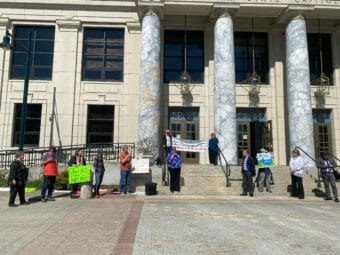
Activists call for tighter restrictions to keep PFAS out of drinking water. May 12, 2022. (Stremple/KTOO)

Two bills that would tighten regulations on the group of chemicals known as PFAS are stalled in committee as Alaska’s legislative session draws to a close. They could just die at the end of session — which would send lawmakers back to square one and leave clean water advocates high and dry for another year.

PFAS have been linked to cancer, liver damage, fertility problems, asthma and thyroid disease. Activists rallied for the bills at the Alaska State Capitol last week.

“We think it’s high time that these bills be passed to protect our Alaska communities,” said Pamela Miller, director of Alaska Community Action on Toxics. “There are communities from the North Slope of Alaska, all the way down through Southeast that have contaminated drinking water because of this dispersive use of these chemicals in industrial firefighting foams, used on airports and on military bases.”

Sara Siqiñiq Thomas joined the rally to advocate for her hometown of Utqiaġvik where firefighting foams at a naval base contaminated drinking water at Imikpuk Lake.

“I know too many people who have passed away from cancer in their 20s, people who have been on thyroid medication since their teens, things that are not normal and we’re seeing way too much of it,” she said.

Those foams are also the source of contamination around a state-run airport in Gustavus, where the state supplies bottled water to residents like JoAnn Lesh whose wells have been poisoned with toxic runoff.

JoAnn Lesh’s Gustavus property and drinking water was contaminated with PFAS from the nearby state-run airport. Sen. Jesse Kiehl and Rep. Sara Hannan look on. May 12, 2022. (Stremple/KTOO)

“I’m the face of it. I’m the face of PFAS,” she said.

Lesh and her husband ran an inn at what’s basically the gateway to Glacier Bay National Park for years, where they served patrons fresh food from their garden. She said discovering the water and soil on their property is contaminated was devastating.

“We moved there for everything to be pristine and everything is now polluted,” she said.

Senator Jesse Kiehl represents Gustavus and he’s been working on PFAS legislation since he was elected. He’s one of the sponsors of Senate Bill 121, which would put tighter regulation on PFAS in the state and limit the use of firefighting foams that are known to contain PFAS. He says the state’s regulatory agency — the Department of Environmental Conservation — doesn’t do enough to protect Alaskans from PFAS.

“The problem of these PFAS chemicals, these are forever chemicals. They don’t break down. They don’t go away. And they are in Alaskans’ drinking water,” he said.

He says Senate Bill 121 and its companion bill House Bill 171 would do the bare minimum to protect Alaskans’ drinking water and ensure the toxic firefighting foams aren’t widely used in the state any longer.

He says there’s money to enact their legislation in the federal infrastructure bill.

The state’s Department of Environmental Conservation raised a number of concerns about the legislation. DEC once regulated PFAS to higher standards but rolled them back following political pressure.

Tiffany Larson directs the division of Spill Prevention and Response at DEC. She says the state defers to the federal government — specifically the Environmental Protection Agency — on the question of PFAS.

“We will follow EPA when they come out with new drinking water standards,” she said. “Because they have the resources and have been able to invest that sort of effort into that.”

But Representative Hannan says the federal government isn’t moving fast enough.

“We should not and cannot afford, for our health, to wait for the federal action to clean this up,” she said.

It would be difficult to pass the bills in the remaining hours of the legislative session. If they don’t pass, legislators say they will try again next year.
Alaska has the fastest rising rate of overdose deaths in the country, CDC says

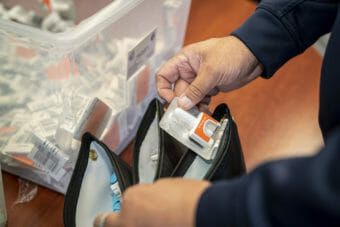
A new shipment of the overdose reversing drug naloxone arrived in Anchorage the last week of April. Test kits now have twice the amount to counteract the effects of fentanyl. The state’s health department recommends all Alaskans carry naloxone. (Image courtesy of Project HOPE.)

Alaska had the highest increase of drug overdose deaths in the nation last year, according to provisional data released by the Centers for Disease Control and Prevention on Wednesday.

Alaska’s rate of drug overdose deaths is usually lower than the national average.

Jessica Filley, with the state’s health department and Office of Substance Misuse and Addiction Prevention, says Alaska is now leading the nation because of the synthetic opioid fentanyl.

“It’s just been a slower process to get up here,” she said. “So I think what we saw happening on the East Coast in 2013 with this surge of fentanyl is just now hitting us up here.”

Alaska’s rate of overdose deaths increased by 75.3% last year, compared to 15% nationally. That’s as national overdose deaths reached an all-time high.

The state’s health department recommends all Alaskans carry naloxone, a drug that can rapidly reverse an overdose.
Alaska needs to train more nurses, but it doesn’t have enough nursing faculty to meet demand

Incoming staff nurses get trained on IV equipment at the Alaska Native Medical Center on Friday, Oct. 1, 2021 in Anchorage. (Photo by Lex Treinen/Alaska Public Media)

Alaska is short on health care workers — especially nurses and nursing assistants. Experts say increasing our reliance on out-of-state workers is economically untenable. But one big roadblock to training a homegrown workforce is hiring enough nursing faculty at the state’s university.

Nursing home administrator Kirk Elmore says his staffing woes really started at the beginning of the pandemic.

“We had some people that left to be travelers, we had some people that just didn’t want to work in health care during a pandemic,” he said.

By the spring of 2021, Elmore was struggling to fill gaps in the schedule at Juneau’s Wildflower Court nursing home.

“We realized really quickly that within about six weeks’ time that we wouldn’t be able to operate at full capacity. And that’s when we had to close one of our wings,” Elmore said.

He said it’s an economic hardship for the small nonprofit to operate without all of its beds full. The closure resulted in a backup at the regional hospital as well. In February it was holding 11 patients who couldn’t find room in a nursing home, but didn’t require hospital level care any longer.

Elmore hired traveling nurses to partially reopen the closed wing, but Wildflower Court is still not at full capacity. He said he’d like to hire about a dozen nurses or certified nursing assistants, but no one is applying for the job openings.

“Our concern is this is just going to get worse,” said Jared Kosin, president of Alaska State Hospital and Nursing Home Association. “The only way to sustainably address it is to really train Alaskans and give them opportunities to enter the health care workforce and fill those jobs.”

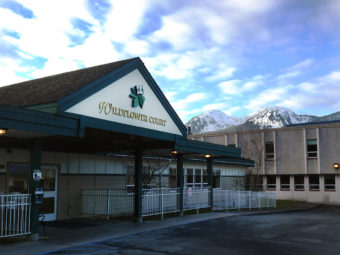
Wildflower Court is a non-profit, 57-resident long-term-care facility in Juneau. (Photo by Ed Schoenfeld/CoastAlaska)
Wildflower Court is a nonprofit, 57-resident long-term care facility in Juneau. (Photo by Ed Schoenfeld/CoastAlaska)

He says not enough health care workers are entering the workforce. The pandemic only exacerbated a nationwide shortage. Alaska is already heavily reliant on out-of-state labor, called travelers. They’re more expensive to hire and less likely to stay in the state. As a result, Alaska has some of the most expensive health care in the nation.

Last month Kosin told legislators that from an economic standpoint, the state has to be able to develop its own health care workforce or those costs could go up even more.

“Our pipeline, and how we’re developing Alaskans to go and take health care jobs, is underperforming so severely, that we really can only go up,” he said. “We’re so bad right now, that we can only really improve.”

He says there is homegrown interest in health care education, but there’s a huge problem: the state’s biggest nursing program has to turn away two applicants for each one they accept.

“We get a lot more applications than what we have seats,” said Carla Hagen, director of the nursing program at the University of Alaska Anchorage.

“Just as there’s a nursing shortage, there’s also a nursing faculty shortage. So obviously, if we had more nursing faculty, we would be able to open the doors wider, so to speak,” she said.

She says academia doesn’t typically pay as much as being a practicing nurse, which is another challenge.

Nearly all of the school’s graduates get their initial licenses in state. Last month, most of the graduates from the university’s Fairbanks program went directly to work in a local hospital.

“Our mission is to try to provide that education and accessibility to nurses that will be staying in their own communities and, you know, building really that pipeline to meet the health care needs,” Hagen said.

There’s some forward movement. The state pledged $2.1 million dollars to the university to support nursing faculty recruitment and retention. Another nursing program at Alaska Pacific University was just nationally accredited.

Back at Wildflower Court in Juneau, Kirk Elmore says he’s glad that he got some financial help to attract traveling staff so he could open up a few more beds at the nursing home. But he says those workers are likely temporary and staff is still stretched thin.

“People are having to work more hours, overtime,” he said. “A lot of people are still postponing vacations and times to get away because they’re needed here to fulfill those vital roles.”

We passed an occupational therapist in the hall. It’s a challenge, she says, but there are a lot of big hearts in the building and everyone’s doing the best that they can.

Site notifications
Update notification options
Subscribe to notifications