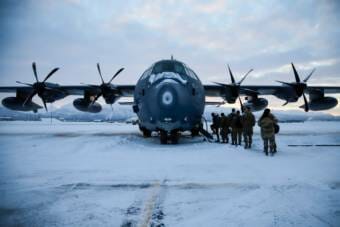
Members of the Alaska Air National Guard board a C-130 plane at Joint Base Elmendorf-Richardson in Anchorage on Dec. 2, 2021. (Jeff Chen/Alaska Public Media)
Five U.S. military bases in Alaska — and one in Greenland — failed to prepare for climate change like they were supposed to. That’s according to federal inspectors from the Department of Defense’s oversight agency. A report released this month said that most base leaders were unaware even of the requirements expected of them to prepare for climate change. The report also said that’s because military leaders at the sub-Arctic bases didn’t have enough training, funding, or guidance from the Defense Department to fulfill them.
Joint Base Elmendorf-Richardson, Clear Space Force Station, Eielson Air Force Base, Fort Wainwright and Fort Greely, and an Arctic base in Greenland were cited in the report.
These bases are especially vulnerable to climate impacts like flooding and wildfires. Images released with the report show flooding and damaged infrastructure at Alaska military installations, though the details are classified. Details on specific risks to Alaska bases are censored in the public version of the report.

Alaska’s sub-Arctic military bases are strategically important because of the risk of attack from countries like Russia and China and new shipping opportunities as Arctic sea ice melts.
Federal defense reports identify climate change as a potential threat. The Department of Defense called the effects of climate change a national security issue. Extreme weather cost the nation hundreds of billions of dollars in damages over the last five years.
Teen ambassadors from across the state will lead a virtual anti-tobacco summit this Thursday. It’s part of a peer-to-peer education program called Youth Encouraging Alaskans’ Health, or YEAH.
Charlie Ess is an adult organizer with the program. He says the teens get trained in public speaking and presenting before going to health fairs and presenting in classrooms.
“These are folks dedicated to making healthy lives for people they know. And so they come up with what they think is important. And then they come up with ways to present that where they think it will resonate to the folks they present to,” Ess said.
The teens create tobacco prevention videos that teachers across the state use in their classrooms.
Leihla Harrison is a sophomore at Soldotna High School. She and another ambassador just finished making an educational video about the dangers of vaping.
“The best part for me is getting to teach other kids about how dangerous it is,” Harrison said. “Because I see all these kids are vaping, and they’re smoking in the bathrooms and in the parking lots. And I want to educate them that it’s not a good thing to do, that it harms them.”
Leena Edais is a sophomore at Dimond High School in Anchorage. She says she got involved with the program because a lot of her friends vape or use e-cigarettes.
“I know the effects of it, but a lot of kids don’t. They just think it’s like breathing air — flavored air — but it’s not. So I wanted to help kids around Alaska and the Lower 48,” she said.
Data from the Centers for Disease Control and Prevention shows that more than a third of Alaska teens have used some form of tobacco product.
The non-profit Rural Alaska Community Action Program has run the YEAH program for the last four years with funding from the state.
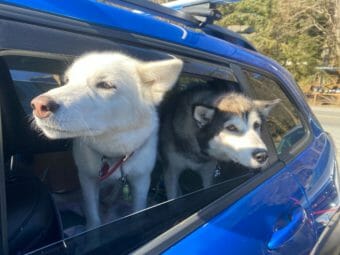
Osprey and Chinook, retired sled dogs, wait in the Juneau Animal Rescue parking lot for shots. (Stremple/KTOO)
Juneau’s pet owners are scrambling for care as one of the city’s three veterinary offices closes. The vet shortage is not just a Juneau or an Alaska problem. It’s part of a nationwide trend — as practicing vets retire, there aren’t new ones to fill the gap.

On a sunny, blustery Tuesday this April, a dozen cars were parked outside of Juneau’s Animal Rescue. They were trying to get a slot at a new, weekly vaccine clinic.
Riley O’Connor waited with her two cats. The kitten hid under the seat while the older cat, Margot, sat in her lap.
A big bowl with O’Connor’s lunch salad rested on the center console — she had been outside for two hours. She came because her usual vet, Southeast Alaska Animal Medical Center, announced on social media that it is closing its doors over the next couple of months.
Riley O’Connor and her cat Margot wait for an a rabies and microchip appointment at Juneau Animal Rescue’s Tuesday Vaccine Clinic. (Stremple/KTOO)
“I have nowhere else to really go for vaccines,” O’Connor said. “The baby needs his microchip and rabies, and I wasn’t able to get in with anyone else.”
Southeast Alaska Animal Medical Center didn’t respond to requests for comment, but a Facebook post makes it clear that the pandemic, staff shortages and supply chain woes contributed to the choice to close. Two of the clinic’s doctors retired recently.
The vet crunch has the local nonprofit rescue operation opening up vaccine clinics even though their main focus is getting homeless pets adopted.
“It’s a large need in the community, and we can only meet so much of it,” said Juneau Animal Rescue executive director Sam Blankenship. She popped out to the parking lot in a high viz vest to manage waiting vehicles. She said people have mostly been patient.
“We’re doing the best we can. People started lining up at 12:30 for a clinic that starts at 2:00,” she said.
The rescue just hired a veterinarian with an aim to offset the shortage by offering some basic care services, like these clinics and some wellness exams. Blankenship say she hopes it opens up appointments at veterinary offices for more complicated needs.
“I know a lot of people are really concerned about how are they going to get access for their pets’ health care and different stuff. As well as am I, because I’m a pet owner as well. So the fact of the matter is that there’s a nationwide veterinary shortage and it’s projected to continue for the next ten years,” Blankenship said.
Blankenship urges people to be kind as they work to secure care for their animals. She’s hoping concerned residents will organize to help recruit new vets willing to move to Juneau.
People started lining up more than an hour before Juneau Animal Rescue’s vaccine clinic opened. (Stremple/KTOO)
Back in the parking lot, Lee Parker is waiting with her two retired sled dogs, Osprey and Chinook.
Parker says she’s been taking her pets to Southeast Alaska Animal Medical Center for about 50 years. Now, this is her only option. She said other local vets are too busy for new clients.
“Just a couple of months ago, when I had a really bad emergency, I couldn’t get my dog into any veterinarian,” she said.
She shook her head and let out a deep breath when she talked about her options to get a checkup for Chinook, her geriatric dog. She’s hoping a new vet takes over the Southeast’s practice.
“If not, do a major road trip. Take them either to Canada or down South. So options are not good right now,” she said.
From Juneau, that not a casual trip. It requires either a ferry and a drive or flying with the dogs.
She says after all this time, she’ll be sorry to see the practice close for good.
“When I came here in the mid-70s, there was only one clinic in town. It was Southeast, and they were just a little bitty shack,” Parker said.
She said that shack used to be right next to the Juneau Animal Rescue parking lot where she was waiting. Cars idled in the sun, and a sign in the driveway read: “Clinic full. Please come back next week!”
Dr. Tina Woods opens the Culture Heals website on her cell phone. April 13, 2022. (Photo by Claire Stremple/KTOO)
Tribal citizens in Southeast Alaska who are experiencing addiction have access to a new, free online treatment. It’s called Culture Heals and it’s offered by the new mental health program at the Central Council of Tlingit and Haida Indian Tribes of Alaska.
Dr. Tina Woods leads the Council’s Community and Behavioral Health Services team. She says the goal is to remove barriers for people seeking information or care.
“Half the battle with behavioral health is being able to choose the right words to describe how you feel, to describe what you need,” she said. “Culture Heals Addiction is a platform that will allow people with resources all in one place to learn about something that they might be struggling with.”
She says the Culture Heals tool addresses issues that underlie addiction like generational or childhood trauma.
William Andrews joined Dr. Woods’ team last year and will lead men’s healing groups. He says he got involved after therapy with the tribe helped him through the pandemic. He says that was the only therapy he could access because other local resources were unavailable.
“I think this is one of the most important things that we’re doing, as far as taking leadership in our community, is to help meet unmet needs that not just our citizens, but our community, has,” he said.
Culture Heals is available online and is mobile-friendly. It has links to information, culturally relevant videos and an emergency hotline.
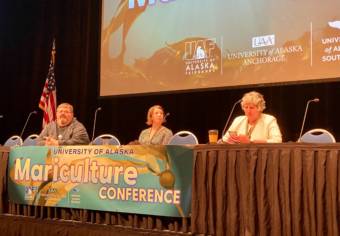
Tlingit and Haida President Richard Chalyee Eésh Peterson, Juneau assembly member Christine Woll, and UA President Pat Pitney at the UA Mariculture Conference in Juneau. April 12, 2022. (Stremple/KTOO)
Supporters of mariculture in Alaska are working to build a $100 million industry out of shellfish and seaweed over the next two decades. They’re meeting up at the University of Alaska Mariculture Conference in Juneau this week to talk about how to get there.
The Juneau Economic Development Council is hosting the conference. Executive Director Brian Holst said mariculture is a good long term investment for the state.
“It is an industry that’s sustainable for Alaska, and can create jobs in not just in communities such as in places like Juneau, but in rural areas throughout Southeast. And anything that’s good for communities around Southeast Alaska is also good for Juneau,” he said.
The University of Alaska is sponsoring the 3-day event. President Pat Pitney said the university is “all in” on mariculture.
“Alaska needs to be on the world map for mariculture,” she said. “We have people who are better prepared and more willing to work for it. And that’s gonna get us there.”
The university is developing academic programs in mariculture for its undergraduates and now offers a master’s degree in marine policy, in a partnership between the University of Alaska Fairbanks and the University of Alaska Southeast.
Julie Decker directs the Alaska Fisheries Development Foundation, a non profit that supports fisheries. She says mariculture is a way to grow seafood opportunities in the state.
“This incredible, once in a lifetime opportunity has to be balanced with a sense of responsibility. The urgency needs to be balanced with equity. And so the real challenge that’s before us is figuring out how to do things better than we’ve done them in the past,” she said.
There’s $32 million in mariculture research over the next decade coming from the settlement from the Exxon Valdez oil spill. An additional $50 million could come from the federal government and $25 million could come in matching funds from the state.
The Alaska Department of Fish and Game has started testing wildlife for COVID-19. It’s part of a partnership with the U.S. Geological Survey’s National Wildlife Health Center and the Centers for Disease Control and Prevention. Scientists want to make sure a new variant doesn’t emerge in animals and then infect people.
But Kimberlee Beckmen, a wildlife health veterinarian for Fish and Game, says not to worry too much about getting COVID-19 from an animal.
“It’s more a concern of us infecting wildlife and if wildlife could become a reservoir, but that hasn’t been shown yet,” she said.
When she says “reservoir,” she means the risk is that the virus could take hold in an animal population, mutate and infect humans with a new variant.
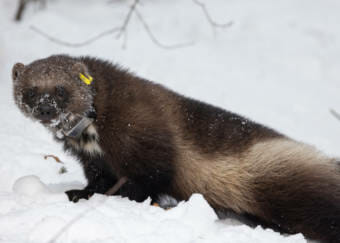
In Alaska, biologists are collecting samples from a number of mammals: moose that live near residential areas, lynx (because they’ve gotten it in zoos down south) and mustelids — that’s wolverines, minks and martens. There are plans to test caribou and Sitka black tail deer, as well as seals and belugas in the North Slope Borough.
If you’re wondering how you test a beluga for COVID-19 — yes, you swab the blowhole. For other animals, it’s a nasal swab, pretty much the same as how we test people.
“We stick it up in both nostrils, but we go way deeper,” said Beckmen. “I mean, we go way up to the level of the eye and roll it around and then put it in the media and then that gets sent to the lab.”
Other states have tested bears. Beckmen says Alaska will likely do the same when they come out of hibernation because bears that have been exposed to human garbage are at elevated risk for infection.
She says the state has submitted over 100 samples for testing but hasn’t gotten many results back yet because an avian influenza outbreak on the East coast is keeping labs busy.
David Saalfeld is an Anchorage-based wildlife biologist who added COVID-19 testing to his regular fieldwork this winter. He live-traps wolverines and lynx with walk-in traps that don’t harm them. Then he sedates the animals so he can collect samples like nasal swabs and a blood draw.
He says he added COVID screening about halfway through his season.
“So it’d be not a ton of animals, even say two or three wolverine and seven or eight lynx that I sampled,” he said.
There’s currently no evidence that COVID-19 can be passed by handling or eating meat from wild game. Fish and Game recommends hunters use the same precautions as always: wear gloves, clean knives and don’t touch any weird looking tissue.
Hunters can report sick animals or strange behavior to Fish and Game.
Close
Update notification options
Subscribe to notifications
Subscribe
Get notifications about news related to the topics you care about. You can unsubscribe anytime.