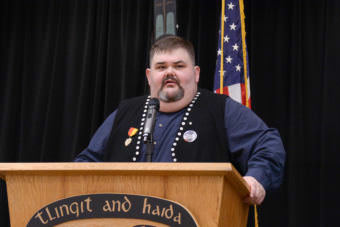
Richard Chalyee Éesh Peterson, President of Central Council of Tlingit and Haida. (Photo courtesy of Central Council of Tlingit and Haida)
Central Council of Tlingit and Haida President Richard Chalyee Éesh Peterson was in Washington, D.C. for the reauthorization of the Violence Against Women Act, or VAWA. The legislation is part of the funding act for this fiscal year.
U.S. President Joe Biden helped write the original piece of legislation that supports responses to sexual assault and domestic violence. Peterson says he was impressed with the president’s remarks on Wednesday.

“It was exciting,” Peterson said. “It was pretty emotional. You know, it is a needed law and Alaska inclusion is so important. It was really great to be able to share that with friends. You know, who had been champions on VAWA. Like Michelle Demmert, former chief justice for our tribal courts.
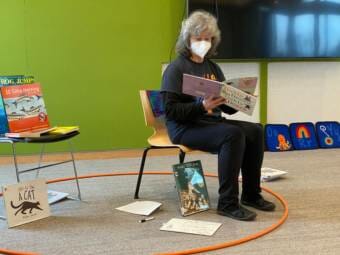
MJ Grande reads to Juneau youth at Mendenhall Valley Library’s first storytime in two years. March 15, 2022. (Photo by Claire Stremple/KTOO)
Juneau officials dropped the city’s pandemic alert level to “minimal” two weeks ago. One of the activities to return to the community’s calendar is storytime at Mendenhall Valley Public Library.
“My heart’s beating really, really fast,” said MJ Grande as she waited for families to arrive.
Grande is the Youth Services Librarian for Juneau Public Libraries. She’s preparing for the first storytime in two years. And she’s anxious because storytime is for kids young enough that they can’t get vaccines yet, but she’s trusting public health guidance.
“This is an essential part of services to children. The schools get them at five. But to link that early literacy in the family setting — and with the smallest people — has been the public library’s responsibility,” she said.
Juneau libraries have also been hubs for information and free pandemic supplies over the last two years. They’ve remained open, except for a couple of weeks in March of 2020.
Families stay spread out in bubbles that are marked by large hoops on the floor.
The McCarthy family settles into one. They moved to Juneau mid-pandemic. They’ve been coming to the library a lot, and today they’re looking for some books about raising ducks. Their youngest, Reed, just turned four, and he’s pretty excited about it.
The McCarthy family moved to Juneau in 2020. This is their first storytime at Mendenhall Valley Library. March 15, 2021. (Photo by Claire Stremple/KTOO)
A few more people come in and find space on the floor.
There are some changes to storytime. Sign-ups are required now — although there were a few no shows, so the library accepted a couple drop-ins. Masking is encouraged. Instead of meeting in the kid’s section, storytime is in a large room with more floor space and better ventilation. At the door, there are at-home test kits, backup masks and hand sanitizer — so the room smells faintly of rubbing alcohol.
Grande starts with some songs, then gets down to business. There’s a book about herring, for the herring season that’s about to open, and a book about a duck family for Reed McCarthy.
Storytime is designed for the average 3-year-old’s attention span, so actual reading is punctuated by songs, and it’s all over in about a half an hour.
Christina Shanley says she and her son Hollis will likely return to storytime at the Mendenhall Valley Public Library. March 15, 2022. (Photo by Claire Stremple/KTOO)
For Christina Shanley and her son Hollis, this is the first storytime. That’s true for most people here because a lot of the kids are barely as old as the pandemic. She says they’ll probably come again.
“This felt nice and safe. There’s things that are opening up in town that’s giving us opportunities, those of us with toddlers to get our toddlers out in the community, which we haven’t been so far,” she said.
MJ Grande says it’s good to be back.
“If a person can have an essential self, this is mine,” she said.
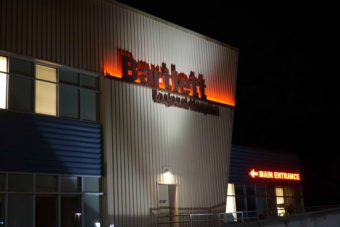
Bartlett Regional Hospital in 2015. (Photo by Jennifer Canfield/KTOO)
The number of mental health patients in Juneau continues to skyrocket. Bartlett Regional Hospital first reported a surge of mental health crises in the spring of 2020, when patient visits doubled. The behavioral health department said it was overwhelmed back then.
Interim Chief Behavioral Health Officer Karen Forrest says the number of patients her department sees a month has now topped its previous numbers by 40%.
“We’re over about 1,400 people, up from 1,000 — that was the previous data point. So, we have seen that continue, and we have seen an increase in services provided across all age ranges,” Forrest said.
A new building to house the hospital’s behavioral health crisis center is slated to be complete in the spring of 2023.
The hospital offers psychiatric services in the emergency department, but clinicians can also meet community members at home. Forrest’s predecessor, Bradley Grigg, began a crisis intervention services team in the spring of 2021.
KTOO spoke to Karen Forrest as part of an hour-long special update on Bartlett Regional Hospital. You can find the full program at KTOO.org.
Correction: This article has been updated to correct the spelling of Karen Forrest’s name.
A wildfire near Juneau in May 2018. Tongass National Forest responded to 32 wildfires in 2018. 15–20 fires/year is normal in the forest. (U.S. Forest Service photo)
A multi-year drought that hit Southeast Alaska before the pandemic had such wide-ranging effects that a group of scientists has just finished studying it.
In 2019, extreme drought was recorded for the first time in Southeast Alaska. But it’s hard to gauge drought in one of the wettest places in North America.
“Drought is relative. At no point did Southeast look like what people often think of as drought — you know, a dried up Kansas cornfield,” said Rick Thoman, a climate specialist for the Alaska Center for Climate Assessment and Policy at the University of Alaska Fairbanks.
Much of Southeast Alaska is a temperate rainforest. Ketchikan has about five times the average rainfall as the rest of the state — up to 160 inches per year.
“Southeast Alaska is built for lots of precipitation,” Thoman said. “And so even though 100 inches of precipitation in a year in most places in the United States would be an immense amount of precipitation, in southern Southeast it isn’t. And so it had impacts to people, to the whole ecosystem.”
Low water exposes the banks of a reservoir near Ketchikan during the drought. (Photo by Jeremy Bynum)
For example, many southeast communities rely on hydropower for electricity. In 2019, Ketchikan had to run on backup diesel generators for months. By one estimate, it cost more than a million dollars. Petersburg and Wrangell burned diesel, too.
So a group of scientists called the Southeast Alaska Drought Project, a partnership between Alaska scientists and the National Oceanic and Atmospheric Association, documented and analyzed what happened. He says their work on the 2016-2019 drought will be an important one-stop resource for Southeast communities when the next one hits.
They’re releasing their findings on a characteristically wet year.
“Right now, no one in Southeast is thinking about drought. But we know it’s going to happen again. And we know, we just have lived through how impactful it can be,” said Thoman.
He says it’s also important to put this particular drought in context.
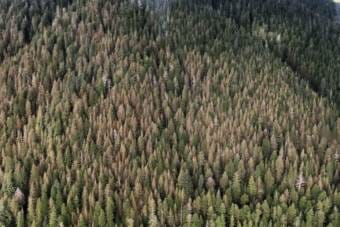
A sawfly outbreak hit the southern Panhandle in summer 2018, spreading to the central Panhandle in 2019. (Photo by Elizabeth Graham/U.S. Forest Service)
Andrew Hoell studies hydro climates across the globe for the National Oceanic and Atmospheric Administration.
“Droughts of this kind have happened in the past. It’s just a drought like this hadn’t happened in our society as we see it today,” Hoell said. “The population had grown accustomed to getting that normal delivery of precip, and then it got dry, and then the impacts were pretty profound.”
So profound, in fact, that the United States Department of Agriculture redefined drought metrics for the region in 2019.
The researchers say more droughts are coming, but maybe fewer and further between. Climate trends indicate the region will warm and get wetter overall.
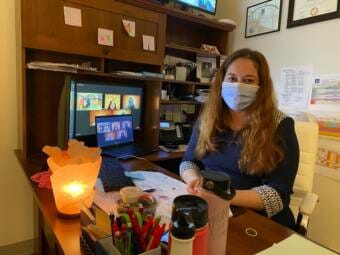
Jamie Shanley at her desk at Little Eagles and Ravens Nest Child Care in Juneau on Feb. 25, 2022. (Photo by Claire Stremple/KTOO)
Last year, the Gold Creek Child Development Center in Juneau was operating at half capacity even though it had more than 100 kids on its wait list. It was struggling to hire and keep teachers. But after an infusion of aid money, Director Amanda Gornik says things have turned around.
“We’re expecting to be at full capacity, staff-wise, and we’re starting to increase our [student] numbers as well,” she said.
The state of Alaska received nearly $100 million dollars last year to support the ailing child care system. Almost half of that was slated to go directly to child care centers in the form of grants. By the end of last year, the state’s Child Care Program Office had distributed only about $5 million of those federal funds, most of them from the American Rescue Plan Act, to care centers in its first round of grants. Now that number is closer to $20 million.
She has applied for another grant and says the first is already helping because she’s been able to make new hires.
“We will have a total of 15 staff members inside our facility,” Gornik said. “So we’ve almost doubled.”
That means she can enroll kids from the waiting list, so her classrooms are filling up. And she says more staff is better for everyone.
“Kids can feel everything,” she said. “When a staff member comes in and they’re stressed and overworked, the kids feel it. Having more staff to be able to handle the work, decrease the stress. Our students are happier and feeling less stressed as well.”
The first influx of money hasn’t solved every child care center’s hiring woes. Up the road at Little Eagles and Ravens Nest Child Care, administrator Jamie Shanley says she made a much needed hire in January, but she still needs more staff.
“We are still actively recruiting, and the applicant pool is very small or non-existent. We’re really exhausting our resources and finding different and creative ways to recruit,” Shanley said.
She says the child care system has been broken for a long time — centers have to choose between paying low wages or charging parents more than they can pay.
“We need reliable money. We need to know how much it’s going to be every month. And, you know, something that’s gonna be long lasting,” she said.
Shanley applied for $30,000 in relief money from the state last week.
Christina Hulquist works for the state’s health and social services department, which is administering the grants. She says the “long lasting” part is what took time to figure out. The plan is that direct assistance will continue through October of this year. The department is also investing millions in programs to ease financial strain on families and care centers.
“Now it’s just about getting all of those different strategies stood up, you know. Some of them are brand new programs, so they take a little bit longer, but it’s nice to have a vision and I feel great about the decisions we’ve made so far,” Hulquist said.
The good feeling is echoed by early childhood education boosters in Juneau. Blue Shibler runs Southeast Alaska Association for the Education of Young Children, a non-profit. She says the only criticism she’s heard from providers is that they would like to get the grants faster.
“The state, I do think, is doing their best in getting them out equitably. And as fast as they possibly can, while also making sure that they’re complying with all the federal guidance that comes with those funds,” Shibler said.
She praised the state for listening to providers more and investing in their feedback.
The state has begun sending out checks for the second phase of grant funding to child care centers. Applications will be open until June 1.
Correction: A previous version of this story misstated Christina Hulquist’s department. She works for the Alaska Department of Health and Social Services. The article has been updated to clarify that about half of the total aid is going directly to care providers in the form of grants and to update the amount of money the state has distributed.
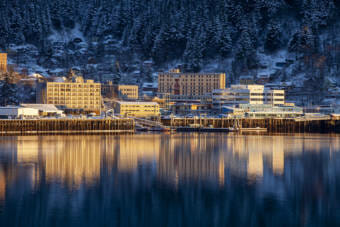
The sun rises over downtown and the cruise ship docks on Dec. 22, 2021, in Juneau, Alaska. (Photo by Rashah McChesney/KTOO)
Juneau lowered its pandemic alert level to “minimal” on Monday. The update means masks are no longer required in Juneau. The city still recommends masks indoors, especially for immunocompromised people or people at risk for severe illness. Large indoor gatherings are also permitted with social distancing of six feet.
The change comes as COVID-19 risk levels drop. Case levels have decreased and hospital capacity is stable, according to a city press release. The community is highly vaccinated and protective masks, at-home COVID tests, and therapeutics to treat the virus are available.
Face masks are still required in city buildings, but officials say an update to that policy will likely come later this week.
Juneau’s risk level is “medium” according to the Centers for Disease Control and Prevention. At that level, the federal guidance for the community is roughly the same. CDC recommends talking to a healthcare provider about masking if you are at high risk for severe illness, staying up to date on vaccines and testing if you have symptoms.