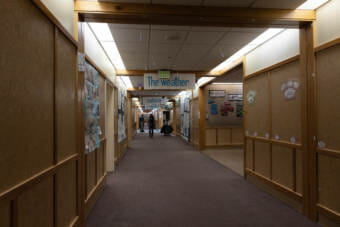
Riverbend Elementary School is being inspected for water damage in Juneau, Alaska on Thursday, Jan. 13, 2022. Over the weekend, a pipe burst and flooded about two-thirds of the school with inches of water. (Photo by Lyndsey Brollini/KTOO)
Juneau’s Riverbend Elementary School will move classes from its flooded Mendenhall Valley school to a nearby church facility while repairs are underway. That’s according to Principal Elizabeth Pisel-Davis, who posted on the school district’s website on Sunday.
Chapel by the Lake is about two miles up the road from Riverbend Elementary. Its reverend opened the building to students temporarily. Nearly all classrooms will fit in the facility.
The church building has a commercial kitchen and space where breakfast and lunch may be served to students. The University of Alaska Southeast has also offered up a classroom and its recreation center, according to the update.
Pisel-Davis wrote that she hopes students will be able to return to school in person at the Chapel by the Lake by the end of the week. Until then, the school is providing at-home learning materials to families.
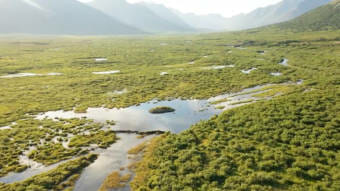
As Arctic tundra warms and thaws, incursions of shrubs and small trees have created new habitat for beaver, which create ponds and wetlands that further transform the once-frozen landscape. (Courtesy of Ken Tape)
Beavers are moving to the Arctic as the Alaska tundra heats up and the beaver population rebounds after centuries of trapping. A study published in December shows the small, industrious mammal is accelerating climate change in the north.
Beaver ponds are showing up in places they’ve never been before. For the past five years, ecologist Ken Tape has used satellite imagery and old aerial photos to map where beavers have dammed streams and created ponds. The University of Alaska Fairbanks professor says he was shocked by the magnitude of change.
“If it were a few streams, it wouldn’t be a big deal,” Tape said. “But it’s a lot more than that.”
Satellite imagery shows beavers have built upwards of 12,000 new ponds in the last half century. The beaver pond count doubled in the last 20 years. That’s bad news for melting permafrost. Tape and his fellow researchers have long tracked the effects of climate change on permafrost thaw and Arctic vegetation and water, but they were really surprised by the effects of beavers.
“When we got to beavers, it was like, ‘Whoa, you get some beavers in on some stream, and it’ll never look the same again.’ I mean, it’s just so transformational, what they do. It affects all aspects of lowland ecosystems: fish, permafrost, water, chemistry, boat travel, I mean, you name it,” Tape said.
When beavers dam a stream, it creates a pond that’s deeper than the stream was, and it retains more heat. Tape says if you liked the Arctic the way it was, this is not a good thing. He says to think of ponds as little oases for creatures that don’t usually live in the Arctic. They thaw permafrost and release carbon dioxide. It’s a case where increased biodiversity isn’t healthy for the native ecology.
“The landscape is falling apart with permafrost thaw, and beavers are that trend on steroids. And one of the big reasons is that permafrost is really rapidly impacted by changes in hydrology and surface water. And that’s precisely what beavers do,” Tape said.
The full effects of these new beaver ponds on fish and water quality aren’t clear yet — Tape says last season kicked off what will be about five years of field study around Nome and Kotzebue. He says he has an idea of the big picture, but it’s the people in Arctic communities who can help him learn how beavers are changing life and livelihood in the North.
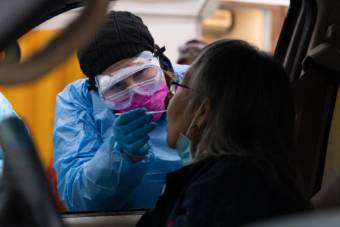
Dr. Ellen Hodges tests a Bethel resident at a COVID-19 testing event hosted by the Yukon-Kuskokwim Health Corporation in Bethel, Alaska on Nov. 7, 2020. The state is now tracking COVID-19 by looking at trends over time rather than granular data as they did at the beginning of the pandmeic. (Katie Basile/KYUK)
Omicron is now the dominant COVID variant in Alaska — and it is changing the way the health department looks at the pandemic. And, the state has new recommendations about how to gauge your risk.
The state’s public health officials say that the level of granular data we had at the beginning of the pandemic is pretty unusual. Now they will be tracking COVID-19 more like they have always tracked the flu — looking at trends over time.
As the state’s case counts reach an all-time high, Chief Medical Officer Dr. Anne Zink says the metrics public health is using to understand the virus’ spread and severity have changed.
One example is the percent positivity rate. That’s the percent of all of the tests for COVID-19 that come back positive. It used to be a good way to get a sense of the virus’ hold in a community. The higher the number, the more testing needed to be done.
But, that’s no longer the case.
“It really is changing in its usefulness,” Zink said. “If we have a lot of people doing at-home tests, we always struggle with some of the smaller facilities in getting reports in.”
Zink says it’s better to look at the total number of positive cases, which is still an indicator of risk and community spread. But state epidemiologist Louisa Castrodale says now we need to look at those numbers in broad strokes instead of worrying about daily counts.
“So whether we give you a number that is like, you know, 1,435 versus 1,537, like it’s up. That’s good; that’s what we want people to take away from it. Knowing that we have community spread, that’s sort of enough to help educate people into what they might want to do for mitigation,” Castrodale said.
Public health officials say contact tracing isn’t so useful anymore either and they’re phasing it out. The state hasn’t hammered out the full details, but they say they will be getting rid of some of their contact tracing staff.
“Way back when, it was super important to know exactly where that person had traveled and exactly where that person had been, because there were so few cases, and there really wasn’t community transmission,” Castrodale said.
In other words, contact tracing was useful in interrupting the spread of the disease. Now, Southeast Regional Public Health Nurse Manager Sarah Hargrave says omicron is moving too fast to catch every case before it spreads.
“When we have a huge number of cases, we really want to focus on those that are the newest, because they would have had less chance to spread it around to other people. The ones that are already 10 days out … they’ve spread it everywhere. As far as they’re going to, at any rate,” said Hargrave.
She says public health is “triaging” contact tracing. Instead of trying to reach everyone who’s positive, the state will first contact the newer positive cases and people who are at high risk or who live in group settings, like homeless shelters, mines and assisted living facilities.
Hargrave says public health needs to put its resources back on things like opioid addiction, tuberculosis and sexually transmitted diseases.
As the state changes how it tracks the pandemic in Alaska, local community leaders are having to change how they track it, too. Hargrave says they should be looking at case counts and vaccination rates as they make public health decisions.
State epidemiologist Joe McLaughlin says for people trying to make decisions about their personal level of risk, the most accurate metrics are the number of local hospitalizations and deaths. Case counts are still useful — even though they aren’t as accurate as they were before because the state isn’t getting data about all of the positive test results now.
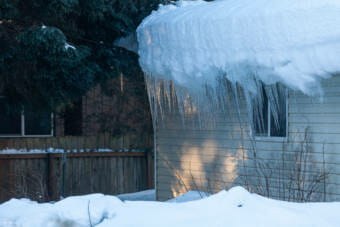
Ice hangs off of Stan Savland’s Lemon Creek home on Tuesday, Jan. 4, in Juneau. Svaland cleared some of the overhanging snow off of his roof in an attempt to keep it from falling and damaging his oil tank, but a several-hundred pound piece hit him in the leg on the way down. (Rashah McChesney/KTOO)
Winter weather is in full effect across Alaska, but unusually high snow accumulation is testing Southeast. Usually some snow melts between storms, but that’s not happening this winter.
Long icicles dangled under a block of snow piled on top of Stan Savland’s home in Juneau’s Lemon Creek neighborhood. Savland and his son knocked a piano-sized chunk of snow and ice off the roof with a steel bar this week.
Savland says warming from the attic created an ice dam that blocked the snow from sliding off his metal roof. He estimates more than three feet of ice and snow teetered above his fuel tank. So he took matters into his own hands.
“We put some protection by the oil tank, and it basically bounced off the protection and then bounced out, hit me in the leg and knocked me down,” he said. “We accomplished our goal but kind of got caught in the crossfire.”
Savland brushed off concern about his injury but was noticeably limping. Now he advises caution if you have a dangerous amount of snow. He says anything that can keep you off the roof is probably a good idea — like a snow rake. He’s also seen roofers advertising snow removal.
“I think they said like 50 cents a square foot. So 1000 square feet would be 500 bucks to clear a roof, but could be well worth it. I mean we’re expecting warming temperatures and more snow which is going to create more weight,” he said.
Stan Savland walks up a street near his home in Lemon Creek after a close-call with a chunk of ice he pulled from his roof that hit him on its way down, on Tuesday, Jan. 4, in Juneau. (Rashah McChesney/KTOO)
Down the road in Mendenhall Valley, friends and neighbors started calling Nate Geary to ask about the weight of the snow load on their houses. He’s an engineer for the state. Since he has the safety equipment on hand, Geary scaled his roof and cut out a one-foot block of snow.
“I just put that into a container and weighed it on a bathroom scale,” he said.
The snow block from his roof weighed 42 pounds — getting pretty close to the limit of what his roof can support.
Geary’s block was nearly three feet thick. At that point, he recommends getting up there and shoveling it off if you can do it safely.
“At a minimum, I think people should use a snow rake to clear the overhangs of the roof since that’s the weakest part of the structure,” he said.
A state Department of Transportation worker clears snow from the sidewalk along the Glacier Highway in Lemon Creek on Tuesday, Jan. 4 in Juneau. (Rashah McChesney/KTOO)
Juneau City Manager Rorie Watt says this has been the most intense pile-up in his three decades in Juneau. But he doesn’t want people to panic about snow on their rooftops.
“I would generally caution people to be careful and not overreact,” he said. “If they saw signs of flexing or cracking in the sheet rock, you know, then they might want to think about shoveling their roof off.”
He says if there’s signs the roof is taking too much weight, people might want to shovel it off, but he also worries about people getting up on their roofs in high winds and frigid temperatures.
Watt says city code is for roofs to withstand 50 pounds per square foot, but the old code was 40 pounds per square foot. He says most buildings were probably built to that lower rating.
Buildings with flat roofs are especially susceptible.
It’s not just Juneau laboring under heavy snow — Yakutat residents teamed up to clear the school roof this week. And as KHNS reports, the Haines’ Avalanche Center warned that local snowpack weighed up to 57 pounds per foot and could crush structures.
Jimmy Brackett clears lanes for the Auke Lake Curling Club on Tuesday, Jan. 4, in Juneau. (Rashah McChesney/KTOO)
National Weather Service meteorologist Greg Spann says this isn’t the snowiest winter Southeast Alaska has ever seen, though snow accumulations at the Juneau airport are nearly double the average for this time of year.
“What’s made this winter in part stand out in so many places, is that the snow hasn’t been able to melt after each system,” he said. “Eventually the all that accumulated snow starts to become a real problem and a real hassle.”
That’s what’s happening this week. Juneau is running out of snow storage downtown and has blown through its snow removal budget already, according to the borough.
Another significant snow storm is coming this weekend after several days of truly frigid temperatures. Spann says the good news is that temperatures may bounce back up above freezing after that.
But more snow and warming temperatures could add even more weight on rooftops.
Rashah McChesney contributed to this story.
Close
Update notification options
Subscribe to notifications
Subscribe
Get notifications about news related to the topics you care about. You can unsubscribe anytime.