Claire Stremple

"I support KTOO reporters and guide coverage that informs our community and reflects its diverse perspectives."

When she's not editing stories or coaching reporters, you can find Claire outside with her dog Maya.

Hazard maps and city code stall affordable housing project in Juneau

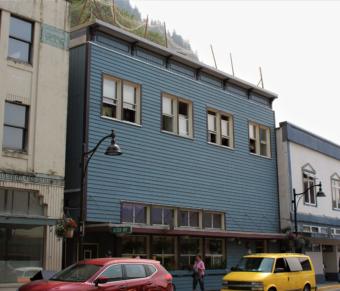
Mariya Lovishchuk with her dog at 247 Franklin Street in December, 2021. (Claire Stremple/KTOO)

Outdated hazard maps and city code are stalling an affordable housing project in downtown Juneau. The city is grappling with its need for affordable housing and how it interprets its own code.

The blue building at 247 South Franklin Street once housed dozens of people each night as The Glory Hall, Juneau’s emergency shelter and soup kitchen.

Director Mariya Lovishchuk tries a few keys before the door springs open. Glory Hall moved to a more spacious location this summer, and the downtown property that the Glory Hall non-profit still owns is almost empty.

Lovishchuk walks through the commercial kitchen into a high-ceilinged dining area that once served up to a hundred meals a day. She heads up to the second and third floor, where she’s proposing to convert dorm spaces into apartments.

Lovishchuk says the city sorely needs affordable housing downtown, but Juneau’s development department won’t green-light her plans.

According to city paperwork that’s because the Glory Hall’s building is in a severe avalanche hazard zone. City code says existing properties in those zones cannot increase density through new construction.

A dormitory room at 247 Franklin Street that The Glory Hall would like to turn into an apartment. December 2021. (Claire Stremple/KTOO)

Lovishchuk argues her plan actually reduces the number of people who might sleep there. The room she’s standing in is full of bunk beds. It once housed a dozen people. As an apartment only one or two people would live there.

“Overall, we are neither increasing the density of the people who are sleeping here, or the spaces inside the building. So I’m really hopeful that this is all gonna work out,” she said.

Lovishchuk’s plan will add some walls to the inside of the building, but instead of sleeping 50 people as a shelter, the apartments will sleep 7-14 people.

“The rub is in their reading of the code,” said City Manager Rorie Watt.

“They’re reading this as a conversion of building. In the planning world, they’re converting the use.”

He says the development department sees the new construction as a conversion of use — from a shelter to apartments — and they say that’s prohibited by code.

Code says development by conversion can’t increase density. The main goal is to “minimize the risk of loss of life or property due to landslides and avalanches.

“For somebody not steeped in land use code or not regularly in it … you’d be like, ‘well, that doesn’t really make sense.’ And it’s like, well, it might not make sense. But that’s still what they think the code means,” Watt said.

Lovishchuk appealed the city’s decision to the planning commission, which voted unanimously to hear her appeal at a future meeting that hasn’t been scheduled yet.

Officials from the department wouldn’t speak on the matter while it is in an appeal process.

Omicron is ‘likely’ already spreading in Alaska, state says

""
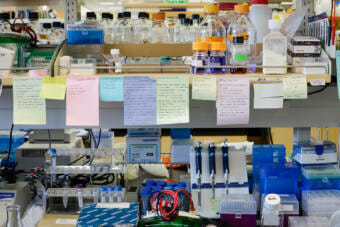
A lab at the University of Alaska Anchorage where scientists are part of a state-sponsored consortium that searches for new strains of COVID-19. (Jeff Chen/Alaska Public Media)

Alaska has only identified one case of the omicron variant in the state so far, but state epidemiologist Louisa Castrodale says it’s likely here and spreading.

“We kind of expect that there likely is omicron circulating in Alaska and elsewhere that hasn’t been detected yet. And we’ll get notifications of that and need to sort of adjust back the dates where we thought it was or wasn’t present,” she said.

Across the globe, scientists are racing to learn more about omicron. The World Health Organization has warned that it spreads faster than any other variant of the coronavirus.
In Alaska, information is still scarce about the first omicron case.

In a video conference with media, Castrodale that the state health department did not get a response when it reached out to the Anchorage resident who tested positive for omicron, so it doesn’t know where that person may have traveled in Alaska.

The department is monitoring the spread of omicron elsewhere in the world. Chief Medical Officer Dr. Anne Zink said it appears to be easier to get the omicron variant than the delta variant, but the subsequent illness is not as severe.

Zink said that’s good on an individual level — Alaskans who get omicron may not get as sick. But it’s not so good for the health system.

“From a healthcare standpoint, if we have a whole bunch of people who at once have, you know, even mild disease that might require hydration or short hospital stay, that can very quickly overwhelm our hospital system,” Zink said.

State epidemiologists say that omicron may rapidly become a significant variant in Alaska. They say it’s possible that both omicron and delta could spread in the state at the same time.

Retreating glaciers will open up salmon streams in Alaska, study says

The Mendenhall Glacier Visitor Center in Juneau (Claire Stremple/KTOO)

A new study shows retreating glaciers are likely to open up thousands of miles of salmon spawning habitat by the year 2100. While that may sound like the distant future, it’s the blink of an eye in geologic time.

Eran Hood is a biologist who teaches Environmental Science at the University of Alaska Southeast. He co-authored a study that maps where glacier retreat will open up new spawning zones for salmon over the next 75 years. The findings are new, but the process isn’t. It’s already happened right here near the Mendenhall Glacier in Juneau.

Eran Hood at Steep Creek near the Mendenhall Glacier. (Claire Stremple/KTOO)

“One of the streams here at the glacier … now has spawning salmon. And it didn’t probably 100 years ago. The stream was covered by ice. So this is new habitat that’s opened up since the Mendenhall Glacier has retreated,” Hood said.

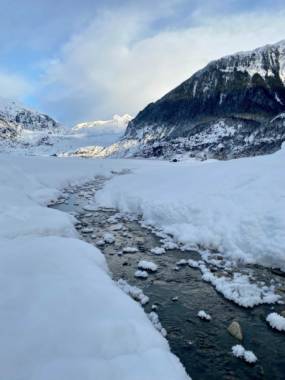
Technically, Steep Creek is also covered by ice today, but it’s not glacier ice. There are some patches of dark flowing water where the current resists freezing. Under the snow, salmon eggs are nestled in the gravel of the stream bed.

This is just a small example of what could happen on a much larger scale over the next hundred years, especially in the region between the Alsek and Copper rivers. Deglaciation could increase salmon habitat by nearly 30% in the Gulf of Alaska by 2100.
“We look at the glacier now, and you just think, ‘oh, everything underneath that is sort of barren, unproductive land,’ which is true when the glacier recedes … but in the longer term, it can develop into productive habitat,” Hood said.

A stream flows towards the lake surrounding Mendenhall Glacier. (Claire Stremple/KTOO)

The study looks at the ecosystems in terms of salmon, but there are other opportunities in the newly revealed earth.

“There are competing interests in some of these landscapes that are being opened up by glacier recession,” Hood said. “And one of those interests might be the development of minerals.”

Jonathan Moore, a Simon Fraser University professor and another author of the study, says mining interests in the transboundary region of northern British Columbia see potential in underground minerals currently buried by glaciers.

“Groups are staking claims on recently deglaciated areas. And then also, you know, preemptively in some cases,” Moore said.

That is, companies are staking claims on glacier-covered land with the knowledge that the melting glacier might reveal mineral-rich earth. In Alaska, mining interests have staked claims on new territory that was under the Herbert Glacier. And earlier this year, the U.S. Forest Service made moves to protect it from happening at the Mendenhall.

Moore says the paper shows areas where salmon and mining may jostle for space.

“There are these brand new rivers that are being created. And I think, you know, we have a bit of a decision in front of us in terms of what happens to those, you know, newborn nascent ecosystems and one option is to think about their potential value for salmon and steward them accordingly,” he said.

Hood says glaciers — and the way they retreat — have a tremendous impact in Southeast Alaska. Even here, at this relatively small salmon stream.

“This is obviously an important population for tourism much more than a fishery because this is probably the most common place that people come to view salmon,” Hood said.

In 30 years, tourists who stand at the window of the Mendenhall Glacier Visitor Center probably won’t be able to see the glacier. But if they stand by this stream, they’re likely to see salmon and bears in the ecosystem the glacier left behind.

Grant will expand telehealth services to Southeast Alaska, saving patients a trip to Seattle

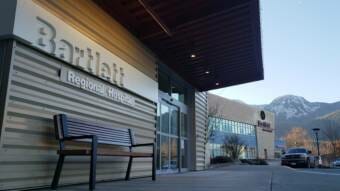
Bartlett Regional Hospital 2018 12 01
Bartlett Regional Hospital, pictured here on Dec. 1, 2018, is located at 3260 Hospital Drive in Juneau. Seattle’s Virginia Mason Medical Center is planning to expand virtual access to specialists in partnership with Bartlett. (Jeremy Hsieh/KTOO)

Seattle’s Virginia Mason Medical Center got half a million dollars from the Rasmuson Foundation to fund virtual access to specialists for Southeast Alaska patients.

Rasmuson Foundation president and CEO Diane Kaplan says the pandemic raised the profile of telemedicine. She said that’s useful in Southeast when patients can’t travel.

“What our grant will do is expand virtual care, in partnership with Bartlett, for Alaska patients — and particularly many of the specialty areas where patients normally would have to travel back and forth between Juneau and Seattle to access the services of a specialist and then get the follow up care that they need and tracking,” Kaplan said.

The program will start with cardiology, medical oncology — that’s cancer care — and vascular services, or vein care. Patients will be able to access specialists in Seattle from their homes. The idea is to cut down on unnecessary flights.

“We do very, very, very few grants outside of Alaska can count them on two hands that we’ve ever done. But this one was the type of thing we would do if there’s a service being provided to Alaskans,” she said.

The money will go to technology and training for the Seattle hospital and its Southeast partners. Virginia Mason CEO Dr. Gary Kaplan says the hospital had long-ago identified the need for these services, but now the technology has caught up with the demand.

“This is going to help us improve access, which will improve quality, improve outcomes, improve functionality for people,” he said. “People will be happier because they’re able to access certain types of specialty care that they couldn’t access in their communities.”

Kaplan says this is likely to mean Alaska patients won’t wait as long for appointments with their specialists.

Those who typically travel to see their cardiologist or oncologist should expect to have a virtual option by next year.

Juneau drops its mask requirement for vaccinated residents

IGA Mask sign customer 2020 07 17
A customer wearing a mask heads into the Foodland IGA in Juneau on Friday, July 17, 2020. In December 2021, Juneau dropped its mask mandate for vaccinated people. (Photo by Jeremy Hsieh/KTOO).

Vaccinated Juneau residents are no longer required to wear masks indoors—though it’s still recommended. Juneau’s Emergency Operations Center dropped the city’s COVID-19 alert level to “moderate” Monday afternoon. It cited a drop in COVID-19 cases and increased hospital capacity as reasons for the change.

Private businesses can still require masks regardless of vaccination status. And masks are still required in all city buildings as well as on the bus.

77% of Juneau residents 5 and up are fully vaccinated against COVID-19.

All other cautionary measures are still in place. Indoor gatherings are limited to 50 people or fewer. Bars, gyms, and waiting rooms are at 50% capacity. Restaurants must ensure social distancing between dining parties.

Site notifications
Update notification options
Subscribe to notifications