Claire Stremple

"I support KTOO reporters and guide coverage that informs our community and reflects its diverse perspectives."

When she's not editing stories or coaching reporters, you can find Claire outside with her dog Maya.
State proposes an official end to TB screening in schools

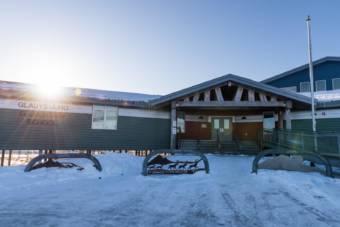
Gladys Jung Elementary School in Bethel, Alaska (Katie Basile/KYUK)

Alaska is proposing to get rid of tuberculosis screening in schools. Critics question the plan because Alaska regularly tops the list of states with the most cases of the disease. But the state health department says the school screening program hasn’t turned up a single case in years.

In early November, the state posted a proposal to end regular tuberculosis screening in schools.

The plan generated blowback online after Scott Kendall — an outspoken critic of Gov. Mike Dunleavy’s administration — tweeted about it. His tweet included the fact that Alaska has the highest rate of TB in the nation.

Online commenters were especially concerned about the implications for Alaska Native youth. In the mid-1900s, TB was especially deadly among Alaska Native people, who continue to experience the disease at a significantly higher rate than any other group.

Kendall’s tweet is true, but there’s more to the story.

The state considered axing the program as early as 2016, during the Walker administration, and state data shows other methods of fighting the disease are more effective.

As early as 2013, the state stopped requiring universal screening at schools in low-risk areas for TB. And in 2019, the state suspended the program statewide. Now the state is seeking to take the program off the books altogether and make that suspension permanent.

The state’s health department refused an interview. But state epidemiologist Dr. Michelle Rothoff answered some questions via email.

She wrote that between 2014 and 2019, the state didn’t find any cases of TB in school screening even though it tested more than 10,000 students per year.

State data from 2019 shows that cases of TB in  kids under 14 accounted for less than 15% of cases statewide. There were 58 cases of tuberculosis recorded in Alaska last year, according to Dr. Rothoff’s email. She did not say how many of those cases were among children.

Alaskans can still comment on the proposal. The deadline is Dec. 27, 2021.

Juneau’s solution to the national health worker shortage? Hire locals and pay to train them.

Marchan Putong, who works at Bartlett Regional Hospital, recently finished her coursework and passed her CNA exam. The hospital is training new staff from the community to address the shortage of health care workers. (Claire Stremple/KTOO)

Alaska, like the rest of the nation, has a shortage of health care workers. In Juneau, care facilities have found a local solution to that problem: they are paying people to get certified as nursing assistants.

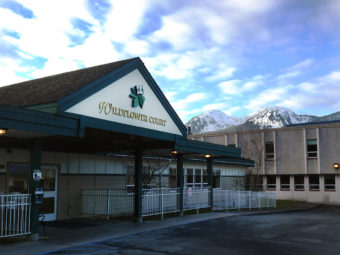
Wildflower Court, a nursing home in Juneau, closed an entire wing of its facility in early October because it didn’t have enough staff to operate it. Kirk Elmore, the nursing home’s administrator, says he would need to hire 11 certified nursing assistants, or CNAs, to open it back up.

But because of a national health worker shortage, he can’t find them.

So Elmore teamed up with Bartlett Regional Hospital, where they’re training new staff from the community — and he’s paying people to get certified.

“We’re providing them an hourly wage, as they’re taking the class we pay for the class. And we also pay for their licensing, with a commitment for them to come and work for us after they finished the coursework,” he said.

He says it’s an up-front investment for Wildflower Court, but it’s worth it. He gets to give staff that may already be employed with him a leg up to a better job. He says the investment stays in the community, which is a contrast to paying higher wages and fees for temporary traveling nurses.

Bartlett Regional Hospital’s staff development director, Jennifer Twito, says the hospital has also been fighting an uphill battle to keep nurses and CNAs. It’s why they started to train their own.

“It’s hard to recruit people into Juneau sometimes,” she said.

But just 18 hours after she posted the training offer, she says she had more local applicants than she could handle.

Twito says emergency regulations related to the pandemic make the program possible. Alaska usually has some of the most stringent requirements in the country for aspiring CNAs, but it has cut requirements in half during the public health emergency.

That expires at the end of the year. Twito says she’s not yet sure if the program will continue after that, but the hospital has made the most of the window. Her staff has trained a dozen locals in the first two cohorts. She’s got seven people signed up for another session this month.

“We’re creating career pathways for so many people in Juneau who maybe wouldn’t have an opportunity to get into the, you know, maybe they can’t get into the UAS program, because it’s always full. Maybe they don’t have the means to travel outside of Juneau to go to another program,” Twito said.

One of those people is Marchan Putong, who is now on a shift on Bartlett Regional Hospital’s third floor. Putong recently finished coursework and passed her CNA exam.

“I waited for so long, and this is it. I grabbed the opportunity,” she said.

Putong was a midwife in the Philippines until she moved to Juneau 11 years ago. She tried to take CNA training at the University of Alaska Southeast but didn’t pass the English exam. She found out about the opportunity at Bartlett because she was already working there, in housekeeping.

“For me, I start from the very low position, and then I go to CNA training program. And I get the job and it’s very easy because I already know the the building and other facilities, and they know me already,” she said.

The program has been a step up for several Bartlett employees. So far, only one Wildflower Court employee has gone through the training. But there are four more signed up this month. It’s not enough to reopen the closed wing, but it’s a step in the right direction.

A man in his 20s is Juneau’s 17th coronavirus death

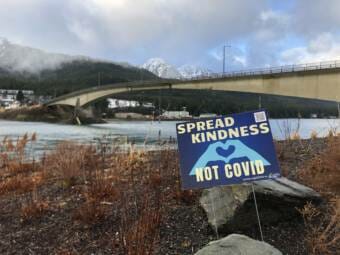
A City & Borough of Juneau sign reads "Spread Kindness, Not COVID." Photographed Nov. 26, 2020, at Overstreet Park.
A City & Borough of Juneau sign reads “Spread Kindness, Not COVID.” Photographed Nov. 26, 2020, at Overstreet Park. (Jennifer Pemberton/KTOO)

Another Juneau resident has died of COVID-19. State health officials reported that a Juneau man in his 20s died last week in Anchorage after a medevac. Over the course of the pandemic, Juneau has had 17 deaths — 16 residents and one visitor to the city who later died out of state.
The state reported seven resident deaths on Tuesday. So far, at least  810 Alaskans have died from the virus.

On Tuesday state health officials reported two new Juneau residents tested positive for COVID-19. The school district reported one person at Sitʼ Eeti Shaanáx̱: Glacier Valley School tested positive for COVID-19 and was contagious while in school. Bartlett Regional hospital was treating three people with active COVID-19 infections on Tuesday.

Citing declining case counts and increased hospital capacity, city officials lowered Juneau’s community risk level on Monday from “High” to “Modified High.” Masks are still required indoors in public spaces, but some capacity limits have changed for businesses.

Alaska’s COVID-19 rates dropped but remain some of the highest in the country

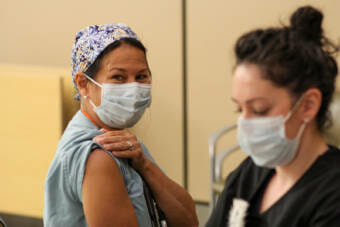
Alaska Native Medical Center nurse Rocky Carloni rolls up her sleeve before getting a COVID-19 booster shot. (Photo by Nat Herz/Alaska Public Media)

New COVID-19 cases in Alaska have dropped by more than a third in the last couple of weeks, but Alaskans are still getting infected and dying from the virus at rates that lead the nation. And state health officials caution that this declining trend might not be the case in future weeks.

Alaska has the fourth highest case rate and the highest death rate in the United States, according to data compiled by the New York Times.

Graph showing declining COVID-19 cases by week for October and November 2021. (Data from Alaska Department of Health and Social Services)

The Alaska Department of Health and Social Services reports that Alaska’s hospital capacity remains limited. It says patients can anticipate long wait times, some care may be delayed and hospital beds may not be available.

Over the course of the pandemic, nearly one in five Alaskans have been infected with the virus, and more than 800 Alaskans have died.

Among Alaskans who are eligible for the COVID-19 vaccine (Alaskans age 5 and older), 54% are fully vaccinated.

Climate change is making Glacier Bay unstable. Scientists are mapping the risks to visitors.

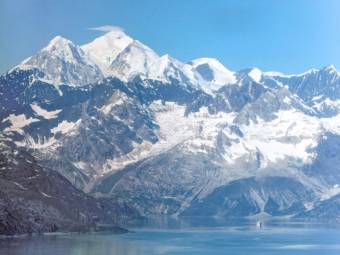
A cruise ship is dwarfed by the mountains of Glacier Bay in this undated photo. (NPS photo)

Glacier Bay’s geology reads kind of like a recipe for giant waves: It’s a recently glaciated area that’s still rebounding from ice cover. It freezes and thaws. There are steep slopes above deep water in an active fault zone.

In fact, the biggest wave ever recorded anywhere was on the park’s outer coast, in Lituya Bay in the 1950s. Geologists say the conditions that can lead to landslides are only getting more pronounced in Alaska.

“So this begs the question, you know, as temperatures continue to warm here, will we start seeing more of them or not?” asked Jeff Coe, who leads the U.S. Geological Survey team that’s working with the park.

Some really big slides in 2012 and 2016 are what piqued his interest.

“There was nothing like them in the historical record. They were two to five times larger than anything else that had happened in the historical record back to 1984,” he said.

Coe’s guess is that they’re related to degrading permafrost and rock. That’s because two big slides look like they’re associated with warm winter temperatures.

Landslides and tsunamis aren’t historically common in Glacier Bay, but because more than half a million visitors tour the park each year — most of them by cruise ship — park superintendent Philip Hooge wants a clearer picture of the risk. That way, he can take steps to keep visitors safe.

“I’d like to sleep better at night and know that I did what was right,” Hooge said.

Over the next several years, the park will refine its understanding of where landslides could happen, and which slides could generate tsunamis.

“You can’t prevent all hazards from happening in your visits to parks, but it just seemed like we needed to get a good handle on exactly what that potential was, especially with climate change and the potential for that increasing,” Hooge said.

lamplugh glacier landslide
Haines pilot Paul Swanstrom spotted this massive landslide on the Lamplugh Glacier near Glacier Bay on June 28, 2016. (Photo courtesy Paul Swanstrom)

So far, the park has taken precise, three-dimensional measurements of the park. Next, scientists will study the likelihood of any large landslides making it into the water, and what kinds of waves that might generate.

Hooge says the risk of a tsunami happening while a cruise ship is nearby isn’t zero, but it is a very small statistical probability. An initial study shows there are a handful of areas in the park where a landslide could hit the water and generate a wave that would affect boats.

“There’s a 90% chance of capsize if you have a wave that is the size of the beam of a ship,” Hooge said.

The beam of a ship is its width. The Majestic Princess, one of a few ships that visited the park this summer, has a 150-foot beam. The estimated wave from a landslide at Tidal Inlet is up to 250 feet high.

“Cruise ships can only go like 30 degrees, at the most, over,” Hooge said. “You know, they’re not built for tilting.”

But there’s a big difference between a wave hitting the bow or the side of a ship. Hooge has thought a lot about how to keep visitors safe while they’re observing this dynamic landscape. One solution is some kind of warning system. He says placing sensors around risk zones could give ships a chance to take the wave from an advantageous angle.

“Legs would break and swimming pools would empty, but they could potentially turn the boat,” he said.

That’s just a theoretical example, he said, and a warning system like that would be complicated and expensive to build. And again, the odds of a cruise ship passing Tidal Inlet at the exact moment of a landslide are really, really small.

For now, Jeff Coe with the USGS plans to monitor the area remotely. He says the landslide at Tidal Inlet has been a source of concern for a while, but so far, its movement looks pretty non-threatening.

This year was the agency’s first year of field study at Glacier Bay. Coe hopes to return next year and continue to study the area over the next six or seven years.

“I think with climate change the way it is, and warm temperatures continuing to warm, I think Alaska will be kind of the landslide research frontier,” he said.

The ultimate result will be a map showing how likely slides are in different areas of the park.

Site notifications
Update notification options
Subscribe to notifications