Claire Stremple

"I support KTOO reporters and guide coverage that informs our community and reflects its diverse perspectives."

When she's not editing stories or coaching reporters, you can find Claire outside with her dog Maya.

Alaska scrambles to spend nearly $100M in federal child care relief as centers close

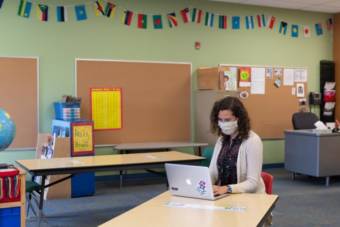
Amanda Gornik runs Gold Creek Child Development Center in downtown Juneau. She says she needs more government aid to make up for pandemic losses. (Claire Stremple/KTOO)

The first round of checks are in the mail to help child care centers across Alaska. They represent just 5% of the nearly $100 million in federal COVID relief funding the state has to stabilize its child care system. Meanwhile, care centers say they need more — and it can’t come fast enough.

Amanda Gornik is the director of Gold Creek Child Development Center, a preschool and daycare in downtown Juneau. The desks in an empty classroom come up to her shins. There can be up to 20 students in these little desks, but there are currently only six.

Gornik is running the center at under half capacity right now, at serious financial cost to the business. Just 29 students are enrolled in the whole center — and that’s despite huge demand.

“I have 125 kids on our waiting list,” she said. She has room for more students, but she doesn’t have the staff to support them, so she can’t offer up any spots.

Gornik is trying to hire more teachers. She’s offering a $1,000 signing bonus once they complete three months of work. She has 11 teachers and she would like about three more. But things are going the wrong direction. Two teachers have put in their notice since Gornik started as the center’s director two months ago.

“COVID is stressing our staff out. Because we don’t have as many here, they’re overworked. We have a lot of teachers doing overtime,” she said. “Stress sometimes isn’t worth it for them. And so they’re leaving. And it’s devastating to us all.”

COVID-19 is stressing a system that was already struggling. Nearly a fifth of the state’s licensed child care facilities have closed since March 2020, according to its Childcare Program Office.

Relief money is on the way. The state received about $95 million from the federal government this spring to address the child care crunch. It’s scrambling to figure out how best to distribute the money, while guidance from the feds trickles in. So far, the state has written a grant program to distribute only $5 million of that statewide.

“We are hearing that providers are concerned that there isn’t enough funding being distributed initially and that the timeline is taking too long,” said  Shawnda O’Brien, the director of the state’s Division of Public Assistance, the office responsible for distributing the funds to child care centers.

O’Brian’s staff is moving cautiously because the federal millions are a one-time payment. They want to make an impact that’s sustainable with a funding source that’s limited.

The typical budget to manage Alaska’s child care programs is about $28 million. Federal relief more than quadruples it.

So, even though she and her staff just got the windfall of their dreams, they say it’s a challenge to spend it right.

Meanwhile, care centers are hurting. Gornik’s Juneau preschool asked the state for $6,800 and is likely to get it. The state is awarding all requests up to $11,000 from qualifying centers. Gornik plans to spend it on bonuses for her current teachers and signing bonuses to attract new ones.

She says that money won’t go very far.

“We will take anything that we can get. And I’m blessed to use this to further our recruitment process,” Gornik said.

The state aims to have a plan for the remaining $90 million of federal funds by the end of the year. Applications for the next round of funding should be available between January and March.

Alaska has a teacher retention problem. The state is ready to pay someone to help solve it.

Second grade teacher Jenna Nadine works in her empty classroom on the first day of school at Mikelnguut Elitnaurviat. (Katie Basile/KYUK)

The state’s education department calls the lack of teachers in Alaska an emergency issue and says the pandemic is only making things worse. It’s willing to pay up to $300,000 to figure out how to attract—and keep—more teachers in the state.

Teachers and the union support the move, but they say the number one reason they’re leaving is pretty obvious.

James Harris is Alaska’s 2017 Teacher of the Year, but he doesn’t live or teach in Alaska anymore.

He took his skills and his family to Washington state a few years ago. There were a lot of reasons, he said, but the big one is retirement.

“Unfortunately, the retirement system in Alaska, it was set up in a way that there was just absolutely no way for me to retire with any kind of dignity,” he said.

Harris began teaching in Alaska in 2006, the first year after the state’s Legislature cut teacher pensions known as “defined benefits.” Alaska is the only state in the union that doesn’t offer teachers a pension or social security benefits.

Teacher turnover has hovered above 20% for the last decade. That puts Harris among the one in five teachers that leaves each year.

He said he hoped state leaders would provide funding for education and educators, but eventually decided he couldn’t wait any longer.

Corrine Marks teaches high school English in Juneau and trains teachers-to-be at the University of Alaska Southeast. She also thinks that the loss of defined benefits is the reason behind so many teachers leaving the state.

She has about 30 people in the program right now. Teachers from Alaska are more likely to stay here, but she still sees turnover.

“I’ve had more teachers come and go just here in Juneau, which is an easy place to stay, comparatively, right? Because they have nothing holding them here,” she said.

Marks plans to retire here, so she can collect her pension.

New teachers get retirement benefits in Alaska; they just aren’t pensions. They usually come in the form of contributions to a retirement account. After teaching for five years, Alaska teachers can take those retirement accounts with them if they leave the state.

Union leaders say that leads to “teacher tourism,” where out-of-state teachers have a five-year Alaska adventure and then take their experience home for the rest of their careers — after Alaska has invested in training them.

“I’ve been working on the pensions issue since the state Legislature first ruined it in 2005,” said state Sen. Jesse Kiehl.

He says dropping the pension was a mistake that’s losing the state money and talent. One study estimates Alaska spends $20 million on teacher turnover each year.

He’s supportive of the state’s effort and says the Legislature bears some of the blame for turnover. It’s up to them to fund education, but they haven’t increased funding for more than five years. That puts stress on the whole system.

Kiehl introduced a bill this year that brings back the opportunity for teachers and other public servants that lost pension in 2006, to earn one again. Not a big one, he said, but it’s an incentive to keep families in Alaska.

“By doing away with a pension, we have created a system where the rational economic choice teacher with five years experience is to leave,” he said.

“Is that really the system we want?

So far, it’s the system Alaska’s been choosing. But this year the education department is investing in someone to lead the state towards a solution to the broader problem of attracting and keeping teachers.

“This is not a problem that we can solve by ourselves,” said Michael Johnson, commissioner of the Department of Education and Early Development. “So the department can’t solve it. Not one entity can solve it, not one district, not the Legislature, not the governor. All of us have to work together.”

He agrees pensions and pay are among the biggest issues, but says there’s more than one challenge to teaching in Alaska. Research bears this out. A working group identified six aspects the state should address to attract and keep teaching talent here, things like working conditions and developing leadership.

“The bottom line for me is that we take this report, we take this word from the task force, and then we do something,” said Johnson.

Applications for the job closed on Oct. 15. The state refused to say how many applicants submitted a proposal. The state plans to issue a contract by Nov. 1.

Newscast — Oct. 12, 2021

In this newscast:

  • There are 33 new cases of COVID-19 in Juneau for Tuesday
  • Police confirmed that a body found near the Auke Bay Ferry Terminal is a man who has been missing since late August
  • The family of a Juneau man who has been missing for more tan two weeks are offering reward money for  information about where to find him
  • Power is expected to be out across most of Gustavus on Wednesday as utility workers upgrade infrastructure
  • Alaska residents and officials are still seeking Ivermectin, an unconfirmed COVID-19 treatment
  • After more than four years, the remains of a missing Prince of Wales Island man have been found

Juneau hospital board names interim CEO after executive shakeup

Bartlett Regional Hospital 2018 12 01
Bartlett Regional Hospital, pictured here on Dec. 1, 2018, is located at 3260 Hospital Drive in Juneau. (Photo by Jeremy Hsieh/KTOO)

The board of Juneau’s Bartlett Regional Hospital named an interim CEO at a meeting on Tuesday evening. The volunteer board selected Jerel Humphrey to lead the regional hospital for the next several months until a permanent CEO is hired.

The city-owned hospital is paying $9,985 a week to the staffing agency BE Smith for Humphrey’s interim CEO services. He’ll start on Oct. 18, according to Bartlett Human Resources and Risk Management Director Dallas Hargrave.

Humphrey replaces Kathy Callahan, a retired Director of Physician Services who stepped in temporarily to serve as CEO. He’s Bartlett’s fourth CEO in 2021 and the second temporary CEO since Rose Lawhorne abruptly resigned last month. 

Chief Behavioral Health Officer Bradley Grigg also resigned; Humphrey will select his interim replacement.  Grigg’s work has been assigned to Alice Nichols who has been working in the department since February.

KTOO asked to examine a year’s worth of Grigg’s expense reports and that request was denied. City Manager Rorie Watt said there was “an active criminal investigation on this matter.”

Editor’s note: This article has been updated with information about Jerel Humphrey’s pay and the resignation of Bradley Grigg, another former top staff member at Bartlett Regional Hospital.

Juneau’s hospital poised to use crisis care for COVID patients, but not there yet

Emergency room entrance at Bartlett Regional Hospital.
Emergency room entrance at Bartlett Regional Hospital. (Photo by Jennifer Canfield/KTOO)

Juneau’s Bartlett Regional Hospital is one of 20 Alaska care facilities the state has authorized to use its emergency guidelines, known as crisis standards of care, to help navigate this phase of the pandemic.

“Right now, currently at Bartlett, we’re nowhere near in a position where we’d have to prioritize care for our patients,” said Kim McDowell, the chief nursing officer at Bartlett.

But she said the stress on the statewide system affects Juneau.

“So it’s kind of like a game of Jenga a little bit, you know, you kind of balance everything and keep it kind of steady. But one thing could just tip it over,” she said.

She said if Bartlett gets a surge of seriously ill patients that it can’t transfer because Anchorage facilities are full, the crisis standards guidelines will provide the framework for tough decisions.

As of Monday afternoon, there were six patients with active COVID-19 infections in the hospital. But that doesn’t include COVID patients being treated who are no longer infectious. McDowell says she sees many people who have been hospitalized for COVID return later with lingering symptoms that require another hospitalization.

McDowell says the hospital did not make the crisis decision lightly.

“It’s mixed emotions, it is a kind of realization that this is where we are in this pandemic. And some organizations and hospitals are having to make this,” she said. “As a nurse, that’s heartbreaking, because you know that those decisions aren’t easy.”

Crisis standards will be in place until hospitals have sufficient resources to offer the usual standard of care to all patients.

Bartlett is getting help. As part of the state’s contract to relieve exhausted health care workers, six nurses are already in Juneau. The hospital expects three more nurses, two certified nursing assistants and two surgical technicians to arrive in the coming days.

“It’s a huge impact. I mean, it allows us to make sure that our nurse-to-patient ratios are at a normal level. It allows staff to be able to have a higher census, it allows us to be more flexible with elective surgeries,” McDowell said.

The regional hospital is still offering outpatient elective surgeries. Procedures that require an overnight stay are assessed separately.

Officials from the state and the hospital continue to encourage Alaskans to get vaccinated.

Site notifications
Update notification options
Subscribe to notifications