
Claire Stremple

"I support KTOO reporters and guide coverage that informs our community and reflects its diverse perspectives."

When she's not editing stories or coaching reporters, you can find Claire outside with her dog Maya.

COVID-19 crisis at Alaska’s city hospitals has big rural impacts

A Guardian Flight turboprop prepares to take off from Skagway’s airport. (Image courtesy of Guardian Flight)

Larry Geise’s medevac flight from Haines to the emergency room at Providence Alaska Medical Center in Anchorage took only two and a half hours, but once he was there, it took two days to get a bed.

He said there were no beds available and he got moved around in the emergency room a few times before landing in a room.

When patients wait in the emergency room until an inpatient bed opens up it is called “boarding,” and state officials say it’s happening more often as the health system sags under the weight of COVID-19 cases. Geise says they didn’t have to explain boarding to him. It was clear what was going on.

His wife Linda described the scene.

“As I went up into the lobby area, there was probably 50 more people standing to get into the emergency room,” she said. “And then going outside, there was more people in the parking lot, waiting to get up to the main entry to go to the emergency room.”

Medical staff stabilized Geise in the ER—he didn’t have the heart attack doctors feared. He recovered upstairs.

Increased wait times and emergency room boarding are just some of the things that happen when hospitals are full. Right now it’s also harder to transfer patients from rural Alaska communities, which is a crucial part of the state’s medical system.

For remote communities, those transfers are usually medevacs — chartered flights staffed by medics. In Haines, population 2,500, where the Geises are from, officials at the clinic estimate they medevac about eight patients a month, but it can be up to 20.

Guardian Flight is one of the main medevac companies in the state. Doug Williams, who oversees regional operations for the company, said usually when the crew gets a call with the location of the patient and their destination, they get going. Now, they have to wait while they figure out where they are going to go.

“And it just may add a little bit of additional time to coordinate where the right place to go is,” he said.

That wait time puts a strain on local clinics. In addition, rural clinics are holding onto sicker patients that they would typically send out, according to Jared Kosin who represents the Alaska State Hospital and Nursing Home Association.

“If the delta variant starts hitting our rural hospitals really hard, that’s going to produce a lot more complex patients that probably need to be transferred in to a higher level care setting,” he said. “And if that happens right now, finding that room and availability is really challenging.”

Top state health officials say Alaska’s case count numbers are going in the wrong direction — an indicator of increased hospitalizations to come.

Kosin says if rural facilities are hit harder, it could take the pandemic to the next level.


This story has been updated with additional details about Larry Geise’s care.

Acting CEO lays out plan to fill empty leadership roles at Juneau’s hospital

Kathy Callahan, Bartlett Regional Hospital's interim CEO, poses in front of a brown background
Kathy Callahan, Bartlett Regional Hospital’s interim CEO. (Photo courtesy of Bartlett Regional Hospital)

Bartlett Regional Hospital’s board and medical staff leaders met in a special session on Wednesday evening to discuss the replacement of top leadership positions. CEO Rose Lawhorne and Chief Behavioral Health Officer Bradley Grigg stepped down in mid-September.

Kathy Callahan, retired director of Physician Services, stepped in as CEO for the next six weeks until the board selects an interim leader.
“We would expect that person to stay in the role for typically 4 to 6 months while the organization does a search for our permanent CEO to replace Rose,” she said.

Callahan says the board has already begun its hiring process for the interim position.

“They are well on their way to selecting someone. There have been interviews by board members earlier this week. And they’re hoping that there’s a special board meeting next week to finalize and potentially extend an offer to the top candidate,” Callahan said.

In the behavioral health department, Grigg’s work has been assigned to Alice Nichols who has been working there since February. That position will also have an interim replacement until the permanent CEO can make a hire.

Callahan said there is “significant disruption” in the behavioral health department. Bartlett has reduced the number of mental health beds available due to staffing concerns.

First group of COVID-19 health care contractors reports for duty in Alaska

Hospital workers at the Alaska Native Medical Center ICU on Monday, Sept. 20, 2021 (Shirley Young/Alaska Native Tribal Health Consortium)

State officials say the first group of out-of-state health care workers reported to Alaska Native Medical Center for orientation on Tuesday. They’re part of the $87 million contract Gov. Mike Dunleavy signed for 470 health care workers to help Alaska’s hospitals fight the COVID-19 surge.

Once the healthcare workers arrive in Alaska, they take care of paperwork and are matched to hospitals that need their skill set. Nearly 20 institutions across the state requested aid.
Alaska Public Health Director Heidi Hedberg says the first hundred have been assigned to hospitals.

“The first waves of health care workers are going to be focusing in Anchorage and Mat-Su where the greatest need is, because that’s where predominantly all of the critical care is provided,” she said.

She said once the needs are met at those hospitals, workers will be deployed out to other hospitals with critical care needs. On Tuesday afternoon, she said Providence Alaska Medical Center was getting ready to onboard its first influx of workers.

Hedburg anticipates roughly half of the workers will arrive by Wednesday. She said the remainder will trickle in over the next week or so.

Juneau data shows case rates are high, but COVID mandates slow transmission

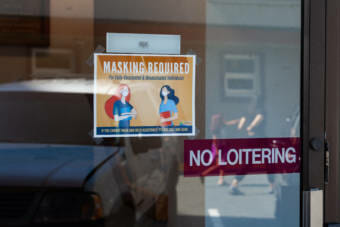
City buildings are requiring masks for vaccinated and unvaccinated people on Thursday, July 29, 2021, in Juneau, Alaska. (Rashah McChesney/KTOO)

Alaskans are getting COVID-19 at a faster rate than any other state in the nation — case rates are nearly double last December’s peak. Experts point to Juneau as proof that emergency mandates slow transmission.

The impacts of the Delta variant became stark in mid-August. And in most parts of the state case counts just continue on that upward trend.

But Juneau’s data sticks out.  In mid-August, its case counts started to go down.

“That downswing started about two weeks after the level-three mandate of reduced capacity and masking,” said Jonathan King, an Anchorage-based economist. He’s spent his pandemic days poring over state data.

In late July, Juneau brought its mask mandate back, and in early August it limited capacity at bars and restaurants among other restrictions. King says what happened next looks like a data confirmation that those mitigation mandates work.

“Is it causing a crash crashing of viral numbers? No, it’s not, but it seems like it’s holding it in check at least and at least slowing the growth rate,” he said.

To be clear, Juneau’s cases are going up right now. Juneau has been hit harder and has seen more cases and more hospitalizations in the last month than ever before in the pandemic.

But compared to the rest of the state on certain metrics, the capital city is doing OK.

“What we see in Juneau is we see about a 4% positivity rate, which is much, much better than say Anchorage is 9% positivity rate, and the positivity rate for testing in other boroughs,” King said.

Positivity rate is the percentage of tests that come back positive. The higher the rate, the more likely it is that you’ll encounter someone who is infected.

Juneau’s rate may be lower than Anchorage’s, but it’s still really high. And Jared Kosin — the chief executive of the Alaska State Hospital and Nursing Home Association — says that just because some of Juneau’s numbers are lower, doesn’t mean they’re healthy.

“Those numbers are valid. And they’re good indicators of things, but they do not tell you the full story on the ground,” Kosin said.

Kosin says that even though the state’s data dashboard has Juneau’s hospital capacity in the green, Bartlett Regional Hospital is really full. On Friday, there were no open beds. And 18 months into the pandemic, the impact on staff is significant.

“These people are exhausted, and the facility is stressed when you put that number of patients on ’em. It’s not something that’s just a simple manageable load,” he said.

State epidemiologists say the two major factors that decrease transmission rates are vaccinations and mitigation—things like masks and social distancing. A state study published in January showed that emergency orders, including a mask mandate, slowed the pandemic in Anchorage last summer. Due to a recent cyberattack, that study isn’t on the Department of Health and Social Services web page any longer, but it’s been saved in internet archives.

More than 80% of Juneau’s eligible population is fully vaccinated. On a call with statewide health providers and reporters this month, Juneau-based public health nurse Sarah Hargrave said there’s a reason the mask mandate is working in Juneau.

“People follow it. You just don’t see people out in the stores without masks. People are pretty good about social distancing in bars and restaurants that are at lower capacity based on city ordinances,” she said.

Jonathan King, the economist, says the Juneau numbers are an indicator of how things could be going a little bit better everywhere else in the state.

“There’s a lot of people in the state that are working very hard. But the lack of public health mitigation measures is hurting the state right now. And it’s costing lives,” he said. “And someday, some very smart person will sit down and actually calculate the number of additional hospitalizations and deaths and cost that the state is incurring because it refuses to pursue even the most basic public health measures.”

He says that just doesn’t add up.

Beds are full, but Juneau’s hospital is not in crisis mode yet

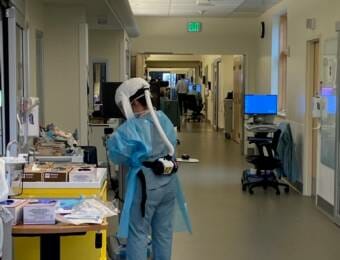
A healthcare provider, wearing several types of personal protective equipment that is being tracked by the State of Alaska, provides care on April 7, 2020, for a woman hospitalized in an isolation room in the critical care unit of Bartlett Hospital, in Juneau, Alaska. on (Photo by Rashah McChesney/KTOO)
A healthcare provider, wearing several types of personal protective equipment that is being tracked by the State of Alaska, provides care on April 7, 2020, for a woman hospitalized in an isolation room in the critical care unit of Bartlett Hospital, in Juneau. On Sept. 24, 2021, the hospital hit a point where no beds where available due – in part – to a surge of COVID-19 cases.  (Photo by Rashah McChesney/KTOO)

All beds at Juneau’s Bartlett Regional Hospital — except some in the mental health department — were full on Friday.
Chief Nursing Officer Kim McDowell said that hasn’t happened in years.

“It doesn’t happen very often,” she said. “But usually surrounding cruise season. Unfortunately, this is not related to cruise season.”

McDowell said there are a lot of reasons why they’re full, but “a lot of it is managing COVID-19 patients we have in house.”

The regional hospital had 11 COVID-19 patients on Friday morning. Three were discharged by evening.

McDowell said when the hospital gets full, staffing is one of the challenges. Bartlett uses “team nursing” — where two nurses may take on up to 12 patients — to alleviate the strain.

She said if new patients arrive, they are held in the emergency room until a bed is available. To make beds available, the hospital helps facilitate discharges for patients who can safely leave the hospital. Sometimes they even arrange rides.

McDowell said that while the state has initiated crisis standards of care, Bartlett regional hospital isn’t at that level yet.

“We’re not at a point at our facility where we’re having to, you know, look at not delivering the best care possible. We’re still able to do that under the circumstances,” she said. “It just may mean that care is delivered in the emergency department until the patient can get up to a bed.”

McDowell said the majority of COVID-19 cases in the hospital are people who have not been vaccinated. She urged people to get the vaccine, saying it prevents hospitalizations, deaths and the lingering effects of COVID-19. She said many patients in the hospital no longer have “active” or contagious COVID but still require hospitalization for COVID-caused ill-health.

Alaska takes extreme measures to respond to COVID surge: ‘This is uncharted territory’

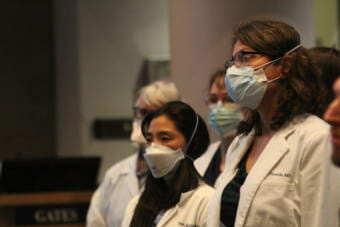
Health care workers at the Anchorage Assembly meeting on Tuesday. (Wesley Early/Alaska Public Media)

Gov. Mike Dunleavy made two big announcements this week about how the state is managing COVID-19. One is a signed contract to bring hundreds of health care workers to the state and the other is moving hospitals to crisis standards of care.

Jared Kosin, the chief executive of the Alaska State Hospital and Nursing Home Association, says hospitals are planning for the worker influx, even though staff has been hard to come by for the whole pandemic.  

“The idea of having hundreds come up all at once, it is hard to fathom how that’s possible. But the signals we’re getting from the state and the meetings we’re having from them, it feels like we’re on track for something big to happen,” Kosin said.

He says that many additional workers could be a game-changer for the state’s overwhelmed hospitals.

As for the second announcement, Kosin says don’t feel bad if you don’t really know what “crisis standards of care” means.

“This is uncharted territory. When you think of a playbook for crisis standards of care over a prolonged period in a pandemic, really go back to the early 1900s. This is something none of us have ever done in this context,” he said.

He said to think of it as formal guidance and recognition from the state that the standards of care in Alaska’s hospitals are not at the usual level. He says there’s some liability protection in that.

What those crisis standards mean for hospitals is that they don’t always have the resources to take care of patients in an optimal way. That means tough choices for providers. But Kosin says despite that, it’s important to still go to the hospital if you need to.

Site notifications
Update notification options
Subscribe to notifications