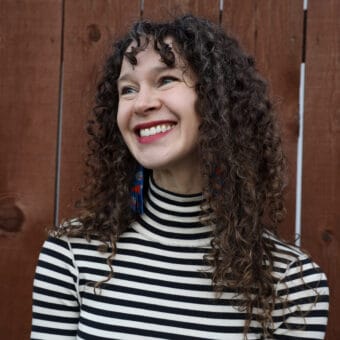
Claire Stremple

"I support KTOO reporters and guide coverage that informs our community and reflects its diverse perspectives."

When she's not editing stories or coaching reporters, you can find Claire outside with her dog Maya.

Glory Hall director awarded sabbatical for community service work

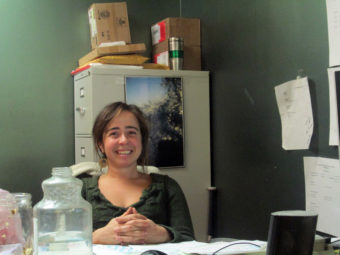
Mariya Lovischuck is the director the Glory Hole.
Mariya Lovischuck is the director The Glory Hall in Juneau. (Photo by Danny Peterson/KTOO)

Juneau’s Mariya Lovishchuk was awarded a sabbatical next year in recognition of her long history of community service. The Rasmuson Foundation will support her organization, The Glory Hall, so Lovishchuk can take three to six months to recharge after more than a decade of long hours.

Lovischuk said running a 70-person emergency shelter means she’s on-call all the time, and something is always happening.

“In 11 years, I have not had a single day of boredom,” she said.
Lovischuk says she plans to spend time outside, including a kayak trip around Prince William Sound and mushroom hunting on her property in Haines. She has plans for a trip to Chicago with her child.

She said she knows her team at Glory Hall will be fine without her for a little while. The rules of the sabbatical state that she can have no contact with work for the whole time.

And as for being selected?

“Definitely feeling like a little bit of impostor syndrome. Like, you know, super, super honored. But also just kind of like wow, like it’s really hard to believe that,” she said.

Lovischuk said she’s proud of all Glory Hall’s partnerships in Juneau, but the Juneau Housing First project feels special — it’s 64 units of housing for people who are chronically unhoused in Juneau.

“Every time I walk into this building, they just, they feel really good about what they’ve been able to accomplish,” she said.

Lovischuk plans to start her sabbatical next spring in mid-May or mid-June. She will take about five months off.

Correction: A previous version of this story misspelled Mariya Lovishchuk’s last name and misstated the number of units in Juneau’s Housing First facility. It is 64. And Lovishchuk has only one child.

Juneau affordable housing project gets $350,000 boost from Rasmuson Foundation

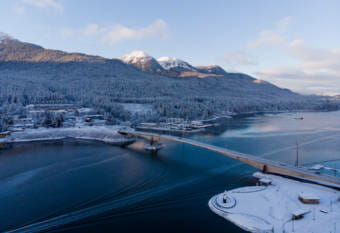
Douglas Bridge in Juneau in December 2018 (Photo by David Purdy/KTOO)

An affordable housing project of Juneau’s domestic and sexual violence shelter got a $350,000 boost last month from the Rasmuson Foundation. AWARE director Mandy Cole says that will pay for about a third of the project — seven apartments on Douglas Island.

“Smaller units, so efficiency units, and one-bedroom units are in constant demand and AWARE already operates 12 units of transitional housing,” Cole said.

“Our longest waitlist is always for the efficiency units.”

The structure is already in place — Cole and AWARE now have to build the inside of the units. She says this is part of a strategy called infill, where affordable housing is integrated into neighborhoods.

Cole says she’s seeking additional funding from other sources, too, like Alaska Mental Health Trust and the City and Borough of Juneau.

“We tried to find a way to build this facility with grant funding so … it could support itself and we could operate it at a very low cost to the tenants,” Cole said.

She says she hopes to have funding secured by construction season next year.

If you are experiencing any harm, domestic or sexual violence you can call AWARE’s crisis line at 1-800-478-1090.

Most Alaskans who died with COVID-19 had underlying health conditions, state report finds

Hospital workers at the Alaska Native Medical Center ICU on Monday, Sept. 20, 2021 (Photo courtesy of Shirley Young/Alaska Native Tribal Health Consortium)

The state’s health department released a report in December that analyzes COVID-19 deaths from the beginning of the pandemic through this September.

Most Alaskans who died from COVID-19 in the first year and a half of the pandemic had known underlying medical conditions. The most common were cardiovascular diseases, including high blood pressure, followed by diabetes and chronic respiratory disease.

Megan Tompkins is an epidemiologist for the state. She says this was not a surprise to epidemiologists, but it’s important information for Alaskans because underlying health conditions are so common — two-thirds of the state’s population has them, including young people.

“Risk does increase with age group. And so do underlying medical conditions generally increase with age group. But if people want to ensure that they are protected and relatively safe from a severe outcome, vaccinations are the best way to do that,” Tompkins said.

More than 650 Alaskans died from COVID-19 by the end of September. More than half of the deaths were among men — 60%. The death rate increased substantially after the delta variant emerged in Alaska this June. This study does not include October and November, among the deadliest months of the pandemic in Alaska, which account for an additional 199 deaths.
“We have some — a large number — of deaths added during this last quarter of the year that would be interesting to analyze. We have no reason to think that they would necessarily be different,” Tompkins said.

The health department recommends vaccination, booster shots and masking in public to prevent COVID-19 deaths.

A year after Haines’ deadly landslide, signs of recovery but still work to do

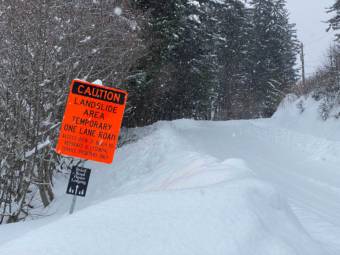
A sign cautions drivers entering the landslide zone on Beach Road. November 30, 2021. (Stremple/KTOO)

On December 2, one year ago, a huge landslide had just torn through Beach Road in Haines. It destroyed houses and killed two people, whose bodies were never found. The road was barricaded to keep people out of the danger zone.

There’s still an orange caution sign, but now a temporary access road passes through the debris. From far away there’s a huge white scar on the side of Mt. Riley. Up close, it’s hard to imagine what kind of force could pull down this much of a mountain.

The Beach Road landslide on the side of Mt. Riley is 600 feet across. Photographed on Sunday, Dec. 6, 2020. (Photo by Rashah McChesney/KTOO)

Haines Mayor Doug Olerud is driving on the road because he doesn’t like to walk it. There’s no other traffic, and wet snow sticks to the windows of his truck.

“It’s a tough drive,” he said.

That’s because he can imagine where the houses used to be. One home is still there but knocked off its foundation by trees and rocks. It looks like a toy next to the huge swath of turned up earth.

“It doesn’t get easier,” he said.

In the early months after the slide, no one was allowed on the road. Residents fought to cross the slide and retrieve the belongings they left behind when they left their houses on the day of the slide.

A half mile past the slide, things start to look normal.

“Then you can see we’ve got people out here,” Olerud said. “Their driveways are plowed, especially at the far end of Beach Road here. Several of them are very happy to be out here.”

The borough got power out to the end of the road by July, but to access these homes you need to pass through what the borough calls the Red Zone, an area that’s geologically unstable.

Closer to the Red Zone, the driveways aren’t plowed. People haven’t come back.

Amber Winkel (left) and Todd Winkel (right) make their way across the Beach Road landslide in order to check on their home in January 2021. (Photo by Henry Leasia/KHNS)

The borough is still waiting for answers about the long-term stability of the area. A landslide contractor promised a study by the end of December or early January. Their instruments are visible in the snow.

Olerud says the findings will guide the borough through the next steps of recovery. The study will help determine whether these homeowners qualify for a land swap with the state, for example. Olerud says some of them are still frustrated with the borough’s decision to call this area a hazard—it will likely ruin home values and jeopardize insurance. He says he stands by that decision, but he’s surprised there wasn’t federal aid for individual people who lost homes or cannot return to their properties. Any federal money has to go through the borough.

“Nobody’s ever going to be made 100% whole out there,” said Olerud. “That’s not going to happen. But what can we do to get them as close to whole as possible? And that’s going to be an ongoing struggle. And I wish I had better answers for them.”

Beach Road is what most people outside of Haines might think of when they think of the December weather disaster, but destruction was spread throughout the Chilkat Valley. Landslides damaged and destroyed homes on Lutak Road, and flooding wreaked havoc on roads and homes in the townsite.

A heavily damaged property on Lutak Road on Sunday, Dec. 6, 2020, in Haines, Alaska. The owners are staying nearby in an RV, working to winterize their home and get some things operational again. (Photo by Rashah McChesney/KTOO)

Olerud estimates 40% of households in Haines sustained some kind of damage from the storm. The work of the last year has been putting homes and infrastructure back in order.

Sylvia Heinz (far right) stands with Chilkoot Indian Association housing coordinator Aliza Tompkins (left) and tribal administrator Hariett Brouillette (center). (Stremple/KTOO)

“For the last year, my life has been dominated by disaster recovery,” said Sylvia Heinz.

She was hired by the Chilkoot Indian Association to manage a $900,000 federal housing grant to help the Haines recovery. She is also a coordinator for Haines’ long-term recovery group. They’ve put 16 households back in  homes since this summer.

“Yeah, it’s not 23 anymore,” she said. “That never feels like success to me. I think that’s part of the story, that the recovery needs are so enormous.”

The response has also been huge. Her recovery team helped over 130 households that needed assistance. They disposed of nearly half a million pounds of construction and demolition debris. They partnered with an international disaster response group that helped with cleanup and pledged to rebuild two homes.

“We’ve made much more progress in the last year than I would have imagined when we were in April,” she said. “The road seemed endless.”

After last year’s slides and flooding, nearly two dozen households were displaced. More than half of them were from Beach Road. There are seven left to go, including Vanessa Wishstar and her family who lived in a home right next

The Wishstar family with their Christmas tree. They evacuated their home Dec. 2 after a landslide came within 500 feet of their property. (Claire Stremple/KHNS)

to the path of the slide. Now, they’re in the Lower 48 with her family, trying to figure out how to make Haines home again.

“A lot of our neighbors are all in the same situation that we’re in,” she said. “A lot of them — actually most of them — are living with family or just kind of bobbing around, bouncing around and also searching for work.”

She said she’s still terrified when there’s a downpour, or when a train passes by — sounds that are too close to what she heard when the mountainside came down around them. Last year, she said it sounded like a dragon; so fearsome it was unreal.

Back on Beach Road, with the truck’s heater blasting, Mayor Olerud says the human healing from the storm is going to take much longer than fixing the physical aspects of it.

“And that’s the toughest part, because it’s a lot easier to hold all that inside than it is to be vulnerable with each other and let people know that it still sucks,” he said.

Alaska health officials share recommendations for second holiday season with COVID-19

A small group of friends sits around a fire at an Anchorage home in the winter of 2020. (Lex Treinen/Alaska Public Media)

It’s the second holiday season of the COVID-19 pandemic, but this year has one major difference from 2020, if you ask the state’s top doctor.

“We have vaccine this year versus last year, we didn’t. And it’s a really big game changer,” Chief Medical Officer Dr. Anne Zink told reporters on a media call last week. She said the vaccine has taken a burden out of holiday planning by allowing families to gather together more safely.

Dr. Zink recommends over-the-counter COVID tests if someone in your holiday gathering is immunocompromised, or if there will be a large group of people in attendance. She said her family was initially skeptical about how easy they’d be to use, but now they’re converts.

She said she won’t be home with them for Thanksgiving this year, however.

“My Thanksgiving isn’t going to be as fun as probably others. I’ll be working in the emergency department, partially because my colleagues are really getting a chance to partner and to be with their families, which they haven’t been able to be. And so I’m covering for them so they can gather with their families,” she said.

The state’s health department recommends avoiding crowded indoor spaces, wearing a mask around anyone who has a weakened immune system, and staying home if you are sick.

The state’s COVID-19 dashboard will not be updated over the holiday. Starting Dec. 6, the state will return to COVID-19 reporting only three days per week.

Site notifications
Update notification options
Subscribe to notifications