Claire Stremple

"I support KTOO reporters and guide coverage that informs our community and reflects its diverse perspectives."

When she's not editing stories or coaching reporters, you can find Claire outside with her dog Maya.

Alaska is fighting a surge in fentanyl deaths with stronger overdose kits

A new shipment of the overdose-reversing drug naloxone arrived in Anchorage the last week of April. Test kits now have twice the amount to counteract the effects of fentanyl. (Image courtesy of DHSS.)

A synthetic opiate called fentanyl is behind a surge of drug overdoses in Alaska. As a result, overdoses in the state have become so deadly that one of the tools used to fight them has changed.

Naloxone is an overdose reversing drug that’s found in opioid emergency kits distributed by the state to places like the Glory Hall, Juneau’s homeless shelter. The shelter had been short on what people casually call Narcan kits — Narcan is the brand for naloxone — for the last several weeks. Luke Vroman and other harm reduction advocates in Juneau were starting to get worried.

But last Friday the shelter received a battered cardboard box filled with new kits. This fresh shipment didn’t contain Narcan at all. It was full of a new brand called Kloxxado that has twice as much naloxone in each dose. This box has fifty kits in it — that’s 100 doses of naloxone.

“It comes with two, so it’s like four of the old ones,” said Vronan as he unzipped one of the kits. “Which is good because it is taking more than one for people, you know.”

If you haven’t seen naloxone before, it looks kind of like that allergy spray that goes up your nose. Except instead of reducing sinus inflammation, it blocks or reverses the effects of opioids.

Vroman said it takes a lot more to bring people back from an overdose now that fentanyl is in most of the drugs around here. He’s seeing the effects at the shelter.

“I’ve worked with Glory Hall for two and a half years, and in the last year, I’ve seen 300% more overdoses,” Vroman said. “None of them deadly, thank God. But yeah, just a lot more overdoses.”

Fentanyl is more deadly than heroin because it’s a lot stronger and can precipitate an overdose in really tiny amounts. It exists because there are medical applications for fentanyl where those tiny doses are closely monitored, but it’s really dangerous on the street where there’s no oversight.

Getting that increased dosage of naloxone is part of why these emergency kits were so scarce for awhile — and not just in Juneau, but across the state.

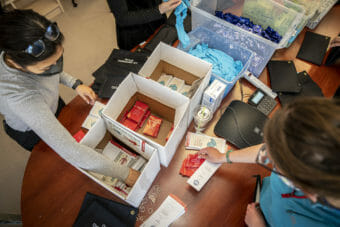
The state packed 3,000 opioid overdose emergency kits and sent them across the state. (Photo courtesy of DHSS.)

Karol Fink, a leader in the chronic disease prevention section of the state’s health department, oversees the state’s supply of free naloxone through a program called Project HOPE.

“About mid February, we were being cautious with the amount of naloxone we sent out to our partners,” she said. “We ran out probably in early March.”

She said finding a higher dosage of naloxone meant the state had to renegotiate with vendors, which took time.

“We also didn’t realize how quickly we were going to run out because there was a surge of opioid deaths in the Mat-Su area, and that really brought attention to the issue,” said Fink.

That meant there was an increase in demand for the kits. Fink said the new shipment of naloxone arrived earlier this month, and the program packed up thousands of new kits to distribute across the state.

They’re needed. Nearly 300 Alaskans died of opioid overdoses last year, and most of those deaths involved fentanyl.

“From a public health perspective, this is unprecedented. And the state of Alaska and health officials, we are very concerned,” she said.

It’s not slowing down, either. The state’s drug task force seized twice as many grams of fentanyl in the first three months of this year than it did in all of 2021.

And, to be clear, the shortage was just of that free naloxone through Project HOPE. People could still get the drug with a prescription.

Dolores Van Bourgondien, a nurse at an addiction treatment clinic in Juneau, traced the explosion of fentanyl in Alaska back to about a year ago. Over the course of two weeks last April, the number of her patients with fentanyl in their urine went from 2% to nearly 14%. She said now it’s more than half.

“What we’re seeing on the street, what we’re seeing in our toxicology, what we’re hearing from our patients, okay, preempts anything that comes out kind of publicly,” she said.

She said naloxone and things like recent drug busts across the state help slow deaths down, but the pace is relentless.

“I think everybody’s who’s involved in this, we — you just feel as if you’re paddling upstream, you’re not making any headway,” she said.

Naloxone is only a short-term fix to the most acute symptom of addiction. It gives people like Van Bourgondien time to connect people who use drugs to the other resources they need for long term recovery — things like treatment, housing and access to mental health care.

An Anchorage boy is waiting for a life-saving stem cell transplant, but Alaska Native donors are scarce

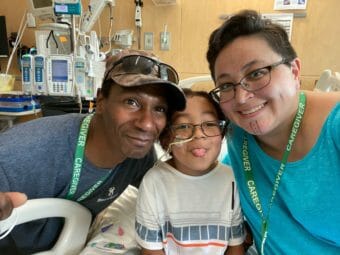
Tiberius with his parents Enrico and Tasha Newbill at Seattle Children’s Hospital. June 19, 2021. (Photo courtesy of the Newbill family)

A bone marrow transplant is a life-saving procedure for people with blood illnesses or cancers, but it’s harder for Alaska Native and mixed-race people to find matches because they’re underrepresented in the donor database. Advocates are hosting a drive next week to connect an Anchorage 6-year-old with a matching donor.

It’s been almost a year since Tasha Newbill found out her 6-year-old son Tiberius has cancer. It was the week after his last day of preschool. She got his results in the afternoon and was on a medevac flight less than an hour later — you can’t get the care he needed in Alaska.

“I talked to a social worker for 10 minutes, and by three o’clock we were in an ambulance on the way to Anchorage airport,” Newbill said. “And by 3:30, we were wheels up on our way to Seattle, and we’ve been here ever since. So we literally walked out of our life with 10 minutes’ notice.”

Since then, Tiberius has had more than 100 transfusions. He’s gone through a lot of chemotherapy. (His mom says he’s also careened around the hospital halls on a quad bike and collected a lot of Yoda stuffed animals.) And, after an experimental stem cell transplant, he had brief remission before he relapsed this February. Now the family is hoping to find a donor for another transplant.


View this post on Instagram


A post shared by KTOO (@ktoopubmedia)

It’s harder for Tiberius to find a match than it is for other patients — he’s Black, white and Inupiaq. A donor match comes from what’s called the human leukocyte antigen, a part of the immune system that is connected to ancestry or ethnic background.

“With Tiberius being such a unique mixture, there’s no one on the registry for him. And there’s currently 4.1 million donors registered worldwide. And there was no one who matched Tiberius,” Newbill said.

Alaska Native people make up less than 1% of donors. Newbill and her husband are only a half match for Tiberius. Most people who need a transplant don’t match perfectly with their relatives, which is part of why there’s a donor registry.

Tiberius Newbill at Seattle Children’s Hospital. (Photo courtesy of the Newbill family)

Christy Youngblood is hosting a donor drive in Anchorage next Monday.

“To join the registry, you have to be 18 to 40 years old, meet the health guidelines and be committed to saving anyone’s life,” she said.

Youngblood is a lymphoma survivor herself as well as a volunteer with Be The Match, a nonprofit that connects patients with donors. To get tested all you need is an oral swab.

She says being a donor is also pretty simple. Most of the time, all you donate is stem cells — Youngblood compared the process to donating blood or plasma. Less than 20% of the time they need bone marrow.

“It’s not as bad as it sounds—they surgically remove it from your hip, and it kind of feels like you fell on the ice. You’re back to normal activities within a day,” Youngblood said.

The group is hoping to find a match for Tiberius. His mom Tasha also wants to boost the number of donors for other patients who need blood that’s underrepresented in the registry.

“It’s really important we get people who are minorities, or are multi-ethnic, to join the registry because we are becoming more and more common in this day and age,” Newbill said. “I like to think of Tiberius as the future.”

Tiberius just started a month’s worth of chemotherapy to reduce his cancer to get ready for the stem cell transplant — if his family can find a donor.

The donor drive will be held at Alaska Native Medical Center in Anchorage from 10 a.m. to 5 p.m. on Monday, May 9.

Gov. Dunleavy speaks out as fentanyl crisis intensifies in Alaska

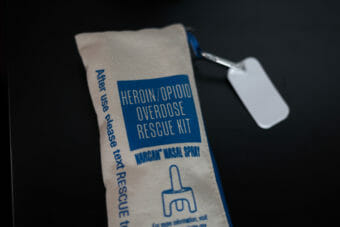
An overdose rescue kit that Capital City Fire & Rescue distributes to people when they get a 911 call for an overdose in Juneau, Alaska on April 15, 2022. (Photo by Lyndsey Brollini/KTOO)

Overdose deaths increased more than 70% in Alaska last year. The state’s health department says that’s because of the highly toxic synthetic opioid fentanyl. It’s been found mixed with heroin, cocaine and methamphetamine.

In a press conference Tuesday Gov. Mike Dunleavy said the problem is only intensifying. The state’s High Intensity Drug Traffic Area task force seized twice as much fentanyl in the last three months than they did in all of 2021.

“It’s incredibly deadly at an incredibly small dose,” Dunleavy said. “Parents, kids and all Alaskans must understand this poison—and that’s what it is—is in our state in many different forms.”

He said he will work with the state legislature to increase the punishment for drug trafficking and told drug dealers they’re in for a “rude awakening.”

Dr. Tom Quimby joined the governor for the press conference. He directs the Emergency Department at Mat-Su Regional Medical Center, a region hard-hit by overdoses.

“What I see happening every day in our emergency department is that this problem knows no bounds. It crosses all levels of our society. I see people in all socioeconomic classes, all ages, all religions, all races, living in all geographic regions, all political parties who are affected by this,” he said.

Sandy Snodgrass’ 22-year old son died of a drug overdose last fall. She said she would do everything in her power to spare another parent from surviving the death of a child.

“There are many parents that I know personally in this room. It is too late to save their children. But they’re here today to save your children,” she said. “Please help us: carry Narcan. Talk to your children tonight about fentanyl.”

Narcan is a brand of the overdose reversing drug naloxone. The state just received 11,000 more doses that it will give away for free in kits that include fentanyl test strips.

Medication-assisted treatment is also available in Alaska to help people quit using opioids.

Nearly 250 Alaskans died of drug overdoses last year. Six of every ten drug overdoses in Alaska involved fentanyl.
Closure of Juneau’s COVID-19 emergency operations center brings changes to testing, data reporting

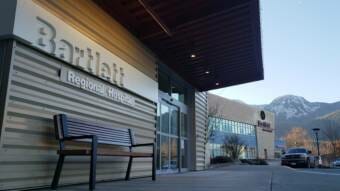
Juneau’s COVID-19 testing site is moving from the Hagevig Regional Fire Training Center to Bartlett Regional Hospital on May 8, 2022. (Photo by Jennifer Pemberton/KTOO)

Juneau’s emergency operations center closed on April 30 after managing the city’s response to the pandemic for more than two years. City officials acknowledge that there are still high rates of COVID-19 in Juneau, but the change indicates that COVID-19 is no longer being treated as an emergency.

Robert Barr was in charge of the emergency operations center from the beginning of the pandemic in Juneau. He says now that people have the tools to calculate risk and have ways to combat the virus itself, it’s time to stop treating COVID-19 like an emergency.

Barr also says a lot of city staff have been doing two jobs for a long time. For instance, he was the head of the library system in addition to being the incident commander for about a year.

Now, public health officials and community healthcare providers will take on long term management of the pandemic.

For two years, people have been able to get tested for COVID-19 at the city’s testing facility at the Hagevig fire training center. On May 8, Bartlett Regional Hospital will be managing testing for the general public. The hospital will bill insurance for those who have it, but officials say they won’t charge anyone out of pocket.

The city has stopped updating its COVID-19 dashboard, but weekly COVID-19 case and hospitalization counts are available on the state’s dashboard. The local public health office is still tracking COVID-19 numbers as it has since the beginning of the pandemic and reporting that information to the state. It takes more work now to find local numbers, but it’s doable.

The city will still provide free high quality masks and at-home test kits as long as there’s state and federal resources to do so. Those are available at City Hall and Juneau libraries.

Masking in Juneau has been only a recommendation for months now. But with the emergency operations center closed, the city won’t be able to impose mask requirements unless the city manager makes a new public health emergency declaration.

The COVID-19 hotline is still available, but Bartlett Regional Hospital will manage it now instead of the city’s emergency operations. The number is still 907-586-6000. And Robert Barr says you can still reach him at the manager’s office if you have questions about how the pandemic is being managed in Juneau.

Newscast — Friday, April 29, 2022

In this newscast:

  • A Juneau mental health organization is helping people formerly involved in the justice system get housing;
  • Juneau’s COVID-19 Emergency Operations Center is closing down at the end of April—here’s how you can access services;
  • Alaska authorities have seized thousands of fentalnyl-laced pills and other drugs this week in a series of  busts from Anchorage to Ketchikan.

Bartlett Regional Hospital names new head of mental health department

Bartlett Regional Hospital 2018 12 01
Bartlett Regional Hospital, pictured here on Dec. 1, 2018, is located at 3260 Hospital Drive in Juneau. (Photo by Jeremy Hsieh/KTOO)

Bartlett Regional Hospital has named a permanent chief behavioral health officer after months of top level turnover. Tracey Dompeling will take over in the lead role from interim officer Karen Forrest on June 20.

Forrest has been filling in for the position since September when Bradley Grigg resigned.

Dompeling is currently the state’s director of the Division of Juvenile Justice. She has degrees in Social Work and Justice Administration from the University of Alaska Fairbanks.

Interim CEO Jerel Humphrey made the hire. Initially, the hospital board intended for the permanent CEO to fill the position, but the board has not yet chosen Humphrey’s successor and Forrest will not extend her six-month interim commitment.

Site notifications
Update notification options
Subscribe to notifications