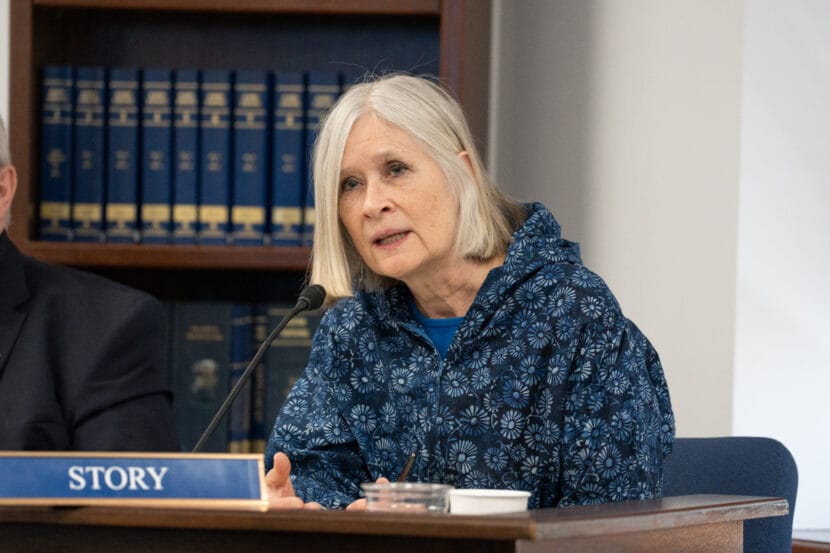

Clarise Larson

City Government Reporter, KTOO

"My mission is to hold Juneau’s elected officials accountable for their actions and how their decisions impact the lives of the people they represent. It’s rooted in the belief that an informed public has the power to make positive change."

When Clarise isn't working, you can find her skijoring with her dog, Bloon, or climbing up walls at the Rock Dump.

Some Juneau schools will have later start times next year

Juneau-Douglas High School: Yadaa.at Kalé in Feb. 2024. (Clarise Larson/KTOO)

The Juneau School District’s consolidation plan for next fall means some students and parents will have to spend extra time traveling each day to get to school.

To accommodate that, the Juneau School Board voted on Tuesday to slightly change the start times for some grade levels. 

While all elementary school start times will remain the same next year, middle school and high school will shift to begin 15 minutes later. 

That means for all the high schoolers heading to Juneau-Douglas High School: Yadaa.at Kalé downtown next year, classes will start at 9:30 a.m. and end at 4 p.m. The middle schoolers headed to Thunder Mountain Middle School in the Mendenhall Valley will start at 8:45 a.m. and get out at 3:15 p.m.

And, despite the change, the district will still offer a bus shuttle service for students who live anywhere to go to the optional programs at the Dzantik’i Heeni Campus in Lemon Creek. Those programs include the Yaaḵoosgé Daakahídi alternative high school, Juneau Community Charter School and Montessori Borealis.

District officials say the benefit of the later start time means high school drivers will be on the road after the morning rush hour traffic, and it will give them more time to sleep in and find parking. 

A different start time option was also discussed by the board Tuesday night. It would have made elementary schools start earlier instead. But, members ultimately decided against it. Dan Debartolo, a former school board member and parent, testified in favor of more sleep for young students. 

“If you’ve ever had an elementary-age student, every drop of sleep in the morning can be precious and be the difference whether or not you’re getting your kid to school tardy, unexcused, or not,” he said. 

The district says new bus route schedules will be developed and posted on its website ahead of the new school year.

Juneau Assembly OKs $2M grant for low-income supportive housing project

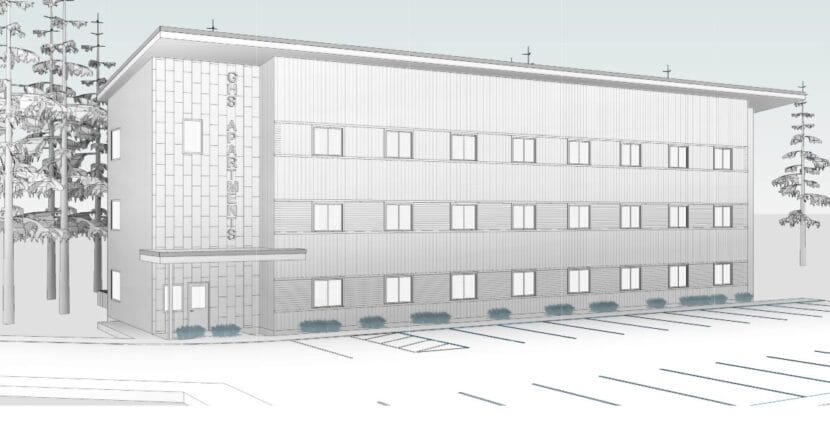
This is a conceptual design for Gastineau Human Service’s proposed 51-unit permanent supportive housing project in the Lemon Creek area. (City and Borough of Juneau)

An affordable housing project built specifically for people in recovery from substance misuse received funding support from the Juneau Assembly this week. 

On Monday, the Assembly unanimously approved a grant of $2 million to Gastineau Human Services, a local nonprofit that works to help people affected by homelessness or addiction. The funding will help the nonprofit construct a three-story building with 51 long-term housing units in the Lemon Creek area. 

Dave Ringle, the executive director of Juneau’s St. Vincent de Paul chapter, was one of the multiple people at the meeting who testified in support of the grant. He said the project is critical to getting people out of homelessness and into stable situations. 

“This is a long-term, cost-effective way to work with the root causes of homelessness and provide a home and support so people can work their way out of the terrible conditions,” he said. 

Usually, affordable housing projects like this one have to apply for money through the city’s Affordable Housing Fund, competing against other projects for funding. 

But Gastineau Human Services was facing a tight deadline to submit its application for other grants it was pursuing to fund the project. So the Assembly agreed to fund it anyway.

The nonprofit will still need to puzzle together another $9.5 million from other sources. 

Lauren Connolly is a nurse at the Southeast Alaska Regional Health Consortium’s Front Street Clinic. It’s geared toward assisting homeless and low-income patients in Juneau. During testimony, she said there is an urgent need for housing units like this in Juneau. 

“In my job — even before I knew anything about this project — you can definitely recognize the need for more supportive, sober living here in Juneau,” she said. 

The nonprofit’s goal is to have construction begin in 2025 with housing available in 2026.

With staff layoffs pending, Juneau Assembly approves school district budget

JSD Office
The Juneau School District building at Harborview Elementary School. (Photo by Bridget Dowd/ KTOO)

The Juneau Assembly unanimously approved the school district’s more than $85 million budget for next school year at a meeting Monday night. 

The move comes after months of turmoil and difficult decisions as the district faced a nearly $10 million deficit. The approved budget plan is funded via city, state and federal dollars. 

Superintendent Frank Hauser said it’s a relief to get to this point, but there’s still much work to be done. 

“We’ve got a budget in place now being able to move forward for (fiscal year) 25. And that’s just good to be able to say, ‘Okay, we’re focusing on, you know, the next steps,’” he said. 

The budget passed by the Juneau school board earlier this spring was built on the assumption that state education funding will not increase. Instead, it relies on cost-cutting measures like school consolidation and reducing the number of staff positions in the district.

Last month the Assembly approved giving $34 million in local funding to the district – the maximum amount allowed by state law. It also approved more than $3.5 million in additional funding for non-instructional programming.

The amount of state funding the district will receive is still up in the air. As this year’s legislative session nears an end, both the House and Senate have included $175 million in one-time funding for education in their proposed operating budgets. And Gov. Mike Dunleavy indicated potential support for the funding earlier this month. 

That potential boost in state funding could mean the district would be able to revise its budget to save more staff positions. The current plan will eliminate nearly 50 positions next year. The district has to send out layoff notices to teachers and staff by Wednesday. 

Hauser said it’s going to be a waiting game with the legislature and governor. 

“We’ll just have to wait and see. I mean, we just don’t know what the legislature is going to do. And if the governor is going to assign operating budget into law, and of course, if there’s gonna be any vetoes as part of that,” he said. 

Last year, Dunleavy vetoed half of a nearly identical increase in one-time education funding. 

He can do that because the state’s constitution allows the governor to veto or reduce budget line items after they’re approved by the legislature. Earlier this year, Dunleavy vetoed a larger bipartisan education bill that would have increased state funding for public schools on an ongoing basis.

Juneau’s municipal attorney will resign in August

City and Borough of Juneau Attorney Robert Palmer at an Assembly meeting on Monday, May 13, 2024. (Clarise Larson/KTOO)

Juneau Municipal Attorney Robert Palmer is leaving his job with the City and Borough of Juneau later this summer to take a position with a private law firm. 

City Manager Katie Koester announced his coming resignation during an Assembly meeting Monday night.

“Huge shoes to fill – we’re super excited of course for him and the next adventure – but boy, this is going to be a tough one,” she said. 

Palmer has been the city’s attorney since 2018. Before then he had worked for the city since 2013. His job meant he was in charge of legal matters for the city and Juneau School District. 

In an interview after the meeting, he said he plans to stay in Juneau and has accepted a job with an Anchorage-based firm that deals with both municipal and private law.

“I have a nice opportunity to move up to a law firm up in Anchorage, but I get to continue to live in Juneau, and then commute up a few times a month, and really looking forward to being able to continue to live here in Juneau. This is where home is,” he said. 

Koester said the city will start accepting applications for the job soon. Palmer’s tentative date of departure is Aug. 31. 

Multi-boat fire at Douglas Harbor displaces resident, causing $500K in damages

A fire engulfs a boat at the Douglas Harbor on Monday, May 13, 2024. (Capital City Fire/Rescue)

A fire that spread to three boats at the Douglas Harbor Monday evening displaced one liveaboard resident and caused more than half a million dollars in damages. 

Capital City Fire/Rescue Assistant Chief Dan Jager said the cause of the fire is still being investigated. 

“The main boat that was on fire first is completely destroyed. There’s some of the hull left that had never sank, but it came close,” he said. “And then there’s two boats on either side of it that sustained some damage from windows breaking out, and heat getting in from the main boat itself.”

Jager said the first boat that originally caught on fire has been deemed a total loss. A resident who lived on the boat wasn’t there when the fire happened. Jager said they are now staying with family. 

Two other boats were damaged by the fire, but no one was living on them. The dock itself and the electrical system of the harbor were also damaged. 

“We’re looking at a preliminary estimate of at least half a million dollars in loss between the boats and damage to the dock and the electrical system for the harbor,” he said.

City Harbor Master Matt Creswell said the last large-scale fire to happen at a Juneau dock was back in 2017. He said he is assessing the damage to city property and figuring out the next steps. But despite the damage to the dock, it is safe for other harbor users.

“The affected power has been secured to the affected area and the dock is safe,” he said.

Jager said the U.S. Coast Guard was at the scene Monday and continues to monitor any environmental impacts. 

Bill adding more Indigenous languages to Alaska’s official list heads to governor

Rep. Andi Story, D-Juneau, speaks during a House Education Committee meeting on May 3, 2024. (Eric Stone/Alaska Public Media)

Alaska lawmakers passed a bill last week that adds several Indigenous languages to Alaska’s official list of languages.

A version of the bill, sponsored by Juneau Rep. Andi Story, was approved by the Senate and then OK’d by the House last week. It was originally passed in the House last year. Now it heads to the governor.

Earlier this year, Story, a Democrat, called the changes included in the bill an important step in recognizing all of the 23 distinct Alaska Native languages in the state. 

“This reflects the goal of sustaining and reinvigorating Alaska Native languages, a concept that goes beyond preservation,” she said. 

The languages that the bill adds to the official list are Cup’ig, Middle Tanana, Lower Tanana and Wetał. Middle and Lower Tanana were previously classified as just one language. 

According to a recent report from the council, there are currently no high-proficiency speakers of the Wetał language. It comes from the Portland Canal region of Southeast Alaska and British Columbia.

The bill also expands and renames the Alaska Native Language Preservation and Advisory Council. The council advocates to promote the survival and revitalization of Indigenous languages in the state. It will now be called the Council for Alaska Native Language. 

The bill adds two seats to the council and moves it from the Department of Commerce to the Department of Education and Early Development to better emphasize the council’s focus on education. 

In testimony earlier this year, the chairman of the council, X̱ʼunei Lance Twitchell, said he supports the bill and argued Indigenous languages need to be a bigger priority for the state. Twichell teaches Alaska Native languages at the University of Alaska Southeast. 

“Alaska Native languages are the oldest living resource in Alaska,” he said. “These languages are older than the trees, they’re older than some of the rocks, and none of us are qualified to make the decision that they should not exist anymore.”

He said it’s crucial that these languages are recognized as the valuable and historic resources that they are.  

“Every single Alaska Native language is sacred and irreplaceable,” he said. “It contains concepts that cannot be translated, it contains things that cannot be replaced, and that give a sense of fulfillment and wholeness and health to Alaska Natives and to non-natives in Alaska.”

The bill passed unanimously in the Senate. In the House, only Rep. David Eastman, a Wasilla Republican, voted against it. He argued some of the languages proposed, like Wetał, are not spoken regularly and should not be added to the official list.

A spokesperson for Gov. Mike Dunleavy did not directly respond to questions asking whether the governor plans to sign the bill.

Site notifications
Update notification options
Subscribe to notifications