
Clarise Larson

City Government Reporter, KTOO

"My mission is to hold Juneau’s elected officials accountable for their actions and how their decisions impact the lives of the people they represent. It’s rooted in the belief that an informed public has the power to make positive change."

When Clarise isn't working, you can find her skijoring with her dog, Bloon, or climbing up walls at the Rock Dump.

Ravenstail weaving comes to life at historic Juneau event

Students from Harborview Elementary’s Tlingit Culture, Language and Literacy Program dance on stage during a Ravenstail robe ceremony on Tuesday, April 30, 2024. (Clarise Larson/KTOO)

There’s a story behind every Ravenstail robe. 

“Up here we have the northern lights with the Chilkoot mountains,” said fifth-grader Aurora Southerland, describing a robe she was wearing. “And then down here are bear prints and the salmon going upstream.” 

She’s in fifth grade and in Harborview Elementary’s Tlingit Culture, Language and Literacy Program. And on Tuesday night, she and her classmates made history.

“You have just witnessed the largest gathering of Ravenstail regalia in history — ever,” master weaver Lily Hope told a full crowd at Centennial Hall.

Adult and youth dancers gather on stage during a Ravenstail robe ceremony on Tuesday, April 30, 2024. (Clarise Larson/KTOO)

They had gathered to learn the history — and future — of Ravenstail weaving, or Yéil Koowú. People say the intricate art form slept for a century before it was brought back to life by master weavers like Cheryl Samuel and Kay Parker. 

Both were honored at the event. Weaver Ksm L’x Sg̱a̱a Ruth Hallows commended their dedication to passing their knowledge to others. 

“In 2019, there were fewer than a dozen weavers in the world who had woven Ravenstail dancing robe,” she said. “Today there are four times as many, and our numbers are growing.”

At the event, people learned about the stories behind the weaving and the journey that it took to bring it back to life today. And they got the first look at dozens of newly created, child-sized Ravenstail robes, which will soon be on display at the Juneau-Douglas City Museum.

Not only did they get to look at them — they got to watch them come to life. 

On stage, dozens of students and adults danced and sang in unison to a drum beat. As they moved and twirled, the white fringes of their robes flew in the air like the tail feathers of a bird. 

Memo Contreras, one of the students dancing, said his favorite part of dancing was watching the fringe move.

“Because it looks delightful,” he said.  

Harborview Elementary’s Tlingit Culture, Language and Literacy Program students Jaelyn Jackson (left) and Josephine Lindoff (right) help tie each other’s robes at Centennial Hall before a Ravenstail robe ceremony on Tuesday, April 30, 2024. (Clarise Larson/KTOO)

Marie Johnson was one of the adult dancers on stage. She said it gives her so much joy to see people young and old gather to celebrate their culture. 

“This is a great honor. You know, to bring something to life, and to be able to just share our culture,” she said. “Because every blanket and every article has a story.”

Adult dancers smile while on stage during a Ravenstail robe ceremony on Tuesday, April 30, 2024. (Clarise Larson/KTOO)

After the event, Hope said the journey to grow the number of Ravenstail weavers is far from over. 

“It means we’re doing the good work. It means our communities are strong. It means we have mentors in multiple cities and villages. It means the art form is alive and well,” she said. “And it’s just going to get bigger and better from here.”

Master weaver Lily Hope speaks to a full crowd at Centennial Hall during a Ravenstail robe ceremony on Tuesday, April 30, 2024. (Clarise Larson/KTOO)

On Friday, the robes will go on exhibit at the Juneau-Douglas City Museum. They’ll be on display there through the summer.

Disclosure: KTOO was contracted to produce a broadcast of the event for TV and online. You can watch the recording of Tuesday’s event at ktoo.org and lilyhope.com

Newscast – Wednesday, May 1, 2024

In this newscast:

  • Thunder Mountain High School parents want to remove the Juneau school board’s president and vice president.
  • The Iditarod’s Burled Arch that marks the finish line of the race fell on Saturday.
  • The University of Alaska and a union representing graduate student workers have reached a tentative contract agreement.

Juneau Assembly rejects resolution calling for peace between Israel and Palestine

Assembly member Paul Kelly speaks during a meeting on Monday, April 29, 2024. (Clarise Larson/KTOO)

The Juneau Assembly rejected a symbolic resolution calling for a bilateral peace agreement between Israel and Palestine in a 2-5 vote Monday night. 

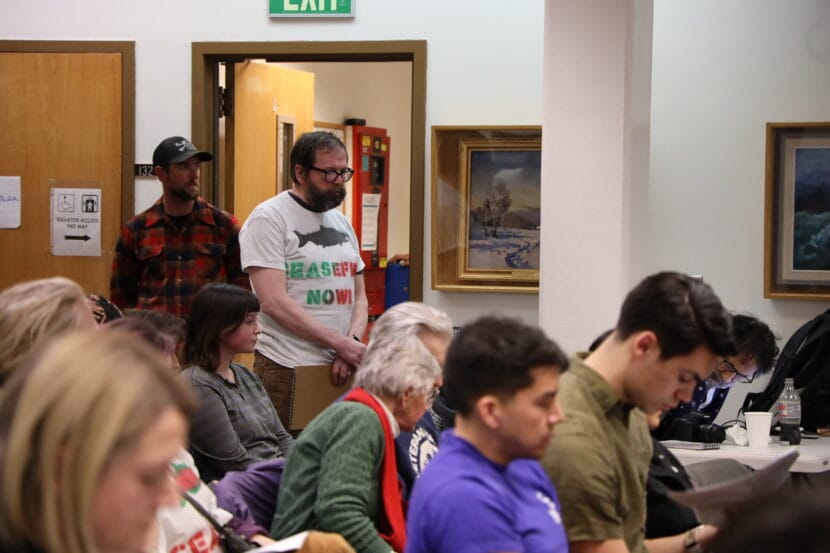
Residents packed the Assembly chambers during the meeting, and more than a dozen testified in favor of the resolution. Many wore the colors of the flag of Palestine and shirts with the message “ceasefire now.”

After the vote — which came at nearly 11 p.m. — some people with a group called Juneau for Palestine said they felt misled by the Assembly. 

Residents wait in line to give testimony on a resolution calling for a peace agreement between Israel and Palestine at an Assembly meeting on Monday, April 29, 2024. (Clarise Larson/KTOO)

Sonia Kumar testified on Monday night. She’s one of several residents who have regularly attended Assembly meetings in recent months to advocate for a resolution. 

“I feel powerless, like, what can I do? I can talk to my Assembly members. I can talk to my legislators. We talked with Mary Peltola a couple of months ago. Not a single person is listening to us,” she said. 

Dozens of cities in the U.S. have passed local resolutions calling for a ceasefire. And last month the Anchorage Assembly passed one to “support negotiations which lead to lasting peace in the Israel-Hamas conflict.”

George Partlow said he was testifying Monday night on behalf of his great-grandchildren. 

“When my great-grandchildren read of the history of this time and the suffering of other children — Palestinians and Israelis — and ask ‘What did you do about it?’ I hope the answer will be ‘At least we spoke out against the violence,’” he said. 

The resolution does not mention the word “ceasefire.” Assembly member Paul Kelly introduced it, but he ultimately voted against it. In an interview after the meeting, he said he should have brought it to a committee first so it could be discussed and workshopped before going to the full Assembly.

“In retrospect, I probably should have asked it to be introduced at a committee. I do regret that, yes,” he said

Some testifiers were upset with Kelly and with Assembly member Wade Bryson, who they said was playing on his phone instead of listening during the meeting. One person, while testifying, asked Bryson to get off his phone, but he did not. Bryson voted against the resolution’s passing. 

Assembly member Christine Woll has long advocated for the Assembly to support a ceasefire resolution. She said it is the Assembly’s job to listen to constituents and their concerns. 

“Local voices speaking up is actually the only thing that is going to change the trajectory of our government’s actions on this, and we do have a responsibility to be responsive to the people coming and speaking to us,” she said. 

Assembly member Greg Smith said he didn’t believe the Assembly should be weighing in on international issues. Despite that, he was one of the two members who voted in favor, along with Woll. 

“We all want peace in the Middle East, we all want people to stop dying in Gaza,” he said. “But the Juneau Assembly should, I believe, focus its time and energy on things we can make an actual impact on. And I have concerns of precedent on this.”

Despite the failed vote, Kumar said she and others a part of Juneau for Palestine plan to continue to testify for city action at future meetings.

Ambitious 20-year plan for downtown Juneau heads to Assembly

Downtown Juneau in January, 2024. (Clarise Larson/KTOO)

Picture a downtown Juneau where housing isn’t as cutthroat to find, businesses don’t close down after cruise ships leave and the pressures of tourism don’t feel so heavy.

That sounds ambitious, but those are the priorities of a plan called Blueprint Downtown. Over the past six years, a commission of Juneau residents has examined every aspect of downtown and created a plan to lay the foundation for the next 20 years. 

Betsy Brenneman, a member of the Blueprint committee, explained the concept at a city planning commission meeting last week. 

“The intent was to nurture the preservation, restoration and revitalization of downtown,” she said.  

Brenneman described it as a vision that could guide everyone from the city government to local businesses in their decision-making.

The plan addresses priorities like housing growth, year-round business vitality and tourism management. It recommends things like revising zoning regulations, increasing public safety measures and completing the Seawalk along the downtown waterfront. 

Some planning commissioners had questions. Member Mandy Cole said she wonders how much “teeth” the plan would have to move the needle on issues like the housing shortage. 

“We’ve done many things to sweeten the pot and still haven’t gotten where we needed to get,” she said. “In my view, this plan is exactly that vehicle for the next three to five years to try and increase housing downtown by various methods.”

Others said they wanted more language in the plan to address short-term rental regulations. 

The commission voted unanimously at the meeting to recommend the Assembly adopt the plan. Ultimately, the Assembly will decide what aspects of the plan go into place and when.

Newscast – Friday, April 26, 2024

In this newscast:

  • A ban on social media accounts for children under 14 passed the Alaska House
  • The Alaska House passed a bill that would put more guardrails on the property assessment process in the state
  • More Alaskans died of opioid overdose last year than ever before
  • An Oregon man convicted of murdering an Anchorage teenager more than four decades ago has been sentenced to 50 years in prison

Alaska House passes bill that would put more guardrails on property assessments

Rep. Julie Coulombe, R-Anchorage, speaks on the floor of the Alaska House of Representatives on Feb. 28, 2024. (Eric Stone/Alaska Public Media)

The Alaska House of Representatives passed a bill on Wednesday that would put more guardrails around the state’s property assessment process. 

Last year, many residents in Juneau and Haines said they saw steep jumps in their property assessments — large enough that some questioned whether their assessors were being transparent and fair. Rep. Julie Coulombe, an Anchorage Republican who sponsored the bill, said the bill would tackle some of their concerns.

“HB 347 puts some baseline requirements in place to protect the taxpayer, while preserving the important principle of local control,” she said. 

The bill would stop assessors from raising a property’s value during an appeal, establish new certification standards for assessors, and require a response from the government if a property owner presented an appraisal that didn’t match theirs.

It also changes the default for who hears tax appeals to an appointed Board of Equalization, instead of the municipality’s locally elected officials.

Some residents have also urged the Legislature to cap how much the assessed value of a property can go up, but neither this bill nor a companion bill in the Senate does that.

Rep, Sara Hannan, a Juneau Democrat, called it a “fairly clean-cut bill” and said it only aims to standardize the appeal process in municipalities across the state — not expand the state’s tax authority.

“It simply sets up standards to make sure that citizens are treated fairly and have a recourse,” she said. “And if someone says they’re an assessor and establishing the tax for you, that you know that they’ve met a professional standard of governance.”

The bill did see some pushback. Rep. Jesse Sumner, a Wasilla Republican, argued that putting limits on raising values after appeals could incentivize more people to file them. And he fears big landowners could find new ways to game the system.

“I think that we may inadvertently be causing a lot of headaches for our local governments in relation to those very large property taxpayers. So, I would just question if this is really the best thing to do,” he said. 

But the bill sailed through the House on Wednesday with a wide bipartisan majority — and with Juneau’s delegation speaking strongly in favor. The House reconsidered the bill on Friday afternoon but passed it again. 

The bill now heads to the Senate. Sen. Jesse Kiehl, a Juneau Democrat, introduced a nearly identical bill in the Senate earlier this year. He said he’s optimistic the bill will have support there.

Site notifications
Update notification options
Subscribe to notifications