Heather Bryant

Continuing resolution protects Eielson F-16s for now

Congress is preparing a six-month stop gap funding bill. It should keep the government afloat until the end of March, and avoid any potential for a government shutdown before the election.

The House is expected to vote on a continuing resolution by the end of the week, and the Senate is likely to follow. The funding bill would keep the government operating at essentially the same funding levels, staving off any chance of a government shut down when the fiscal year ends September 30.

House lawmakers included language blocking any money for Air Force relocations, and that could grant a six month reprieve in Fairbanks. Representative Don Young called it a step in the right direction. He included a provision in a defense authorization earlier this year that would have required the Air Force to conduct a study on the realignment – a legislative maneuver to delay the move.

“The only thing that bothers me a little bit is, it’s not quite as strong as my language was. It’s only for a period of time – six months,” Young said.

So Congress could again open the issue of relocating the planes from Eielson to JBER next year.  But Senators Mark Begich and Lisa Murkowski have insisted they have assurance from the Pentagon the move won’t happen.

Earlier this year the Senate Appropriations Committee temporarily blocked the move. Senator Murkowski serves on the Appropriations Subcommittee on Defense.

Senator Begich says the language in the CR reinforces the delegation’s demand.

“That language just codifies what we’ve already done, so it’s echoing what we’re doing already: They can’t spend the money, they can’t move forward,” Begich said.

It’s unclear whether the Senate will pass the House version of the CR as is, or it alters. If it does, the two chambers will have to meld the bills.  And that’s an unlikely option with Congress taking time off in October to campaign.

The entire Alaska delegation says they’ll support the stop gap.

Ice prompts Shell to halt Arctic drilling

Shell has paused its drilling operation in the Arctic just a day after starting. The Noble Discoverer drill rig cut into the Chukchi Sea floor Sunday morning but had to disconnect from the well site Sunday evening to get out of the way of a massive island of sea ice bearing down on the area.

“It’s about 30 miles long. It’s about 12 miles wide,” Shell spokesperson Curtis Smith says. “It’s moving about 0.3-0.5 knots. It varies in thickness of course, but in its thickest area it’s about 25 meters (82 feet) thick, so that’s pretty substantial.”

Operations could be shut down for several days while the ice moves past the drill site. Smith emphasized that this just part of working in the Arctic.

“When we worked in the Chukchi and the Beaufort in the 1980s and 90s, this happened then, so it’s not unusual. I think the key is just having a heads up approach and making sure you see what’s coming.”

Smith says Shell had been monitoring the ice island since it was about a hundred miles away from the drill site. A shifting wind brought it towards the company’s Burger prospect. On Monday afternoon it had moved to within 15 miles of the vacated drill site.

GoDaddy Web outage takes out small-business sites

Thousands and possibly millions of web sites hosted by GoDaddy.com are down. A hacker is claiming responsibility, but the real reason for the outage is unclear.

A Twitter feed allegedly affiliated with the “Anonymous” hacker group says it’s behind the outage, but another Twitter account associated with Anonymous says the first one is just taking advantage of an outage it had nothing to do with.

GoDaddy.com hosts more than 5 million websites, mostly for small businesses. Websites that were complaining about outages on Twitter included MixForSale.com, which sells accessories with Japanese animation themes, and YouWatch.org, a video sharing site.

Whale surveys spot killer whales in Alaska Arctic

A marine mammal survey crew flying over the Beaufort Sea last month spotted surprise visitors – 13 killer whales.

Orcas have been seen before in the Arctic Ocean but are considered unusual that far north.

Their presence may be another indication of changes associated with climate warming but scientists say it’s too soon to draw conclusions.

Research biologist Paul Wade of the National Marine Mammal Laboratory says the orcas may have followed prey – gray whales – to northern waters.

The survey crew spotted the killer whales Aug. 20 just 6.2 miles northeast of Barrow, Alaska.

A second survey crew on board a research vessel spotted 25 to 30 orcas five days later northwest of Barrow in the Chukchi Sea.

Princess Cruises says video disproves guilt

The owners of the Star Princess cruise ship say that they have new video evidence that proves they are not responsible for ignoring a stranded fishing vessel 100 miles off the coast of South America in March.
Adrian Vasquez says he tried to signal the cruise ship after his fishing boat, called the Fifty Cent, broke down, but the ship failed to come to his aid. Two of his friends, also on the boat, later died from exposure. Vasquez and the families of the two men are suing Princess Cruise Lines in a Miami court, alleging that its ship failed to come to their rescue as required under U.S. and international maritime law.

Judy Meredith, who was aboard the Star Princess at the time, says that she and other passengers saw the Fifty Cent early one morning when they were up looking for seabirds. Meredith says they saw a man on the fishing boat signaling distress through high-powered binoculars.

“I could see a fellow in the front of the boat vigorously waving a T-shirt up over his head and down to the floor,” she said a few weeks afterward. “Up and down, up and down. So, we all watched him for a bit and thought, ‘This guy’s in distress. He’s trying to get our attention.’ ”

Meredith and the other bird-watchers tried to persuade the crew to stop and render aid, without success. After returning home to Oregon, Meredith was horrified to hear that a fisherman had been rescued off the coast of Ecuador 11 days later.

Meredith suspected it was one of the men she and her friends had spotted. Later, Vasquez, the lone surviving fisherman, confirmed his was the vessel they saw, identifying it in one of their photos. He said he and one of his friends had waved a T-shirt and a life jacket to try to get the cruise ship’s attention.

But Julie Benson, with Princess Cruises, says the company has uncovered information that tells a different story.

“We have discovered some recent video that we believe conclusively proves that our ship, Star Princess, was not the cruise ship spotted by the Fifty Cent boat that was adrift in the Pacific Ocean,” Benson says.

Benson says that was also the conclusion of a retired NASA photo analyst the company hired to examine the images. Princess has released photos pointing out areas in which it says the images don’t match. The boat Vasquez was found in has a flat bow, its name on the hull, and a double-striped design. The birders’ photo, Princess says, shows a boat with what appears to be a raised bow, a single stripe and no visible name on the hull.

The cruise line says with this new evidence, it will ask the judge hearing the case for an immediate dismissal.

Other lawyers, including Vasquez’s attorney Robert Dickman, say that a dismissal is unlikely. Dickman calls the Princess analysis “nonsense” and says he has evidence that he’ll introduce in court that shows his client’s boat was the one spotted and passed that day by the Star Princess.

“They’ve come up with three or four different excuses in this case,” Dickman says. “And this is just another one in the line. And, it’s just not making sense. And, I expect more of this in the future. But we look forward to litigating the case.”

Birder Meredith says she won’t dispute what’s in the video or Princess’ analysis of the long-range photo. It’s now a legal case before a federal judge in Miami who, along with a jury, will sort through the evidence if it goes to trial.

But if Princess is right, Meredith says, she has another concern — that some other fishermen were more than 100 miles offshore, signaling for help when the Star Princess passed them by.

Wildlike movie seeks to tell a real Alaska story

Production photo courtesy of Wildlike

With everywhere from Maine to Louisiana having played the role of Alaska on the big screen, Juneau is appearing on the silver screen for the first time in 13 years.

Wildlike, the story of a troubled young girl, spotlights Alaska as what producer Schuyler Weiss calls the “healing element.”

“Rather than Alaska as a kind of adversary or something to be conquered, Alaska is the salve in this movie,” Weiss said. “It’s a character in its own right. And for our two leads, a teenage girl and an older man, they come to Alaska seeking something and they might not even know what it is.”

Production Weekly describes the movie as the story of a young girl sent to Alaska by her struggling mother.

[box]The story of Mackenzie, a troubled but daring teenage girl sent by her struggling mother to live with her uncle in Juneau, Alaska. At first he is a supportive caretaker and friend, but the relationship is not what it seems and Mackenzie must run away. Trying to make her way back to Seattle to find her absent mother, Mackenzie only winds up deeper in the Alaskan interior. With no one else to turn to, she shadows a loner backpacker, Bartlett, an unlikely father figure with scars of his own.-Production Weekly [/box] Director Frank Hall Green said the crew filmed across Alaska in Anchorage, Portage, Whittier, Palmer, the Denali Highway, Matanuska Glacier, along the Glenallen Highway, George Parks Highway, on the Alaska Marine Highway System boats MV Kennicott and MV Malaspina, and McKinley Village and Denali National Park

Weiss emphasizes the importance of Alaska as a place of reflection.

“We’ve tried to capture that side of Alaska and I think that’s what, when we speak to real people, especially transplants, that’s what they say. They thought ‘we’ll just be here for a few months,’ and twenty years go by. It’s that quality we’re trying to tap into,” Weiss said.

The crew had local help with that aspect. While the number of the people working on the project varied depending on what they were doing, there were ten full-time Alaskan crew members on the crew of 23 total production workers.

“We have all these local Alaskans saying ‘actually, it would be better if you went this route,’ and we’ve taken their advice at almost every turn and it’s been well worth it,” producer Julie Christeas said.

Writer and director Frank Hall Green originally conceived the idea for the film while visiting Alaska.

A scene set at Skater's Cabin on Mendenhall Lake. Production photo courtesy of Wildlike
A scene set at Skater’s Cabin on Mendenhall Lake. Production photo courtesy of Wildlike

“It was always going to have to be here. He dreamed of it here. We’re not shooting Canada for Alaska. We’re not shooting Seattle for Alaska,” Christeas said.

Producer Joe Stephans added that the crew actually used Alaska for Seattle in one scene. He calls it a little payback.

In the film, Juneau serves as Mackenzie’s introduction to Alaska.

“It’s her gateway to Alaska. We found Juneau to be the most cinematic of cities with the ever changing weather against the landscape,” Weiss said.

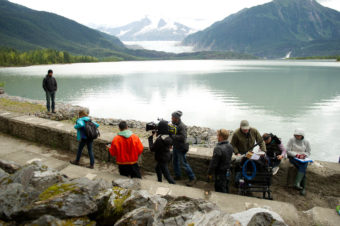
The film crew spent a week and a half shooting around Juneau with scenes at Cope Park, the Breakwater Inn, and the Juneau Airport. Filming also included a shoot at Mendenhall Glacier that resulted in an up close experience with the wildlife.

“The script supervisor looked up and saw a bear. She looked down at her script and saw there wasn’t supposed to be a bear,” Stephans said. “She looked up again and just said ‘bear.’”

Stephans said that park officials were on top of things and cleared the cast and crew out while the mother and two cubs wandered through the set.

“Every single day there is something new and just when you’ve seen what you think will be your single take home memory of the shoot, something else happens and that’s just a daily occurrence,” said Weiss.

Production finished on Sept. 6 with filming aboard the AMHS ferry Malaspina while it was docked in Juneau.

Filming on the ferry. Production photo courtesy of Wildlike

Juneau last saw time on the big screen with the 1999 film Limbo.

“We’re not necessarily on the movie map yet, but hopefully things will change,” said Elizabeth Arnette, with the Juneau Convention & Visitors Bureau.

The film has applied for the Alaska Film Production Incentive Program, which the producers give credit to for being able to shoot in Alaska.

“It encouraged us to come here and find crew that lived here, worked here and has resources here,” Christeas said.

The film, from Tandem Pictures and Green Machine Film is expected to be released in 2013. You can follow the film-making process on Wildlike’s Facebook page and see behind the scenes photos from scouting through the wrap up.

Site notifications
Update notification options
Subscribe to notifications