Heather Bryant

In the 2012 election, Twitter becomes the world’s largest roundtable

#election2012

By the end of today the election frenzy will finally start to abate. But for today at least, it’s still an endless stream of polling, predictions and political ads. However, another source of information and predictions has made a splash this election cycle: Twitter.

Twitter, started in 2006, was moderately adopted in the 2008 General Election. But the 2012 election cycle has broken many records for Twitter.

On Election Day in 2008, 1.8 million total tweets were posted to the social networking site.

Fast forward four years to the first presidential debate on Oct. 3. More than 10 million tweets, specifically about politics, were posted in 90 minutes. More than 20 million tweets were posting during the Democratic and Republican conventions.

“The scale has shifted so dramatically with the amount of conversation happening,” says Elaine Filadelfo, a spokesperson with Twitter. Filadelfo works with Twitter’s government and election team.

“What we’ve seen is that twitter has become the place for this intelligent focused discussion to happen around politics over the past four years–both between voters and because of the prevalence of elected officials and candidates on Twitter themselves.”


Filadelfo explains that Twitter becomes useful in elections because it establishes a direct method for people to get in touch with candidates and elected officials. She notes this is particularly valuable for people living in more rural states like Alaska, where candidates may not visit and traveling to rallies and events might not be possible.

[quote]“Being on Twitter and following the candidates, whether it’s the presidential candidates, whether it’s your own governor or local legislator candidate you can have that one on one interaction with them. You can tweet a question and many campaigns are quite responsive. You can see pictures in real time from a rally. You can see a staffer live tweeting what one of the candidates is saying. So it really breaks down that border if you’re not able to go to these sorts of events in person and have that same direct relationship. You can still be a part of that through Twitter,” Filadelfo says.[/quote]

While Alaska may feel as far from the national election as it gets, Alaskans have also been active participants in the political discussion on Twitter.


The tricky part is figuring out just how many Alaskans. Twitter doesn’t require users to identify their location, unless the user self identifies their location or uses geotagging for their tweets.

“Nothing requires you to tell us where you are coming from,” Filadelfo says.

However, users that have identified themselves as from Alaska, contribute enough data for Twitter to calculate which political issues are resonating with Alaskan voters. Twitter measures this by how much users in Alaska engage with tweets by favoriting, retweeting or replying. The results are displayed in an interactive Political Engagement Map.

For example tweets from @MittRomney about terrorism had the most engagement of any topic that account tweeted about, while retirement generated the most engagement with tweets from @BarackObama.

This election day, Filadelfo expects there to be a notable amount of conversation on Twitter.


“The great thing about the election–well of course we hope–is that so many will be voting and sharing their opinions. It really is something for everyone to rally around and for everyone to be sharing about. It’s something the whole nation can participate in. So we do think it will be a really interesting day on Twitter,” Filadelfo says.


All accounts are publically visible, so even if a person doesn’t have their own account, they can still see other’s tweets. Twitter has a created an event page for the national election that curates tweets about the election from a variety of politicians, candidates, pundits and citizen users.

Voters can follow updates about the Alaska Election by searching tweets with the #akelect tag.

Coast Guard’s only active icebreaker stops in Juneau

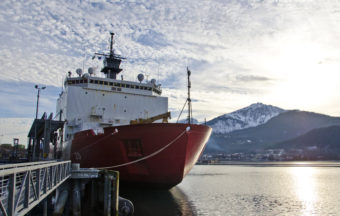
The crew of the Healy took groups of curious visitors on tours around the ship.

The icebreaker Healy stopped in Juneau last week after another season’s work, and the ship’s crew invited the public aboard.
The Healy is its own community. Between the bridge and laboratories, narrow flights of stairs connect three levels of living quarters. The crew needs to keep the ship running 24/7. This year, the Healy hosted Weather Channel TV crews twice, rescued a whaling crew from an ice floe and escorted a Russian fuel tanker to Nome. The Healy entered active duty in 2000 and is 20 years newer than the Polar Sea and Polar Star, which are both in Seattle. The Polar Sea could be demolished in 2013, whereas the Polar Star could be reactivated.

Captain Beverly Havlik is the commanding officer of the Healy.

“I was assigned to the ship last April. April 2011 Our deployment has brought us now to Juneau, it’s our last stop before we go back home to Seattle, homeport is Seattle, Washington,” Havlik says.

Earlier this year, the Healy escorted Russian fuel tanker Renda to Nome to provide heating oil and gas to the iced-in community. Havlik says people travelled to Nome just to witness the historic delivery.

While ice breakers perform commercial deliveries down south in the winter, along the East Coast and Great Lakes, the Nome delivery was the first of its kind in Alaska in recent years. The Healy led the Renda across more than 800 miles of sea ice.

[quote]“The ice conditions were never beyond the capabilities of the ship, the ship handled the ice quite well. Ice breaking is a combination of the hull design and sheer horsepower. The ship has a design to just push through the ice and break it, it’s a little bit of a process of riding on top of the ice and breaking down from above, so you’re kind of stepping down on the ice,” Havlik says. [/quote]

The Healy doesn’t normally escort other ships through the ice. Havlik says the hull is designed to do as little damage to the sea ice as possible so scientists can sample ice floes easily.

She says Russian tankers are generally towed through ice:

[quote]“They will sometimes touch each other. We have no such system on board here, we don’t hook onto other vessels and we don’t tow them through ice, so learning to work together without that assistance that they were accustomed to having was a challenge but we figured out how to work through the language barrier, and the experience differences, the cultural differences to get the job done.”[/quote]

When the Healy got the call last fall to help with the fuel delivery, it was wrapping up some scientific research  – its main mission.

Master Chief Tim Sullivan is the ship’s navigator:

[quote]“Day’s pretty busy, again up on the bridge. We’re staffed 24 hours per day so the ship is always moving and we do a lot of science. It’s an exploration of the Arctic that not a lot of people get an opportunity to see, so it’s like riding on a cruise ship but it’s one of the US icebreakers.”[/quote]

Petty Officer Matthew Emmons came to the Coast Guard from the Navy.

“I’ve been on board here for roughly 4 months and I’m an electronics technician. We fix navigation equipment, radars, radios, GPS, we also maintain the TV system on board. I enjoy it, it’s pretty fun. It’s just different duty than normal Coast Guard duty. It’s not law enforcement, it’s not drug interdiction and such, it’s more science related, so it’s something more out of rate than what people normally do and sometimes that’s a good thing to have a little change-up in your career.”

Scientists use the ship's cranes for a variety of things, including scraping the sea floor.
Scientists use the ship’s cranes for a variety of things, including scraping the sea floor.

Last winter, Captain Havlik led the Healy through its first winter science mission. The ship went north-to-south, outracing the edge of the sea ice to track an environmentally sensitive, but abundant type of plankton known as copepods.

This past summer, the icebreaker used high resolution sonar to map parts of the Arctic Ocean’s seafloor. The Healy’s mapping may help the US extend the exclusive economic zone, which is currently 200 nautical miles offshore.

Havlik says the icebreaker will likely do more search-and-rescue in the Arctic as more ecotourism and  resource exploration ships make their way to the far north. There will be ice in the Arctic Ocean even as the Northwest Passage becomes more navigable.

[quote]“And the ice can be dangerous, it will blow around with the wind and move where it wants to go. I won’t say that everyone pays attention to what happening around them, and there is a possibility that they can get trapped in an ice field, and ice under pressure is very very dangerous. ice under pressure can crush ships.”[/quote]

Science missions have propelled the ship to Arctic waters for more than a decade. Havlik says the Healy heads north again in July.

“And then in January the ship will go into a dry dock and spend about two months on dry dock. Then we’ll do the load-out for more science research and get underway in July and be back up to the Arctic again.”


Photos by Heather Bryant/KTOO

Juneau builders find heating solution underground, but it’s not what you think

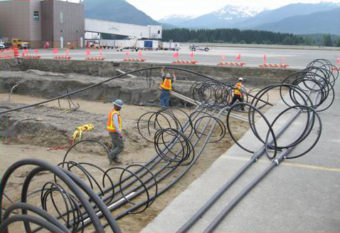
Harri Plumbing and Heating workers install piping in the ground that provides the geothermal ground loop for the airport'€™s heat pump system. There are about 16 miles of piping in the ground. (Photo taken by Airport Construction Assistant, Greg Jerue.)
Harri Plumbing and Heating workers install piping in the ground that provides the geothermal ground loop for the airport’€™s heat pump system. There are about 16 miles of piping in the ground. (Photo taken by Airport Construction Assistant, Greg Jerue.)

Rising fuel prices have long put builders on the lookout for a viable alternative to expensive boilers with low efficiency.
In Juneau, the answer has come in the form of heat pumps.

The Juneau Assembly this summer took another step forward in planning a new library in Mendenhall Valley. The assembly authorized the city manager to apply for a grant to fund a ground source heat pump for the facility, even before voters approved the project in October.

The new facility would replace the library that’s been renting space in the Mendenhall Mall for more than 25 years.

If awarded, the grant would provide more than one million dollars of the estimated $1.3 5 million needed for installing the heat pump.

The proposed library heat pump would be one of several in Juneau.

Three are already in operation and another three are under construction.

As CBJ Engineering Director Rorie Watt explains it, ground source heat pumps use tubing deep in the ground to bring heat to the surface.

[quote]“We pump liquid down these wells some hundreds of feet into the earth where the water is maybe 45 degrees or something. And we take a little bit of heat out of cold water and bring it back up the surface and run it through heat exchangers and turn that into useful heat in the facilities.”[/quote]

The growing number of heat pumps in use is a reflection of the advancement of the technology, Juneau’s geothermal resources and the opportunity for fuel savings.

Part of the heat pump system at AEL&P. (Photo provided by Alec Mesdag)

Alaska Electric Light & Power installed the first Juneau heat pump in the late 1990s. Now the company has 21 heat pumps in its building in Lemon Creek.

Alec Mesdag is the Energy Management Specialist for AEL&P. Mesdag estimates heat pumps will save the company 50,000 dollars over 25 years.

The Dimond Park Aquatic Center and Juneau International Airport installed ground source heat pumps in 2010.

The airport terminal added approximately 12,000 square feet during the construction project. Roughly half the building is heated by 31 pumps.

Consulting engineer Doug Murray calls the savings so far “pretty incredible.”

[quote] “We were able to put some preliminary information together for the first years’ worth of operation this last May or June. That was showing approximately a $120,000 worth of savings in the first year.[/quote]

In October, Juneau voters approved a bond issue which will provide another 6.9 million dollars to the airport. Some of the funds will be spent on more heat pumps, an expensive technology upfront.

Rorie Watt estimates the increase in construction costs to be as much as 50 percent.

[quote]“At the Auke Bay School, we estimated conventional oil system about $2.8 million and ground source heat a little over $4 million. So it’s a lot more capital intensive. But on the other hand we estimated that the energy costs would be about a third. So when you do ground source you’re essentially paying a lot more money upfront in exchange for lower long-term operating costs.”[/quote]

AEL&P’s Mesdag says that long-term savings are the main reason ground source heat pumps are becoming more common in large projects, especially public buildings.

[quote] “ They’re built with the intention of being around for in the order of 50 or a hundred years. When we spend public money on a building ideally the plan should be for the long term because it’s expensive. With that being the case if you look at the lifecycle costs of that project, the longer it is in place, the more important the energy systems are to the overall lifecycle costs of the building. And when you look in the order of 50 years on a ground source heat pump, based on everything we know right now, that does make a lot of sense over the long term.” [/quote]


For more information check out these documents:

Airport Project Report: A Brief Report to the Alaska Energy Authority

Dimond Park Public Library Presentation

Study: Ground Source Heat Pumps in Cold Climates


Construction barge begins removal of DeHart’s marina

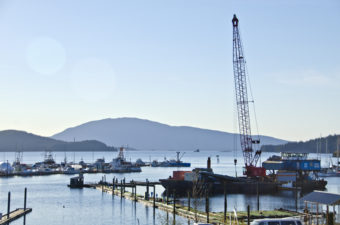
A construction barge from Pacific Pile and Marine of Seattle is docked in Statter Harbor.
A construction barge from Pacific Pile and Marine of Seattle is docked in Statter Harbor. (Photo by Heather Bryant/KTOO)

A construction barge is removing the DeHart’s marina in Auke Bay this week. The work is the first phase of the Statter Harbor master plan.
CBJ Port Director Carl Uchityl expects the project to be complete by May of next year.

[quote]At the Statter Harbor facility we’re decommissioning the DeHart’s marina. And so what you see down there is a construction barge from Pacific Pile and Marine of Seattle. And what they’re doing this week is demolishing the old facility and once that is cleared out. They’ll remobilize with two new floats that will be attached to the existing Statter Harbor facility. And that’s where we’ll move the harbor patrons at the old DeHart’s into the new facility at Statter Harbor.[/quote]

In addition to new floats at Statter Harbor, other repairs and additions will be made, including a new fuel float.

The Statter Harbor Master Plan has four phases. Phase 2 and 3 is a new boat launch, additional parking and a new haul out facility. Phase 4 is a long term plan to add a commercial float to support whale watching boats and fishing charters.

Costumed families gather for fun learning at Fall Fest

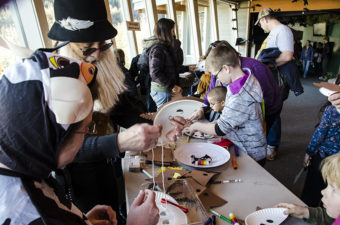
Dozens of families gathered today for the annual Fall Family Fun Fest at the Mendenhall Glacier Visitor Center.

After passing through a spooky tunnel of spiderwebs and fog, visitors were treated to the Visitor Center decked out in full Halloween glory.

Ranger Jane Terry, in costume as naturalist John Muir, played a big part in putting the event together. Terry says the event is great for combining educational experiences with the festive mood of the holiday season.

“It’s really a fun way for parents and kids to learn together,” Terry says.

“We provide a fun way to learn about the natural world,” says interpreter Laurie Craig.

This year’s fest follows a decade of festivals, with educational games including mask-making, print-making, an ice tunnel crawl, petroglyphs, and dissecting owl pellets.

Craig and Terry say that the event is all about the people with volunteers from the Park Service and the Visitor Center leading kids through fun events.


Pawsitively Fabulous Pet Fashion Show

Ten dogs and one cat took to the stage last Saturday for the Pawsitively Fabulous Pet Fashion Show. Hear an audio postcard from the event here.

Site notifications
Update notification options
Subscribe to notifications