Heather Bryant

Photos from the news in 2012

2012 saw a variety of stories and events in Juneau. Here are some of the photos from this year covering major events, breaking news and stories from Juneau and around Alaska.

NORAD’s annual Santa Tracking program kicks into high gear

NORAD has its eye on the sky tracking Santa’s trip around the world this Christmas Eve with a variety of technology including radar and even satellites that track the infrared heat signature of Rudolph’s nose. Two Canadian fighter pilots safely escort from the jolly man from the North Pole to North America.

The Sear's ad from 1955 had a typo in the phone number that cause children to call the red phone in the command center of the Continental Air Defense Command.
The Sear’s ad from 1955 had a typo in the phone number that cause children to call the red phone in the command center of the Continental Air Defense Command.

Stacey Knott with the NORAD Public Affairs Office says the tradition started all because of one little typo in a Sears ad.

“What happened was in 1955 a Sears Roebuck store here in Colorado Springs printed up an ad that said hey kiddies call and talk to Santa and it had a phone number. Well it had one number wrong and it actually went to the predecessor to NORAD. It went to the command center for the continental air defense command CONAD and to the dreaded red phone. The colonel on duty there picked up on it and he was expecting the chairman of the Joint Chiefs of Staff or the Secretary of Defense or something like that because this was the phone and instead this little tiny girl’s voice asked for Santa,” Knott says.

Colonel Harry Shoup, thought someone was playing a joke on him when he answered the phone. After talking to the girl and her mother, he figured out what had caused the confusion. Shoup checked the radar and told the little girl where Santa was.

“They started getting more phone calls, so he directed all of his staff to check the radar and check on Santa’s location and talk to the kids and from there a tradition was born. And that was in 1955. In 1958 NORAD took over from CONAD and we’ve been doing it ever since,” Knott says

For 26 hours on Dec. 24 and into the early hours of Dec. 25 a team of volunteers at the operations center will track Santa’s trip around the world. NORAD uses radar, satellites and fighter jets to track and escort Santa’s sleigh ride.

“We have 1,200 volunteers who help answer phone calls throughout that 26 hour period to tell people where Santa is at and you know that’s very important, because Santa won’t stop at your house if you’re still awake and not in bed. So we make sure that everyone knows where Santa is located,” Knott says.

The NORAD website will also features video from the “Santa Cams,” which NORAD has pre-positioned at many locations around the world to capture images and video of Santa as he and the reindeer fly by. The site also hosts a variety of games and a countdown to TrackSanta.

Knott says that NORAD volunteers enjoy the annual event.

“365 days a year NORAD is a bi-national command between the US and Canada and we’re providing homeland defense for North America. But on this one day a year we’re proud and honored to be a part of so many people’s holiday traditions and help track Santa for the world.”

People can follow along either through NORAD’s website, phone and tablet apps, Twitter, Facebook, YouTube or by calling the operations center.

Phone: 1-877-HI-NORAD (1-877-446-6723)

Email: noradtrackssanta@outlook.com

Getting to Graduation gathers students and community to talk about dropout crisis

Juneau public broadcasting’s months-long American Graduate project culminated Dec. 10 in Getting to Graduation, a community discussion broadcasted live on TV, radio and online.

The project, spearheaded by KTOO, KRNN, KXLL and 360 North, was a result of a grant to get local stations involved in discussing the dropout crisis facing many communities.

In Juneau, nearly 1 in 3 students won’t attain a high school diploma. Ninety-three students dropped out of Juneau high schools in the last school year. Statewide, more than 2,830 students quit school for one reason or another.

The hour and a half of talking circles featured kids and families, representatives of education and community programs, and local policy makers.

The evening emphasized the participation of students telling their own stories.

Kayla Ryan, graduated in 2008 at the age of 21, two years after she should have graduated. Ryan says she suffered from learning disabilities and an unstable home life. She dropped out of school after becoming frustrated with feelings that teachers didn’t want to waste time on her because of her learning disabilities.

Ryan says she didn’t just want a GED, she wanted her diploma. She found out about the program at Yaakoosge Daakahidi Alternative High School, and returned to school.

When asked about what could be done to help students, Ryan says it’s about understanding what students are facing.

[quote]“Listen, we have drama. I’ll give you that. But there’s usually something to that drama,” Ryan said.[/quote]

Crystal Rogers graduated from Yaakoosge in 2002 and is almost finished with her bachelor’s degree. Her journey to graduation was tumultuous, dealing with multiple foster homes and separation from her twin sister.

Rogers says it’s important to remind students that no matter what they are going through, or what it may look like from the outside, “they are not defective human beings and they have it in them to do whatever it is that they want to do.”

The principal of Yakoosge, Sarah Marino, works with students facing a wide range of obstacles.

Marino says that one of the most important parts of her job is helping student dream.

[quote]“Many students don’t know what they want next and that makes graduating so much harder,” Marino says.[/quote]

Laury Scandling, the Assistant Superintendent for the Juneau school district, was a project coordinator for the American Graduate series and the Getting to Graduation event.

[quote]“The point was to stimulate conversations about graduation. I did not expect that there would be an answer. There is no answer. There are a variety of strategies that help a variety of youth. Because youth are not monolithic. Every kid has a different set of needs.”[/quote]

Scandling says she’s taking notes on the concrete commitments that were made by leaders and on things that students said were important. She plans to work in those ideas into what the school district is doing.

For more information about the American Graduate project, check out the project page with the full community discussion, interviews with students and local educators and a stories leading up to the community discussion.


Underground fuel tanks compound the severity of fuel leaks

Rainbow sheen seen on the creek.
Rainbow sheen seen on the creek. August 20, 2012 (Photo courtesy Alaska Department of Environmental Conservation)

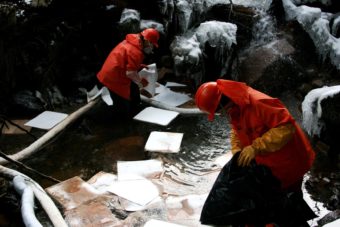
The smell of diesel and rainbow sheen on a Douglas Island creek in July led environmental responders on a complicated three-month hunt to a leaking underground fuel tank.

The Alaska Department of Environmental Conservation answered a homeowner’s call about the foul smell and oily creek. Investigators traced the sheen back to the soil around an old culvert that runs under Nowell Avenue.

Complicating the search for the source was the number of apartment complexes in the area—many with buried fuel tanks says Crystal Smith who was part of the response team.

“Years ago a number of them were put in just because people didn’t want to have a tank in their backyard. It’s not the prettiest thing to have in your backyard. So people put them underground not knowing the risk of having them underground,” Smith says.

The team checked tanks for water which can indicate if a tank is leaking. But none of the tanks showed high amounts of water. They reviewed fuel records for the complexes to see if any had large number of deliveries coming in, but again nothing seemed out of the ordinary. City crews pulled manholes and storm drains; they rigged up cameras in culverts.

By the end of August the response team narrowed down the potential tanks and used special dyes that could travel with the fuel.

It was a waiting game punctuated with manning absorbent materials in the creek to try and clean up the spill.

On Halloween, the team finally started to see some color in the creek and after a couple days it turned in a bright red that had been added to one of the tanks. It had taken 63 days for the dye to travel from the tank to the creek.

Since then, the owners of the tank have started the lengthy and expensive process of cleaning up.

[quote]“We’ve actually crunched the numbers around here and asked an environmental consultant. For every gallon of fuel that is lost in a fuel spill, the cleanup cost is about $100 a gallon. So 75 gallons lost would be $7,500 just in the cleanup cost,” Smith says.[/quote]

The size of the area that the fuel contaminated is hard to guess because the tank was buried.

“It’s really hard to estimate because we don’t know how long it’s been going, but in looking in how much they recovered underneath the tank and how big of an area that it was spread over we’re saying it’s probably over a 1,000 gallons that was released, “ Smith says. “It’s really hard to make an estimate with these, but we know it was a large amount. We know that it was leaking for at least 3 months.”

Smith stresses the importance of closely monitoring underground tanks and even replacing them with an above-ground tank before a spill happens. The integrity of underground tanks can be checked by testing for water and oil tank pressure.

“If they want their tank to be tested for water, then we here at the state are more than happy to come out and test their tanks or they can ask their fuel providers. A lot of times people carry the water finding test on their trucks and they can do it right then and there.”

Absorbent material is still sopping up fuel from the creek. Tank owners are required to maintain it until the water runs clean.

But DEC officials are calling it a successful cleanup. They’re using it to educate others to pay attention to their buried, unseen tanks.

The DEC website has guidance on how to inspect fuel tanks and what to do in the event of a leak.

Correction: An earlier version of this story stated that the dye took 36 days to travel from the tank to the creek. It was actually 63 days and the story has been corrected to reflect that.


Following the election, some Alaskans join secession bandwagon

Following last week’s re-election of President Obama, petitions for secession began appearing on the We the People website hosted by the White House.

The site allows people to post a petition to be addressed by the Obama Administration. If the petition gains 25,000 signatures in 30 days the White House will offer an official response.

Two people from Alaska have submitted petitions.

“Matthew G” from Palmer, created a petition on Nov. 10. The petition requests that “the Federal Government allow Alaska to peacefully secede from a dysfunctional Union that is run by corrupt politicians who buy the votes of individuals who can no longer be seen as American citizens but rather, slaves to a tyrant.”

So far it has gained 507 signatures, most of which come from outside Alaska. Only 57 signers self-identified as being from Alaska.

Though the site requests people to avoid making duplicate or similar topic petitions, another secession petition for Alaska was added on Nov. 11.

“Paul M” from Anchorage created a petition for Alaska to have an election to decide whether or not to secede from the United States.

[quote]“Our main “goal” is a legal vote and ballot; one that was not given in 1958 and was in violation of International Law and Treaty. Alaskans were robbed of the choices we were to have as a non-self-governing territory, and steam-rolled into the current classification of a State. The Native population of Alaska, in a large percentage, did not even receive a ballot because of the Federal Voting Rights Act in place. Alaskans now seek to a statewide free election to decide whether Alaska should be a free and Independent Nation.”[/quote]

The petition is still 18,602 signatures shy of the 25,000 required for review. So far several hundred self-identified Alaskans have signed on.

Thus far, citizens in approximately 40 states have posted petitions for secession. However, only a handful have gained enough signatures to meet the threshold for response. Petitions for the secession of Texas, Louisiana, Florida, Georgia, Tennessee, Alabama and North Carolina each have more than 25,000 signatures. The petition from Texas boasts the most with more than 98,000 signers.

There are some petitions approaching the issue from the other side. There is a petition to make all states wishing to secede pay their share of the national debt first. Another asks to exile American citizens who signed petitions for secession, which has gained nearly 10,000 signatures.

There is currently no timeline on when the White House might respond to the petitions, however the White House did tell ABC News that it will review and respond to the petitions that obtained enough signatures.

New partnership seeks to protect and maintain salmon habitat

Wild Pacific Northwest salmon face a bleak future, boasting but a tiny fraction of their historical population size, according to an alliance of salmon biologists and conservation advocates.

Alaska enjoys a healthier salmon harvest than the Lower 48.  A new organization dedicated to protecting and maintaining fish habitat invited Oregon State University’s Robert Lackey  to talk about the future of salmon and consequences of salmon habitat destruction.  Lackey teaches political science and fisheries science and co-edited the Salmon 2100 anthology.

The Southeast Alaska Fish Habitat Partnership connects state and federal agencies, conservation groups and Alaska Native corporations who have an interest in salmon protection. The National Fish Habitat Board recognizes the group as a candidate partnership, and partners must show they are pursuing conservation goals before being recognized as a formal partnership.

Robert Lackey’s lecture was the organization’s first public event. Steering committee chair Neil Stichert said partners also were invited to display posters and share their own research.

“So we thought it would be a great way to draw in folks, consume information that was derived from their own Southeast Alaska backyard, and have a moment to settle in for a lecture, ” Stichert said.

Spawning sockeye salmon

Lackey told the audience of about 75 that wild Pacific salmon populations are in danger of dropping to unsustainable levels by 2100 because of habitat destruction from human development.

The Salmon 2100 project was a 2006 collaboration of 33 scientists, policy analysts and advocates. It looked at ways to return Pacific Northwest wild salmon populations to a healthy, harvestable size.

“We know more about salmon than any other group of fish in the world, so don’t say we don’t know enough about salmon. If we don’t know enough about salmon, we don’t know enough about any of the other species,” Lackey said.

Salmon populations used to extend from Russia to Southeast Asia, across much of Europe, down the northern East Coast, and as far southwest as San Diego.  Lackey said salmon runs on the West Coast, excluding Alaska, have fallen to five percent of their historical average, before the Gold Rush.

“’People knew what was happening. The newspapers of the day said ‘The runs are being decimated,’” Lackey said.

Now, that five percent excludes hatchery fish.  Lackey and his collaborators wanted to know how past habitat destruction impacted wild salmon from California to Alaska.

“There are arguably more salmon alive than there’s ever been in history. The vast majority are in cages,” Lackey said.

Because there’s less development in Alaska, Lackey said the future of salmon is not as bleak.

[quote]“If you continued on to Alaska, you’d find runs roughly the size of historical runs. There are issues, there are challenges, there are problems, but the runs in Alaska will still be pretty good. If I was in the Lower 48, this would basically be undeveloped land. I mean if you look at the mining operations these are trivial compared to the lower 48,” Lackey said.[/quote]

Lackey said “salmon is the stereotype of death by a thousand cuts.”

“You put a mine in, you put a school in, you really just don’t help salmon,” Lackey said.

The Salmon 2100 team looked at data that suggests California and the Pacific Northwest could quadruple their human populations by 2100, making the region as packed as Europe.  Seattle could as large as Mexico City. He said the free market doesn’t factor in the toll of development on salmon habitat; irrigation agriculture in the region would put farmers and salmon in competition for the same water.

“Fish, salmon, need water. That’s your biology lesson 101. And a compromise is always a loss for salmon. It’s not likely someone’s going to come up with a substitute for water for salmon,” Lackey said.

Lackey and his team conclude that current policy yields a troubling forecast for wild salmon populations in 2100.

Heather Hardcastle is a commercial fisherman who works with the national conservation group Trout Unlimited. She called the lecture a “wakeup call.”

[quote]“If we don’t take steps now to protect habitat, it could be lost. For a place like Southeast Alaska where salmon is so important, it’s good to heed that warning from the Lower 48,” Hardcastle said. [/quote]

The future for southern salmon populations was sobering. Biological science technician Thor Eide works with restoration projects for the Forest Service. He believes Alaska’s salmon runs have an encouraging future.

[quote]“The nice thing about Alaska is that people are very connected with salmon, it’s a part of their life, so they have a vested interest in seeing healthy salmon runs,” Eide said. [/quote]


In the spring, the Southeast Alaska Fish Habitat Partnership plans to draw from research across Southeast Alaska and will hold a multi-day symposium on fish management in the region.

Site notifications
Update notification options
Subscribe to notifications