Heather Bryant

Group of Alaska Air National Guardsmen first to reach top of Denali this year

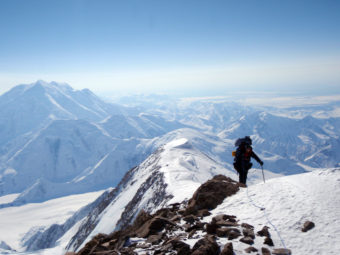
Five members of Alaska’s Air National Guard  reached to the top of Mount McKinley in Denali National Park on May 9.

Maj. Matt Komatsu, Chief Master Sgt. Paul Barendregt, Tech. Sgt. Kyle Minshew, Staff Sgt. William Cenna and Staff Sgt. Brett Wilson spent two weeks ascending the mountain as part of a training exercise in winter survival skills.

Two men on the team had been on Denali before. Barendregt had summited twice before and Cenna had previously climbed. For Komatsu, Minshew and Wilson, it was their first trip up Denali.

“We were dropped off by the 210th Rescue Squadron in a HH-60 Pave Hawk helicopter on April 25 and began our training the next day to enhance our high altitude winter rescue and glacier skills,” Komatsu said in a press release.

“The nature of climbing Denali provided our team the training we needed in terms of being able to survive in those types of climates. We went out there to train, with the added benefit of summiting Denali if possible.”

The group started their ascent on April 26 and climbed for approximately 6-8 hours each day. The group had 4 storm days where they had to stop climbing and stay in their tents. The worst weather happened in the lower altitudes while the group was making their way up the glacier.

“Our daily plan was pretty predictable,” Komatsu said. “You wake up when the sun hits your tent, spend a couple hours getting something to eat and drinking plenty of water before preparing for the day’s movement. Nothing super spectacular, but sort of the patient approach to the route is the best way to avoid getting altitude sickness.”

Since it’s still early in the season, the team benefitted from the lack of people on the mountain and allowing them to train in isolation. By the time the team came back down, they say that people were starting to fill up camps.

“Nowhere else can we experience true winter environments, true glacier environments to help facilitate our training for overland movement, rope travel, glacier techniques so we’re more confident in the mountains and traveling through them to assist with rescues…This training is absolutely essential and borderline mandatory for guys to get up there and experience,” Cenna said.

“I had never been on a mountain like that with any kind of altitude. I’m the new guy up here,” said Minshew. “You’re living it day in and day out. You’re constantly immersed in that environment. It just forces you over time to just adapt.”

The Guardsmen are part of 212th Rescue Squadron, also known as Guardian Angels. Two more teams from the squadron will head to Denali this season to train in rescue and climbing operations.

Three members of the squadron are assisting National Park Service climbers in rescue operations on the mountain as part of the Volunteers-in-Parks program.

This year is the 100th anniversary of the first successful ascent of Denali.


Note: The article has been updated to include comments from Tech. Sgt. Kyle Minshew and Staff Sgt. William Cenna

What does the country’s most expensive Quarter Pounder with Cheese look like?

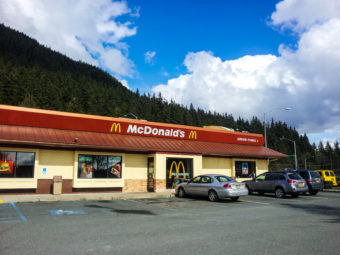
Juneau McDonald's
Juneau’s only McDonald’s boasts the United States’ most expensive Quarter Pounder with Cheese. (Photo by Heather Bryant/KTOO)

Perhaps you’ve heard by now that Juneau has topped another “most expensive _______” list. The culprit this time? The McDonald’s Quarter Pounder with cheese.
And here it is:

This new honor comes from the Quarter Pounder Index (QPI) billed as a basic cost of life estimator from the group NerdWallet. The QPI is NerdWallet’s effort to help people understand the purchasing power of a dollar by using cheeseburgers.

Juneau’s Quarter Pounder with Cheese came in at $4.82.

The country’s cheapest Quarter Pounder is approximately 3,000 miles away in Conway, Arkansas where the Quarter Pounder rings up at $2.24.

The Quarter Pounder pictured here was purchased at Juneau’s only McDonald’s, however it now costs $4.99 and totaled $5.24 with sales tax.

Anchorage and Fairbanks are ranked fifth and sixth respectively for the cost of Quarter Pounders.

What are Alaskans watching on YouTube?

Alaska often gets left out of maps of trends in the United States. The clean cluster of the contiguous states fit perfectly in maps of trends in the U.S. The presence of Alaska and Hawaii is often determined by the impact of the data to be displayed or the thoroughness of the graphic artist making the map. Sometimes, we’re left out because not enough information is available for the nation’s largest state.

But when it comes to watching YouTube, Alaska makes it on the map.
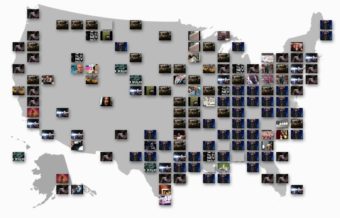
Google has built a visualization of YouTube trends, where you can see what YouTube videos are the most popular in a region.

The tool’s information page says that the dashboard is an experiment in visualizing YouTube data. The map displays the most shared or viewed videos from the last 12-24 hours.

Information is available for Alaska’s three largest cities.

So what are Alaskans watching?

In Anchorage the most shared video is the “True Blood Season 6 Trailer”

Fairbanksans are into music videos today with “Queens of the Stone Age – I Appear Missing”

Juneau is sharing the “Young Woman Being Arrested for Nothing” video from the story about the Alaska State Trooper investigation.

You can sort the information for views or shares and by age groups below the map. A list of videos on the right also show the most popular videos overall. A more comprehensive dashboard is also included, yet Alaska cities are absent from those lists.

The FAQ notes the tool is just getting started and with the nature of YouTube in mind answers another important question:

Why is ____ video so popular with 13-17 year old females?

No one will ever know…


Shell’s Arctic ‘beer can’ passes federal test in Puget Sound

BSEE photo of damaged containment dome on board the Arctic Challenger in Sept. 2012
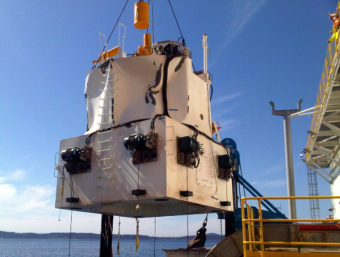
The Arctic Challenger’s containment dome, crumpled after a field test in Puget Sound in Sept. 2012. Credit: BSEE

Shell Oil had to postpone its Arctic drilling for a full year after one of its oil rigs ran aground off the Alaska coast this winter. But Shell’s efforts to open a new frontier of oil exploration in the Arctic Ocean continue in Puget Sound.

The oil giant passed a key test with federal regulators last month in the waters off Anacortes, Washington.

It took several tries, and neither Shell nor the federal government announced the results.

But a contractor successfully deployed Shell’s Arctic oil-spill containment system in Samish Bay in March.
Crews from Superior Energy Services lowered a steel dome over the side of Shell’s Arctic Challenger barge.

They anchored the dome in 150 feet of water and successfully sucked up seawater at a rate of about 2,000 gallons a minute.

That’s what the dome’s supposed to do if a blown-out well gushes oil and gas from the bottom of the Arctic Ocean.

Earlier tests of the containment dome had gone badly. In September, the 20-foot dome wound up “crushed like a beer can.”

In an email, Nicholas Pardi with the federal Bureau of Safety and Environmental Enforcement said the spill system handled more than twice the volume of oil that’s expected in a worst-case well blowout.

Pardi did not respond to KUOW’s requests to interview one of the two BSEE officials who were on board the Arctic Challenger.

Nor did he provide the requested documentation of the test results.

On his first day in office, President Barack Obama ordered federal agencies to take steps to make his administration the most transparent ever.

Here’s President Obama speaking to world leaders on transparency in 2011.

Obama: “We pledge to be more transparent at every level. Because more information on government activities should be open, timely and freely available to the people.”

But journalists and open-government advocates complain that many agencies—from the EPA to the FDA— didn’t seem to get the memo.

It can be difficult or impossible to get many Obama administration officials to answer questions.

Curtis Smith of Shell-Alaska declined to comment on the successful test of the oil-spill system, except to say that Shell has a 10-day information blackout before its quarterly earnings reports.


Wolves in Yukon-Charley National Preserve drop by more than half

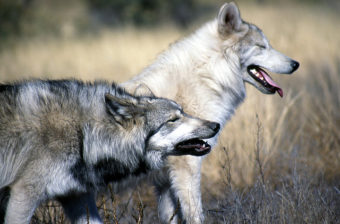
Grey wolves. (Flickr creative commons image by Caninest)

Alaska’s predator control program has resulted in the number of wolves in Yukon-Charley Rivers National Preserve dropping by more than half, according to the National Park Service.

The Park Service counted 80 wolves in 9 packs in November, 2012. This spring, biologists have only been able to account for 28 to 39 wolves in six packs.

That’s more than a 50 percent drop, which is the highest drop in population since the park service began tracking wolves 19 years ago says Deb Cooper, Associate Regional Director for NPS.

Natural deaths and subsistence and sport hunting and trapping account for some of the loss, but Cooper says those rates are fairly consistent from year to year.

“This year there has been predator control efforts along the boundary of Yukon-Charley Rivers National Preserve, particularly in the 70-mile country which is kind of bounded on three sides by the preserve. The predator control program has taken quite a few animals. We know a number of them are from packs that are previously monitored.”

The Park service will be closely monitoring the wolves to see if the numbers can rebound.

“As long as there is a breeding pair or some sort part of the pack structure intact, they can come back. This year, we know that we lost one pack that was 24 animals in size. There was two other packs that we think there’s only one animal left which is really no longer a pack, just a transient animal. When you lose whole packs that can have more of a long term effect.”

Fish and Game's Upper Yukon Tanana Predator Control Program Area
Fish and Game’s Upper Yukon Tanana Predator Control Program Area. (Image from Annual Report to the Alaska Board of Game on Intensive Management for Moose and Caribou with Wolf Predation Control in the Upper Yukon/Tanana Rivers – February 2013)

The wolves play an important part in keeping the forty-mile caribou herd at healthy levels. Cooper says the herd is at a level above the state’s goal for its population and is starting to show signs of over population.

“The herd is beginning to show signs of nutritional stress. So the ramifications that has to a national preserve is there’s some deterioration of the habitat like over-grazing or where there’s so many caribou they begin to not have enough to eat,” Cooper says.

“We’ve had no formal communication from the State of Alaska on results of their helicopter and fixed wing predator control work in the Forty mile country,” said Yukon-Charley Rivers Superintendent Greg Dudgeon in a press release. But according to Cooper, this is a local issue and the field biologists for the department and the park service have been communicating informally.

“We have two different mandates. It’s the state’s policy to grow caribou and moose for hunters. Which in this case is involving the manipulation of populations of ungulates and predators and we’re bumping up against the preserve which has the responsibility and obligation to preserve the natural dynamics of an ecological system,” Cooper says.

 We were unable to reach anyone at Fish and Game for comment today and will update the story as soon as we can get in touch with them.


View Yukon-Charley Rivers National Preserve in a larger map

Lynden committed to purchasing Northland Marine Services

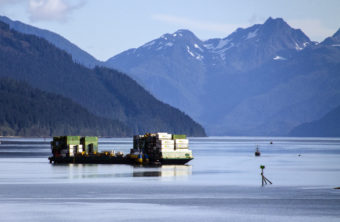
A barge departs from the Alaska Marine Lines dock in downtown Juneau.
A barge departs from the Alaska Marine Lines dock in downtown Juneau. (Photo by Heather Bryant/KTOO. Taken Oct. 10, 2012)

Lynden, a freight shipping company, has signed a purchase agreement to buy Northland Marine Services.

Lynden has several different operating companies including Alaska Marine Lines, Lynden Transport and Lynden International. Adding Northland to the corporate family will increase Lynden’s reach, according to AML President Kevin Anderson.

“It opens up a whole bunch more markets. Right now, our barge company which is Alaska Marine Lines, they serve southeast Alaska and Prince William Sound,” says Anderson. “Northland will give them the ability to serve westward, the chain which is Dutch Harbor and Kodiak and Bristol Bay and then all the way the west coast. It also opens up the market of Hawaii.”

Northland will join the group but continue to be operated separately.

“Northland will keep their current management and they’ll run separately. They won’t be folded into AML at all,” Anderson says.

“We have seen significant growth in our business over the past decade, and bringing two great companies and teams together will help improve and expand service in the communities we serve,” says Northland President Larry Stauffer in a press release.

Lynden and Northland are the currently the only freight carriers operating in Juneau.

Lynden has a series of regulatory hurdles to clear first, but if all goes well, Anderson expects the purchase to be completed later this year.

Site notifications
Update notification options
Subscribe to notifications